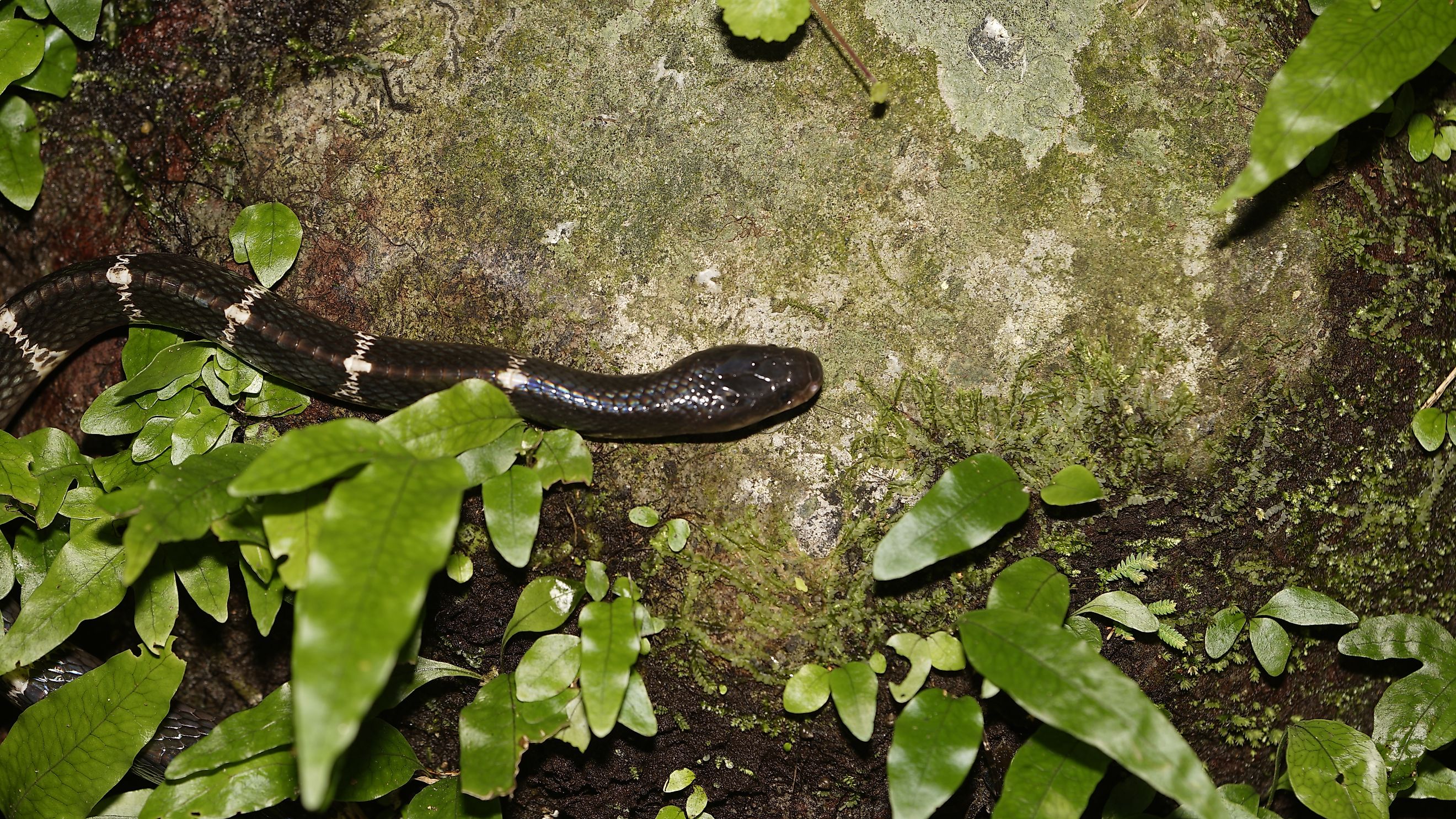
Many-Banded Krait
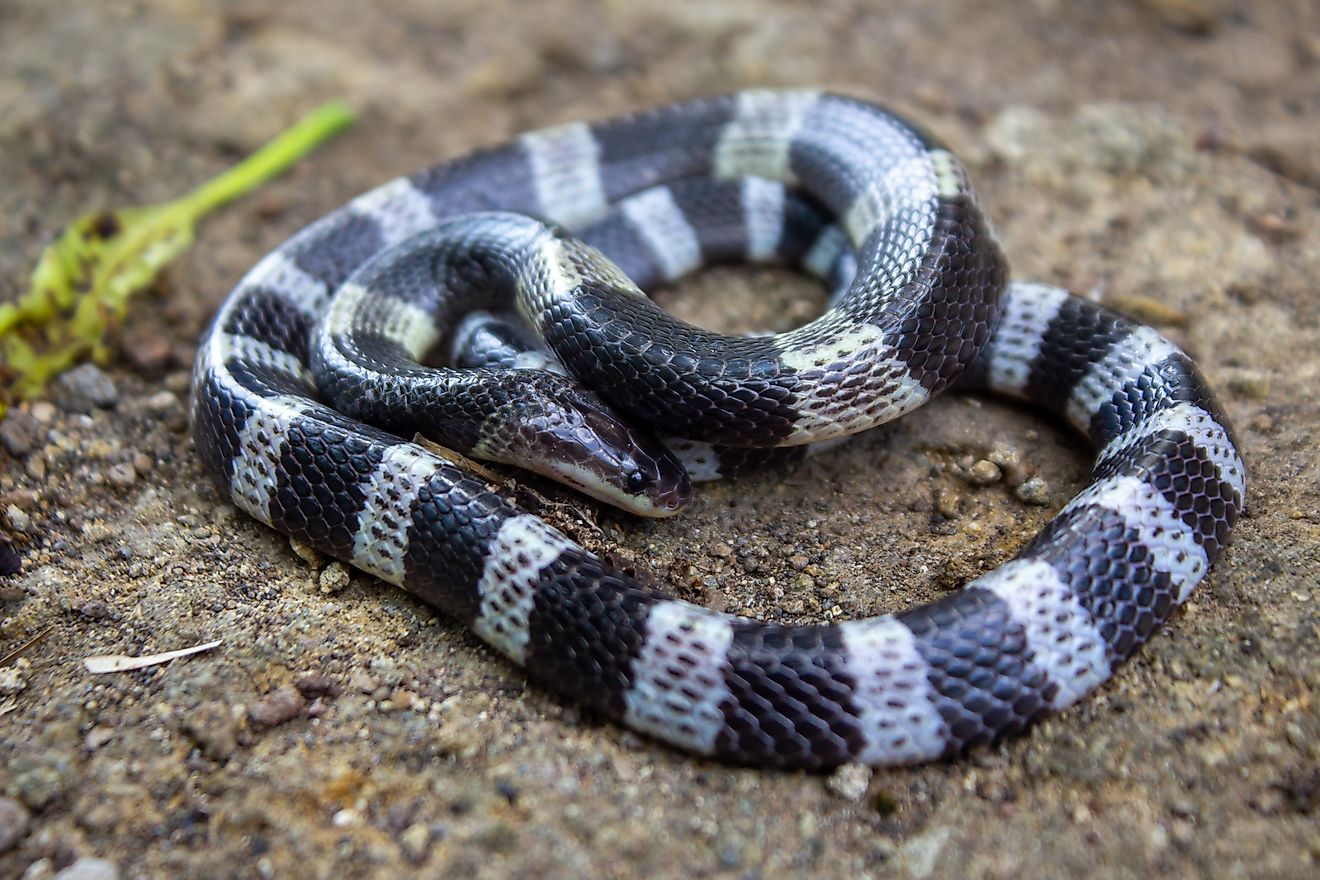
The many-banded krait (Bungarus multicinctus) carries one of the most powerful venoms of any land snake in Asia, yet most people never see the animal that delivers it. This slender, black-and-white banded elapid moves at night, keeps to itself, and rarely strikes unless handled or trodden on. That combination of extreme toxicity and quiet temperament is exactly what makes it so dangerous to the rural communities that share its range.
Found across southern China, Taiwan, and mainland Southeast Asia, the many-banded krait is a small-headed, shiny-scaled predator that hunts frogs, fish, rodents, and, remarkably, other snakes. Its venom is a fast-acting neurotoxin cocktail that can shut down the nerves controlling breathing, which is why the World Health Organization ranks it among the most medically important snakes in East Asia.
Taxonomic Classification

The many-banded krait belongs to the family Elapidae, the group of front-fanged venomous snakes that also includes cobras, mambas, taipans, and sea snakes. Within that family it sits in the genus Bungarus, the kraits, which contains roughly eighteen recognized species spread across South and Southeast Asia. The full binomial is Bungarus multicinctus, and the species goes by several common names, including the Taiwanese krait, the Chinese krait, and the umbrella snake.
The English zoologist Edward Blyth first described the species in 1861, noting that it carried far more body bands than the related banded krait. The genus name traces back to a Telugu word for krait, while the species epithet multicinctus combines Latin roots meaning "many" and "encircled," a direct nod to the numerous pale rings that cross its body. Herpetologists sometimes recognize two subspecies, the nominate B. m. multicinctus and B. m. wanghaotingi, though the boundary between them is debated and modern genetic work continues to refine krait taxonomy.
Physical Description

The many-banded krait is a medium-sized snake with a distinctly slim, cylindrical build. Adults typically measure 3.5 to 5 feet (1 to 1.5 m), and unusually large specimens can approach 6 feet (1.8 m). The body is glossy black or bluish-black, crossed by numerous narrow white or cream bands that continue down onto the tail. In some individuals the pale bands fade toward gray, tan, or near-invisibility, so color alone is an unreliable way to judge the species.
Several structural features set kraits apart from harmless look-alikes. The head is rounded and only slightly wider than the neck, the eyes are small with round pupils, and the tail ends in a short point. Running along the spine is a raised vertebral ridge formed by an enlarged row of backbone scales, which gives the body a subtly triangular cross-section. The scales beneath the tail, the subcaudals, are undivided, a useful diagnostic detail for anyone identifying preserved specimens. Sexual dimorphism is modest, with females often growing slightly longer and heavier than males.
Range and Habitat

The many-banded krait occupies a broad swath of East and Southeast Asia. Its core range covers central and southern China, including Hong Kong and Hainan, along with Taiwan, northern Vietnam, Laos, Myanmar, and parts of Thailand. Some references extend records farther across southern Asia, though the well-documented heartland lies in China and the northern reaches of Indochina.
Within that range the snake favors low to moderate elevations and damp settings. It turns up in lowland wooded areas, bamboo thickets, marshes, and the margins of streams and ponds. Above all it thrives in agricultural country, especially rice paddies, where frogs and rodents are abundant. This tolerance for farmland brings the species into close contact with people. Many-banded kraits are frequently found near villages, in gardens, and even on the outskirts of large cities, which is a major reason bites happen despite the animal's shy nature.
Diet

The many-banded krait is a carnivore with a surprisingly varied menu for a snake of its size. It preys on frogs, fish, eels, lizards, and small rodents such as mice, seizing them in wetland and paddy habitats where such animals gather. Prey is subdued quickly by the snake's potent venom, which immobilizes small victims within moments.
One of the species' most striking habits is its appetite for other snakes. It readily eats other serpents, including smaller kraits and, on occasion, members of its own kind. It will also consume snake eggs when it finds them. This snake-eating behavior, known as ophiophagy, is common across the genus and helps kraits exploit prey that many other predators avoid. As a nocturnal hunter, the many-banded krait does most of its foraging after dark, working slowly through vegetation and shallow water in search of a meal.
Behavior

Temperament is the key to understanding this animal. By day the many-banded krait is famously docile and often lethargic, coiling up in cover and rarely offering to bite even when disturbed. That daytime calm has fooled many people into underestimating it. After sunset the snake becomes far more active and alert as it sets out to hunt, and it is during these night hours that most dangerous encounters occur.
The many-banded krait is a terrestrial, ground-dwelling species rather than a climber or a strong swimmer, though it happily patrols the wet edges of its habitat. It is largely solitary outside the breeding season. Because it seeks shelter in burrows, under debris, and inside the nooks of rural buildings, it sometimes ends up close to sleeping humans. A person who rolls onto a krait in the night, or reaches into a woodpile, may be bitten before the snake is ever seen. The bite itself can be nearly painless, which adds to the danger because victims may not realize how serious their situation is until symptoms set in.
Reproduction

The many-banded krait is oviparous, meaning it lays eggs rather than giving live birth. Mating generally takes place in late summer, around August and September, and females deposit their clutches in the warmer months of late spring and summer. A single clutch usually contains between 3 and 20 eggs, each a few centimeters long, set into moist, sheltered ground such as leaf litter, loose soil, or the cavities near water.
Females of many krait species remain with the clutch during incubation, coiling around the eggs until they hatch. Newly emerged young measure roughly 10 inches (25 cm) in total length and are fully venomous from birth, capable of hunting small prey on their own almost immediately. There is no extended parental care after hatching. Given the risks of life in farmland and the wild, reaching adulthood is far from guaranteed, though healthy adults can live for a number of years.
Venom and Importance to Humans

The many-banded krait owes its fearsome reputation to a venom built around powerful neurotoxins. The two headline components are alpha-bungarotoxin and beta-bungarotoxin. Alpha-bungarotoxin blocks the receptors that muscles use to receive signals from nerves, while beta-bungarotoxin attacks the nerve endings themselves. Together they cause a creeping paralysis that can spread to the muscles of breathing, and in untreated cases this leads to respiratory failure and death.
Bites often produce little swelling or pain at the wound, so the true threat can be hidden for hours until weakness, drooping eyelids, and difficulty breathing appear. Because the species is common in densely populated farming regions, it accounts for a meaningful share of serious snakebite cases in China and Taiwan, and the World Health Organization classifies it as a Category 1 medically important venomous snake in East Asia. Prompt antivenom and supportive breathing care are the standard treatment, and both antivenoms produced in the region are effective against the venom.
As a predator of frogs, rodents, and other snakes, it helps regulate the populations of animals that flourish in rice-growing landscapes, including agricultural pests. Its venom molecules have also become priceless laboratory tools.
Threats and Conservation

The global picture for the many-banded krait is more reassuring than its danger to people might suggest. The IUCN Red List assessed the species as Least Concern in 2012, reflecting its wide range and its ability to persist in modified, human-dominated habitats. Unlike many specialized reptiles, this krait tolerates farmland and settlement edges rather than depending on untouched wilderness.
That does not mean it faces no pressure. Wetland drainage, the intensification of agriculture, and the loss of natural cover all chip away at local populations. The snake is collected in parts of its range for its skin, for food, and for use in traditional medicine, and many individuals are simply killed on sight out of fear. Road mortality and pollution of paddy and stream habitats add further strain. Some national and regional assessments have flagged the species as more threatened than the global listing implies, so the healthy overall status should not be read as a reason for complacency.
Takeaway
The many-banded krait is shy and often sluggish, yet it wields one of the deadliest venoms of any land snake in its region. It shuns confrontation, yet its habit of sheltering near homes and paddies puts it in the path of the very people most at risk from its bite. Understanding that paradox is the key to living alongside it safely, since most serious encounters come from accidental contact at night rather than aggression.
For now the species remains widespread and adaptable enough to be listed as Least Concern, but wetland loss, persecution, and harvesting are quiet threats that deserve attention. Beyond the danger it poses, the many-banded krait has repaid human curiosity in an unexpected way, handing science a molecular key that unlocked how nerves communicate with muscle.
Fun Facts

- It reshaped neuroscience. Alpha-bungarotoxin from this snake binds so tightly and selectively to a key muscle receptor that scientists used it to isolate and identify the nicotinic acetylcholine receptor, a landmark in understanding how nerves talk to muscles.
- It eats its own relatives. The many-banded krait regularly preys on other snakes, and it will even eat smaller members of its own species, a habit that makes it both predator and cannibal.
- Its bite can be painless. Victims sometimes feel almost nothing at the moment of a bite, which delays treatment and makes the venom's slow paralysis all the more dangerous.
- Gentle by day, deadly by night. The same snake that can be handled with relative ease in daylight becomes a far more active and hazardous animal after dark.
- It has a ridged spine. A raised row of vertebral scales runs down the back, giving the body a faintly triangular shape that helps experts tell true kraits from harmless mimics.
Quick Facts
- Scientific name: Bungarus multicinctus
- Family and order: Elapidae, Squamata
- Common names: Many-banded krait, Taiwanese krait, Chinese krait, umbrella snake
- IUCN status: Least Concern (assessed 2012)
- Length: 3.5 to 5 feet (1 to 1.5 m), rarely up to about 6 feet (1.8 m)
- Diet: Carnivore (frogs, fish, eels, lizards, rodents, other snakes, snake eggs)
- Activity: Nocturnal, terrestrial, solitary
- Reproduction: Egg-laying, clutch of about 3 to 20 eggs
- Venom: Potent neurotoxin (alpha- and beta-bungarotoxins), WHO Category 1 medically important
- Range: Central and southern China, Taiwan, northern Vietnam, Laos, Myanmar, and Thailand