Killer Whale
The killer whale is the ocean's undisputed apex predator, a black-and-white hunter that sits at the very top of the marine food chain and answers to no natural enemy. Despite its fearsome name, it is not a whale at all. The killer whale (Orcinus orca) is the largest member of the oceanic dolphin family, and it ranks among the most widely distributed mammals on Earth, second only to humans in the sheer breadth of habitat it occupies.
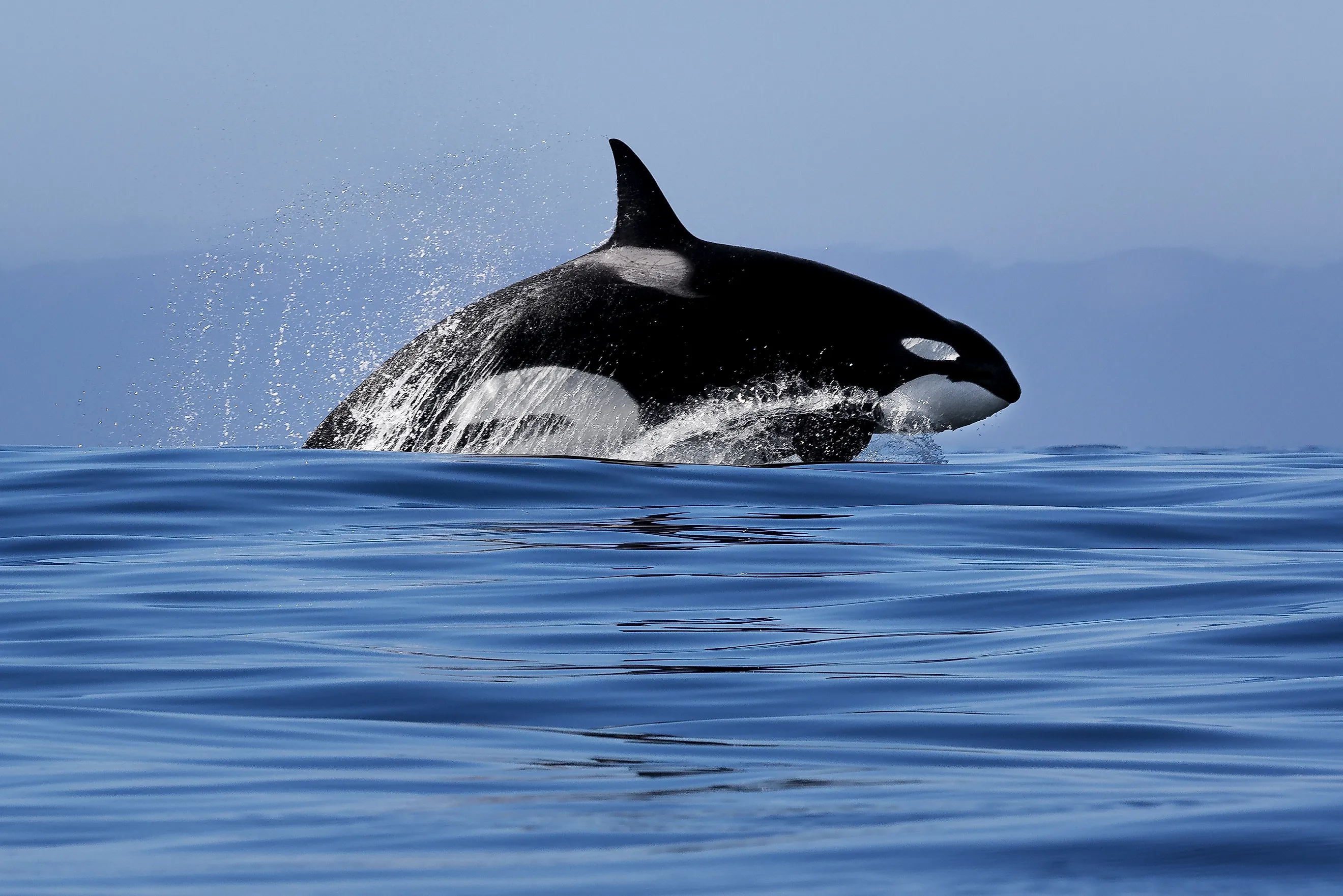
Found in every ocean, whether the pack ice of the poles or the warm waters of the tropics, the killer whale is instantly recognizable by its glossy black back, bright white underside, and the pale patch above each eye. Males can carry a towering dorsal fin that rises higher than a person, slicing through the surface like a sail. Yet the animal's most remarkable feature is not its size or its speed but its mind. Killer whales live in tight matriarchal families, pass hunting techniques and vocal dialects from one generation to the next, and display forms of culture once thought unique to humans.
Taxonomic Classification

The killer whale belongs to the family Delphinidae, the oceanic dolphins, within the infraorder Cetacea and the order Artiodactyla. Its scientific name is Orcinus orca, and it is the only living species in the genus Orcinus. Carl Linnaeus first described the animal in 1758, giving it the name it still carries today.
The common name is a source of frequent confusion. Ancient sailors watched pods attack and kill far larger whales and called them "whale killers," a phrase that over time flipped into "killer whale." Because the animal is a dolphin rather than a true whale, many biologists and writers now prefer the name orca, drawn straight from the scientific name.
Taxonomy is an active area of research for this species. Populations across the world differ so sharply in diet, behavior, appearance, and genetics that scientists have long debated whether the killer whale is truly one species or several. In 2024 the Society for Marine Mammalogy's taxonomy committee took a step toward resolving the question by recognizing two North Pacific ecotypes as distinct subspecies, the resident orca (Orcinus orca ater) and the Bigg's or transient orca (Orcinus orca rectipinnus). Further splits may follow as genetic work continues, and the possibility that hidden species lurk within the killer whale label is one reason its conservation status remains uncertain.
Physical Description

Killer whales are the giants of the dolphin family. Males are considerably larger than females, a clear case of sexual dimorphism. A mature male commonly reaches 19 to 22 feet (5.8 to 6.7 m) in length, and the largest individuals on record have measured close to 32 feet (9.8 m). Females are smaller, typically around 16 to 23 feet (5 to 7 m). A large bull can weigh well over 12,000 pounds (5,400 kg), and the heaviest males exceed 20,000 pounds (9,000 kg), which makes the killer whale several times heavier than any other dolphin.
The most striking difference between the sexes is the dorsal fin. In an adult male the fin stands tall and straight, sometimes reaching 6 feet (1.8 m) in height, the tallest of any marine mammal. In females and young animals the fin is shorter and curved. Behind the fin sits a gray marking known as the saddle patch, which, together with the shape of the fin and any scars, allows researchers to identify individuals on sight.
The bold coloration follows a consistent pattern. The back and sides are black, the belly and lower jaw are white, and an oval white patch sits just above and behind each eye. This countershading helps break up the animal's outline in the water, hiding it from prey looking up toward the bright surface or down into the dark. Beneath the skin, a thick layer of blubber insulates the body against frigid seas and stores energy. Powerful flukes drive the animal forward, and killer whales rank among the fastest marine mammals, with bursts recorded at about 34.5 miles per hour (55.5 km/h). Inside the mouth sit up to 52 conical teeth, each as long as 4 inches (10 cm), built to grip and tear rather than to chew.
Range and Habitat

Few mammals match the killer whale for range. The species is found in all of the world's oceans, reaching the ice edges of the Arctic and Antarctic as well as the equatorial tropics. It is most abundant in cold, productive waters at high latitudes, where prey is plentiful, but it turns up almost everywhere, including enclosed seas and, on occasion, river mouths.
Within that vast range, different populations behave like specialists tied to particular places and prey. Some pods stay close to coastlines and show strong fidelity to a home region, returning to the same waters year after year. Others roam the open ocean far from land. In the northeastern Pacific, researchers recognize resident, transient (Bigg's), and offshore forms that overlap in geography yet rarely mix, keeping to separate social worlds. This blend of a global footprint and intense local specialization is one of the animal's defining traits.
Diet

Taken as a whole, the killer whale is a generalist predator with one of the broadest diets in the sea. Across its range the species eats fish, squid, seals, sea lions, dolphins, porpoises, sharks, rays, seabirds, and even the largest whales. Yet individual populations are anything but generalists. Once a family learns what to hunt, it tends to stick to that menu for life, and different ecotypes can share the same water while eating entirely different things.
Fish-eating residents in the North Pacific specialize in salmon and will ignore nearby seals. Mammal-hunting transients do the opposite, stalking marine mammals in near silence. Some pods have learned to hunt sharks, flipping them upside down to hold them still, while others target the tongues of much larger whales. A large adult may need to eat several hundred pounds of food each day to fuel its enormous body, and hunting is often a cooperative effort. Pods herd fish into tight bait balls, wash seals off ice floes with coordinated waves, and in a few places deliberately strand themselves on beaches to snatch sea lions before wriggling back into the surf.
Behavior

Killer whales are among the most social animals in the ocean. They live in stable family groups called pods, organized around the oldest females. In some resident populations the bonds are so strong that offspring, both sons and daughters, stay with their mother for their entire lives, a rare arrangement in the animal world.
Communication runs deep in these societies. Pods produce distinct sets of calls that function like regional dialects, and researchers can often tell one family from another by sound alone. Killer whales also use echolocation, sending out clicks and reading the returning echoes to locate prey in dark or murky water. Hunting techniques, vocal patterns, and social customs are learned and passed down through generations, which is why scientists describe killer whales as having culture. Their intelligence, memory, and problem solving rival those of any non-human animal, and older females appear to serve as living libraries, guiding their pods to food during lean times.
Reproduction

Killer whales reproduce slowly, which shapes much of their biology. Females typically reach breeding age between 6 and 10 years, while males mature a little later. Gestation is long, lasting roughly 15 to 18 months, among the longest of any dolphin, and a female usually gives birth to a single calf every three to ten years.
Calves are born tail first and can swim from the moment they surface for their first breath. A newborn measures about 8 feet (2.4 m) and nurses for a year or more, staying close to its mother well beyond weaning. Mothers, grandmothers, and other pod members all help protect and teach the young. Females stop reproducing partway through their lives yet continue to live for decades, one of the few species besides humans to experience menopause. These post-reproductive matriarchs play a vital role, using their long memories to lead the family. Females often live to about 50 years and can reach 90 or more, while males average closer to 30 years and may live past 60.
Importance to the World

As the top predator in nearly every sea it occupies, the killer whale exerts a powerful influence on the ecosystems below it. By preying on seals, sea lions, fish, and other whales, it helps regulate the numbers of animals further down the food web, and shifts in killer whale behavior can ripple outward to reshape entire marine communities. A predator that no other animal hunts becomes, in effect, a control on the balance of life in the ocean.
The species matters to people as well. Killer whales hold a central place in the stories and traditions of many coastal cultures, especially across the Pacific Northwest, where they appear in art, myth, and identity. Today they anchor a large whale-watching industry that draws visitors to coastlines around the world, and their intelligence has made them one of the most studied and most beloved animals in the sea. That fascination, in turn, has helped drive public support for ocean conservation.
Threats and Conservation

The killer whale is listed as Data Deficient on the IUCN Red List, which means scientists lack the information needed to judge the global extinction risk of the species as a whole. Worldwide numbers are estimated at roughly 50,000 animals, though no precise census exists. The Data Deficient label reflects real uncertainty, partly because the killer whale may in fact be several species, each of which would need to be assessed on its own.
Beneath that broad status, some populations are in serious trouble. The Southern Resident killer whales of the Pacific Northwest number fewer than 80 animals and are protected as endangered under United States law, squeezed by declining salmon, underwater noise that interferes with their hunting, and toxic contaminants. The orcas of the Strait of Gibraltar are assessed as Critically Endangered. The main threats to killer whales everywhere are similar. Prey shortages driven by overfishing, chemical pollutants such as PCBs that build up in blubber and impair health and reproduction, noise from ships that disrupts echolocation, entanglement in fishing gear, and the warming and changing of the oceans all weigh on the species. Because killer whales reproduce so slowly, populations recover only gradually once their numbers fall, which makes protecting healthy pods a priority.
For an animal that rules the sea without a rival, the killer whale's fate rests almost entirely in human hands. Keeping its prey abundant, its waters clean, and its ocean quiet is the surest way to ensure that the most far-ranging predator on the planet continues to thrive.
Takeaway
The killer whale is remarkable for the contrast between its formidable hunting abilities and its close-knit family life. It is powerful enough to take on some of the ocean's largest prey, yet it also displays complex social behavior, with individuals learning from one another and passing knowledge between generations. At home in polar ice and tropical seas alike, the species has adapted to almost every ocean while developing distinct hunting strategies and social traditions suited to the conditions of its particular habitat.
The killer whale's wide range and adaptability do not make it immune to human pressures. Declining prey populations, chemical pollution, underwater noise, and warming seas all threaten its survival, while its slow reproductive rate means that affected populations can take many years to recover. Protecting the salmon, seals, and clean, quiet waters that killer whales rely on is essential to maintaining healthy populations. By protecting one of the ocean's most wide-ranging predators, we also help preserve the marine ecosystems it depends on.
Fun Facts

- Not a whale. The killer whale is the largest member of the dolphin family, despite its name and its whale-like size.
- Whale killer, reversed. The name comes from ancient sailors who saw pods hunting large whales and called them "whale killers," a phrase that later flipped into "killer whale."
- They speak in dialects. Each pod uses its own set of calls, so distinct that researchers can identify a family by its voice alone.
- Grandmothers lead the way. Killer whales are one of the very few animals, along with humans, in which females live for decades after they stop reproducing, guiding their pods with a lifetime of knowledge.
- Lifelong family bonds. In some populations, calves stay with their mother for their entire lives and never leave the pod they were born into.
- Beach hunters. In a few regions, killer whales deliberately strand themselves on beaches to grab sea lions, then wriggle back into the water.
Quick Facts
- Scientific name: Orcinus orca
- Family and order: Delphinidae, Artiodactyla (infraorder Cetacea)
- IUCN status: Data Deficient (some populations Endangered or Critically Endangered)
- Length: 16 to 32 feet (5 to 9.8 m), males larger than females
- Weight: up to 12,000 pounds (5,400 kg) and more, with the largest males exceeding 20,000 pounds (9,000 kg)
- Dorsal fin height (male): up to 6 feet (1.8 m)
- Top speed: about 34.5 miles per hour (55.5 km/h)
- Lifespan: females about 50 years and up to 90 or more, males about 30 years and up to 60 or more
- Diet: carnivore (fish, squid, seals, sea lions, dolphins, sharks, seabirds, and other whales)
- Range: all oceans worldwide, polar seas and tropics alike