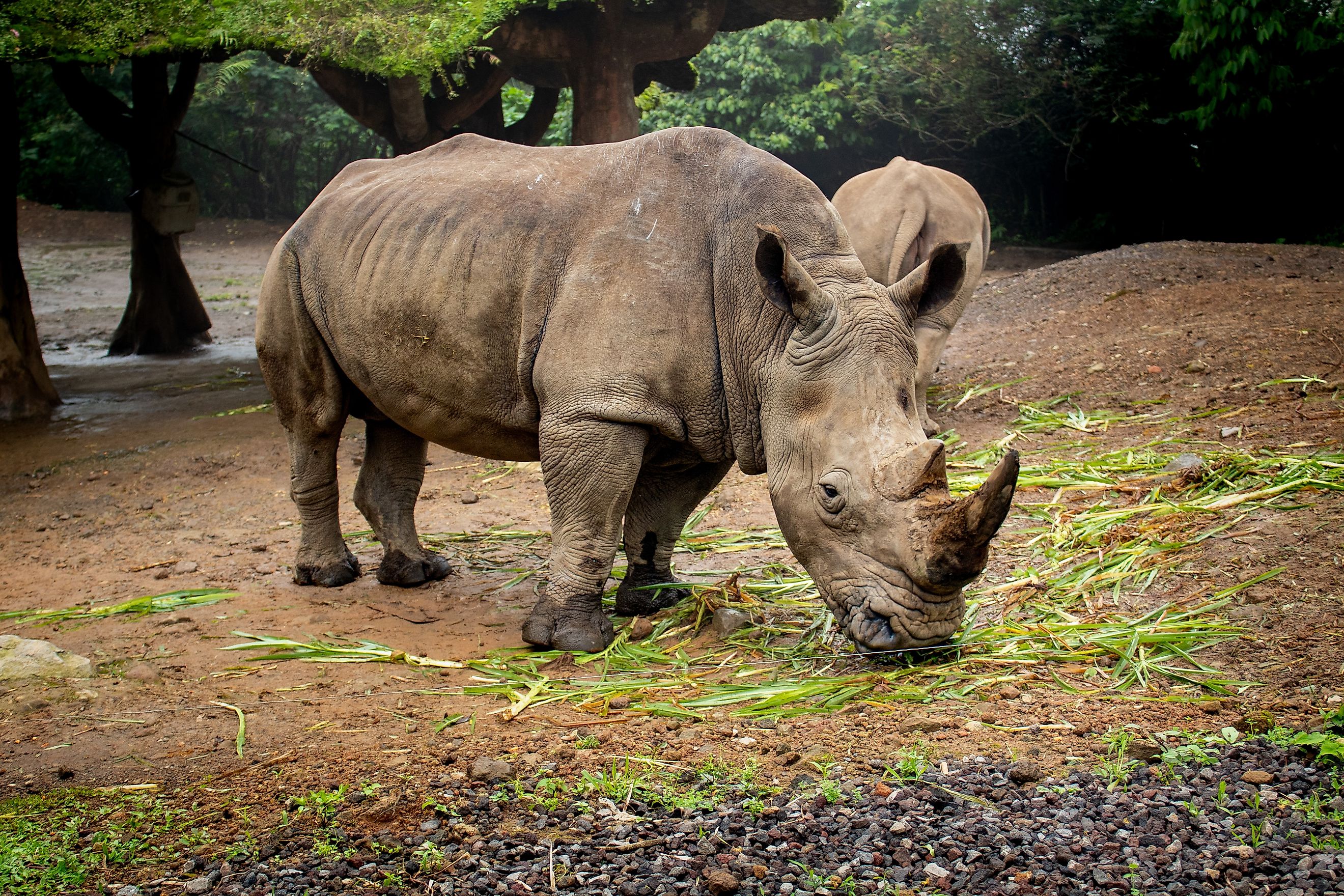
Javan Rhino
The Javan rhino (Rhinoceros sondaicus) holds a grim distinction. It is widely regarded as the rarest large mammal on Earth, with only about 50 individuals believed to survive, all of them inside a single national park on the far western tip of one Indonesian island. No animal of its size lives closer to the edge of extinction.
Once, this was a wide-ranging species. Javan rhinos moved through the forests and floodplains of mainland Southeast Asia and the Greater Sunda Islands, reaching the foothills of the eastern Himalayas in the north and the coasts of Java and Sumatra in the south. A century of hunting and habitat loss erased that range almost entirely. Today the entire species clings to Ujung Kulon National Park in Indonesia, a peninsula of lowland rainforest that is both its last refuge and, worryingly, its only one.
Taxonomic Classification

The Javan rhino belongs to the family Rhinocerotidae and the order Perissodactyla, the odd-toed ungulates that also include horses and tapirs. Its scientific name, Rhinoceros sondaicus, was assigned by the French naturalist Anselme Gaetan Desmarest in 1822. The species name points to the Sunda Islands of Indonesia, the region where the last population endures.
Within the genus Rhinoceros, the Javan rhino shares close kinship with the greater one-horned rhino (Rhinoceros unicornis) of India and Nepal. Both carry a single horn rather than the paired horns of Africa's white and black rhinos and Asia's Sumatran rhino. For this reason the Javan rhino is often called the lesser one-horned rhinoceros, a name that reflects its smaller size and shorter horn. The alternative name Sunda rhinoceros nods to the same island homeland.
Three subspecies were historically recognized, and only one still exists. The Indonesian form (Rhinoceros sondaicus sondaicus) survives. The Indian subspecies (R. s. inermis) was gone by the early twentieth century, and the Vietnamese subspecies (R. s. annamiticus) ended in 2010, when the last individual was found poached in Cat Tien National Park. With that death, mainland Javan rhinos vanished for good.
Physical Description

The Javan rhino is a heavy, thickset animal built low to the ground. Adults stand roughly 4.6 to 5.6 feet (1.4 to 1.7 m) at the shoulder and measure about 6.6 to 10.5 feet (2.0 to 3.2 m) in body length. Weight ranges widely across the few animals ever measured, between about 2,000 and 5,100 pounds (900 to 2,300 kg). That makes it the second smallest of the five living rhino species, larger only than the Sumatran rhino.
Its most distinctive feature is its skin. Loose, nearly hairless, and grey to grey-brown, the hide falls into deep folds across the neck, shoulders, and hindquarters, breaking the surface into segments that resemble riveted plates of armor. A mosaic of small polygonal scales covers the skin, which darkens to near black when wet. The folds show a soft pink tone where they crease.
The horn tells its own story. Only males reliably grow one, and even then it stays modest, usually under 10 inches (25 cm) long. This is the smallest horn of any rhino. The longest specimen ever recorded reached only about 10.6 inches (27 cm) and now sits in a museum collection in London. Females typically carry no horn at all, or at most a small raised knob, which makes the Javan rhino the only rhino species whose adult females are routinely hornless. Both sexes possess sharp lower incisors, which they use in fights far more than the horn. A long, grasping upper lip completes the picture, an adaptation suited to a life spent stripping foliage.
Range and Habitat

The Javan rhino now occupies one place on Earth. Ujung Kulon National Park, at the southwestern tip of Java in Indonesia's Banten Province, holds every wild individual. The park protects the largest surviving stand of lowland rainforest on Java, a landscape of dense vegetation, rivers, mud wallows, and coastal plain, and it carries UNESCO World Heritage status in part because of the rhino.
This is a severe contraction from the animal's former range. Historical records place Javan rhinos across a broad arc of Asia that once took in eastern India, Bhutan, Bangladesh, Myanmar, Thailand, Laos, Cambodia, Vietnam, the Malay Peninsula, and the islands of Java and Sumatra, reaching into southern China. Relentless hunting and the clearing of forests for farming and settlement stripped that range away piece by piece across the nineteenth and twentieth centuries.
Javan rhinos favor tropical lowland forest close to sea level, with reliable water and mud for wallowing. They can range up to elevations near 3,300 feet (1,000 m) but are far more common below about 2,000 feet (600 m). Ujung Kulon sits within reach of Anak Krakatau, an active volcano, a detail that matters more for the animal's survival than for its comfort.
Diet

The Javan rhino is a browser. It feeds on the leaves, young shoots, twigs, buds, and fallen fruit of hundreds of plant species found in its forest home, plucking and tearing foliage with that flexible upper lip. Saplings are often bent or pushed over so the animal can reach the tender growth at the top, a habit that reshapes the surrounding vegetation.
A large rhino eats a large volume, and an adult can consume tens of kilograms of plant matter in a single day. In its current rainforest habitat the species is a pure browser, though evidence suggests that in other parts of its former range it may have been a mixed feeder that grazed on grasses as well. Javan rhinos also seek out mineral sources, and animals in Ujung Kulon have been seen drinking seawater along the coast, likely to obtain salts that the inland forest lacks.
Behavior

Javan rhinos are solitary and secretive. Adults live alone for the most part, coming together only to mate, with the enduring exception of a mother and her dependent calf. They are so elusive, and so few, that most of what is known about them comes from camera traps, dung, tracks, and the patient work of monitoring teams rather than direct observation.
Wallowing in mud sits at the center of daily life. A coating of mud cools the animal, shields its skin from biting insects, and may help control parasites. Rhinos communicate largely through scent, leaving dung piles, spraying urine, and scraping the ground to signal their presence and mark territory. Their vocal range is limited. For an animal this large, the Javan rhino leaves a remarkably quiet footprint in its forest.
Reproduction

Reproduction is slow, a fact that weighs heavily on the species. Females reach breeding age at around three to four years, males somewhat later. After mating, gestation lasts about sixteen months, among the longest of any land mammal, and produces a single calf. Mothers give birth only once every three to five years and care for the young calf closely through its early life.
In the wild, Javan rhinos are thought to live roughly 30 to 45 years. That long life is one of the few factors working in the animal's favor. Even so, the combination of late maturity, long pregnancy, and wide birth intervals means the population can recover only very slowly from any loss.
Importance to the World

As one of the last megaherbivores of Southeast Asia's rainforests, the Javan rhino plays an outsized role in its habitat. By feeding on and trampling vegetation, it opens gaps in the understory that let light reach the forest floor and allow different plants to take hold, maintaining a varied and healthy forest structure. In moving through the landscape and consuming fruit, it helps disperse seeds and supports the regeneration of the plants it depends on.
The Javan rhino also plays an important role in protecting its wider ecosystem. The large, well-guarded forests needed to support even a small rhino population provide habitat for other threatened wildlife on Java, including banteng, silvery Javan gibbons, Javan leopards, and numerous rare bird species. Protecting the rhino therefore helps preserve one of the island's last major areas of lowland rainforest and the many species that depend on it. This makes the rhino's conservation important not only for the species itself but for an entire endangered ecosystem.
Threats

The Javan rhino is listed as Critically Endangered on the IUCN Red List, the highest risk category before extinction in the wild. The wild population climbed slowly for decades and reached an estimated high near 76 animals in 2022. Investigators then uncovered a poaching operation that had killed an estimated 26 rhinos, most of them males, between 2019 and 2023, and current estimates place the surviving population at around 50. Poachers target the animals for their horn, which is trafficked for use in traditional medicine despite having no proven medical value.
Poaching is only part of the danger. Because every Javan rhino lives in one park, the entire species is exposed to a single catastrophe. A tsunami, an eruption of nearby Anak Krakatau, an earthquake, or a disease outbreak could strike the whole population at once. The habitat itself is under pressure from the fast-spreading Arenga palm, an invasive plant that crowds out the species the rhinos eat and shrinks the effective feeding area. A skewed sex ratio of roughly two males to every female, low genetic diversity, and the risk of inbreeding further limit the population's ability to grow. No Javan rhinos exist in captivity, so there is no safety net outside the wild.
Conservation work focuses on keeping the animals alive where they are. Rhino Protection Units patrol the park against poachers, field teams clear Arenga palm to restore feeding habitat, and monitoring tracks births and deaths closely. Plans to establish a second population in a separate protected area have long been discussed as the single most important step toward reducing the risk of losing everything to one disaster.
Takeaway
The Javan rhino is hanging on in a remarkably small corner of the world. Its armored hide, ancient lineage, and role in the forests of Java all belong to a species whose entire wild population is confined to a single vulnerable area. Protecting it means stopping poaching, restoring its habitat, and establishing another secure population before disease, natural disasters, or other threats can have catastrophic consequences. The Javan rhino is a clear example of how fragile a species can become when its entire future rests in one place, and why protecting what remains is so important.
Fun Facts

- Rarest of the rare. With around 50 individuals left, the Javan rhino is widely considered the rarest large mammal on the planet.
- Hornless females. Female Javan rhinos usually grow no horn at all, making this the only rhino species whose adult females are routinely hornless.
- The horn is not a weapon. When Javan rhinos fight, they rely on their sharp lower incisor teeth rather than the horn, which serves mainly to scrape mud and pull down plants.
- Keratin, like fingernails. A rhino's horn is made of keratin, the same protein found in hair and hooves, and it can regrow if broken off.
- No zoo has one. No Javan rhino lives in captivity anywhere in the world, and the last captive individual died in 1907.
- Living beside a volcano. The entire species survives within reach of Anak Krakatau, one of the world's most famous active volcanoes.
Quick Facts
- Common name: Javan rhino (lesser one-horned rhinoceros, Sunda rhinoceros)
- Scientific name: Rhinoceros sondaicus
- Family: Rhinocerotidae
- Order: Perissodactyla
- IUCN status: Critically Endangered
- Population: around 50 individuals (2025 estimate)
- Height: 4.6 to 5.6 feet (1.4 to 1.7 m) at the shoulder
- Length: 6.6 to 10.5 feet (2.0 to 3.2 m)
- Weight: 2,000 to 5,100 pounds (900 to 2,300 kg)
- Lifespan: about 30 to 45 years in the wild
- Diet: browser, feeding on leaves, shoots, twigs, buds, and fallen fruit
- Range: Ujung Kulon National Park, Java, Indonesia