Jararaca
The jararaca is one of the most medically important snakes in South America, and it carries a strange double reputation. It is a venomous pit viper responsible for a large share of serious snakebites across its range, yet its venom also handed modern medicine one of its most successful drugs. Few animals sit so squarely at the crossroads of danger and healing.
Bothrops jararaca is a slender, ground-dwelling viper native to the humid forests and grasslands of southern Brazil, northeastern Paraguay, and northern Argentina. It is abundant where it lives, often turning up in farmland and along forest edges close to people, which is a large part of why it bites so many of them. Its bite can cause severe swelling, tissue death, and internal bleeding, and it remains a real public health concern in rural areas.
What makes the jararaca worth knowing is not only its potency but its role in science. Research on its venom in the twentieth century led directly to captopril, the first of the ACE inhibitor blood pressure drugs now taken by millions of people worldwide. A snake feared across three countries became the unlikely origin of a life-saving medicine.
Taxonomic Classification

The jararaca belongs to the family Viperidae and the subfamily Crotalinae, the pit vipers. Its genus, Bothrops, is a large group of Central and South American snakes commonly called lanceheads, named for the narrow, lance-shaped head shared by many of its members. The German naturalist Prince Maximilian of Wied-Neuwied first described the species in 1824, and the accepted scientific name is Bothrops jararaca.
The common name comes from Old Tupi, an Indigenous Brazilian language, and is often understood to mean "large snake." No subspecies are currently recognized. The species did pass through a brief taxonomic detour. A 2009 study proposed moving it and several relatives into a new genus, Bothropoides, but later work returned it to Bothrops, where it remains today. This kind of reshuffling is common as DNA studies continue to refine the snake family tree.
Physical Description

The jararaca is a moderately sized viper with a slim build. Most adults measure roughly 2 to 3 feet (60 to 90 cm), though large individuals can reach about 5.2 feet (160 cm). Females grow noticeably larger than males, one of the clearest cases of sexual dimorphism in the species.
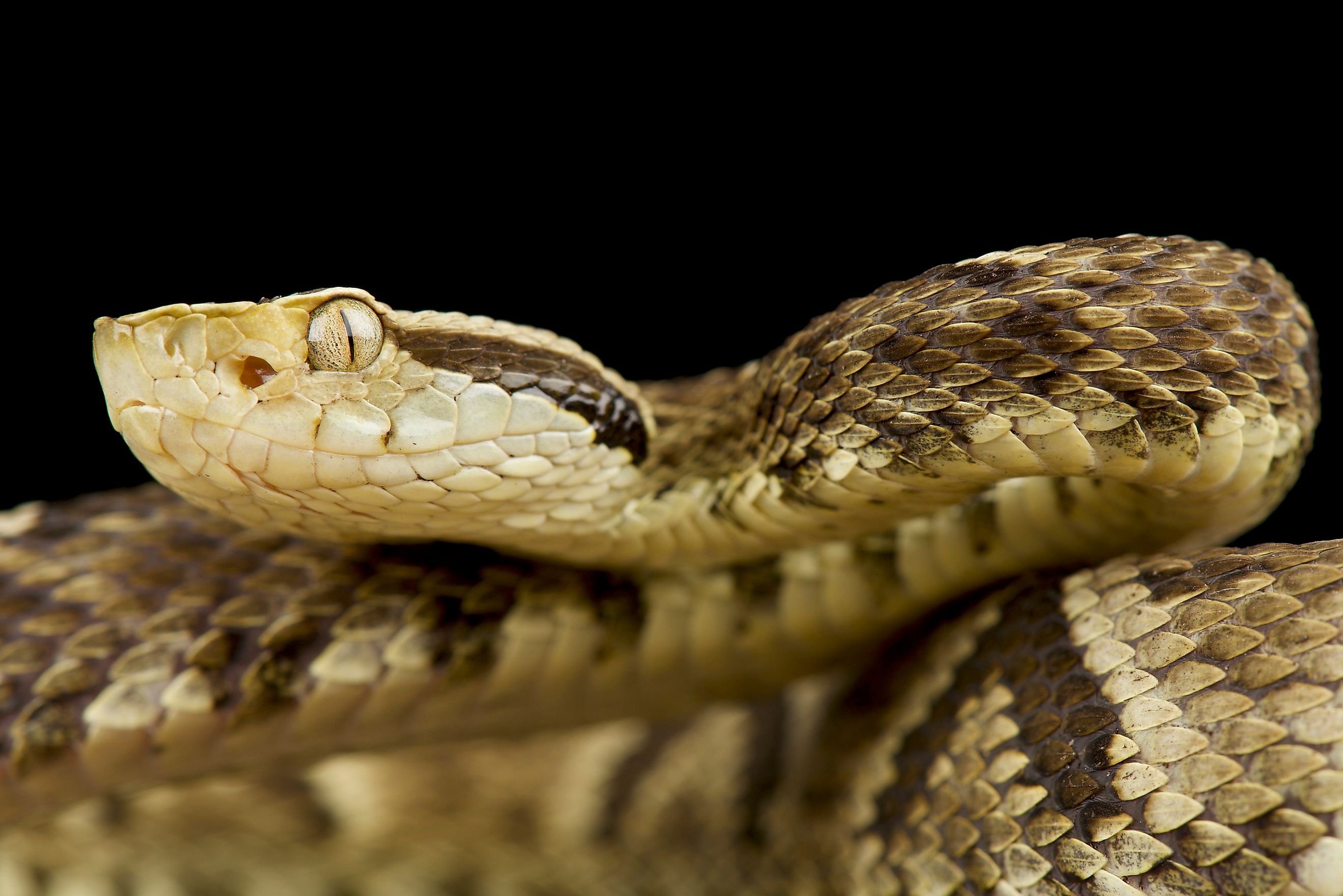
Its coloration is built for concealment. The body wears a background of tan, brown, gray, or muted maroon, overlaid with darker markings that form a zigzag, diamond, or hourglass pattern down the back. Against leaf litter and a dappled forest floor, this camouflage can make a resting snake almost invisible. The head is broad and triangular, set off sharply from the neck, and the vertical pupils mark it as a hunter of the night.
The most important feature sits on the face. Between each eye and nostril lies a loreal pit, a heat-sensing organ packed with nerve endings and dense with blood vessels. These pits detect the infrared warmth of nearby animals, giving the snake a kind of thermal vision that works in complete darkness. Long, hinged fangs fold back against the roof of the mouth when not in use, then swing forward to drive venom deep into prey during a strike. Females also produce far more venom than males, around 220 mg against roughly 40 mg, a difference tied to their larger size and their diet.
Range and Habitat

The jararaca is endemic to southeastern South America. Its range covers southern Brazil, reaching north into the state of Bahia and south to Rio Grande do Sul, along with northeastern Paraguay and the Misiones province of northern Argentina. It is most strongly tied to the Atlantic Forest, one of the most biologically rich and heavily cleared biomes on the continent.
Within that broad zone the snake proves adaptable. It occupies humid subtropical forest, forest edges, grasslands, and remnants of Cerrado savanna, and it readily moves into cultivated fields, plantations, and the disturbed ground at the margins of towns. It occurs from near sea level up to about 3,300 feet (1,000 m) in elevation. Its comfort around farmland and settlements is a mixed blessing. It thrives near people, which also puts it in frequent and dangerous contact with them.
Diet

The jararaca is an ambush predator that changes its menu as it grows, a pattern biologists call an ontogenetic diet shift. Young snakes feed heavily on cold-blooded prey, with frogs making up as much as three quarters of their meals, supplemented by arthropods. As the snake matures it switches to warm-blooded prey, and adults take mostly small mammals, with rodents accounting for roughly 80 percent of the diet.
Its hunting style relies on patience rather than pursuit. A jararaca coils in cover and waits, using its heat-sensing pits to track approaching prey in the dark, then strikes in a fraction of a second and injects venom that both subdues the animal and begins breaking down its tissues before it is even swallowed. Juveniles sometimes wiggle a pale tail tip to lure curious frogs within range, a behavior known as caudal luring.
Behavior

Jararacas are mostly nocturnal, hunting through the night and resting by day in vegetation or on the ground. Activity is flexible, and individuals may shift into the twilight hours of dusk and dawn during cooler weather or shorter nights. Like most vipers, they are solitary and come together only to breed.
By day the snake often basks to warm its body to a working temperature, relying on the same heat-detecting biology that helps it hunt. When threatened, a jararaca may hold its ground rather than flee, coiling and striking quickly if pressed. Its combination of camouflage, stillness, and speed is a large reason bites so often happen when a person steps near one without ever seeing it.
Reproduction

The jararaca gives birth to live young rather than laying eggs, a reproductive style called viviparity that is typical of pit vipers. Mating is polygynous, and rival males wrestle in ritual combat for access to females during the breeding season.
Ovulation and fertilization take place in the southern spring, roughly October through December or January, and females give birth in the late summer and early autumn months of February through April. A typical litter numbers around 10 to 14 young, each one fully formed, already venomous, and independent from the moment of birth. Both sexes reach breeding age at about two years old.
Importance to the World

In its own ecosystem the jararaca works as a mid-level predator. By eating large numbers of rats and mice, it helps hold down rodent populations that damage crops and stored grain, and it in turn feeds larger predators and birds of prey. Remove it, and the balance of small-vertebrate populations begins to shift.
Its greatest claim to fame reaches far beyond the forest. In 1948 the Brazilian scientist Maurício Rocha e Silva and his colleagues, studying blood plasma exposed to jararaca venom, discovered a compound they named bradykinin, which relaxes blood vessels and lowers blood pressure. In 1965 the pharmacologist Sérgio Ferreira isolated a bradykinin-potentiating factor from the same venom, a set of small peptides that amplified this pressure-dropping effect. Working from that discovery, scientists at the Squibb company designed captopril, the first angiotensin-converting enzyme inhibitor and a landmark treatment for high blood pressure and heart failure. In effect, the snake's own weapon was reverse-engineered into a cure.
The jararaca also anchored Brazil's pioneering antivenom program at the Butantan Institute, founded by Vital Brazil, which turned the study of this and related vipers into a lasting national scientific tradition. Antivenom developed from work on Bothrops species continues to save lives across the region today.
Threats and Conservation

The jararaca is listed as Least Concern on the IUCN Red List, and it remains common across most of its range. No overall population estimate exists, but the species is considered abundant wherever suitable habitat survives. In Argentina, at the southern edge of its range, it is treated as Vulnerable under national assessment.
Its threats are the familiar ones. The Atlantic Forest has been reduced to a fraction of its original extent, shrinking and fragmenting the snake's habitat. Because it is venomous and common near settlements, the jararaca is also widely killed on sight out of fear, even though it plays a useful role in controlling pests. For now, its adaptability and wide distribution keep it secure, but continued habitat loss remains the main long-term concern.
Takeaway
The jararaca illustrates the complex ecological and medical significance of venomous snakes in tropical ecosystems. As an ambush predator, it helps regulate populations of rodents and other small vertebrates, while its venom contains a diverse mixture of bioactive compounds that have contributed to research into coagulation, blood pressure, and pharmaceutical development. At the same time, its close association with agricultural landscapes makes human encounters and snakebite an important public health concern across parts of its range. Understanding the jararaca therefore requires looking beyond its reputation as a dangerous snake. Its biology, ecological role, and venom all demonstrate how a species can influence both natural ecosystems and human health.
Fun Facts

- A viper helped invent a blockbuster drug. Captopril, one of the first modern blood pressure medicines, traces directly to peptides found in jararaca venom.
- It sees heat. Loreal pits between the eyes and nostrils detect infrared warmth, letting the snake track warm-blooded prey in total darkness.
- Females out-venom males. Larger females can carry roughly five times as much venom as males, about 220 mg against 40 mg.
- Babies fish with their tails. Young jararacas twitch a pale tail tip to lure frogs close enough to strike, a behavior called caudal luring.
- No eggs required. Like other pit vipers, the jararaca gives birth to live, fully venomous young rather than laying eggs.
- The name is ancient. "Jararaca" comes from Old Tupi, an Indigenous Brazilian language spoken long before European contact.
Quick Facts
- Scientific name: Bothrops jararaca
- Family: Viperidae (subfamily Crotalinae, the pit vipers)
- IUCN status: Least Concern
- Length: roughly 2 to 3 feet (60 to 90 cm), up to about 5.2 feet (160 cm)
- Distinguishing features: heat-sensing loreal pits, triangular head, and a dark zigzag or diamond pattern
- Diet: frogs and arthropods as juveniles, rodents and small mammals as adults
- Reproduction: live-bearing, about 10 to 14 young per litter
- Maturity: around 2 years of age for both sexes
- Range: southern Brazil, northeastern Paraguay, and northern Argentina
- Habitat: Atlantic Forest, grasslands, and farmland, up to about 3,300 feet (1,000 m)