Indochinese Tiger
The Indochinese tiger is one of the rarest big cats on Earth, with fewer than 250 believed to remain in the wild. Known scientifically as Panthera tigris corbetti and also called Corbett's tiger, it is a mainland Asian tiger that once ranged across Myanmar, Thailand, Laos, Cambodia, Vietnam, and southern China. Today, breeding populations survive in only two of those countries. Thailand remains the species' last true stronghold, while a smaller population persists in Myanmar.
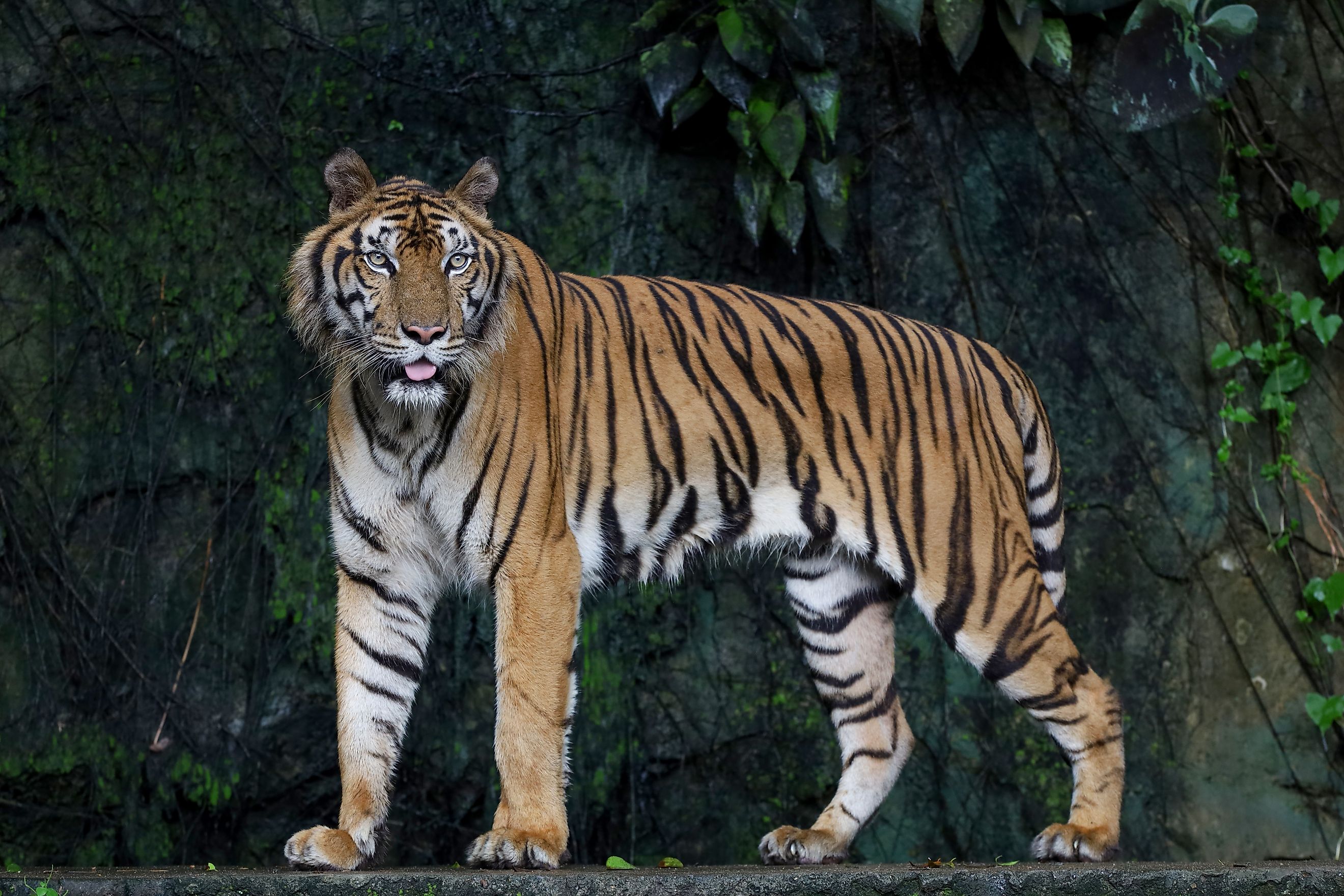
Mid-sized by tiger standards, males weigh up to about 430 pounds (195 kg) and are smaller and darker than the better-known Bengal tiger, with shorter, narrower stripes suited to hunting from cover in dense forest. As an apex predator, it helps regulate the herbivores it hunts and anchors the health of the wider ecosystem. It is also the national animal of Myanmar.
What makes the Indochinese tiger worth understanding is the speed of its decline. Its population has fallen by well over 70 percent in little more than a decade, one of the steepest drops of any tiger, driven mainly by poaching and habitat loss. Yet where protection has been serious, notably in western Thailand, the population has stabilized and even begun to recover.
Taxonomic Classification

The Indochinese tiger belongs to the kingdom Animalia, phylum Chordata, class Mammalia, order Carnivora, and family Felidae. Its genus is Panthera, the genus of big cats that also includes the lion, jaguar, leopard, and snow leopard. The species is Panthera tigris, the tiger.
The name Panthera tigris corbetti was proposed in 1968 by the Czech biologist Vratislav Mazák, who distinguished this population from other tigers using skin coloration, stripe pattern, and skull measurements. He named it in honor of Jim Corbett, the hunter turned conservationist whose later work helped shape modern tiger protection. Because of this, the animal is sometimes called Corbett's tiger.
Tiger taxonomy has since been reorganized. In 2017 the Cat Classification Task Force of the IUCN Cat Specialist Group revised felid classification and folded the mainland Asian tigers, including the Indochinese, into the nominate subspecies Panthera tigris tigris. Under that scheme the Indochinese tiger is treated as a distinct population, or clade, within the continental subspecies rather than a separate subspecies of its own. A 2018 whole-genome study added nuance, supporting six genetically distinct tiger groups and finding the Indochina and Malaysia specimens separable from other mainland populations. The debate over how finely to split tigers is ongoing, so both the traditional trinomial and the newer arrangement remain in use.
Physical Description

The Indochinese tiger is a large cat, though a mid-sized one by tiger standards. Males typically measure 100 to 112 inches (255 to 285 cm) in total length and weigh 331 to 430 pounds (150 to 195 kg). Females are smaller, running 91 to 100 inches (230 to 255 cm) long and weighing 220 to 290 pounds (100 to 130 kg). That makes this cat clearly smaller than the Bengal and the Siberian tiger, roughly 20 percent lighter than the Bengal on average, but larger than the island tigers of Sumatra.
Its coat is a deep orange to golden ground color marked with black stripes, with white on the underside, chest, and around the muzzle. Compared with the Bengal tiger, the Indochinese tiger tends to be darker overall, and its stripes are shorter, narrower, and more numerous. A set of eleven museum skins held in London carried between 21 and 31 stripes each. The skull is smaller than a Bengal's, and the stripe pattern on every individual is unique, functioning like a fingerprint and allowing researchers to identify specific animals from camera-trap images.
Everything about the build serves ambush hunting in thick cover. The body is muscular through the shoulders and forelimbs, the paws are broad and padded for silent movement, and the long whiskers help the cat navigate dense undergrowth in low light. The coat runs slightly thicker in cooler seasons and at higher elevations.
Range and Habitat

Historically the Indochinese tiger occupied a wide band of Southeast Asia, including Myanmar, Thailand, Laos, Cambodia, Vietnam, and parts of southern China. That range has collapsed. The cat has not been recorded in China since 2007 and is considered gone there, and evidence points to the loss of viable populations in Laos, Cambodia, and Vietnam as well. Breeding tigers are now believed to persist only in Thailand and Myanmar.
Thailand is the last true stronghold, and it holds two key populations. The Western Forest Complex, a network of protected areas covering roughly 7,200 square miles (18,700 sq km) along the border with Myanmar and anchored by the Huai Kha Khaeng Wildlife Sanctuary, is the cornerstone. Long-running camera-trap monitoring there has produced the best tiger dataset in the region, and the complex currently holds an estimated 140 to 160 tigers, a population that has stabilized and begun to recover after decades of decline. Farther east, near the Cambodian border, the Dong Phayayen-Khao Yai Forest Complex supports a smaller group of roughly 20 to 34 tigers that is breeding successfully. In Myanmar, the Hukaung Valley in the far north was set aside as a tiger reserve in 2004 and later expanded into one of the world's largest, but conflict, terrain, and access problems make its population one of the least understood in the tiger world.
The animal favors tropical and subtropical evergreen forest, deciduous and dry broadleaf woodland, and rugged, often mountainous country. Dense cover and adequate prey matter more to it than any single forest type.
Diet

As an apex predator, the Indochinese tiger sits at the top of its food web and eats large herbivores. Its core prey includes sambar deer, wild boar, muntjac, banteng, and other hoofed animals, supplemented by smaller mammals when larger prey is scarce. A tiger of this size needs a substantial amount of meat and will feed heavily after a successful kill, then go days before hunting again.
The hunting style is built on stealth rather than speed. The tiger stalks close using cover and shadow, then closes the final distance in a short, explosive rush, aiming to bring prey down with a bite to the throat or nape. Because this ambush strategy depends on dense vegetation and healthy prey herds, the loss of either quickly undermines a tiger's ability to survive in a given forest. Depletion of prey through hunting and snaring is, in practice, one of the most damaging pressures on the population.
Behavior

Indochinese tigers are solitary and territorial. Adults hold individual home ranges that they patrol and scent-mark, and males occupy far larger territories than females. Male ranges can span roughly 35 to more than 100 square miles, while female ranges tend to run between about 13 and 27 square miles, with a male's territory often overlapping those of several females.
Tigers communicate through scent marking, scrapes, vocalizations, and visual signals, using these to advertise presence, status, and reproductive condition while avoiding unnecessary conflict. They are strong swimmers and comfortable crossing rivers, and they rely on ambush from cover rather than long pursuits. Activity is flexible, but hunting frequently peaks around dawn and dusk when prey is active and cover is good.
Reproduction

Breeding can occur at any time of year. Females reach sexual maturity at about three to four years of age and males somewhat later, at four to five years. After mating, gestation lasts roughly 93 to 112 days, most often around 104 to 106 days, and typically produces a litter of two to four cubs, with two or three being common.
Cubs are born blind and helpless and depend entirely on the mother, who raises them alone. They nurse for the first months, then gradually learn to hunt under her guidance before dispersing to establish their own territories at around 18 months to two years. Cub mortality is high, driven by disease, starvation, and the difficulty of finding safe territory in a fragmented landscape. In the wild, Indochinese tigers generally live up to about 15 years, with somewhat longer lifespans possible in captivity.
Importance to the World

As a top predator, the Indochinese tiger regulates the numbers of the large herbivores it hunts, which in turn shapes vegetation, forest structure, and the balance of the wider ecosystem. Protecting a viable tiger population requires vast, connected tracts of healthy forest. As an umbrella species, the tiger's conservation also benefits countless other plants and animals that share the same landscape.
The tiger's importance extends beyond conservation and ecology, with its presence also bringing meaningful economic benefits. As a flagship species, its popularity helps attract conservation funding and political support that can benefit entire landscapes rather than just the animal itself. Forests protected for tigers provide water, timber, and other resources to nearby communities, while well-managed reserves can create jobs and generate income through regulated wildlife tourism. These combined ecological and economic benefits help explain why so much conservation effort is focused on preserving tiger populations.
Threats and Conservation

The species Panthera tigris is listed as Endangered on the IUCN Red List, and the Indochinese population is regarded as endangered, with a number of researchers arguing it now meets the criteria for Critically Endangered given how far it has fallen. The working estimate is about 200 to 250 tigers remaining, drawn largely from rigorous Thai surveys, with Thailand's own national figure placed at roughly 179 to 223 in a 2024 assessment. The scale of the decline is stark, with the population falling by well over 70 percent in little more than a decade leading up to 2020.
The most serious threat is poaching for the illegal wildlife trade, driven by demand for tiger bones and body parts used in traditional medicine. Habitat loss and fragmentation compound the problem, as forests are cleared for agriculture, logging, plantations, mining, and hydropower, and as roads slice through the landscape and cut off the corridors tigers need to move and breed. Snaring, which strips forests of both tigers and their prey, is especially destructive.
Conservation efforts are meaningful and, in places, working. The Global Tiger Recovery Program, adopted in 2010, set a shared goal of doubling wild tiger numbers, and sustained protection in Thailand's Western Forest Complex has helped that population stabilize and edge upward. Ongoing camera-trap monitoring, ranger patrols, anti-poaching enforcement, and proposals to reintroduce tigers into suitable habitat such as Cambodia's Cardamom forests all point toward a possible recovery, provided the pressure on the remaining animals can be held back.
Takeaway
The Indochinese tiger's future comes down to a few clear points. Only about 200 to 250 remain, concentrated in Thailand and Myanmar, so losing any single stronghold would be a serious blow. Poaching for the illegal wildlife trade and the loss of forest are the two decisive pressures, and the population rises or falls with how well they are controlled. Where enforcement, monitoring, and habitat protection have been sustained, most clearly in Thailand's Western Forest Complex, numbers have stabilized and begun to climb. The priorities are straightforward and all center on protecting the conditions the species needs to survive, from keeping snares and poachers out of core reserves and protecting the prey base to reconnecting forest corridors and pursuing reintroduction where suitable habitat remains. This tiger's fate is not yet sealed, and with continued protection, its remaining forests can hold, and even grow, one of the world's rarest big cats.
Fun Facts

- Its stripes go all the way down. A tiger's markings are printed on its skin as well as its fur, and no two individuals share the same pattern, which lets researchers identify specific cats from camera-trap photos.
- It is named after a hunter who switched sides. The scientific name honors Jim Corbett, who shot tigers before becoming one of the most influential voices in tiger conservation.
- It is a national symbol. The Indochinese tiger is the national animal of Myanmar.
- Unlike most cats, it likes water. These tigers are powerful swimmers and will readily cross rivers and cool off in pools during hot weather.
- Thailand's stronghold is a World Heritage Site. The core of the Western Forest Complex, the Thungyai and Huai Kha Khaeng sanctuaries, is recognized by UNESCO, and its tiger population has begun to recover after decades of decline.
Quick Facts
- Common name: Indochinese tiger (also Corbett's tiger)
- Scientific name: Panthera tigris corbetti (now often treated within Panthera tigris tigris)
- Family / Order: Felidae / Carnivora
- IUCN status: Endangered (species-level); many researchers argue this population warrants Critically Endangered
- Population: Roughly 200 to 250 in the wild; Thailand estimated about 179 to 223 (2024)
- Length: Males 100 to 112 in (255 to 285 cm); females 91 to 100 in (230 to 255 cm)
- Weight: Males 331 to 430 lb (150 to 195 kg); females 220 to 290 lb (100 to 130 kg)
- Lifespan: Up to about 15 years in the wild
- Diet: Carnivore; sambar deer, wild boar, muntjac, banteng, and other large herbivores
- Range: Breeding populations now only in Thailand and Myanmar; historically also Laos, Cambodia, Vietnam, and southern China
- Habitat: Tropical and subtropical forest and rugged, hilly terrain