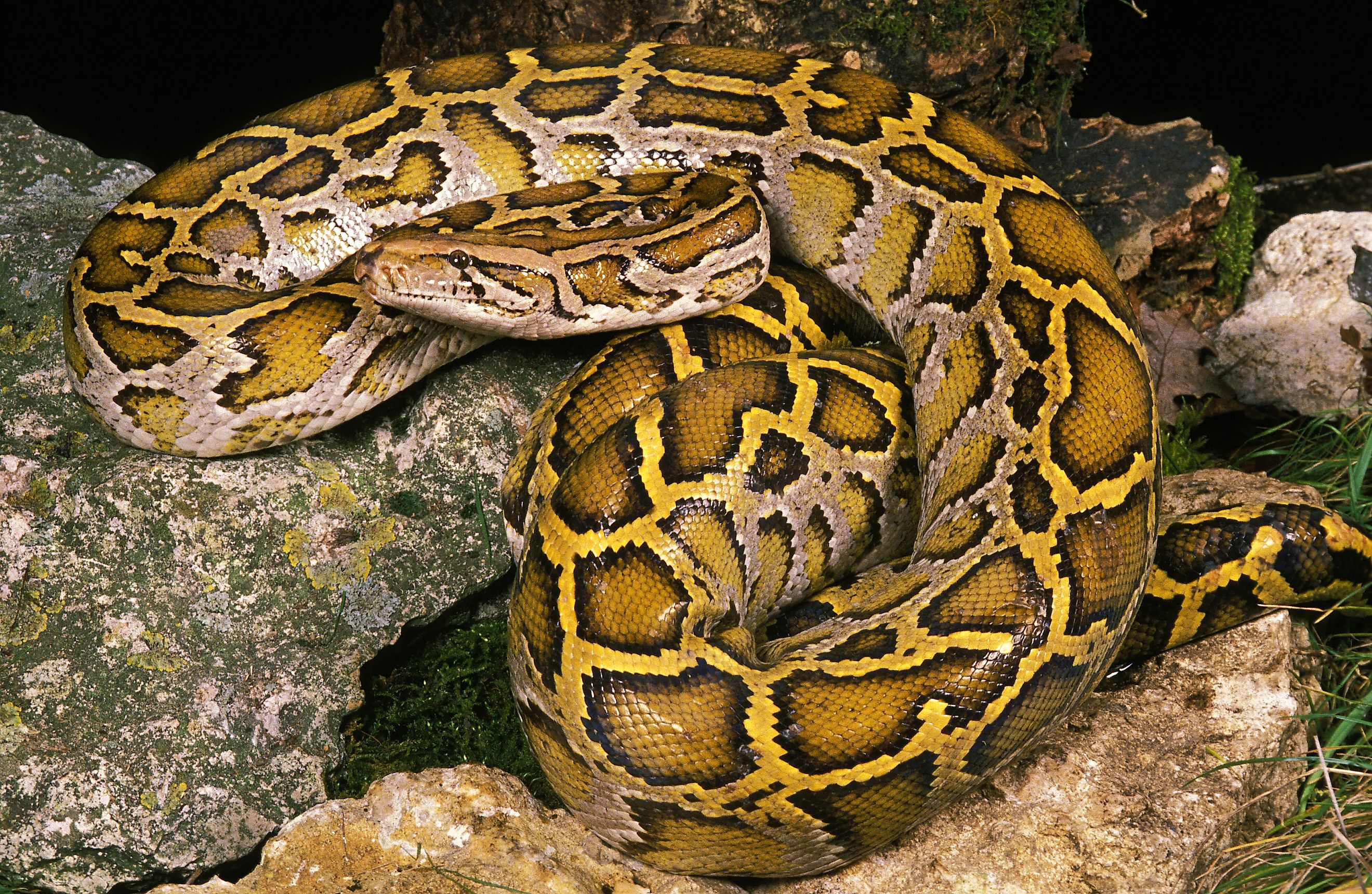
Indian Python
Not many reptiles carry as much mystique on the Indian subcontinent as the Indian python. It is a heavy-bodied, nonvenomous constrictor that can stretch beyond 10 feet (3 m), swallow prey larger than its own head, and go two years without a meal. It is also the serpent behind Kaa, the python who mentors Mowgli in Rudyard Kipling's The Jungle Book. Indian pythons are less theatrical but far more useful, serving as patient ambush hunters that help keep rodent and small mammal populations in check across grasslands, forests, and wetlands, with a range reaching Pakistan in the west and Sri Lanka in the south.
Scientifically named Python molurus, the Indian python is one of the largest snakes native to Asia, though it is not the record breaker that popular imagination suggests. That distinction belongs to its close cousins, the reticulated python (the longest snake in the world) and the Burmese python (once classified as a subspecies of Python molurus itself). What makes this python worth knowing is not raw size but its role as a keystone predator across a wide range of habitats, and the fact that its numbers are now falling fast enough to warrant real concern.
Taxonomic Classification

The Indian python belongs to the family Pythonidae, the Old World group of nonvenomous constricting snakes found across Africa, Asia, and Australia. Its genus is Python, and its full scientific name is Python molurus, described by Carl Linnaeus in 1758 (originally as Coluber molurus). Common names include Indian python, Indian rock python, black-tailed python, and Asian rock python.
Taxonomy here comes with an important footnote. Until 2009, the Burmese python was classified as a subspecies of the Indian python under the name Python molurus bivittatus. Genetic and morphological research led to its elevation to a full and separate species, Python bivittatus. Older books and articles still use the subspecies name, so the two are easy to confuse. One further subspecies, Python molurus pimbura, is sometimes recognized in Sri Lanka. Anyone reading pre-2009 sources should treat "Indian python" claims with care, since many older figures actually describe the larger Burmese animal.
The Python genus includes several of the planet's giants, among them the reticulated python, the longest snake in the world. The Indian python sits comfortably among the largest snakes on Earth, though it is outmatched in length by the reticulated python and in bulk by the green anaconda.
Physical Description

The Indian python is a thick, powerfully built snake. Most adults reach about 9 feet 10 inches (3 m). A 1990 study in Keoladeo National Park found that a quarter of the population measured between 8 feet 10 inches and 10 feet 10 inches (2.7 to 3.3 m), with two individuals approaching 11 feet 10 inches (3.6 m). The longest scientifically recorded specimen, collected in Pakistan, measured 15 feet 1 inch (4.6 m) and weighed 114 pounds (52 kg). In Pakistan, lengths of 7 feet 10 inches to 9 feet 10 inches (2.4 to 3.0 m) are typical. Reports of much larger animals usually trace back to stretched skins or confusion with the Burmese python.
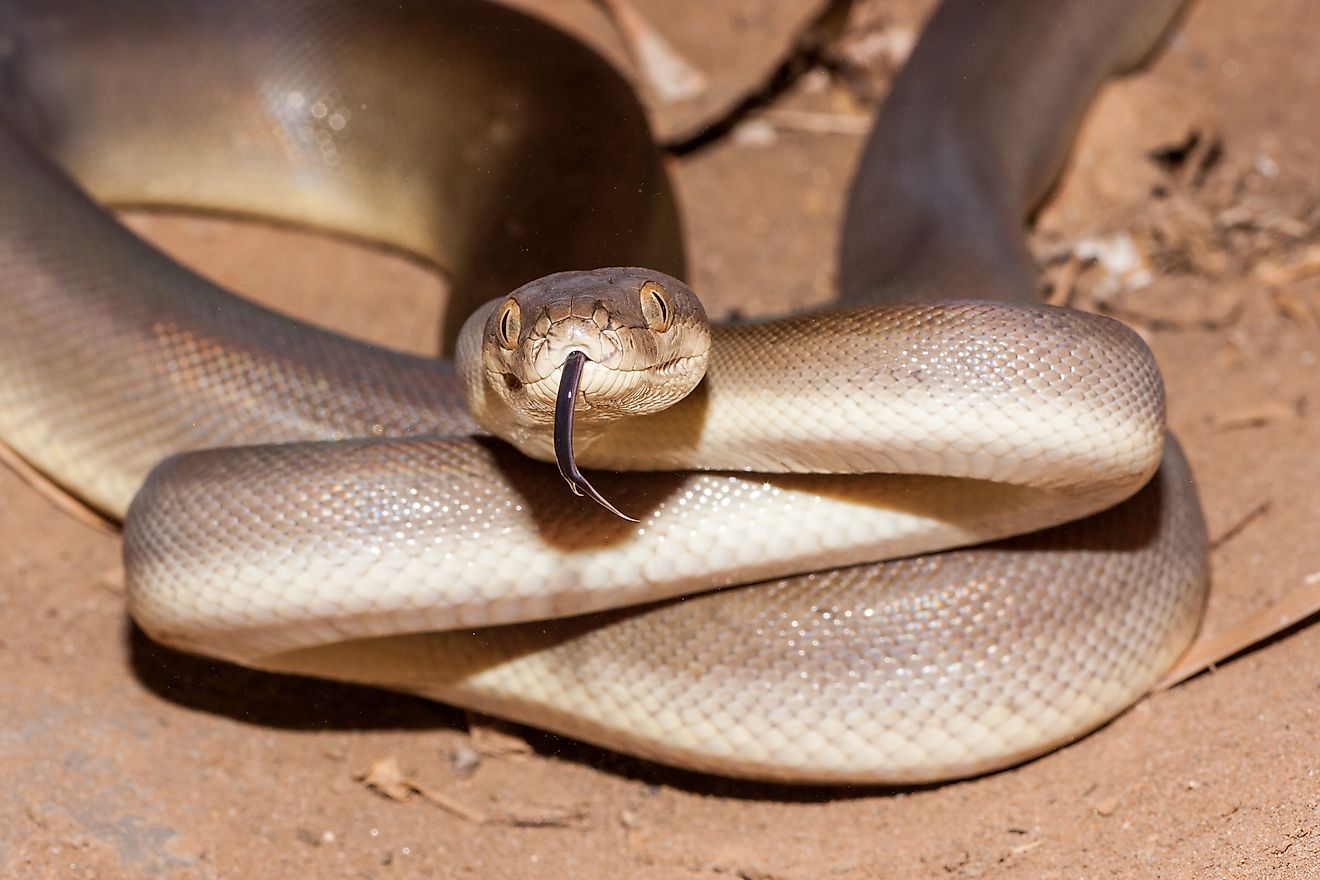
Coloration is pale, generally whitish to yellowish, overlaid with blotches that range across tan and dark brown. The exact shade tracks the habitat. Pythons from the humid hill forests of the Western Ghats and Assam tend to be darker, while those from the drier Deccan Plateau and Eastern Ghats are usually lighter. A pale, arrowhead-shaped mark sits on top of the head, and light centers inside the flank spots help separate this species from the Burmese python, which favors wetter ground and tends toward a darker overall tone.
Like all snakes, the Indian python swallows food whole. Its jaw bones are not fused at the front, so the mouth can open wider than the snake's own body to swallow prey. Backward-curving teeth grip the meal and prevent escape. These are not features built for show. They are the tools of an animal that eats infrequently but eats large.
Range and Habitat

The Indian python occupies most of the Indian subcontinent south of the Himalayas. Its range covers India, southern Nepal and Bhutan, southeastern Pakistan, Bangladesh, and Sri Lanka, and it probably extends into northern Myanmar. This is a native predator of the region, not a stray from somewhere else, and its distribution has contracted as human land use has expanded.
Habitat flexibility is one of the species' defining strengths. Indian pythons live in grasslands, swamps, marshes, rocky foothills, woodlands, open forest, and river valleys. The one consistent requirement is a reliable source of water. When resting or waiting out the heat of the day, the snake shelters in abandoned mammal burrows, hollow trees, dense stands of water reed, and mangrove thickets. It is an excellent swimmer and can stay fully submerged for several minutes, though it usually stays close to the bank.
Diet

The Indian python is a strict carnivore. It takes mammals, birds, reptiles, and amphibians, with a clear preference for mammals. Studies from Keoladeo National Park illustrate the breadth of its diet, with documented prey including deer, wild boar, jackals, dogs, jungle cats, civets, hares, porcupines, rodents, birds, snakes, monitor lizards, and other reptiles. Larger pythons take larger prey, which is why the species can matter economically as well as ecologically.
The hunting method is patient rather than fast. Roused by a passing animal, the python advances with a quivering tail and strikes with an open mouth. It throws one or two coils around the prey and tightens until the animal can no longer breathe. Death comes from circulatory arrest and suffocation, not crushing, a mechanism the python shares with the boa constrictor and other constrictors. The meal is then swallowed head first. After a large kill, an Indian python may not need to feed again for weeks, and the longest recorded fast for the species is roughly two years.
Behavior

For all its size, the Indian python is a calm and reclusive animal. It is slow moving and timid, and it rarely attacks even when handled or disturbed. This temperament sets it apart from the region's more famously defensive reptiles, such as the king cobra. When a python does move, it often travels in a straight line, advancing on the tips of its ribs and belly scales in a motion sometimes described as walking on its ribs, rather than throwing the sideways loops most people expect from a snake.
Indian pythons are largely solitary outside the breeding season. Activity patterns shift with the weather. In cooler months the snake is active in a single midday window, while in the warmer spring and summer it splits activity between late morning and late afternoon to avoid the harshest heat. After a heavy meal it becomes reluctant to move at all. If forced to flee while digesting, a python may disgorge its meal to lighten the load and escape, a costly but effective survival tactic.
Reproduction

Indian pythons are egg layers. A female can produce a large clutch, with counts of up to 100 eggs recorded, then coil around the pile to guard and incubate it. Remarkably, she does not simply rely on ambient warmth. She can raise her body temperature above the surrounding air through rapid muscular contractions, a form of shivering that generates metabolic heat and keeps the clutch warm. This behavior, documented in pythons since a landmark 1966 study, is unusual among snakes and represents a rare example of active brooding in a cold-blooded animal.
Hatchlings emerge at about 18 to 24 inches (45 to 60 cm) and are fully independent from the moment they leave the egg. Each breaks out using a temporary egg tooth that drops off soon afterward. Young pythons grow quickly under good conditions but face heavy predation early in life. In parts of India, conservationists have developed climate-controlled artificial incubation methods to rescue abandoned or unattended clutches and release the hatchlings, a small but meaningful boost to wild recruitment. Lifespan is often reported at 20 to 30 years, with longer lives recorded in captivity.
Importance to the World

The strongest case for protecting the Indian python is ecological. As a large, adaptable predator, it exerts steady pressure on populations of rodents and other small mammals, including agricultural pests. A single python removes a surprising amount of prey biomass over its long life, and in farming landscapes that service has direct economic value. Remove the python and rodent populations lose one of their most effective natural controls.
The species also sits within a broader food web as both predator and prey. Eggs and juveniles feed birds of prey, smaller carnivores, and other snakes, while adults help regulate the mid-sized mammals that would otherwise strip vegetation and raid crops. Culturally, the Indian python has a long presence in South Asian folklore and literature, most famously through Kaa in The Jungle Book. That cultural familiarity is an asset for conservation, because people tend to protect what they recognize and value.
Threats and Conservation

The Indian python is classified as Near Threatened on the IUCN Red List, based on a 2021 assessment that estimated a population decline of around 30 percent over the decade from 2010 to 2020. The trend is downward, and the causes are familiar. Habitat loss and degradation shrink the wetlands, forests, and grasslands the species needs. Over-exploitation compounds the pressure, as pythons are killed for their skin in the leather trade, collected for the pet trade, hunted for meat, and sometimes killed simply for preying on livestock such as chickens and goats.
Legal protection exists but is unevenly enforced. The Indian python is listed on Schedule I of India's Wildlife Protection Act of 1972, the country's highest level of protection, and on Appendix I of CITES, which bans commercial international trade. Despite these measures, poaching and smuggling continue across parts of the range. Effective conservation therefore depends less on new laws than on enforcing existing ones, protecting habitat, and reducing conflict where pythons and rural communities overlap. Artificial incubation and release programs, anti-poaching patrols, and protected areas such as national parks all contribute, but the decline will not reverse on its own.
Takeaway
The Indian python is a reminder that a snake does not need to break records to matter. It is a patient, adaptable, and largely harmless predator that has quietly regulated the small mammal populations of the Indian subcontinent for millennia, and it survives across an impressive spread of habitats, with a range reaching Pakistan in the west and Sri Lanka in the south. Its Near Threatened status is not yet a crisis, but the direction of travel is clear. Protecting habitat, enforcing the trade bans already on the books, and supporting local incubation and release efforts would keep this remarkable constrictor a working part of South Asia's ecosystems rather than a fading one.
Fun Facts

- Kaa was one of these. The python who mentors Mowgli in Rudyard Kipling's 1894 The Jungle Book is an Indian python, one of the species' most enduring cultural cameos.
- It can fast for up to two years. After a large enough meal, an Indian python can go without food for an extraordinarily long stretch, the longest recorded being roughly two years.
- Mothers shiver to keep eggs warm. A brooding female raises her body heat through muscular contractions, a rare form of warmth generation in a cold-blooded animal.
- Its genes reached Florida. A 2017 genetic study found that invasive Burmese pythons in the Florida Everglades carry hybrid ancestry from Python molurus, meaning the Indian python has left a genetic mark on one of the most notorious reptile invasions in the world.
- It walks on its ribs. Heavy Indian pythons often move in a straight line using rectilinear locomotion, inching forward on the tips of their belly scales rather than slithering side to side.
Quick Facts
- Scientific name: Python molurus
- Family and order: Pythonidae, Squamata
- IUCN status: Near Threatened (2021 assessment)
- Length: typically about 9 feet 10 inches (3 m); up to 15 feet 1 inch (4.6 m)
- Weight: up to about 114 pounds (52 kg)
- Lifespan: often reported at 20 to 30 years, longer in captivity
- Diet: carnivore (mammals, birds, reptiles, and amphibians)
- Range: Indian subcontinent (India, Pakistan, Nepal, Bhutan, Bangladesh, Sri Lanka)