Impala
The impala is one of Africa's most abundant and athletic antelopes, a medium-sized grazer and browser famous for explosive leaps that carry it three times its own height into the air. Found across the savannas of eastern and southern Africa, it thrives where grass, water, and light woodland meet. Its scientific name, Aepyceros melampus, comes from Ancient Greek and translates roughly to "black-footed high-horn," a nod to the dark tufts above its hind hooves and the long, ridged horns carried by males.
Few antelopes are so easily recognized or so central to the ecosystems they inhabit. The impala serves as a primary food source for nearly every large African predator, yet it remains numerous and stable across most of its range. That combination of vulnerability to hunters and resilience as a species has earned it a reputation as the workhorse of the savanna food web.
Taxonomic Classification

The impala belongs to the kingdom Animalia, the phylum Chordata, and the class Mammalia. Within the order Artiodactyla, the even-toed ungulates, it sits in the family Bovidae alongside cattle, buffalo, sheep, goats, and the many other antelopes. What sets it apart is its isolation on the family tree. The impala is the only living species in the genus Aepyceros and the only member of the tribe Aepycerotini, which means it has no close living relatives among the bovids.
German zoologist Hinrich Lichtenstein first described the animal for European science in 1812. Up to six subspecies have been proposed over the years, but genetic work based on mitochondrial DNA generally recognizes only two. The common impala (Aepyceros melampus melampus) ranges widely across eastern and southern Africa, while the black-faced impala (Aepyceros melampus petersi) occupies a small area of southwestern Africa and shows a distinct dark facial blaze. Though the two look broadly similar, the genetic distance between them is significant, and no natural hybrids have been recorded.
Physical Description

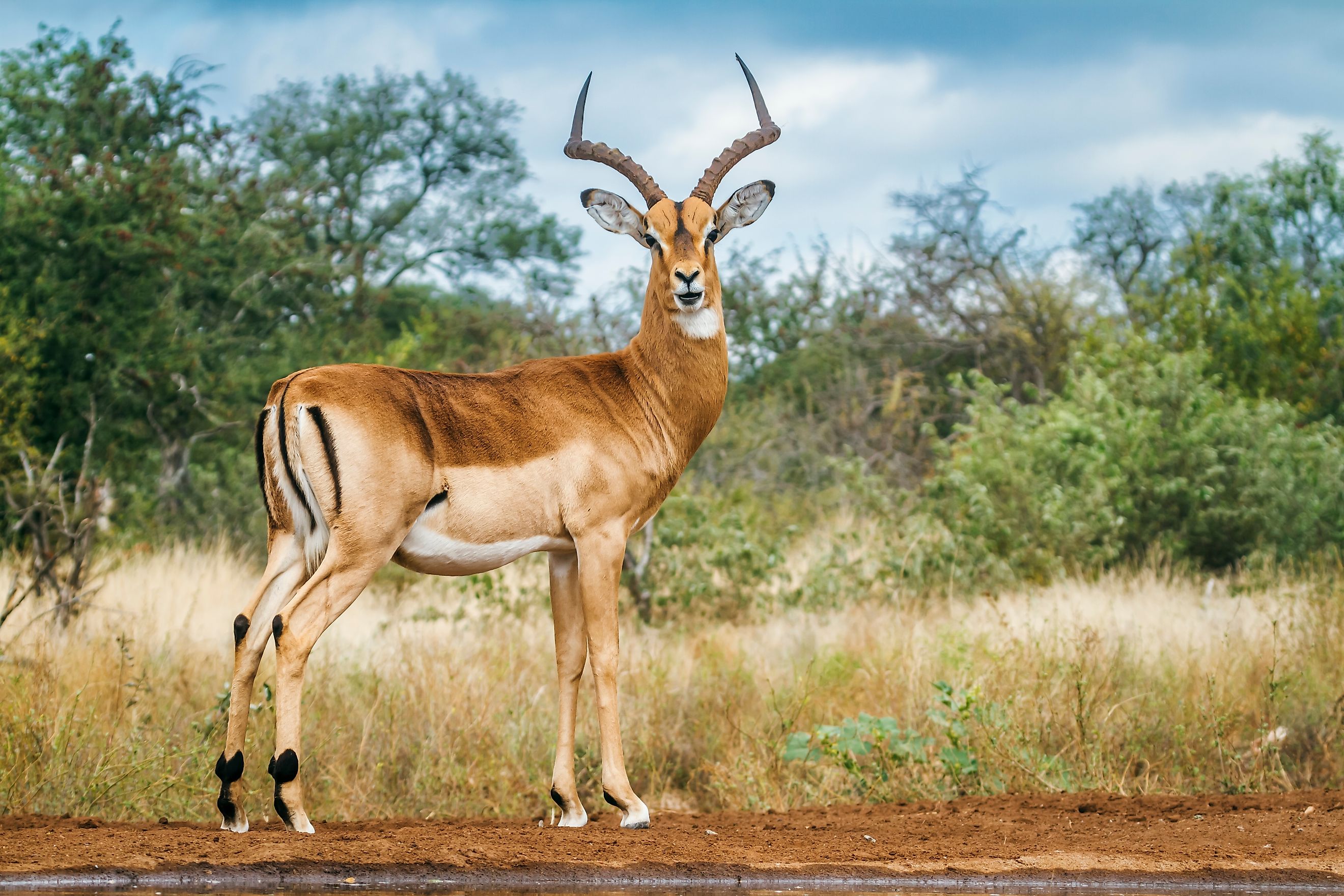
Impalas are slender, long-legged antelopes built for speed and agility. Males stand roughly 28 to 36 inches (70 to 92 cm) at the shoulder and weigh between 117 and 168 pounds (53 to 76 kg). Females are noticeably smaller, usually 88 to 117 pounds (40 to 53 kg). The coat is a glossy reddish-brown across the back that fades to a lighter tan along the flanks and gives way to a white belly, chin, and throat.
The species is strongly marked. A vertical black stripe runs down each thigh and along the tail, the ear tips are black, and a distinctive black "M" pattern crosses the rump and rear legs. Only males carry horns. These horns are lyre-shaped, sweep back in a graceful S-curve, and grow 18 to 36 inches (45 to 92 cm) long, ridged along most of their length. Impalas also possess scent glands. Tufts of black hair above the hind hooves conceal metatarsal glands, and males have sebaceous glands on the forehead used in marking and display.
Range and Habitat

Impalas occur across eastern and southern Africa, in countries that include Kenya, Tanzania, Uganda, Zambia, Zimbabwe, Botswana, Mozambique, Namibia, Angola, and South Africa. They favor the transition zones between open grassland and denser woodland, a habitat that offers grass to graze, shrubs to browse, and cover from predators. Light savanna and acacia woodland suit them well.
Water is the one thing an impala cannot do without for long. The species is water-dependent and rarely strays more than about 5 miles (8 km) from a permanent source, drinking at least once a day where it can. This reliance on water keeps herds tied to river systems and waterholes, especially during the dry season. In parts of its former range, such as areas of Uganda, the impala has become locally extinct, though it remains widespread overall.
Diet

The impala is a mixed feeder, and this flexibility is one of the keys to its success. During the wet season, when grasses are green and plentiful, it grazes like a dedicated grass eater. As the dry season sets in and grass withers, it switches to browsing, taking leaves, shoots, seedpods, and fruits from shrubs and trees. Acacia pods are a favored dry-season food. This ability to shift between grazing and browsing lets the impala exploit habitats that would starve a more specialized antelope.
As a ruminant, the impala processes tough plant matter through a multi-chambered stomach, chewing the cud to draw nutrients from fibrous vegetation. Its dependence on daily drinking shapes its feeding routine, and herds organize their movement around access to both forage and water.
Behavior

Impalas are active mainly during the day, alternating bouts of feeding with periods of rest and rumination. They are highly social and gather in herds that can number up to 100 animals, and they often mix with other grazers such as zebra, wildebeest, and kudu, gaining extra safety from many watchful eyes.
Social organization shifts with the seasons. Populations sort into breeding herds of females and young, bachelor herds of non-territorial males, and territorial males that hold and defend patches of ground. A territorial male marks his range and drives off rivals with roaring calls, erect posture, and outright fighting.
The impala's most celebrated behavior is its leap. When alarmed, an impala can spring as high as 10 feet (3 m) and cover up to 33 feet (10 m) in a single bound, clearing bushes and other obstacles rather than running around them. A startled herd will scatter in a burst of leaping bodies, a tactic that confuses pursuing predators. Impalas also leap when no threat is present, apparently for no reason beyond exercise or play. When fleeing at speed, they can run at around 50 miles per hour (80 km/h). A well-known partnership rounds out their behavior. Oxpecker birds ride on impalas and feed on ticks and other parasites, cleaning areas the antelope cannot reach itself.
Reproduction

Impalas have a polygynous mating system in which dominant males compete to control access to females. The breeding season, or rut, peaks toward the end of the dry season, often around May and June in southern Africa. During this period, rams roar, chase, and clash horns to establish and hold territory, expending so much energy that they neglect feeding.
After a gestation of roughly 194 to 200 days (about six and a half months), a female gives birth to a single calf weighing around 11 pounds (5 kg). Expectant mothers isolate themselves from the herd to give birth, and a female can even delay delivery by a short period if conditions are harsh. Calves are weaned at four to six months and gather in nursery groups. Females reach sexual maturity at around one to two years, while males can breed as yearlings but rarely secure a territory before about four years of age. In the wild, impalas typically live up to 12 to 15 years.
Importance to the World

Few animals feed the African savanna as directly as the impala. Its abundance makes it a cornerstone prey species for lions, leopards, cheetahs, hyenas, wild dogs, crocodiles, and pythons. So many predators depend on it that guides sometimes call it the "McDonald's of the bush," a nickname that plays on both its role as fast food for carnivores and the "M" marking on its rear.
Beyond feeding predators, impalas shape the vegetation around them. By grazing grass and browsing shrubs, they influence plant growth and help disperse seeds across the landscape. Economically, the species supports wildlife tourism and photographic safaris, and it is a mainstay of game farming and regulated hunting across southern Africa, providing income to reserves, conservancies, and local communities.
Threats and Conservation

The common impala is in a strong position. The International Union for Conservation of Nature lists the species as Least Concern, with a stable population estimated at around 2,000,000 mature individuals. Its future looks secure as long as large, well-managed populations persist in protected areas, private reserves, and conservancies.
The picture is different for the black-faced impala. This subspecies is classified as Vulnerable, with fewer than 1,000 individuals recorded in the wild as of 2008, and it faces pressure from habitat loss and the risk of hybridization with introduced common impalas. Conservation efforts focus on protecting its limited range and managing translocations carefully so that founder populations stay healthy and genetically distinct.
Takeaway
The impala endures because it is a generalist in a landscape that rewards flexibility. It grazes and browses, forms large protective herds, and escapes danger with leaps that few predators can follow. That adaptability keeps it common even as it feeds nearly every hunter on the plains. For most of Africa the impala's outlook is bright, and the main conservation concern rests with the rarer black-faced subspecies, whose survival depends on careful stewardship of its small corner of the continent.
Fun Facts

- A genus of one. The impala is the sole living species in the genus Aepyceros and the only member of its tribe, so it has no close relatives among the antelopes.
- Built-in trampoline. An impala can leap roughly three times its own height, clearing 10 feet (3 m) vertically and up to 33 feet (10 m) horizontally in a single bound.
- Leaping for fun. Impalas sometimes bound and spring into the air with no predator anywhere in sight, apparently just for the movement.
- The McDonald's of the bush. The black "M" on the impala's rump, combined with its role as go-to prey for big cats, earned it this savanna nickname.
- Tick cleaners on board. Oxpecker birds perch on impalas and eat the ticks and parasites the antelope cannot reach on its own.
- Delayed delivery. A pregnant female can postpone giving birth for a short time if drought or other harsh conditions make it risky.
Quick Facts
- Scientific name: Aepyceros melampus
- Family: Bovidae (order Artiodactyla)
- IUCN status: Least Concern (black-faced subspecies Vulnerable)
- Shoulder height: 28 to 36 inches (70 to 92 cm)
- Weight: 88 to 168 pounds (40 to 76 kg)
- Horn length (males only): 18 to 36 inches (45 to 92 cm)
- Lifespan: up to 12 to 15 years in the wild
- Diet: mixed feeder, both grazer and browser
- Gestation: about 194 to 200 days
- Range: eastern and southern Africa