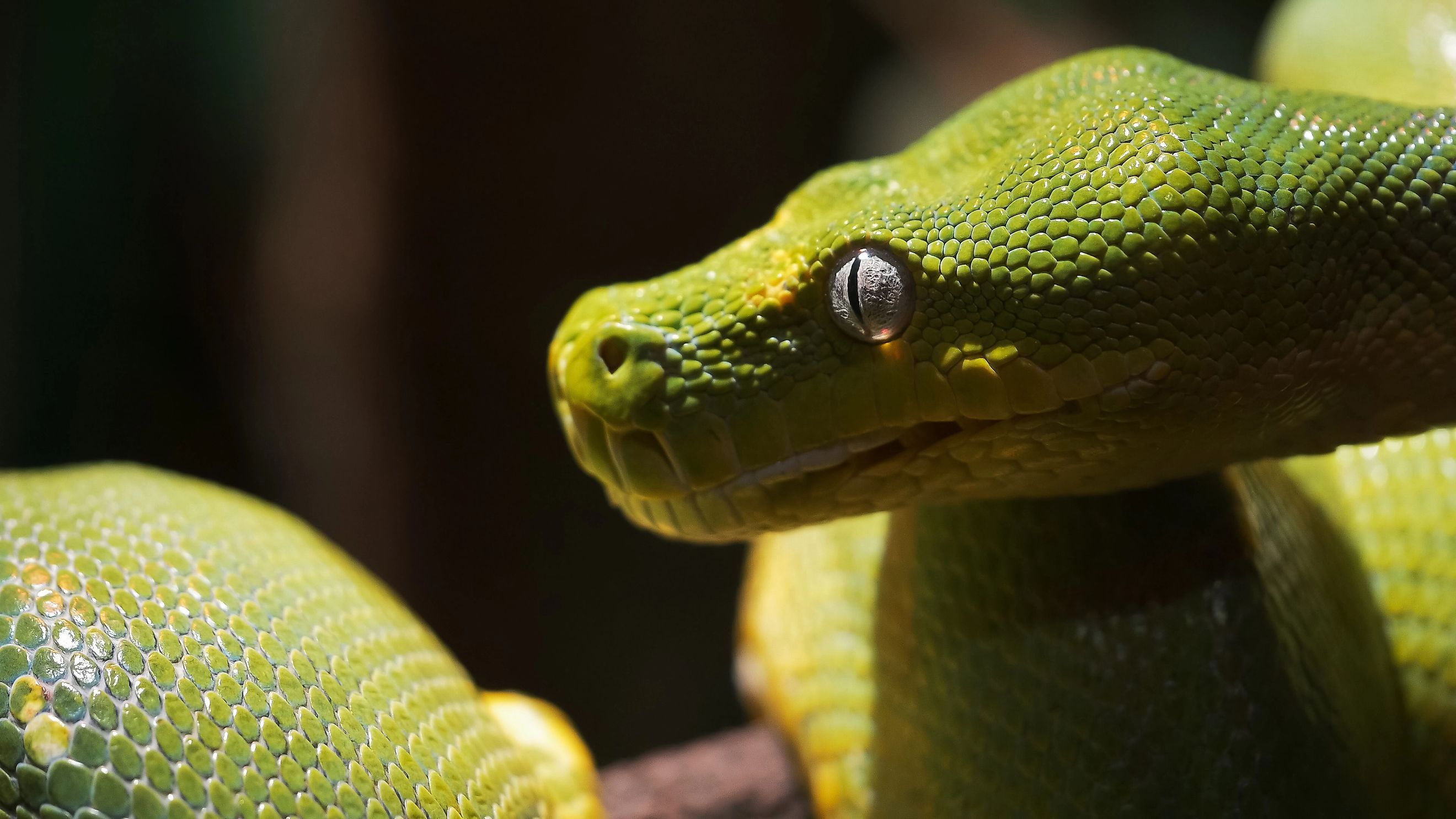
Green Tree Python
Coiled in a tidy loop over a horizontal branch, head resting in the center like the clasp on a necklace, the green tree python is one of the most recognizable serpents on the planet. That posture is not just for the camera. It is a hunting platform, a resting pose, and a piece of evolutionary engineering that this python shares, remarkably, with a distant relative on the other side of the world.
The green tree python (Morelia viridis) is a nonvenomous, tree-dwelling constrictor native to the rainforests of New Guinea, several Indonesian islands, and the far northern tip of Australia. It is among the most arboreal of all pythons, spending nearly its entire life in the branches. What makes it worth a closer look is not only the color. It is the way almost every feature of this animal, from its curved teeth to its shifting childhood hues, is tuned for a life lived above the forest floor.
For all its fame in photographs and private collections, the green tree python is also a species under quiet pressure, prized enough by the pet trade that wild populations have paid a real price.
Taxonomic Classification

The green tree python belongs to the family Pythonidae, the group of nonvenomous constrictors that includes some of the largest snakes on Earth. Its scientific name is Morelia viridis, with viridis meaning "green" in Latin. German naturalist Hermann Schlegel first described the species in 1872, originally as Python viridis. For much of the twentieth century it carried the name Chondropython viridis, and it was only reassigned to the genus Morelia, alongside the carpet pythons, in the 1990s.
The classification is still moving. A detailed genetic study published in 2019 concluded that what was long treated as a single species is better understood as two, separated by the central mountain range that runs the length of New Guinea. Under that revision, populations north of the divide are assigned to Morelia azurea, the northern green python, while those to the south keep the name Morelia viridis. Most references and the IUCN Red List still catalog the whole complex under M. viridis, so readers will encounter both names in current sources. The disagreement is a useful reminder that even a well-studied, widely kept animal can hold taxonomic surprises.
Physical Description

An adult green tree python is remarkably well adapted to life in the canopy. Most individuals reach a total length of around 4 to 6 feet (1.2 to 1.8 m), with the largest approaching 7 feet (2.1 m), and weigh in the region of 3.5 pounds (1.6 kg). Females run slightly longer and heavier than males. The body is compact and muscular rather than long and thin, built to bridge gaps between branches and to hold a coil for hours without tiring.
The adult color is a saturated green, frequently marked by a line of white or pale yellow scales down the spine and scattered flecks of blue or white along the flanks. This palette dissolves the snake into sunlit foliage. Juveniles, however, hatch in a strikingly different palette of bright lemon-yellow or brick-red, marked with white and darker patterns. Somewhere between six months and about a year of age, they undergo a dramatic shift to adult green, a process called ontogenetic color change that does not line up with skin shedding or with the onset of sexual maturity.
The head is large and blunt, with a slim neck and deep labial pits that act as heat-sensing organs, allowing the snake to detect the body warmth of nearby prey even in darkness. Inside the mouth sit more than 100 long, backward-curving teeth, the front pairs noticeably enlarged and ideal for seizing and holding a struggling animal. The tail is strongly prehensile and serves as both an anchor and a lure.
Range and Habitat

The green tree python is a creature of lowland and hill tropical rainforest. Its core range is the island of New Guinea, divided between Indonesia's Papua provinces and the nation of Papua New Guinea, along with a scatter of surrounding Indonesian islands such as Misool, Salawati, Biak, and the Aru group. At the southern edge of its distribution, a population reaches into Australia across the Torres Strait, occupying the rainforests of the Cape York Peninsula in far northern Queensland.
Across this range the snake is tied closely to forest with a dense, continuous canopy. Adults favor the higher branches and the interior of the forest, while younger snakes tend to occupy lower, more open vegetation at forest edges and in regrowth, a difference that tracks their change in color and diet. The species tolerates some disturbed and secondary forest, but it depends fundamentally on trees. Where the canopy is cleared, the green tree python has nowhere to live.
Diet

The green tree python is a patient ambush hunter that lets its meals come to it. Rather than actively searching for prey, it adopts a hunting posture, anchoring its body to a branch with its prehensile tail while drawing its forebody into an S-shape and positioning its head toward the open space below, ready to strike at passing prey.
As they grow, green tree pythons gradually change both their habits and their prey, with juveniles, active largely by day, taking small reptiles such as skinks and geckos in the lower vegetation. Adults, which hunt mostly at night, move on to small mammals, especially rodents, and will occasionally take other prey. Young pythons, in particular, use caudal luring to bring curious prey within striking distance. They hold their bodies motionless while wriggling their brightly tipped tails like small worms or grubs, tempting prey to come close enough to seize. Once contact is made, the snake constricts, using its recurved teeth to keep hold while it suffocates the prey and then swallows it whole. Because ambush hunting yields meals irregularly, the green tree python has an efficient metabolism and can go long stretches between feedings.
Behavior

For an animal so often photographed, the green tree python is built around stillness. It is intensely arboreal, arguably the most tree-bound of all pythons, and can spend days coiled in the same spot. The signature resting posture, a tidy series of loops slung over a branch with the head resting in the middle, is both energy-saving and camouflaging.
Activity follows a clear daily rhythm that flips with age. Juveniles are largely diurnal, matching the habits of their small daytime prey, while adults become nocturnal hunters. These snakes are solitary outside of breeding and keep to small home ranges, though males may travel farther when searching for mates. They are not aggressive by nature, relying on concealment rather than confrontation, but a cornered individual will pull into a tight S and strike hard and repeatedly. Those long teeth make a defensive bite from a large adult a memorable event, even though the snake carries no venom.
Reproduction

Much of what is known about green tree python reproduction comes from captivity, because mating and egg-laying have rarely been observed directly in the wild. The field evidence that does exist suggests egg-laying is timed so that hatchlings emerge around the start of the wet season, when small prey becomes abundant.
The green tree python is oviparous, meaning it lays eggs. A clutch commonly numbers between about 6 and 30 eggs, with many falling near a dozen or two. The female deposits them in a sheltered site such as a tree hollow or a mass of epiphytic plants, then coils tightly around the clutch. Like other pythons, she incubates the eggs with her own body, twitching and shivering her muscles to generate warmth and hold the temperature near the low to mid 80s Fahrenheit (around 29 to 31 degrees C). She does not feed during this period, which runs roughly 45 to 55 days. Once the young hatch, parental care ends. Males reach maturity at around 2 to 2.5 years and females at around 3, and although wild lifespans are poorly documented, individuals are thought to live 15 years or more, with captive animals reaching about 20.
Importance to the World

As both predator and prey, the green tree python is a working part of its rainforest. By feeding on rodents and other small vertebrates, it helps regulate the populations of animals that would otherwise multiply unchecked, a service that carries real value across tropical forests. In turn, its eggs and young feed birds of prey, larger reptiles, and mammals, linking the canopy food web to the forest floor.
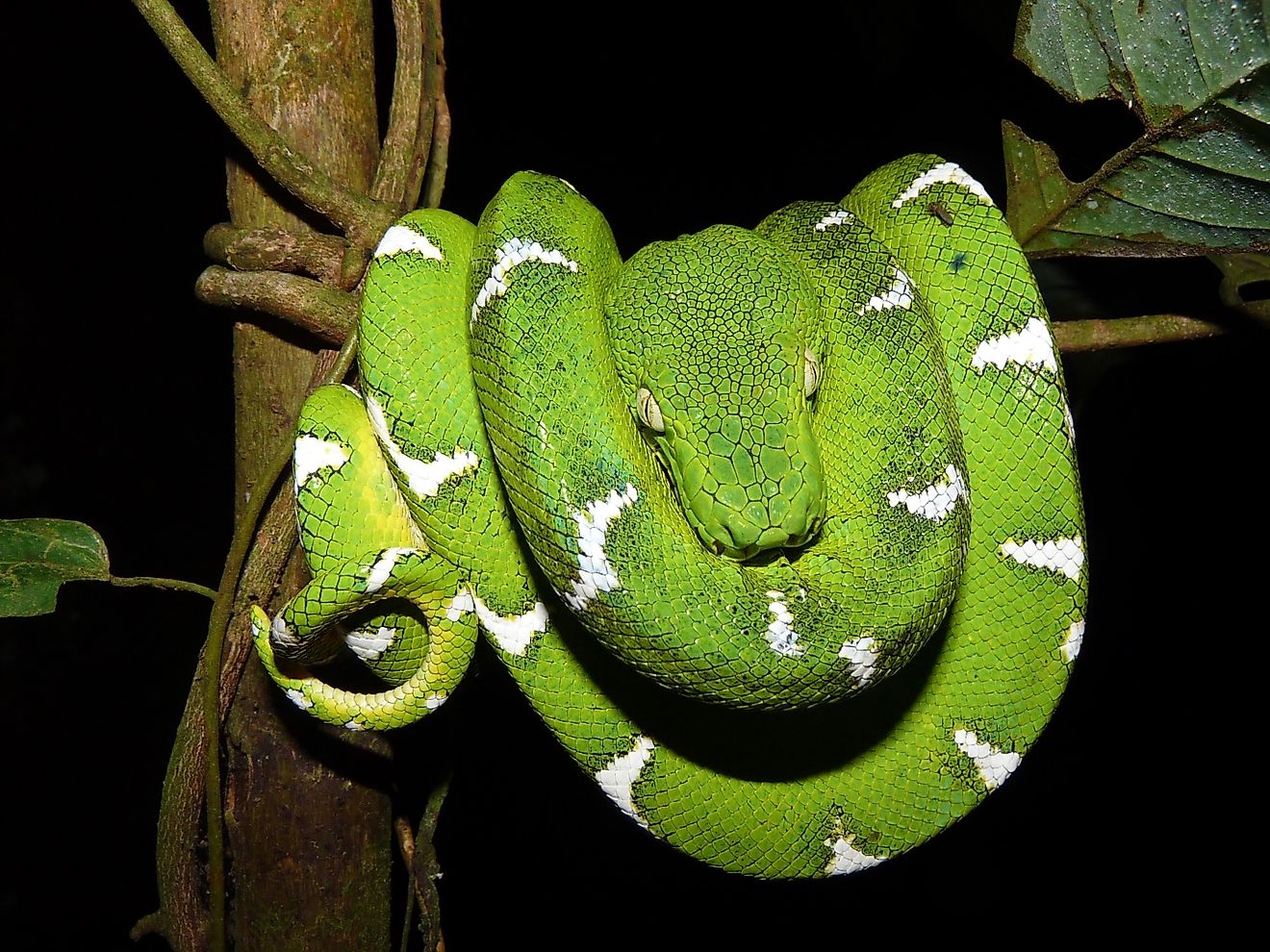
The species is also scientifically significant because it provides a clear example of convergent evolution. On the other side of the world, in the Amazon Basin, the unrelated emerald tree boa (Corallus batesii) has arrived at nearly the same green adult color, the same looped resting posture, and the same red or yellow juvenile stage. Two lineages, separated by oceans and tens of millions of years, solved the problem of arboreal ambush hunting in strikingly similar ways. For scientists, the green tree python is a live demonstration of how evolution can repeat itself.
Threats and Conservation

The species is common enough and spread across enough territory that the IUCN lists it as Least Concern, but that label rests on the animal's wide distribution rather than on any hard population survey. The absence of real numbers is itself part of the risk.
The two clearest threats are collection and habitat loss. The snake's beauty has made it a prize in the international pet trade, and for years, large numbers of wild-caught animals were smuggled out of Indonesia, often laundered through operations that claimed to be captive-breeding facilities. That drain fell on wild populations no one had ever counted. Habitat loss compounds the problem. Logging and slash-and-burn agriculture continue to clear rainforest across parts of New Guinea, removing the canopy that the species depends on for survival. International trade is now regulated under CITES Appendix II, and in Australia, it is illegal to collect green tree pythons or to import stock that originated in New Guinea. Captive breeding has also matured to the point that responsible keepers can obtain healthy, legal animals without touching the wild population. Choosing those animals is the single most direct way an enthusiast can help.
Takeaway
A few things set the green tree python apart if you want to know it at a glance. Color is not a reliable indicator of age or species. A yellow or red snake may simply be a juvenile that has not yet turned green, while the nearly identical emerald tree boa of South America is a separate species that can be distinguished by its range and scale arrangement. Nearly everything else about the python points back to the canopy, from the prehensile tail and heat-sensing lip pits to the tight resting coil it can hold for days. It stays green year-round, tops out around 6 feet (1.8 m), and lives 15 to 20 years. Widespread and currently listed as Least Concern, it is one of the more secure tree snakes in its range, and one of the easier ones to recognize once you know what you are looking at.
Fun Facts

- Its tail is a fishing lure. Young green tree pythons wave the brightly colored tip of the tail to imitate a wriggling grub, drawing curious lizards and frogs within striking distance.
- Babies and adults look like different species. Hatchlings are yellow or red and only turn green months later, a change unrelated to shedding the skin.
- It has a body double in the Amazon. The South American emerald tree boa evolved almost the same appearance and habits despite no close kinship.
- Mothers run a fever on purpose. A brooding female shivers her muscles to warm the eggs, keeping the clutch several degrees above the surrounding air.
- The teeth are outsized for the snake. An adult carries more than 100 backward-curving teeth, the longest reaching around three quarters of an inch (about 2 cm).
Quick Facts
- Scientific name: Morelia viridis (northern populations increasingly treated as Morelia azurea)
- Family / Order: Pythonidae / Squamata
- IUCN status: Least Concern; CITES Appendix II
- Length: About 4 to 6 feet (1.2 to 1.8 m); up to roughly 7 feet (2.1 m)
- Weight: Around 3.5 pounds (1.6 kg); females larger than males
- Lifespan: 15-plus years in the wild; about 20 years in captivity
- Diet: Carnivore. Lizards as juveniles, small mammals as adults
- Range: New Guinea, nearby Indonesian islands, and the Cape York Peninsula of Australia