The Most Populous Mammals in the World
Ask which mammal is the most common on Earth, and the honest answer is a little deflating: it is us, and then it is the animals we raise to eat, milk, ride, and keep us company. Of the world's roughly 6,000 mammal species, the ones with runaway populations are almost all domestic, and wild mammals together make up only a few percent of all mammal biomass.
Counting them is the catch. One famous group belongs near the top but cannot be ranked honestly, so it gets its own note below rather than a number. Everything else here can be counted, and these are the ten most populous mammals on Earth.
The 10 Most Populous Mammals on Earth
- Humans - 8.2 Billion
- Cattle - 1.5 Billion
- Sheep - 1.3 Billion
- Goats - 1.1 Billion
- Domestic Pigs - 960 Million
- Domestic Dogs - 900 Million
- Domestic Cats - 600 Million
- Water Buffalo - 208 Million
- Horses - 60 Million
- Donkeys - 50 Million
1. Humans - 8.2 Billion

No contest: Homo sapiens tops every list, with the global population passing 8.2 billion in 2025 and still climbing by roughly 70 million a year. The milestone most people remember, 8 billion, was crossed back in 2022. India is now the most populous country, home to about 1.45 billion people after overtaking China (around 1.41 billion) in 2023, and the two remain the only nations above a billion. The next tier runs well behind: the United States at about 340 million, Indonesia near 285 million, and Pakistan above 250 million. Where humans go, our livestock and pets follow, which is exactly why the rest of this list looks the way it does.
*Rats and Mice

If any wild mammals belong in this company, it is the rats and house mice (Rattus norvegicus and Mus musculus) that live wherever people do. They sit outside the numbered ranking on purpose, because no one can honestly count them. You have likely heard there is one rat for every person, or some 8 billion worldwide, but that claim traces to a single 1909 estimate in England and has no rigorous basis; modern urban studies suggest the real ratio is far lower in most places.
The honest truth is that these commensal rodents almost certainly number in the billions, which could place them near the top of this list, yet their populations have never been measured within an order of magnitude. Rather than invent a figure, we leave them here, just below our clear number one, as the great uncounted mammals of the world.
2. Cattle - 1.5 Billion

Once you set humans aside, cattle (Bos taurus and the humped Bos indicus) are the planet's most numerous large mammal, with the FAO putting the global herd near 1.5 billion head. India holds the largest inventory, followed by Brazil and China, and the total keeps creeping up alongside demand for beef and dairy. Roughly a quarter of the world's cattle are dairy cows; the rest are raised for beef, leather, and, in much of the world, draft power and even religious significance. For all the talk of plant-based diets, the cattle count has risen, not fallen, over the past decade.
3. Sheep - 1.3 Billion

Sheep (Ovis aries) number about 1.3 billion worldwide, raised for wool, meat, and milk across nearly every climate humans occupy. China keeps the largest flock, with India, Australia, and parts of Africa and the Middle East close behind. New Zealand still posts one of the highest sheep-to-person ratios on Earth, though it has slipped from roughly twenty sheep per person decades ago to about five today as farms shift toward dairy. Hardy, efficient grazers, sheep thrive on marginal land that would defeat cattle, part of why they remain so widespread.
4. Goats - 1.1 Billion

With about 1.1 billion head, goats (Capra hircus) edge out pigs for fourth, and their numbers have more than doubled over the past forty years. They are the small farmer's mammal: cheap to keep, able to browse rough terrain, and generous with milk, meat, and fiber, which is why the vast majority live in developing countries across Asia and Africa. China again leads with well over 100 million, and the global herd keeps growing faster than almost any other livestock species. A goat can turn scrubland into cheese, which goes a long way toward explaining its success.
5. Domestic Pigs - 960 Million

The world keeps close to 960 million domestic pigs (Sus domesticus), a figure that swings year to year as outbreaks like African swine fever ripple through herds. China alone accounts for roughly 400 to 450 million of them, close to half the global total, with the United States, the European Union, and Brazil among the other big producers. Pork is the most widely eaten meat in much of the world, and pigs are prized for converting feed to meat efficiently. Their numbers dipped hard during recent swine-fever years, then rebounded, a reminder of how tightly livestock counts track human appetite.
6. Domestic Dogs - 900 Million

Estimates for domestic dogs (Canis familiaris) cluster around 900 million and may reach a billion, though the figure is slippery because so many of the world's dogs are free-roaming rather than household pets. In wealthy countries most dogs live indoors; across much of Asia, Africa, and Latin America, village and street dogs make up the bulk of the population. The United States keeps the most pet dogs, on the order of 80 to 90 million, with Brazil and China next. However you count them, the dog's long partnership with humans, as guard, herder, hunter, and companion, has made it one of the most successful mammals alive.
7. Domestic Cats - 600 Million

Domestic cats (Felis catus) are usually pegged at around 600 million worldwide, counting pets and the enormous population of strays and free-roaming cats that shadows human settlement. The true number is genuinely uncertain, since unowned cats are even harder to tally than dogs. Asia holds the largest share, with sizable populations in North America and Europe as well. Beloved as they are, free-roaming cats are also formidable predators, and their sheer numbers put serious pressure on small wildlife, one reason conservationists push to keep pet cats indoors.
8. Water Buffalo - 208 Million

The first animal here that most Westerners rarely think about, the domestic water buffalo (Bubalus bubalis) numbers roughly 208 million, and more than 95% of them live in Asia. India keeps over half the world's total, followed by Pakistan and China. These powerful bovids are the backbone of smallholder farming across South and Southeast Asia, plowing rice paddies and supplying milk; it is the water buffalo, not the cow, that gives the milk behind traditional mozzarella and much of India's dairy. The wild ancestor, by contrast, is critically endangered, with only a few thousand left.
9. Horses - 60 Million

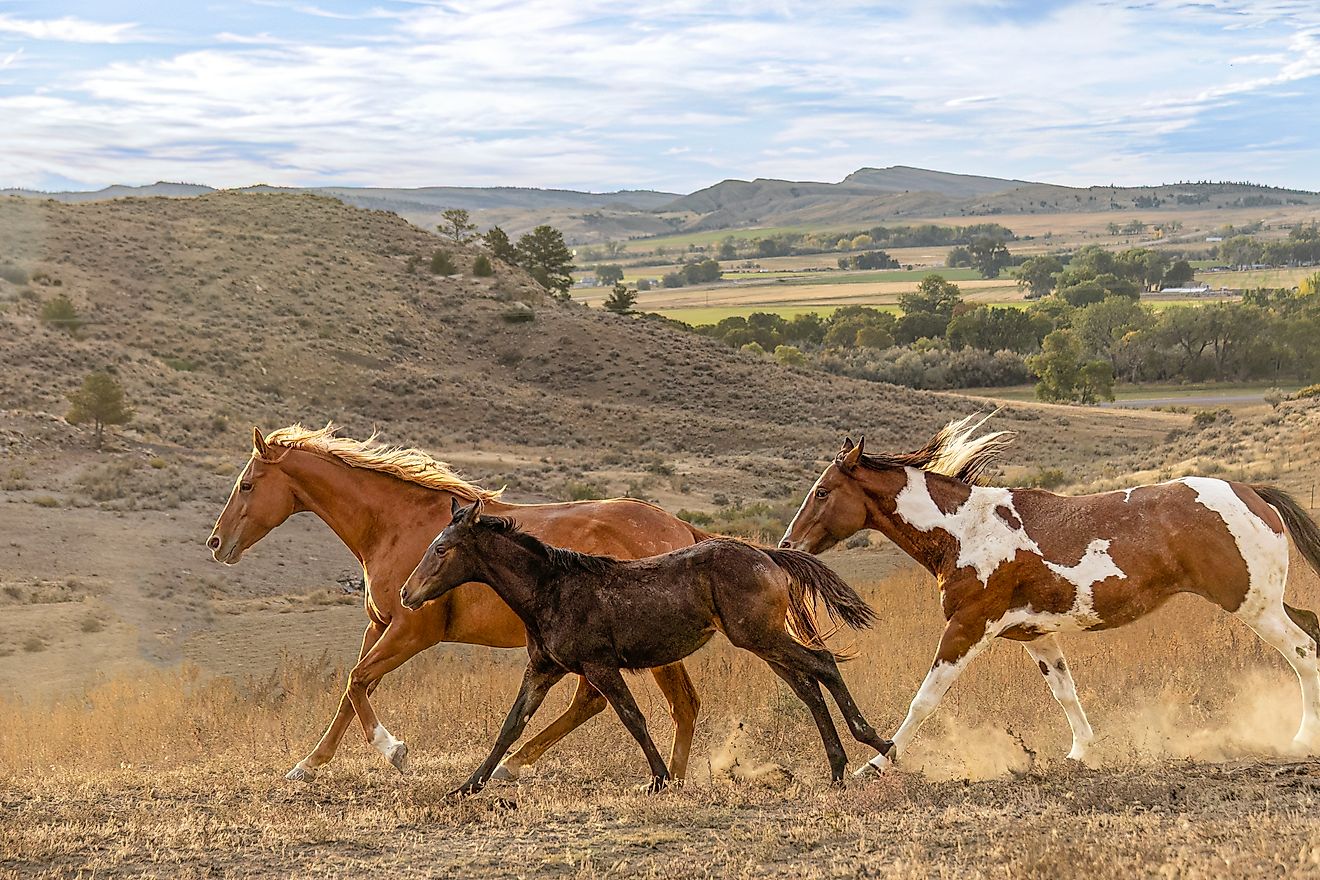
Despite their outsized place in human history, horses (Equus caballus) number only about 60 million today, a fraction of the livestock above them, after tractors and cars replaced most of their working roles over the last century. The largest populations are in the Americas and Central Asia, where horses remain central to ranching and herding cultures. Beyond the farm and the racetrack, free-roaming herds persist, including the mustangs of the American West and the brumbies of Australia, both descendants of domestic horses gone wild. For an animal that once powered entire economies, 60 million is a quiet modern footprint.
10. Donkeys - 50 Million

Rounding out the countable ten, donkeys (Equus asinus) number more than 50 million and, unlike horses, their population is still growing. They remain essential working animals across Africa, Asia, and Latin America, hauling water, goods, and people where roads and machines do not reach. Africa holds a large share of the world's donkeys, and demand has actually surged in recent years, driven partly by a global trade in donkey hides. Humble and tough, the donkey proves that a mammal does not need to be glamorous to rank among the planet's most numerous; it just needs to be useful to us.
A Planet Shaped by Appetite
The pattern is impossible to miss: every mammal on this list except, arguably, the uncountable rodents owes its abundance to people. We are the most populous mammal, and the next nine are the ones we breed, feed, and keep. Wild mammals, elephants and field mice alike, barely register against the weight of our herds. It is a striking measure of how thoroughly a single species has reshaped life on Earth, and a reason the growing interest in plant-based diets and wildlife recovery reaches well beyond the dinner table.