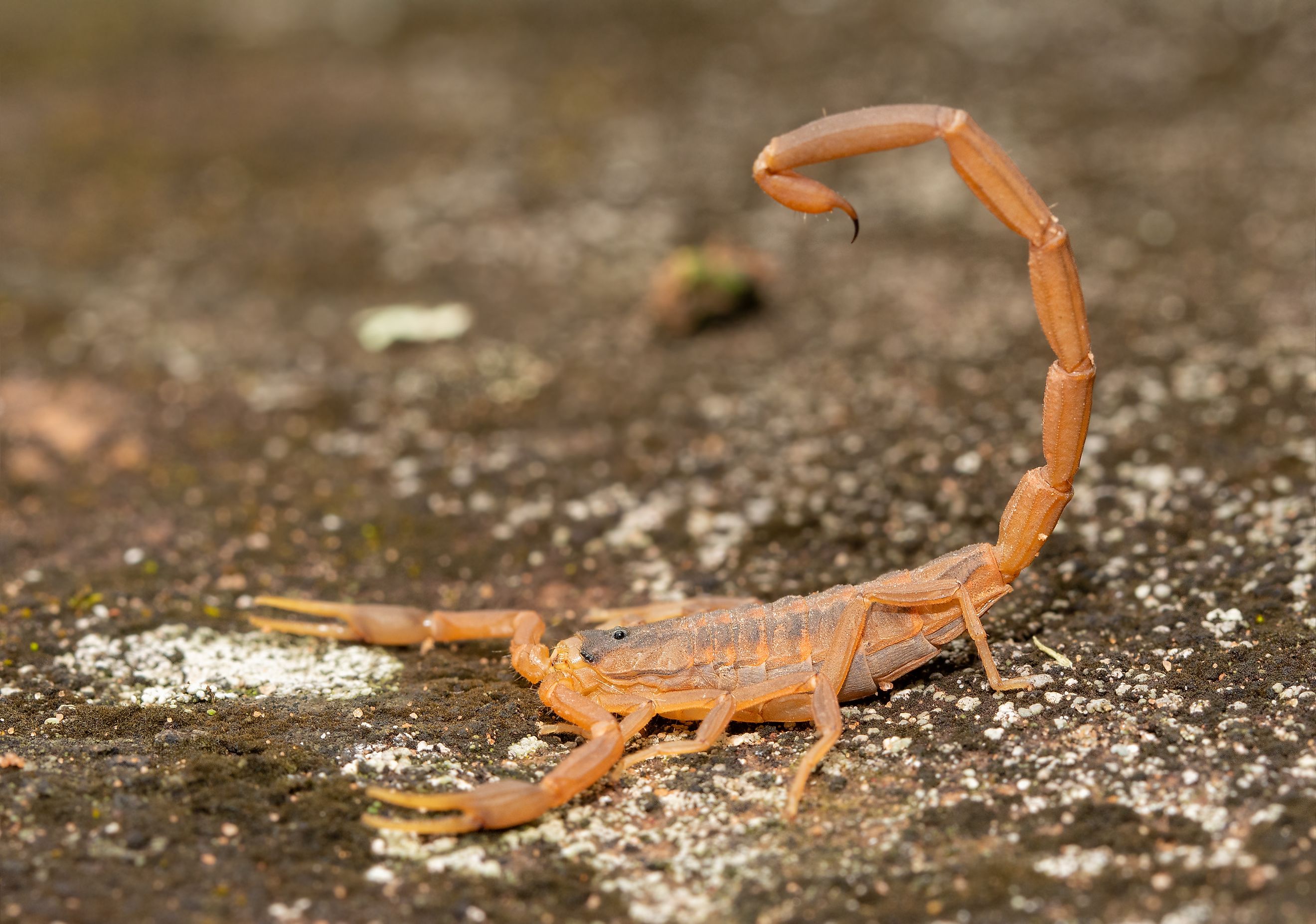
Why Scorpions Stop At The Kansas Line
According to a 2025 article in Nebraskaland magazine, most Nebraskans don't realize their state has scorpions. Many people on the northern plains think all scorpions live south of the Kansas line, among the limestone ledges and red sandstone buttes of Kansas and Oklahoma. However, specimen records show a different story, though only by a few counties. Biologists first found the striped bark scorpion in Thayer County, Nebraska, in the 1940s. In 2023, a research team from the University of Nebraska at Kearney started studying a population in the upland mixed-grass prairie of Franklin County. Both counties are on the Kansas border. Farther west, another species, the northern scorpion, lives as far north as about 52 degrees in Alberta. The idea that scorpions stop at the Kansas line is true for just one species, and even then, only roughly. The real reasons have to do with winter temperatures and the shape of the land, not with anything marked on a map.
A Line Drawn for Land Claims

Congress established the Kansas and Nebraska territories with the Kansas-Nebraska Act on May 30, 1854. Settlers had to wait for surveyors to measure the land before they could claim a parcel. In November 1854, Captain Thomas J. Lee of the Army Topographical Engineers marked the 40th parallel on the Missouri River. On May 8, 1855, Deputy Surveyor Charles A. Manners placed a cast-iron monument on the river bluff to mark the start of the base line, which became the boundary between the two territories. Manners and his team extended this line 108 miles west during 1855 and 1856, setting the Initial Point of the Sixth Principal Meridian near what is now Mahaska in Washington County, Kansas. Every township and range in Kansas and Nebraska still traces back to this point. Over time, the cast-iron monument was not well cared for. It was knocked out of place, then incorrectly reset by a crew in 1924. Later, a surveyor had to rely on the original witness stones to find its true location. As a result, the marker for the line was moved before anyone even noticed a scorpion crossing it.
Manners followed a line of latitude as his instructions required, and there is no sign he ever thought about arachnids. On the Great Plains, though, latitude often matches up with how long and harsh the winters are. Sometimes, a legal border and a natural boundary end up close together by chance, and that is almost the case here. The Initial Point sits on the state line, not far from Thayer County, where Nebraska's first scorpions were recorded nearly a century later.
The animal on that border carries a name older than the border itself. Thomas Say, the Philadelphia naturalist who served as zoologist on the Army's 1819 to 1820 expedition toward the Rocky Mountains, published the species in 1821, and it now goes by Centruroides vittatus, the striped bark scorpion, for the two dark bands that run down its back. Like every arachnid, it walks on eight legs, and like most of its genus it hides by day and hunts at night. Say also described the coyote and the swift fox from the same western travels, so the scorpion entered the scientific literature in larger and hairier company.
What Actually Limits the Striped Bark Scorpion

The arachnologists R. M. Shelley and W. D. Sissom compiled locality records for the species in the Journal of Arachnology in 1995 and traced its natural range between northern Mexico and Thayer County, with the Rio Grande and the Sangre de Cristo Mountains marking the western edge and the Missouri and Mississippi Rivers marking most of the eastern one. The scorpion does turn up just across those rivers in Holt County, Missouri, and in two Illinois counties, and Shelley and Sissom credited rafting or natural shifts in the river channels for those outposts. Records far east of the Mississippi cluster in cities, which says more about human shipping than about the scorpion's own movements.
Two conditions set the northern limit, a long, cold winter and a shortage of safe places to spend it. Donald Whitmore and colleagues reported in Physiological Zoology in 1985 that field-collected striped bark scorpions froze at relatively mild subzero temperatures and that a high percentage recovered afterward, a freeze-tolerant strategy better known from certain insects. The same team found no antifreeze compounds in the scorpions' blood at levels high enough to lower their freezing point much. The study did not test prairie winters directly, but it follows that a scorpion's survival depends heavily on where it waits out the cold.
The species does not dig burrows, as Tsunemi Yamashita and Douglas Rhoads noted in PLOS ONE in 2013, and across the northern and eastern parts of its range it favors dry, rocky, south-facing slopes and glades, where cracks in the rock offer cover and the low winter sun strikes the surface most directly. The Nebraska evidence complicates that tidy picture in an honest way. The Kearney researchers found their Franklin County scorpions in upland prairie, climbing on native wildflowers as well as rock, and they learned that the animals stay dormant underground from late October to mid-March, a longer shutdown than southern populations need. Every added week of dormancy leaves less of the year for feeding and breeding, and at some latitude the arithmetic stops working. Yamashita and Rhoads also found little genetic separation among their northern sampling sites, a pattern that fits a relatively recent spread northward, though their data do not prove it.
South of the line, nobody needs convincing. Kansas State University entomologists wrote in 2024 that scorpions are very common in many parts of Kansas and that residents often notice them only in autumn, when the animals try to get indoors.
The Scorpion That Kept Going North

The Kansas line means nothing at all to the northern scorpion, Paruroctonus boreus. Scientists described it in 1854, and it ranges from northern Arizona across the dry interior West into southern British Columbia, Alberta, and Saskatchewan, which makes it the northernmost scorpion in the world. D. L. Johnson tracked its populations in southern Alberta across two decades of observations from 1983 to 2003, and The Canadian Encyclopedia lists it as the only scorpion in Canada. It shelters under rocks and in cracks in the soil of sagebrush and dry grassland country, and it tolerates winters that the striped bark scorpion does not survive. Its species name comes from Boreas, the Greek god of the north wind, and for once a taxonomist's label has needed no correction.
How Dangerous These Scorpions Are

The striped bark scorpion stings people often and hurts them seriously only rarely. The University of Missouri Extension compares its sting to a bee or wasp sting, with pain, swelling, and redness that last a few hours and usually need no medical attention, and Kansas State University entomologists describe the venom in the same terms. Encounters still pile up wherever people and scorpions share houses. A 2017 study in Public Health Reports mapped poison center calls from 2010 to 2015 and found exposure rates of 209 per 100,000 people in Oklahoma City and 178 in Tulsa, both in the heart of striped bark scorpion country.
Arizona produces most of the serious North American cases. Among the 185,402 scorpion exposures that US poison centers logged from 2005 to 2015, Arizona accounted for 68.2 percent, and it also recorded the highest rates of neuromuscular and breathing effects, which clinicians associate with the Arizona bark scorpion, Centruroides sculpturatus. Nearly 98 percent of those exposures happened in a home. An antivenom sold as Anascorp has been available in Arizona since 2011.
Worldwide, the stakes rise sharply. J.-P. Chippaux and M. Goyffon estimated in Acta Tropica in 2008 that scorpions sting more than 1.2 million people a year and kill more than 3,250, with children suffering the most severe envenomations, and they identified high-risk zones in North Africa, the Sahel, South Africa, the Middle East, southern India, Mexico, and South America east of the Andes. Many of the species responsible appear among the most lethal scorpions living today. Mexico has historically logged the most cases of any country, an average of 288,391 a year with about 32 deaths, according to federal health figures summarized in Toxicon in 2023. Brazil has seen the steepest recent climb. Reported cases there rose from 66,986 in 2014 to 170,616 in 2023, according to an analysis by Pucca and colleagues in Frontiers in Public Health, and preliminary figures for 2024 put the total near 200,000 stings and 133 deaths. Scorpions of the genus Tityus, led by the Brazilian yellow scorpion, cause most of them.
Early reports can also overstate the danger. On November 12, 2021, hail, heavy rain, and flash floods struck Aswan in southern Egypt and drove fat-tailed scorpions out of the desert and into homes, and hospitals across the governorate treated 503 people for stings. Newspapers first blamed the scorpions for three deaths, but Egypt's acting health minister said no one died from a sting, and later accounts attributed the three deaths to electrocution from a live cable in the floodwater. The scorpions, in other words, took the blame for a power line.
Practical Precautions on the Plains and Beyond

Hikers, campers, and rockhounds in Kansas, Oklahoma, and the southern edge of Nebraska can avoid most stings with a few habits. Shake out boots, gloves, clothing, and bedding before use, especially in tents and old cabins. Wear leather gloves to lift rocks, boards, or firewood, because the striped bark scorpion hides under exactly those objects by day. Wear shoes after dark on patios, porches, and trails. Carry an ultraviolet flashlight on warm nights, since scorpions glow a greenish yellow under UV light and show up clearly against rock and grass. At home, Kansas State University entomologists recommend sealing cracks and crevices at ground level before autumn and placing sticky traps indoors.
After a striped bark scorpion sting, wash the site, apply a cold compress to ease the pain, and watch for an allergic reaction, which is uncommon but can include chest tightness, nausea, vomiting, or trouble breathing. In the United States, the Poison Help line at 1-800-222-1222 connects callers with a local poison center, and in the 2005 to 2015 national data, poison centers guided 90.1 percent of scorpion exposures through treatment on site. Anyone with breathing difficulty, muscle twitching, roving eye movements, or blurred vision needs emergency care, and parents should treat any sting in a small child seriously. Travelers bound for Arizona, northern Mexico, North Africa, the Middle East, or Brazil face species with far stronger venom, and there the rule is simpler. Seek medical care promptly after any sting, because antivenom and supportive treatment work best when patients receive them early.
What the Kansas Line Actually Marks
People keep repeating the saying about the Kansas line because it is almost true. One species, the striped bark scorpion, thins out near the 40th parallel because winters grow long and sheltered wintering spots grow scarce, and a few of its populations have crossed into Thayer and Franklin counties anyway. Charles Manners ran his line in 1855 to divide land claims, and the scorpions have never paid it any attention.