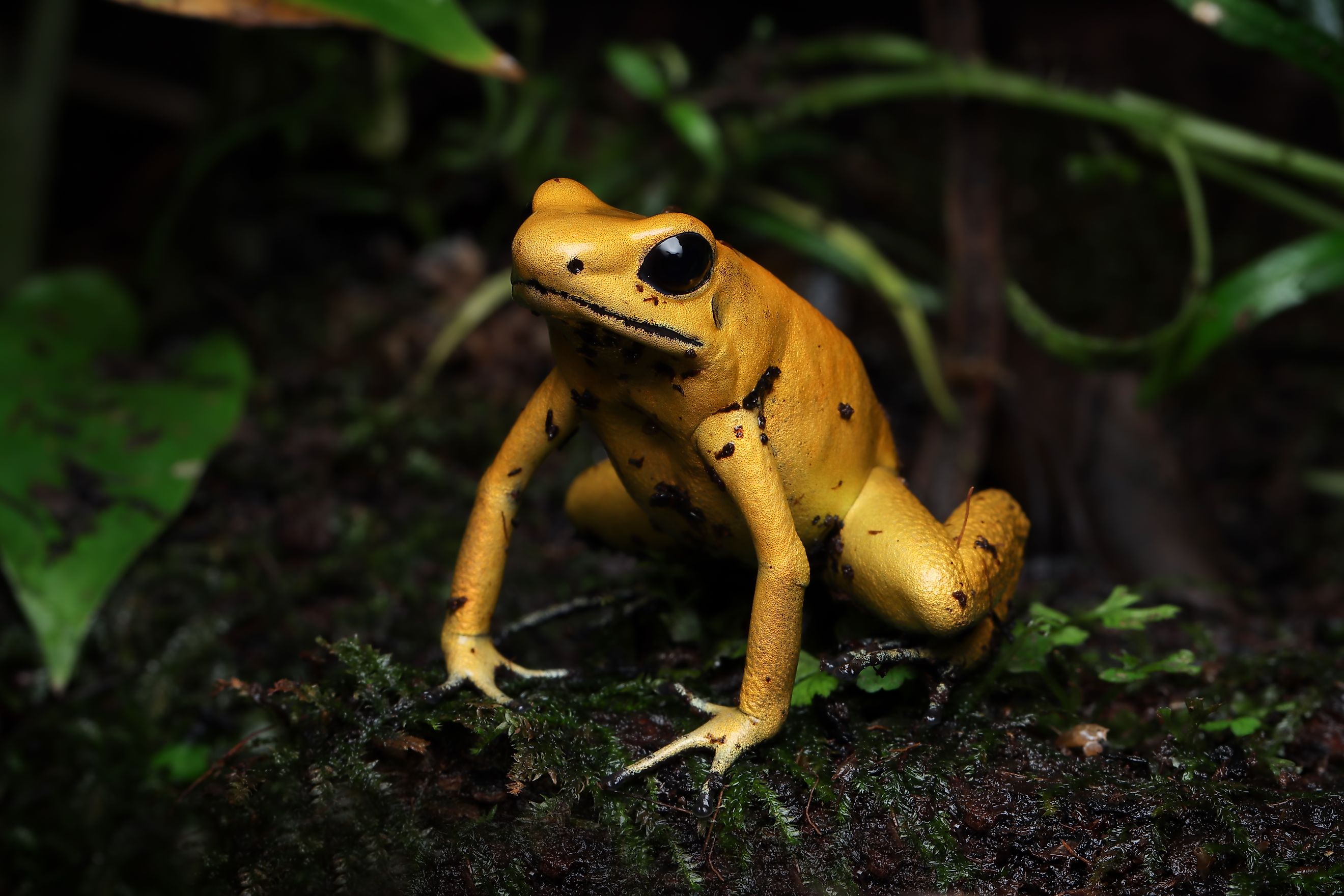
Golden Poison Frog
The golden poison frog carries enough toxin in its skin to kill several grown adults, a fact that ranks it among the most poisonous animals ever studied. This tiny amphibian rarely grows longer than two inches (5 centimeters), yet a single individual can hold roughly 1 milligram of batrachotoxin, a compound so potent that scientists measure its lethal dose in millionths of a gram.
Native to a small stretch of rainforest on the Pacific coast of Colombia, the golden poison frog (Phyllobates terribilis) is a member of the poison dart frog family. Its brilliant yellow, orange, or mint-green skin is not decoration. The color is a warning, broadcasting to every predator in the forest that this frog is far too dangerous to eat.
For centuries, the indigenous Emberá people of Colombia have used the frog's toxin to tip their blowgun darts, a practice that gave the species both its common name and its fearsome reputation. Despite its lethal chemistry, the golden poison frog is now endangered, its survival threatened by the loss of the narrow band of forest it calls home.
Taxonomic Classification

The golden poison frog belongs to the family Dendrobatidae, the group commonly known as poison dart frogs. Within that family it sits in the genus Phyllobates, which contains only a handful of species, all of them native to Central and South America. Its full scientific name is Phyllobates terribilis, a name that leaves little doubt about how its describers regarded it.
The species was first collected in 1973 and formally described in 1978 by herpetologists Charles W. Myers, John W. Daly, and Borys Malkin. The genus Phyllobates is set apart from other dendrobatids by a single striking trait. Its members are the only frogs known to carry batrachotoxin, one of the most powerful natural toxins found anywhere in the animal kingdom. Two close relatives, the black-legged poison frog (Phyllobates bicolor) and the Golfodulcean poison frog (Phyllobates vittatus), share this chemistry but at far lower doses.
Physical Description

By the standards of poison dart frogs, Phyllobates terribilis is a giant. It is the largest member of its family, reaching a body length of about 2 inches (5 to 5.5 centimeters) and a weight approaching 1 ounce (nearly 30 grams). Females tend to be slightly larger than males, a common pattern among amphibians.
The adult frog is famous for its uniform, saturated color. Most individuals are a brilliant golden yellow, though populations also appear in deep orange and in a pale mint green that can look almost white. These three color forms, known as morphs, generally correspond to different geographic populations. There are no stripes, spots, or camouflage patterns. The whole point of the coloring is to be seen.
That bold appearance is a textbook case of aposematism, the use of bright color to advertise danger. Young frogs do not start out this way. Juveniles are mostly black with two golden stripes running down the back, and the dark coloring fades gradually as they grow. By about 18 weeks of age, a froglet has taken on the solid adult color it will keep for life.
Range and Habitat

The golden poison frog lives in one small and very specific part of the world. It is endemic to the Pacific coast of Colombia, where it occupies lowland rainforest along the upper Rio Saija drainage. Its entire natural range covers less than 1,930 square miles (5,000 square kilometers), and within that area the populations are patchy, separated by rivers into isolated groups.
This is one of the wettest environments on Earth. The forest receives up to 16 feet (5 meters) of rain each year, and humidity stays high throughout the seasons. The frogs favor a hilly landscape at low elevations, roughly 300 to 660 feet (100 to 200 meters) above sea level, where the ground is damp and shaded and small streams thread through the trees. Because the species depends on this narrow set of conditions, it cannot simply move elsewhere when its habitat is disturbed.
Diet

The golden poison frog is an insectivore with a reputation as the most voracious eater in its family. It hunts by day across the forest floor, using a quick, sticky tongue to snatch up ants, termites, beetles, and mites. The main staples of its wild diet are small ants in the genera Brachymyrmex and Paratrechina, though it takes a wide range of other invertebrates as well. An adult can swallow prey items considerably larger, relative to its body, than most other dendrobatids manage.
This diet is the source of the frog's astonishing toxicity. The golden poison frog does not manufacture batrachotoxin in its own body. Instead it acquires the raw materials from the small arthropods it eats and concentrates them in glands beneath its skin. Scientists believe a particular type of beetle in the family Melyridae supplies the key ingredient, since the same toxin turns up in these beetles as well. The proof of this dietary link is dramatic. Golden poison frogs raised in captivity, fed on toxin-free crickets and fruit flies, never develop any poison at all and remain completely harmless for life.
Behavior

Unlike many rainforest amphibians that hide in the leaf litter, the golden poison frog is bold and active in the open. It is diurnal, meaning it goes about its business during daylight hours, and it makes no effort to conceal itself. With almost nothing in the forest willing to risk eating it, the frog can afford to be conspicuous. That confidence is well founded, because its warning colors keep most predators at a safe distance.
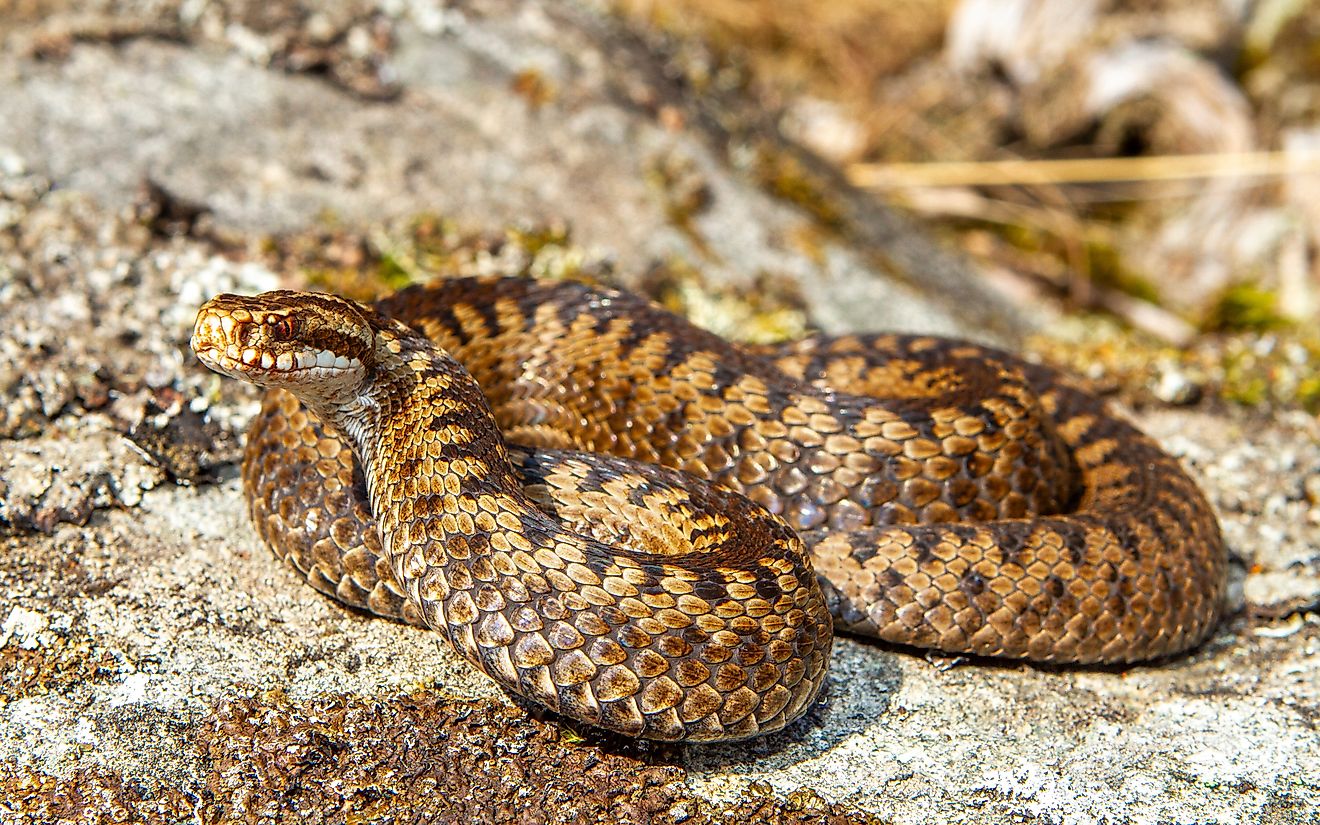
Adults tend to live spaced evenly apart rather than gathering in groups. Males are territorial and use calls to advertise their presence and attract mates. Only one animal is known to prey on the golden poison frog with any regularity, a small snake called Erythrolamprus epinephelus (long classified as Leimadophis epinephelus) that appears to have evolved partial resistance to the toxin. Even this specialist is affected by the poison from fully grown adults, which suggests its immunity has limits.
Reproduction

Breeding in the golden poison frog centers on unusually devoted parental care, most of it provided by the male. The species is polygynandrous, which means both males and females mate with multiple partners over a season. Rather than depositing eggs in water, the female lays a small clutch, usually fewer than 20 eggs, on the moist forest floor or in a sheltered spot.
The male takes charge from there. He guards the clutch and keeps the eggs damp until they hatch. Once the tadpoles emerge, they wriggle onto his back, and he carries the whole brood in search of a suitable pool of water, a task that can take days of travel across the forest. In these small nurseries the tadpoles feed on algae, mosquito larvae, and other bits of edible material until they complete metamorphosis into froglets. In the wild, a golden poison frog can live for around 10 years, and captive animals have reached 15.
Importance to the World

The golden poison frog matters far beyond its small corner of Colombia. Its toxin, batrachotoxin, works by forcing the sodium channels in nerve and muscle cells to stay locked open, which triggers paralysis and, at high doses, cardiac and respiratory failure. That precise mechanism has made the compound valuable to medical researchers, who study it in the search for new painkillers, muscle relaxants, heart stimulants, and anesthetics. Understanding exactly how batrachotoxin acts on nerve cells has advanced the broader science of how the nervous system works.
The species also holds deep cultural significance. The indigenous Emberá and Chocó peoples of western Colombia have long harvested the frog's poison to arm their hunting darts, drawing a dart across the frog's back to coat it with toxin that can remain potent for up to a year. Ecologically, as an abundant predator of ants and other small invertebrates, the frog plays a part in regulating insect populations on the forest floor.
Threats and Conservation

Despite being armed with one of nature's deadliest chemicals, the golden poison frog is in trouble. The International Union for Conservation of Nature lists it as Endangered, and its population is decreasing. The core problem is not predation but the loss of habitat. Its rainforest home is being cleared for logging, gold mining, and agriculture, and in some areas it is degraded by pollution from crop spraying.
The frog's extremely limited range makes these pressures especially dangerous. A species confined to less than 1,930 square miles (5,000 square kilometers) has no reserve of territory to fall back on, so every acre lost is a serious blow. Conservation efforts are underway to address this. In 2012, the World Land Trust worked with the Colombian organization Fundación ProAves to establish the Rana Terribilis Amphibian Reserve, a protected area created specifically to safeguard the frog and the wet forest it needs to survive.
Takeaway
The golden poison frog is a tiny amphibian with an extraordinary chemical defense. Small enough to sit on a fingertip, it is nevertheless among the most poisonous animals on Earth. Its vivid coloration warns potential predators to stay away, while its lethal toxins come from compounds obtained through its diet rather than produced entirely by its own body. For Indigenous communities that have shared its forest for generations, the frog has served as both a practical tool and a cultural symbol. Scientists, meanwhile, study it to better understand how the nervous system works. Yet even such powerful defenses cannot shield it from habitat destruction. Its future depends on preserving the narrow band of Colombian rainforest where it lives.
Fun Facts

- A single frog can kill ten people. One adult golden poison frog carries roughly 1 milligram of batrachotoxin, enough in theory to end the lives of about ten grown adults.
- Captive frogs are completely harmless. Because the toxin comes from wild prey, frogs bred and raised on crickets and fruit flies never become poisonous.
- Its name means "terrible." The species name terribilis reflects the awe and dread its describers felt toward its potency.
- It shares its toxin with a bird. Batrachotoxin is otherwise found in only a handful of creatures, including certain birds of New Guinea such as the hooded pitohui.
- Touching one can be dangerous. A wild golden poison frog is so toxic that skin contact alone can pose a threat, with no bite or scratch required.
Quick Facts
- Scientific name: Phyllobates terribilis
- Family: Dendrobatidae
- Order: Anura
- IUCN status: Endangered (population decreasing)
- Length: up to about 2 inches (5 to 5.5 cm)
- Weight: up to nearly 1 ounce (30 g)
- Lifespan: around 10 years in the wild, up to 15 in captivity
- Diet: insectivore (ants, termites, beetles, mites)
- Range: Pacific coast of Colombia
- Habitat: lowland tropical rainforest