Goblin Shark
The goblin shark is a rare deep-sea creature classified as the sole living species in the Mitsukurinidae family. This is an ancient family, thought to be about 125 million years old. Because the goblin shark is the only living member, it's what's known as a "living fossil," and it looks the part. The common name, "goblin shark," is borrowed from a Japanese word, "tenguzame," because a "tengu" was also a strange-looking (mythological) creature with a very long nose and a bloody red face. The long face and jaws have given rise to disputes over the goblin shark's taxonomy because ancient remains of its predecessors have so often been found in different angles and arrangements, giving rise to questions about its true evolutionary descent. What is certain is that any sailor who saw this long, thin creature with its masquerade mask-looking face and its skin tinged pink from its own visible blood must have thought they were seeing an ancient sea monster, and perhaps in a way they were.
Taxonomic Classification

The goblin shark was thought at first to be an entirely new discovery, and not just the discovery of a new animal, but of a new genus and family. The specimen under investigation was a juvenile male acquired by a naturalist and shipmaster, Alan Owston, in 1898, who delivered it to a professor, Kakichi Mitsukuri (of the University of Tokyo), who in turn delivered it to the ichthyologist David Starr Jordan (of California). It was Mr. Jordan who first published the discovery of this creature and gave it the name Mitsukurina owstoni in honor of Mr. Owston and Mr. Mitsukuri. In the wake of the published discovery, several scientists noticed the similarities to fossils of the Mesozoic shark, "Scapanorhynchus." After decades of dispute, there is little doubt today that the "goblin shark" (aka "elfin shark") is indeed the last remaining member of a family that dates back perhaps as far as the Cretaceous period (c. 125-113 Ma), and is found in fossil records as far back as the Middle Eocene period (c. 49-37 Ma).
Physical Description

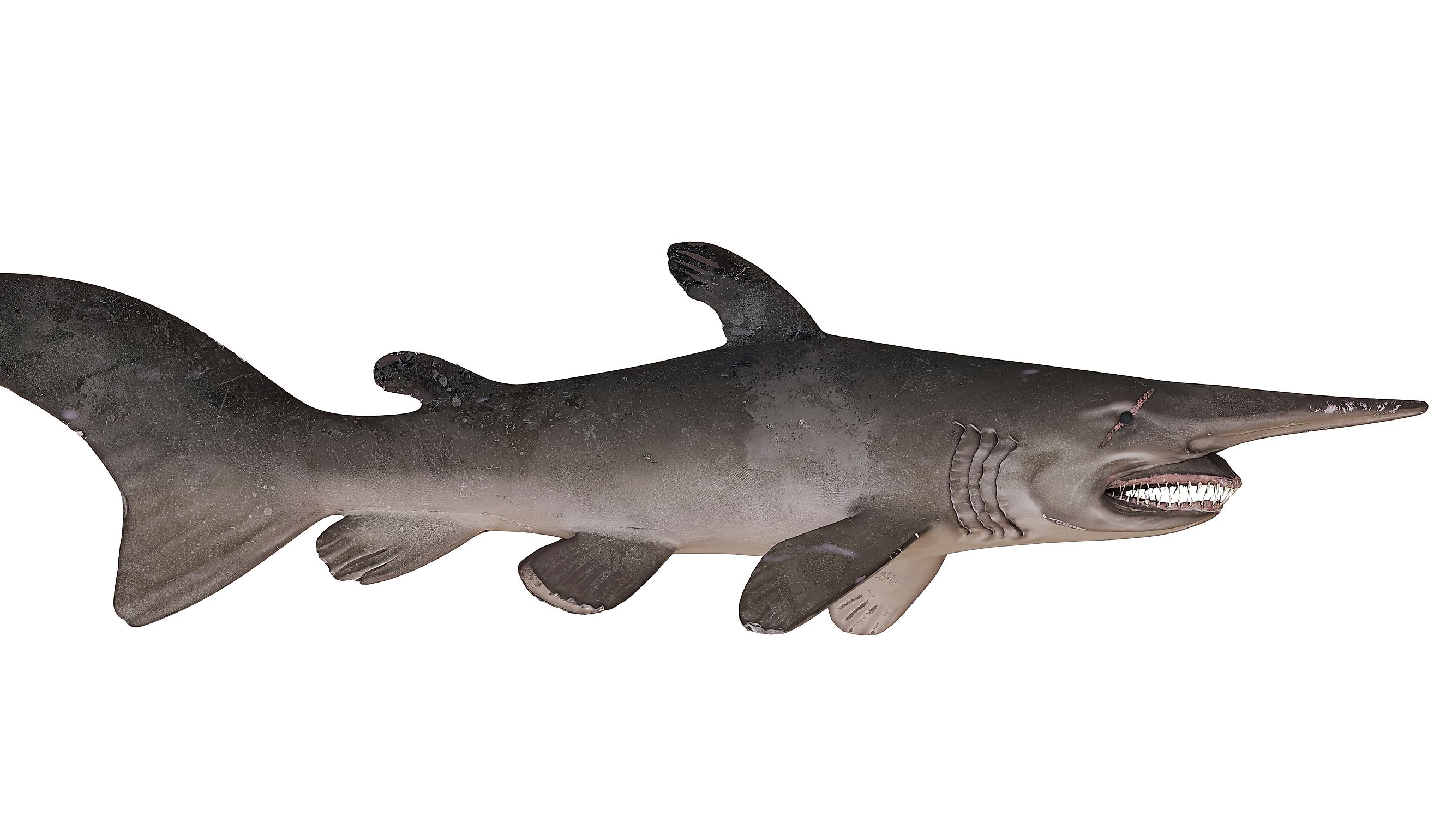
The snout is what you'll notice first. It is long and protrudes from its face like a broadsword or a spade, pointing flatly ahead. The next thing you may notice is its jaws, which are parabolic in shape (U-shaped), and highly elastic, almost like a slingshot, and they can literally shoot forward to catch their prey (the jaws of a goblin shark can protrude 2-9 times further than other species). Even scientists have joined laypeople in likening the way a goblin's shark jaws extend forward from its own face to the jaws of the creatures in the Alien and Predator movies. Inside those jaws are teeth unlike the teeth of other sharks. Rather than standard triangle teeth for tearing, the goblin shark has long, needle-like teeth in the front for gripping slippery prey, and flat teeth at the back designed for crushing. Its eyes are small, black with blue streaks, and have no protective nictitating membranes. Its skin is typically tan or pink, and this is because its blood vessels are somewhat visible beneath its semi-transparent flesh. The juvenile sharks are almost white.
The goblin shark's body is thin, yet almost flabby-looking because its fins are small and rounded in relation to the rest of its body, which deepens this shark's likeness to a goblin of the sea. Adults usually measure between 3 and 4 m (9.8 and 13.1 ft) long. Studies suggest they may have the ability to grow up to 7 m (23 ft) in maximum length, but there have not been any sharks of this size recorded in modern science (not longer than an estimated 6.2 m, or 20 ft). In a word, the goblin shark looks like a nightmare creature the painter Hieronymus Bosch might have invented.
Behavior
A goblin shark's hunting behavior is what's commonly described as that of a slow-moving, ambush predator, but there is nothing common about the method of its ambush. Imagine it swimming alone through its usual haunts, along deep continental slopes, submarine canyons, and underwater seamounts. It's swimming slowly, almost sluggishly, but its long snout is highly active, being covered with ampullae of Lorenzini (special sensory organs that detect the electric fields of other animals). Once it has detected its prey, it does not swim directly toward it, but a bit to the side, only turning to face it immediately before striking, as if it (itself) has only just been surprised by the other creature's presence. Then it rapidly shoots its jaws forward at a speed of ten feet per second to snatch its unsuspecting prey from out of the dark ocean. This is one of the most unique feeding behaviors of any large underwater predator.
While humans have frequently been captivated (and even horrified) to observe goblin sharks feed, humans have never observed goblin sharks mating. This remains a relatively mysterious species that we know to have been swimming through the seas for millions of years, and yet it defies all attempts at closer study. The longest one has ever been kept in captivity was for one week, and so further attempts at aquarium study have been abandoned.
Range And Habitat
Goblin sharks are widely distributed across the seas of the world. They have been seen in the major oceans: the Atlantic, Pacific, and Indian oceans, with scientists recording sightings across the globe, including near Brazil, France, Portugal, the Gulf of Mexico, Japan, Australia, Madeira, and Senegal. Goblin sharks are most often observed at depths of 270-960 m (890-3,150 ft), though they have also been observed at depths as low as 2,000 m (6,600 ft). Adults live at the greatest depths, while immature goblin sharks are most often observed in the submarine canyons off southern Japan at much shallower depths (around 100-350 m, 330-1,150 ft). Scientists do not know how far these sharks travel, nor what their migration patterns may be.
Food
Goblin sharks are carnivores that feed somewhat indiscriminately (opportunistically) on any unlucky creatures also swimming in the ocean's darkest zones. They are known to eat cephalopods, including both squid and octopus, as well as crustaceans like crabs and shrimps, and deep-sea fish like rattails, dragonfish, and blackbelly rosefish. Garbage has been found in the stomachs of some specimens, meaning the goblin shark is not a picky eater, but will stalk and consume most creatures (or supposed creatures) that can fit within its slingshot jaws.
Threats

The International Union for Conservation of Nature (IUCN) rates the goblin shark as a creature of "least concern." Indeed, these sharks face very little direct threat from humans in large part because they swim so deep in the ocean. Occasionally, a goblin shark is a "bycatch" of a fishing ship, but they have never been targeted by deep-sea fishers, in part because even such a novel creature is fairly terrifying to behold, and in part because they are not tasty to eat. The primary threat to these creatures is "ghost fishing" or "ghost nets," meaning they get tangled in lost fishing gear that's sunk deep into the ocean. And of course, environmental changes are a troubling concern for all deep-sea creatures, particularly when we do not have a clear understanding of their patterns and natures. But one may suppose that a creature like the goblin shark that has survived, shrouded in mystery, for millions of years, may sluggishly and shrewdly continue to swim for millions of years to come.
Because the goblin shark represents a 125-million-year lineage and is the sole surviving species of the family Mitsukurinidae, it offers the world a rare window into prehistoric evolution in the sea. By studying both the "living fossil" and fossils dating back to the Cretaceous period, we can better understand how certain species, including this one, survived major environmental shifts (possibly even including the Cretaceous-Paleogene extinction). In terms of biodiversity, the predatory goblin shark is important when it comes to helping maintain balanced populations of other deep-sea animals. And for its own sheer uniqueness, the goblin shark gives science an almost science-fiction-level study opportunity into what is possible with extreme sensory and mechanical evolution. No other creature on earth has a snout and jaw that function like the goblin sharks, and so perhaps no other creature's is as absolutely and admirably terrifying.