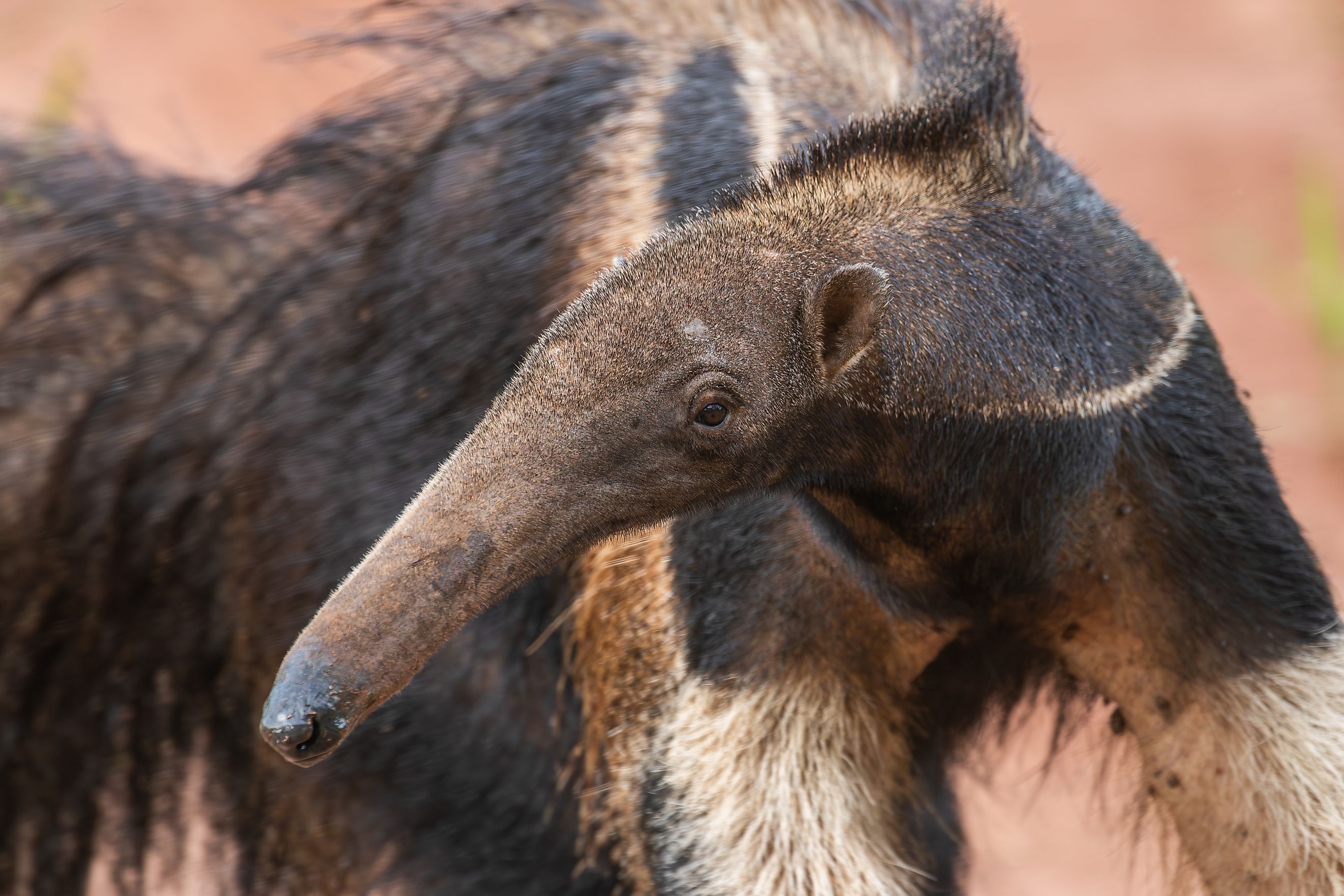
Giant Anteater
The giant anteater (Myrmecophaga tridactyla) is the largest of the four living anteater species and one of the most specialized mammals on Earth. It carries no teeth, extends a tongue up to 2 feet (60 cm) long, and swallows as many as 30,000 ants and termites in a single day. Reaching roughly 8 feet (2.4 m) snout to tail, it is a strictly ground-dwelling insectivore that belongs to the order Pilosa, the same lineage as sloths.
This animal ranges across Central and South America, with Honduras marking its northern limit and northern Argentina its southern one. It inhabits grasslands, savannas, wetlands, and forests. It also runs one of the lowest body temperatures recorded in any placental mammal, about 90.9 degrees Fahrenheit (32.7 degrees Celsius).
Behind the odd silhouette sits a tightly engineered specialist. Nearly every trait is tuned to one purpose, its low metabolism and its powerful foreclaws included, allowing it to make a living from insect colonies that most predators ignore. The giant anteater is also in decline, listed as Vulnerable by the IUCN, which makes understanding it a matter of conservation as much as curiosity.
Taxonomic Classification

The giant anteater sits in the order Pilosa, suborder Vermilingua (a name meaning "worm tongue"), and family Myrmecophagidae. Carl Linnaeus described it in 1758 as Myrmecophaga tridactyla, and it remains the only living member of its genus. The species is sometimes split into three subspecies separated by geography, though the boundaries between them are debated.
Anteaters belong to the superorder Xenarthra, an ancient group that evolved in South America alongside armadillos and sloths. Despite the shared name and diet, the giant anteater is not closely related to pangolins, aardvarks, or echidnas. Those resemblances are the product of convergent evolution, not common ancestry. Its nearest living relatives are the sloths, from which anteaters diverged more than 55 million years ago.
Physical Description

The giant anteater is unmistakable in size and shape. Head and body measure 3.3 to 4.6 feet (1 to 1.4 m), and the bushy tail adds another 2 to 3 feet (60 to 90 cm), for a total length approaching 8 feet (2.4 m). Adults weigh 49 to 99 pounds (22 to 45 kg), with males running slightly heavier than females. Reared up on its hind legs, a large individual stands taller than an adult human.
The skull tapers into a tubular snout up to 18 inches (45 cm) long that ends in a small, round mouth. The animal has no teeth. Instead it deploys a tongue that extends up to 2 feet (60 cm) beyond the mouth, coated in sticky saliva and lined with tiny backward-pointing spines. During feeding the tongue can flick in and out roughly 150 times per minute.
The coarse coat is gray to brown, marked by a diagonal black band edged in white that runs from the throat and chest across the shoulder toward the middle of the back. The forelegs are pale, and the tail hair can reach 16 inches (40 cm) in length. The forefeet carry four digits, the second and third armed with curved claws up to 4 inches (10 cm) long. To keep those claws sharp, the animal walks on the knuckles of its forefeet with the claws curled aside; the hindfeet bear five shorter claws and rest flat.
Its senses are finely adapted to its specialized diet. While its eyesight is poor and its hearing is modest, its sense of smell is about 40 times more sensitive than a human's, allowing it to locate hidden insect colonies. The low-energy insect diet is matched by a slow metabolism and a body temperature near 90.9 degrees Fahrenheit (32.7 degrees Celsius), among the lowest recorded in any placental mammal.
Range and Habitat

Giant anteaters occur across Central and South America, ranging as far north as Honduras and as far south as northern Argentina. Fossils found as far north as Sonora, Mexico, show the species once ranged wider, having moved north during the Great American Interchange after the Isthmus of Panama formed. That northern range has since contracted sharply. The species is now considered extinct or nearly so in Belize, El Salvador, Uruguay, much of Guatemala, parts of Costa Rica, and Brazilian states such as Santa Catarina and Rio Grande do Sul.
Unlike its tree-dwelling relatives, the giant anteater is terrestrial. It uses tropical grasslands and savannas, seasonally flooded wetlands, dry forest, and the edges of rainforest. Two of its strongholds are the Cerrado savanna and the Pantanal wetlands of Brazil, along with the dry Chaco of Argentina and Paraguay. Individual home ranges vary widely with habitat quality, and low population density means the species needs large, connected areas to persist.
Diet and Feeding

The giant anteater is a dietary specialist. It feeds almost entirely on ants and termites, favoring ant genera such as Camponotus, Solenopsis, and Pheidole, along with Nasutitermes termites. A single animal can consume up to 30,000 insects in a day. It locates colonies by scent, rips them open with its foreclaws, inserts its snout, and gathers prey with rapid strokes of its tongue.
Feeding is brief and deliberate. The animal typically spends less than a minute at any one nest and takes only a fraction of the colony before moving on. That restraint serves two purposes, limiting exposure to the soldiers and chemical defenses of ants and termites while leaving colonies intact enough to recover and be revisited. Because insects are rich in protein but poor in energy, the giant anteater must eat constantly, a demand that helps explain its low metabolic rate. It draws most of its water from prey and from licking vegetation, and in the dry season it digs into soil in ways that can open water sources used by other animals.
Behavior and Reproduction

Giant anteaters are solitary apart from mothers with young. Where human presence is low they tend to be active by day, but in disturbed areas they shift toward a nocturnal schedule. They rest up to 15 hours a day, often curling the long tail over the body as insulation against heat loss. They mark and defend loosely overlapping home ranges rather than tight territories, and they are capable swimmers, crossing rivers by holding the snout above the surface like a snorkel.
The animal usually avoids conflict, but its defense is formidable. Cornered by a predator, it rears onto its hind legs, braces with its tail, and slashes with its foreclaws, a response that can injure or kill a jaguar or puma. That same weaponry accounts for the occasional record of a giant anteater fatally wounding a human who cornered it.
Reproduction is slow, which compounds the species' conservation problems. Females breed year-round in some regions and seasonally in others, and gestation lasts about 190 days. A single pup weighing roughly 3 pounds (1.4 kg) is the norm, while twins are rare. The mother gives birth standing upright, braced by her tail, and the newborn climbs onto her back, where it rides for up to a year. The pup's stripe aligns with the mother's, which camouflages it and makes her look larger. Young are weaned around six months, become independent near two years, and reach sexual maturity between 2.5 and 4 years. Researchers have also found evidence of delayed implantation, meaning a fertilized embryo can pause before developing. Wild lifespans run about 14 to 16 years, while animals in managed care have lived past 30.
Importance to the World

As a high-volume predator of ants and termites, the giant anteater regulates insect populations across the grasslands and forests it occupies. A single adult removes millions of insects over a year, which influences colony numbers and the wider food web. Its dry-season digging can also expose water and soil that other species use, giving it a modest role in shaping its habitat.
The species also functions as a flagship for grassland conservation. WWF counts it among the "Big Five" of the Brazilian Cerrado, and because a giant anteater needs a large, connected home range to survive, securing enough habitat for a viable population shelters many smaller, less conspicuous animals that share the same savannas and wetlands. In this way, it serves as an umbrella species, with conservation efforts focused on protecting its habitat also benefiting the wider community of wildlife across the Cerrado and Pantanal. The giant anteater carries scientific value as well. As one of the last members of Xenarthra, an ancient lineage that evolved in the Americas, it gives researchers a window into a group of mammals with no close equivalents elsewhere, and its unusually low metabolism and body temperature make it a recurring subject in studies of mammalian physiology.
Threats and Conservation

The IUCN Red List classifies the giant anteater as Vulnerable, most recently assessed in 2024 under criteria A2cd, and it is listed on CITES Appendix II. The population is declining, with an estimated reduction of at least 30 percent over roughly the past decade. In Central America it is regarded as the most threatened mammal, and fewer than 5,000 are thought to remain there.
Habitat loss and fragmentation caused by agriculture and cattle ranching continue to shrink and divide the large territories the species requires. Grassland wildfires kill anteaters directly, and their coarse, flammable coat leaves them highly exposed. Vehicle collisions are a leading cause of death in some regions, which is why road-mitigation research such as the Anteaters and Highways project focuses on them. The animals are also hunted for meat and leather in places, killed by domestic dogs, and lost to jaguar predation in fragmented populations that offer little room to escape.
Conservation efforts center on protecting large habitat blocks, including Brazilian national parks such as Serra da Canastra and Emas, along with roadway measures, and rescue and translocation of animals displaced by fire. The species is also featured on the Zoological Society of London's EDGE of Existence list, which prioritizes evolutionarily distinct and threatened animals.
Takeaway
The giant anteater is toothless yet highly efficient, cold-bodied yet capable of killing a big cat, and uniquely adapted to exploit a diet that almost no other predator targets on the same scale. Those same specializations, large range requirements, a slow reproductive rate, and dependence on grasslands that are burning and being cleared, are exactly what leave it exposed today. Whether the species holds its ground will depend on protecting connected habitat across Central and South America and on reducing the fires and road deaths that now drive its decline.
Fun Facts

- Among the coldest-running placental mammals: its body temperature of about 90.9 degrees Fahrenheit (32.7 degrees Celsius) is among the lowest recorded in the group.
- All tongue, no teeth: it has no teeth at all and instead uses a tongue up to 2 feet (60 cm) long that flicks about 150 times a minute.
- A nose for colonies: its sense of smell is roughly 40 times stronger than a human's, which it relies on far more than its weak eyesight.
- Knuckle-walker: it walks on the knuckles of its forefeet to keep its digging claws sharp.
- Punches above its weight: with a tail-braced stance and 4-inch (10 cm) claws, it can fend off jaguars and pumas.
- Piggyback camouflage: a pup rides on its mother's back for up to a year, its stripe lined up with hers to stay hidden.
Quick Facts
- Scientific name: Myrmecophaga tridactyla
- Family / Order: Myrmecophagidae / Pilosa
- IUCN status: Vulnerable (2024); population decreasing
- Length: up to about 8 ft (2.4 m), including tail
- Weight: 49 to 99 lb (22 to 45 kg)
- Lifespan: about 14 to 16 years wild; 30+ in managed care
- Diet: insectivore (ants and termites)
- Range: Central and South America, Honduras to northern Argentina