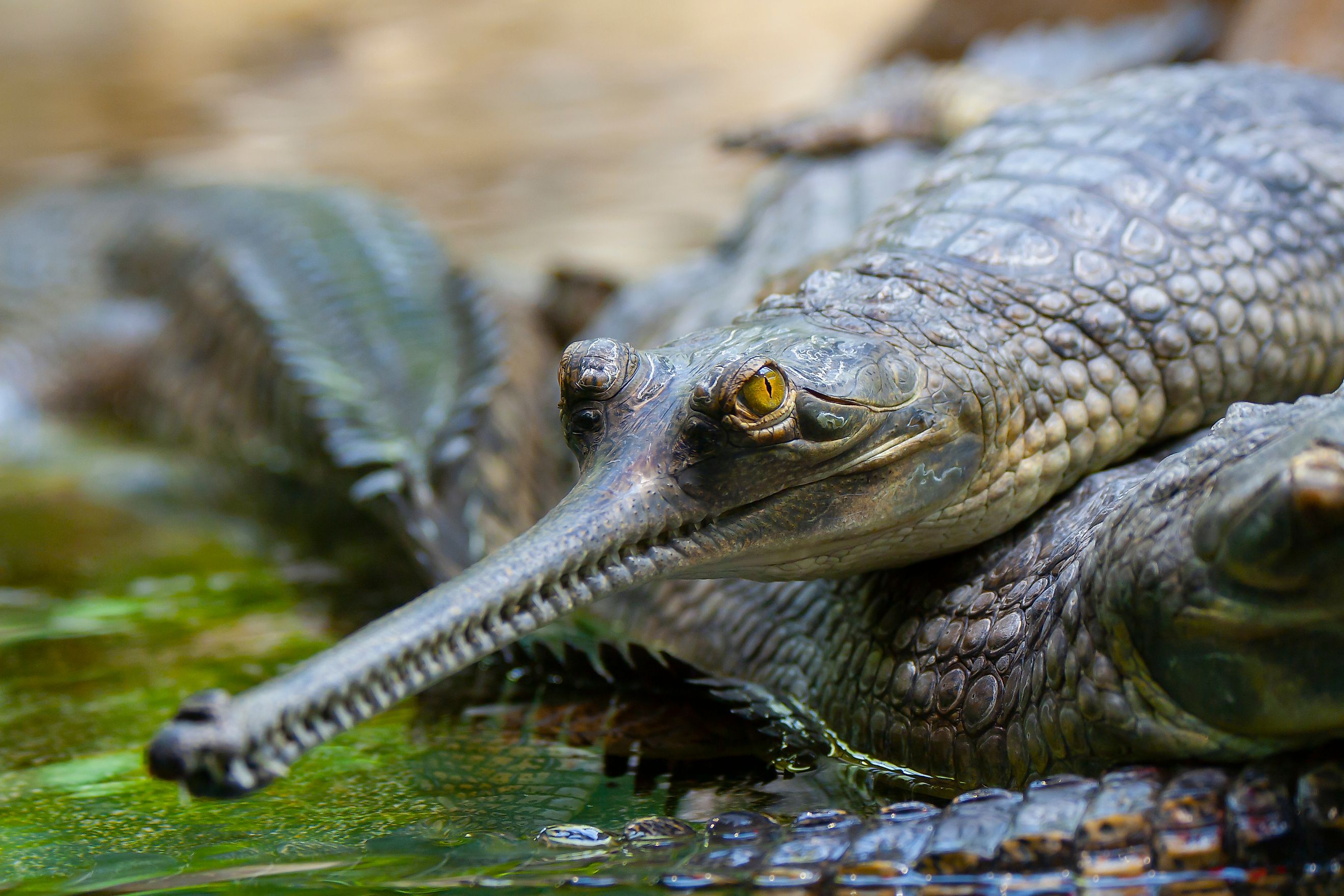
Gharial
The gharial looks like a crocodile that got its snout stretched in a taffy machine. This fish-eating reptile survives in just a handful of rivers across northern India and Nepal. Males grow a bulbous knob on the snout tip that buzzes and blows bubbles to court females. Its lineage stretches back tens of millions of years to one of the oldest branches of the crocodilian tree. Today only a few hundred breeding adults remain in the wild. They now hold just two percent of the range their ancestors once patrolled.
Taxonomic Classification

The gharial (Gavialis gangeticus) is a crocodilian in the family Gavialidae. Also known as the gavial or fish-eating crocodile (the Western spelling "gavial" became the accepted form), it belongs to one of the oldest living crocodilian lineages, with an evolutionary history spanning more than 50 million years. The ancestors of today's crocodilians split into three major groups (alligators, crocodiles, and gharials) roughly 100 million years ago, and the gharial lineage diverged from other crocodilians around 40 to 50 million years ago. Early relatives of the gharial family were widely distributed across Eurasia, Africa, and the Americas. Over millions of years, climate change and competition wiped out almost all of these other species, leaving the gharial as the sole surviving member of the genus Gavialis. The only other living species in the family is the false gharial (Tomistoma schlegelii), though its placement in Gavialidae remains debated among scientists.
Range And Habitat

Historically, the gharial's range spanned all the major river systems of the northern Indian subcontinent, reaching the Indus in Pakistan in the west and the Irrawaddy in Myanmar in the east, and taking in the rivers of India and Bangladesh between them. That range has since contracted to about two percent of its former size. Small, fragmented populations now survive in northern India and Nepal, in fast-flowing, clear freshwater systems such as the Chambal, Girwa, and Son rivers, which hold the deep pools, abundant fish, and sandy banks the species needs. Poorly suited to movement on land because of weak hind legs, the gharial is the most aquatic of all crocodilians. It spends the majority of its time in the water and leaves only to bask or to dig nests for its eggs on mid-river sandbars.
Food

The gharial's diet changes substantially as the animal matures. Juveniles have relatively wide, short snouts, so they prey mostly on insects, crustaceans, frogs, and other amphibians. As they grow, the snout lengthens and narrows, and adults feed almost exclusively on fish, for which their jaws are well adapted. Gharials use three main hunting strategies. They sit motionless and almost completely submerged until prey passes, then snatch it with roughly 110 sharp, interlocking teeth. They also detect vibrations in the water through sensory pits in their skin to track prey. Finally, they stalk and strike, swinging the thin jaw sideways with little water resistance to snap up fish quickly. Gharials do not have large appetites, since they are cold-blooded reptiles with slow metabolisms. An adult does not eat every day, and it averages only about one to two pounds of fish on the days it does feed. During the colder months, when activity slows, a gharial may go weeks or months without eating at all.
Physical Description

Gharials are longer and sleeker than their alligator and crocodile cousins, an advantage in their fast-flowing river environments. Females reach lengths of up to about 15 feet, and males up to about 20 feet, which makes the gharial one of the longest of all living crocodilians. Adults have long, slender snouts that continue to lengthen and narrow with age. Males develop a peculiar bulbous growth on the snout tip called a ghara, from which the species takes its name. Ghara is the Hindi word for the round, earthen pot the growth resembles. The ghara serves as a visual signal during courtship and helps the male produce bubbles and a loud buzzing sound while mating. Gharials have webbed feet for efficient propulsion in the water, but movement on land is awkward and slow because of their weak hind legs, and they mostly slide on their bellies across the sand. Unlike crocodiles or alligators, gharials have relatively smooth scales. They are dark brown or greenish brown on the back and sides and yellow to white underneath. Juveniles carry dark bands on the back and tail that fade with age.
Behavior

Because they are cold-blooded, gharials spend a lot of time basking in the sun on sandbars, especially in the cooler months. Once a gharial finds a basking site it likes, almost always at the water's edge, it tends to return to the same spot repeatedly. During the hot summer months, gharials gape (resting with their jaws open) to release excess heat from their bodies, usually in intervals of ten to twenty minutes. On very hot days, they submerge their bodies in the cooler river water and leave only their heads exposed. Gharials are mostly solitary, and they live, hunt, and bask on their own. Adult males are highly territorial and will not tolerate other mature males in their stretch of the river. Where basking sites are limited, though, several gharials will share the same sandbank peacefully to warm themselves side by side.
Reproduction

The breeding season falls in the dry winter months, roughly between November and February, and it begins with a male attracting the females within his territory using his ghara. Once a female accepts the male's display, courtship begins with snout rubbing, and the male follows the female around his territory. When the female is ready to mate, she signals her consent by pointing her snout upward. Copulation takes place beneath the surface, where the pair may remain for up to 30 minutes. A month or two after mating, the female digs deep holes in the sandbanks and lays her eggs. A clutch of roughly 35 to 60 eggs then incubates for about 60 to 90 days before hatching. The hatchlings are highly vulnerable, and their mother defends them vigorously against predators such as jackals, hyenas, and monitor lizards. Because hatchlings cannot dig themselves out of the sand, they emit high-pitched chirping noises when they are ready to emerge, and the mother carefully opens the nest to free them. Her snout is too long and narrow to carry them to the water the way crocodiles do, so she simply guides them there. The young depend completely on their mother for protection, and they gather into a communal group called a crèche for several weeks or months. Their independence comes when the heavy monsoon rains arrive in July or August, as rising river levels flood the nesting zones and disperse the young, who must then survive on their own. Because of predation and human activity, only about one percent of hatchlings reach adulthood.
Importance to the World

Because the gharial sits at the top of the freshwater food chain, its presence or absence signals the health of the entire river habitat. By preying on larger, slow-moving predatory fish, gharials keep those populations in check and stop them from overeating. This protects smaller fish species and supports a higher level of biodiversity. As gharials move through the water, they also stir up the riverbed and release nutrients trapped in the sediment. Those nutrients feed tiny aquatic plants and plankton, which start the primary food cycle of the river. Gharials are occasional scavengers too, and by cleaning up carrion they help reduce pathogens in the water and slow the spread of aquatic disease and bacterial blooms.
Threats

The gharial is listed as Critically Endangered. Its population has fallen sharply since the mid-twentieth century, to an estimated 3,000 to 4,000 individuals in the wild, of which only about 650 to 800 are breeding adults, a collapse of roughly 98 percent. Human activity is largely to blame. Dams, barrages, and alterations to river courses isolate adults, wash away nesting grounds, and lower water levels. Industrial-scale sand mining strips the riverbanks and destroys the nesting and basking sites the species depends on. Fishing is another major threat, as gharials become entangled in commercial gill nets and drown. When fishermen find a trapped gharial in their nets, they often break or sever the animal's snout to save the net, which leaves it to starve. Heavy overfishing also reduces the gharial's food supply, and illegal poaching and nest raiding continue to drain the population.
A Fragile Recovery
Conservationists, local communities, and the governments of India and Nepal are working to save the gharial through a mix of hands-on biology, protected river zones, and grassroots partnerships. Because so few wild hatchlings survive, captive breeding has become central to the effort. Teams harvest eggs from wild nests threatened by erosion or flooding and incubate them in specialized facilities before returning the young to the rivers. Field crews also guard wild nests, installing protective fencing and watching for illegal activity. Along the roughly 425-kilometer stretch of the Chambal River protected as the National Chambal Sanctuary, an entire river ecosystem now sits under strict protection, giving the world's only surviving member of the genus Gavialis a real chance to avoid extinction.