Gecko
Geckos number more than 2,000 described species, and new ones turn up most years in ground that gets little survey work. They range across every warm continent, in rainforest understory, high desert scrub, mangrove, and on the walls of houses in most tropical cities. Some hold to a single ridge or island and range nowhere else. Others have crossed oceans, their sticky-shelled eggs pressed hard to the bark of a drifting log, and founded new populations from a single stray. It is a wide range for a group of small nocturnal lizards, most of them no longer than a finger.
Taxonomic Classification
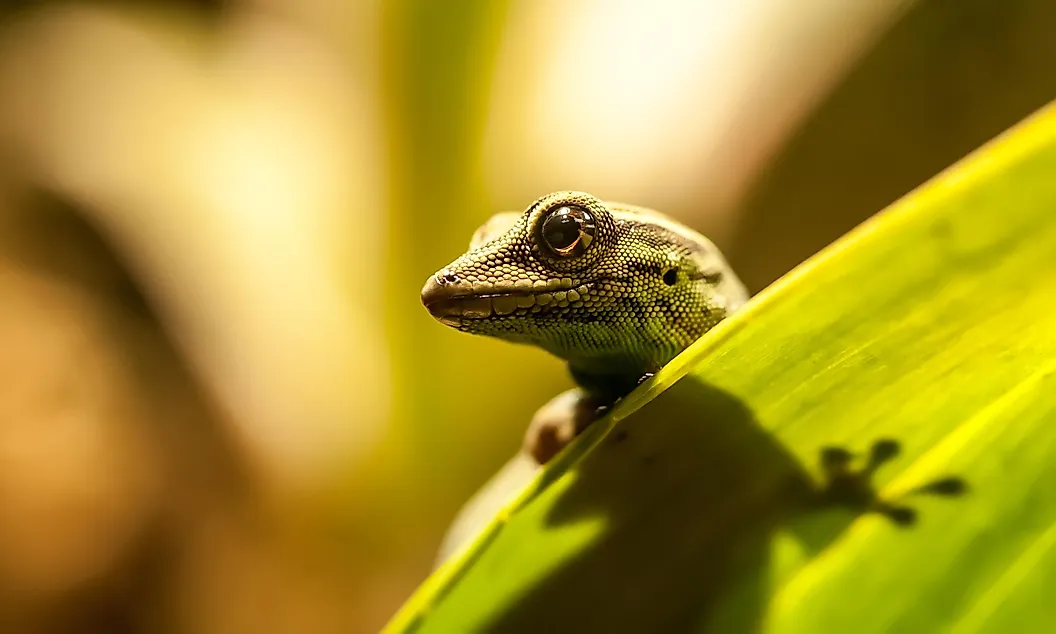
Geckos form the infraorder Gekkota within the squamate reptiles, the same broad group that holds snakes and other lizards. Gekkota splits into seven families. Gekkonidae is the largest and most widespread group, the one most people mean when they say gecko. Eublepharidae holds the eyelid geckos, including the leopard gecko of the dry countries of Iran, Pakistan, and northwest India. Diplodactylidae spans Australia, New Zealand, and New Caledonia, while Carphodactylidae is limited to Australia. Sphaerodactylidae holds the dwarf geckos, including Sphaerodactylus ariasae of the Caribbean, at about 16 millimeters (0.6 inches) snout to vent, one of the smallest reptiles known. Phyllodactylidae rounds out the true geckos, and Pygopodidae, the legless geckos of Australia, look like snakes and often surprise people who learn where they sit on the family tree. Molecular work keeps shifting the boundaries, and some genera have been moved more than once.
Range and Habitat
Geckos occupy warm regions on every continent except Antarctica, roughly between the 50th parallels north and south. They forage in tropical rainforest understory, in high desert scrub, on granite outcrops, in mangrove, and on the walls of houses in most tropical cities. Some species hold to a single ridge or island and range nowhere else. Others have spread far thanks to human traffic. The common house gecko, Hemidactylus frenatus, started in South and Southeast Asia and now turns up around ports across the tropics, often displacing native geckos from the buildings it colonizes.
The animals are sorted by habitat. Some are arboreal and spend their lives in the canopy. Some are terrestrial and shelter under rock and litter through the heat of the day. Desert species dig or take over burrows. The New Caledonian giant gecko, Rhacodactylus leachianus, at about 36 centimeters (14 inches), is the largest living gecko and keeps to hollow trees in a small range on one island group and is rarely seen in the wild.
Physical Description

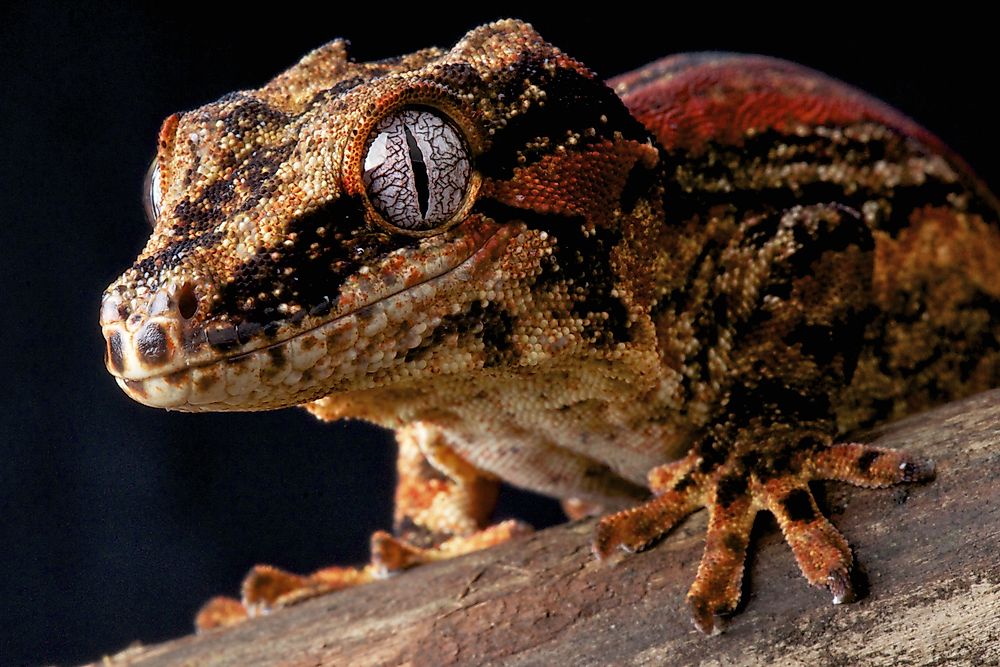
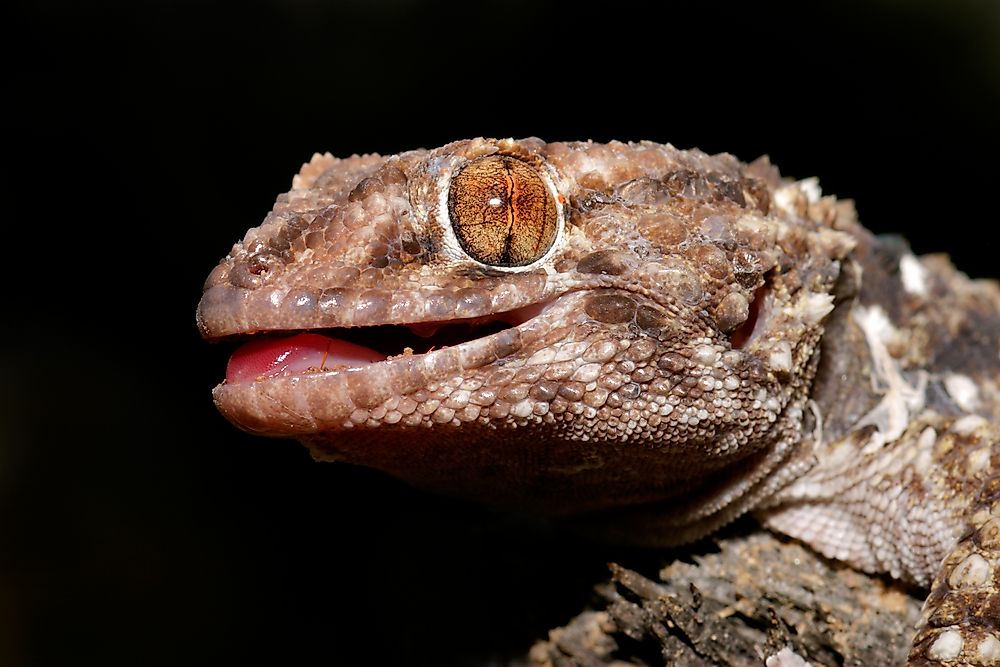
Most geckos run small, palm-sized or less, with a broad head, large eyes, and soft skin over fine scales. The eyes carry the clearest field marks. Most species have no eyelids and clean the eye with the tongue, and the pupil closes in daylight to a vertical slit that, in some desert forms, narrows further to a row of pinholes. Their night vision is strong; several species can distinguish color in light too dim for human color vision. The toe pads vary by family and by surface, wide and lamellate in wall climbers, reduced or absent in ground dwellers, and the sand-swimming species.
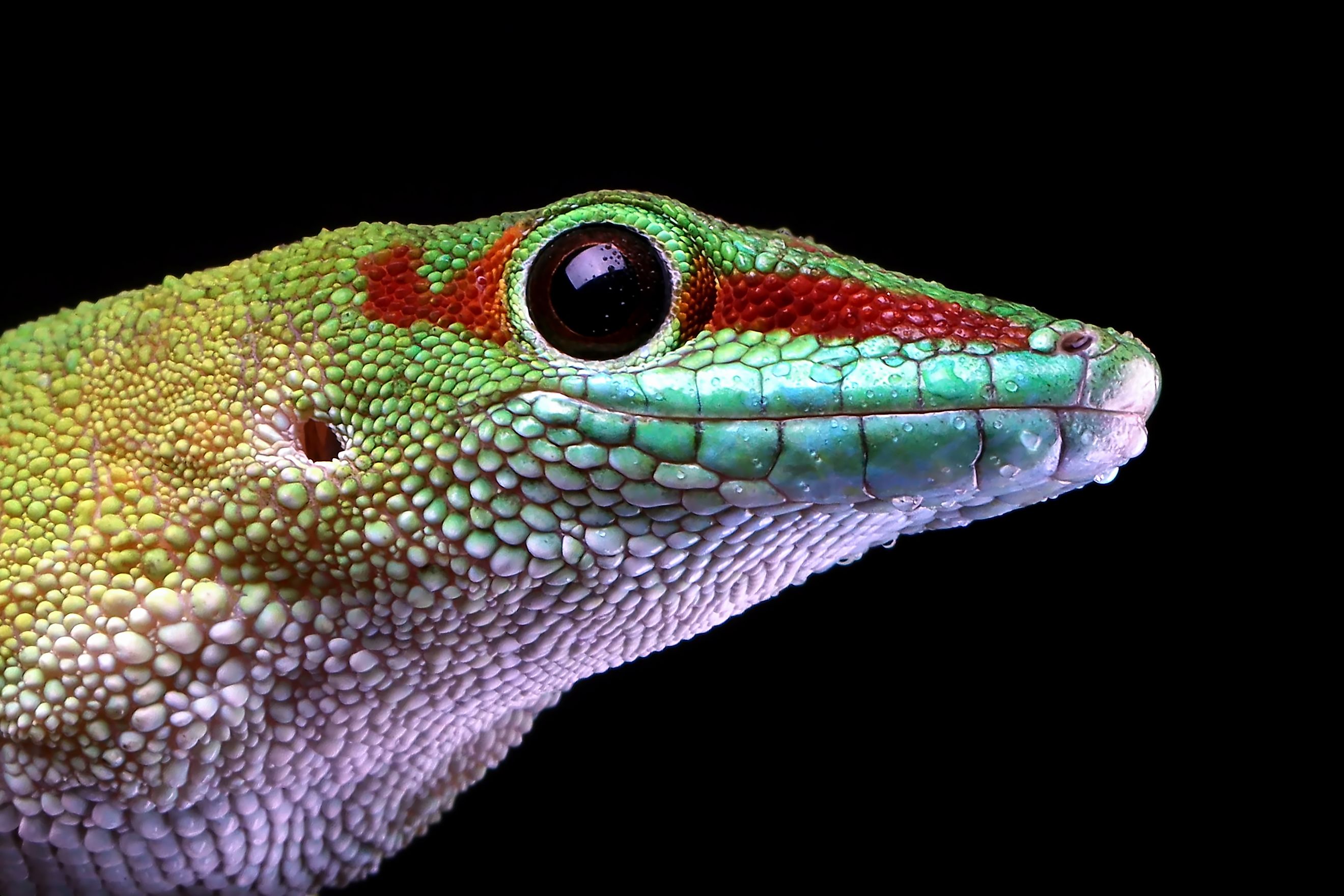
The tail stores fat, aids balance, and detaches at a fracture plane when a predator grabs it. The shed tail keeps thrashing for a minute or more, which buys the animal time to leave. It regrows, usually shorter and plainer, without the original bone. Color runs to browns, grays, and sand tones in most species, tuned to bark or rock, though the day geckos of Madagascar carry bright green and red and forage in the open.
Food

Geckos are mostly insectivores. They take crickets, moths, roaches, spiders, and whatever else moves at the size they can handle, and a house gecko working a porch light will clear a steady run of moths through the night. Larger species take small vertebrates, including other lizards and the occasional nestling. The day geckos and some others also feed on nectar, pollen, and soft fruit, and they move pollen between flowers as they forage. A gecko hunts by sitting still and striking when prey comes within range, rather than by running prey down.
Behavior

Most geckos are nocturnal and shelter during the day in a rock crevice, under bark, or in a roof cavity. They emerge at dusk to forage and hold to warm surfaces that radiate stored heat after dark. Geckos are among the few lizards with real voices. They chirp, click, and bark to hold territory and to court, and the tokay gecko of Southeast Asia, named for its call, can be heard through a wall. Males defend space and will fight, tail raised, over a good foraging wall or a female. In cooler parts of the range, geckos slow through winter and shelter in numbers in the same crevice.
Reproduction

Most geckos lay eggs, usually one or two at a time, several times a season. The eggs of many species have hard, sticky shells that the female presses against bark or stone, where they harden in place, which is one way island species have rafted to new ground on floating debris. The New Zealand geckos are unusual in bearing live young. In several species, incubation temperature sets the sex of the hatchlings, warmer eggs running one way and cooler eggs the other. A few species reproduce without males. The mourning gecko, Lepidodactylus lugubris, is all female across most of its range and lays fertile eggs on its own, which is part of why a single stray animal can found a population on a new island. Hatchlings fend for themselves from the start.
Importance to the World
Geckos hold a working place in warm ecosystems. They eat insects in large numbers and feed hawks, snakes, and larger lizards in turn, a link between the invertebrate and vertebrate ends of the food web. The nectar feeders pollinate plants, and on some islands, a gecko is the main pollinator a plant has. Around houses, they cut mosquito and moth numbers at no cost to anyone. Their feet have driven decades of work on dry adhesives, and materials modeled on gecko setae now show up in climbing gear and gripping tools.
Threats

Habitat loss is the main pressure, as it is for most reptiles. Species tied to one forest, one ridge, or one island have nowhere to go when that ground is cleared or built over. The pet trade takes heavily from wild populations of the showier species, and some, like several Madagascar day geckos, are collected faster than they breed. Introduced predators, cats and rats above all, have cleared native geckos off island after island, and introduced geckos such as the house gecko push out the residents. Climate shift threatens the species with temperature-set sex ratios, which can skew toward one sex as ground temperatures rise. Many geckos have never been assessed, so the real count of species in trouble is almost certainly higher than the record shows.
For all their range, most people meet a gecko in one place: a wall near a light, after dark. The house gecko works the porch and clears the moths through the night, and the rest of the family goes on mostly unwatched, on ridges and islands where few surveys reach. The described count passes 2,000 and keeps climbing, which says less about the geckos than about how little of their range has been walked. Some of what stays unnamed is already gone, cleared with the forest before anyone got to it.