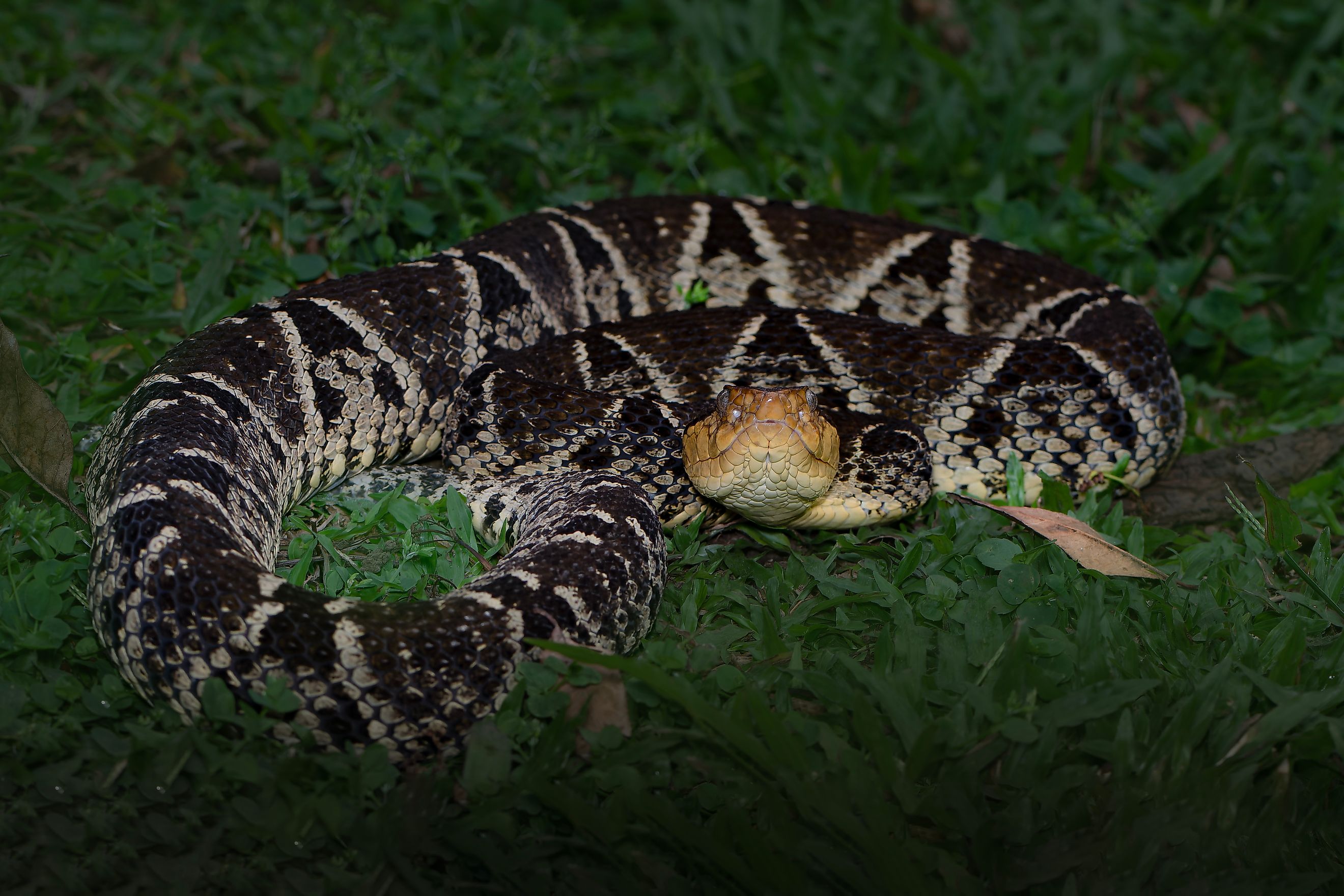
Fer-de-Lance
The fer-de-lance is the snake most responsible for serious snakebite across tropical America, and the animal the name usually points to is Bothrops asper, a large, heavy-bodied pit viper of the Neotropical lowlands. Across Central America and northern South America it accounts for the majority of dangerous envenomations, a record that has earned it the description of the most medically important snake in the region.
"Fer-de-lance" is French for the head of a lance, a nod to the animal's narrow, spearpoint-shaped head. The name was first attached to Bothrops lanceolatus, the lancehead of Martinique, then spread across the wider genus. Today most authorities apply it to B. asper (known locally as terciopelo or barba amarilla) and to the common lancehead, Bothrops atrox, of South America. This profile centers on B. asper, the archetypal fer-de-lance, and notes its close relatives where they differ.
What makes the snake worth understanding is not only its venom. It is one of the most adaptable predators in the American tropics, it thrives on the edges of farms and villages, and it produces some of the largest litters of any snake on the continent. It is also a workhorse of medical research, since its venom drives much of the antivenom production in Latin America.
Taxonomic Classification

The fer-de-lance belongs to Viperidae, the viper family, and within it to the pit viper subfamily Crotalinae. Its genus, Bothrops, contains roughly 50 species distributed across tropical America. The genus name comes from Greek (bothros, meaning "pit," and ops, meaning "face" or "eye"), a reference to the heat-sensing facial pits shared by all pit vipers. The species Bothrops asper was described by the naturalist Samuel Garman in 1884. Its epithet, asper, is Latin for "rough" or "harsh," pointing to the snake's strongly keeled scales. No subspecies are currently recognized. The species varies so much across its range, however, that biologists often treat it as a species complex, and DNA studies continue to refine the boundaries between it and lookalikes such as the common lancehead, B. atrox.
Physical Description

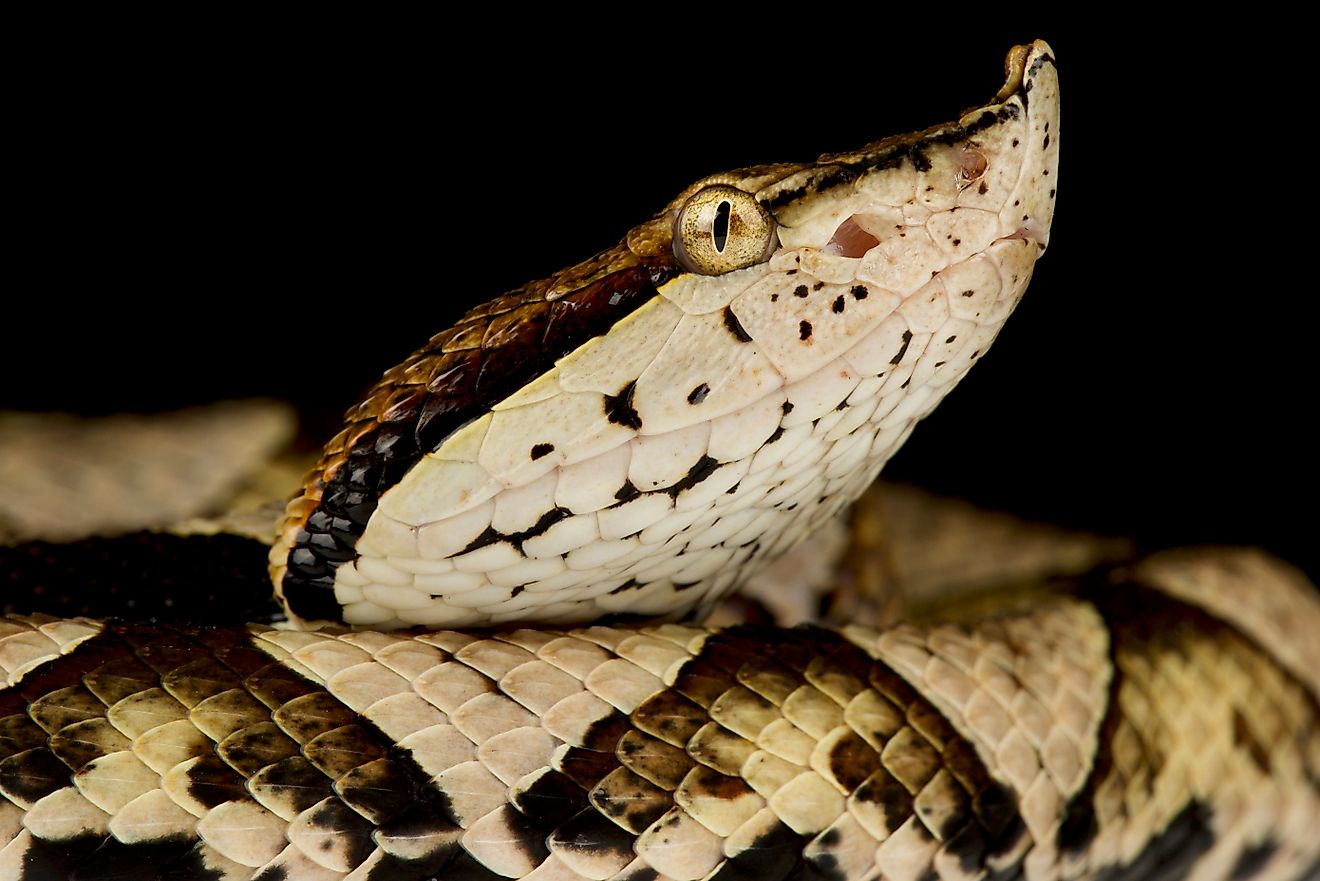
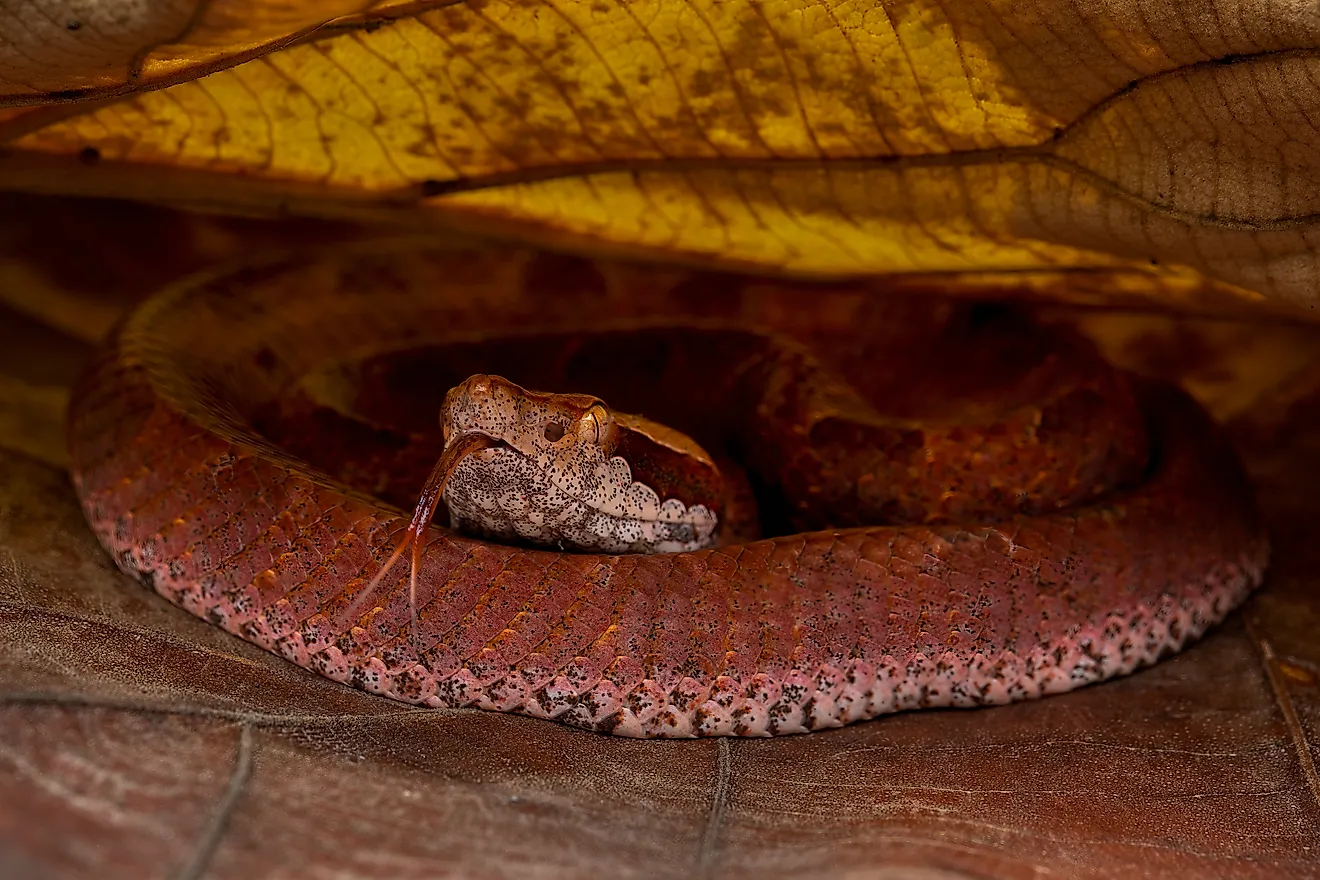
Adults typically measure 4 to 6 feet (1.2 to 1.8 m), with exceptional individuals reaching about 8 feet (2.5 m) and weights approaching 13 pounds (6 kg). The body is thick and muscular, and the head is broad and triangular, clearly set off from a narrow neck. Between each eye and nostril sits a loreal pit, the heat-sensing organ that lets the snake detect warm-blooded prey in the dark. Long, hinged fangs (a solenoglyphous arrangement) fold back against the roof of the mouth and swing forward to strike, injecting a large volume of venom in a single bite.
Dorsal scales are keeled, giving the skin a rough texture that matches the animal's Latin name. Coloration runs brown, olive, or gray, overlaid with dark triangles or diamond shapes edged in pale scales, plus a dark stripe behind the eye. A pale, yellowish jaw and belly explain regional names like barba amarilla ("yellow beard") and yellow-jaw. Sexual size dimorphism is pronounced and female-biased. Females grow considerably larger and heavier, reaching sexual maturity at total lengths of about 43 to 47 inches (110 to 120 cm), while males mature nearer 39 inches (99.5 cm). Males carry proportionally longer tails and, as juveniles, a bright tail tip that fades with age.
Range and Habitat

The fer-de-lance occurs across southern Mexico, throughout Central America, and into northwestern South America, reaching Colombia, Venezuela, Ecuador, and the far north of Peru. Populations live on both the Caribbean and Pacific slopes, and even on the island of Gorgona off the Colombian coast. It is fundamentally a lowland animal of humid tropical forest, yet it climbs to surprising elevations in the Andes, with records near 8,200 feet (2,500 m) in Venezuela and higher still in Colombia. Crucially, it does not need untouched wilderness. It readily occupies plantations, pastures, riverbanks, and the outskirts of towns, and this overlap with farmland is a major reason people encounter it so often.
Diet

As a sit-and-wait ambush predator, the fer-de-lance coils in leaf litter or low cover and waits for prey to pass. It is a dietary generalist, and its menu changes as it grows, a pattern known as an ontogenetic diet shift. Juveniles mainly feed on cold-blooded prey, including frogs, lizards, and invertebrates such as centipedes. Young snakes often use caudal luring, twitching a contrasting tail tip to draw a curious frog or lizard within striking range. As the snake matures, its diet shifts toward warm-blooded prey, chiefly rodents and birds, and large adults become mammal specialists. After a strike, the snake usually releases bigger prey, then follows the scent trail once the venom has taken effect. Its appetite for rodents makes it an effective, if unwelcome, form of pest control around agriculture.
Behavior

The fer-de-lance is largely nocturnal and crepuscular in the hot lowlands, though it may be active by day in cooler or rainy weather. Adults are terrestrial, while juveniles are more willing to climb through low vegetation. Its first line of defense is camouflage, and it relies on stillness and a cryptic pattern to avoid notice. When disturbed, it usually tries to flee, but a cornered adult can reverse course abruptly and strike quickly and repeatedly. Field biologists have described it as excitable and unpredictable, and one influential review dubbed it the "ultimate pit viper." That combination of good camouflage, fast defensive strikes, and a habit of resting on trails and farm edges is exactly what makes accidental bites so common.
Venom and Envenomation

The fer-de-lance has hemotoxic and proteolytic venom rather than neurotoxic venom, meaning it primarily affects the blood, blood vessels, and soft tissue rather than the nervous system. Delivered through long, hinged fangs, it is a protein cocktail dominated by metalloproteinases, phospholipases A2, and serine proteases. A serious bite brings rapid pain and swelling, blistering, and tissue death (necrosis) that can require surgery or amputation, along with disrupted clotting, internal bleeding, shock, and acute kidney injury. The venom is not uniform. It varies across the snake's large range, and juvenile venom is more strongly coagulant and faster-acting than an adult's. Antivenom is the only validated treatment, and speed matters. Laboratories across Latin America produce polyvalent products raised against Bothrops venoms, and because related lanceheads share many toxins, one antivenom often neutralizes several species. The venom that makes this snake dangerous is also the raw material that saves lives.
Reproduction

Like other pit vipers, the fer-de-lance is viviparous, giving birth to live young rather than laying eggs. It is often called the most prolific snake in the Americas, and the numbers back that up. Litter size tracks the mother's body size and varies by region. Pacific-slope populations in Costa Rica average roughly 19 young per litter, while Atlantic-slope females average around 41, with the largest litters exceeding 80. Gestation lasts about 6 to 8 months. Newborns measure roughly 10 to 14 inches (25 to 35 cm) and are fully independent at birth, equipped with working fangs and venom that is actually more potent than an adult's. Females can store sperm for extended periods, and mating seasons differ across the range. Individuals reach maturity at around three years and, in favorable conditions, may live 20 years or more.
Importance to the World

Ecologically, the fer-de-lance sits in the middle of the food web. It suppresses populations of rodents and other small animals, and it is itself prey for coatis, tayras, peccaries, wild cats, monkeys, and birds of prey. Because its diet shifts with age, a single species links amphibian and mammal food chains. Medically and economically, the snake's venom is a genuine resource. It is milked to produce the polyvalent antivenoms used to treat bites across Latin America, and its toxins, including metalloproteinases, phospholipases, and serine proteases, are studied for what they reveal about blood clotting and tissue damage, with potential pharmaceutical applications.
Threats

The fer-de-lance is listed as Least Concern on the IUCN Red List, assessed in 2013 and published in 2021. Its wide range, high abundance, and tolerance for human-altered landscapes keep it secure overall, even as local populations decline in heavily deforested or urbanized areas such as parts of Ecuador. The more pressing story runs the other way. This is one of the deadliest snakes to humans in the Americas. Across its range it is blamed for 50 to 80 percent of snakebites and 60 to 90 percent of deaths from Bothrops envenomation. Its venom is hemotoxic and proteolytic, producing intense pain and swelling, blistering, tissue death that can require amputation, disrupted blood clotting, internal bleeding, and acute kidney injury. The World Health Organization classifies snakebite envenoming as a neglected tropical disease. Prompt antivenom treatment is the only validated therapy, and it sharply reduces the risk of death.
Takeaway
The fer-de-lance is a superbly camouflaged ambush hunter that is also one of the most consequential animals for human health in tropical America. Its success comes from flexibility in diet, in habitat, and in the sheer number of young it produces, which lets it thrive in exactly the farmed and settled landscapes where people are most likely to meet it. It is not endangered, and its outlook is secure. The real challenge it poses is a public-health one, and that challenge is being answered through better antivenoms and through study of the very venom that makes this snake so formidable.
Fun Facts

- Named for a weapon: "Fer-de-lance" is French for the head of a lance, describing the snake's pointed, spear-shaped head.
- The babies are the most dangerous: newborns arrive with venom that is more toxic and faster-acting than an adult's, and they can bite from their first day.
- A living lure: juveniles twitch a brightly colored tail tip to trick frogs and lizards into striking distance.
- Record-breaking litters: a single female can give birth to more than 80 young, arguably making it the most prolific snake on two continents.
- Medicine from venom: its toxins feed both antivenom production and research into human blood clotting.
Quick Facts
- Scientific name: Bothrops asper (the archetypal fer-de-lance)
- Family / order: Viperidae (subfamily Crotalinae); order Squamata
- IUCN status: Least Concern
- Length: 4 to 6 feet (1.2 to 1.8 m) typical; up to about 8 feet (2.5 m)
- Weight: up to about 13 pounds (6 kg)
- Lifespan: up to 20 years or more in the wild
- Diet type: Carnivore (ambush predator)
- Range: Southern Mexico, Central America, and northwestern South America