Caimans are fascinating reptiles belonging to the crocodilian family. Like crocodiles, alligators, and gharials, they are part of Archosauria, an ancient group that also includes dinosaurs and modern birds. The crocodilian lineage can be traced back more than 200 million years, making it one of the oldest surviving vertebrate lineages on Earth. Although modern crocodilians retain many characteristics of their ancient ancestors, they have continued to evolve and adapt over time. Caimans are closely related to alligators and share a common evolutionary history with other living crocodilians.
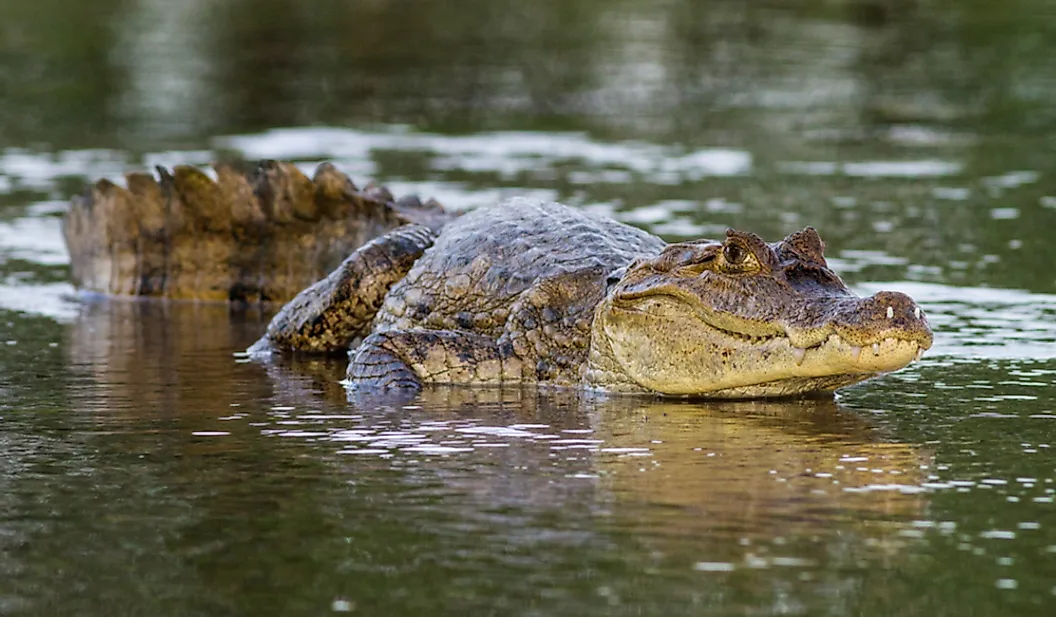
A black caiman in a water body in the Amazon Rainforest
Caimans are New World crocodilians belonging to the family Alligatoridae. The term "caiman" refers to several species found primarily in Central and South America. Taxonomically, they belong to the kingdom Animalia, phylum Chordata, class Reptilia, order Crocodilia, and family Alligatoridae. Although modern caiman species evolved relatively recently, they are part of an ancient crocodilian lineage that dates back more than 200 million years. Like dinosaurs and modern birds, caimans belong to the archosaur group of reptiles and share a distant common ancestor with them.
Physical Description
The spectacled caiman is the most common crocodilian species in the world.
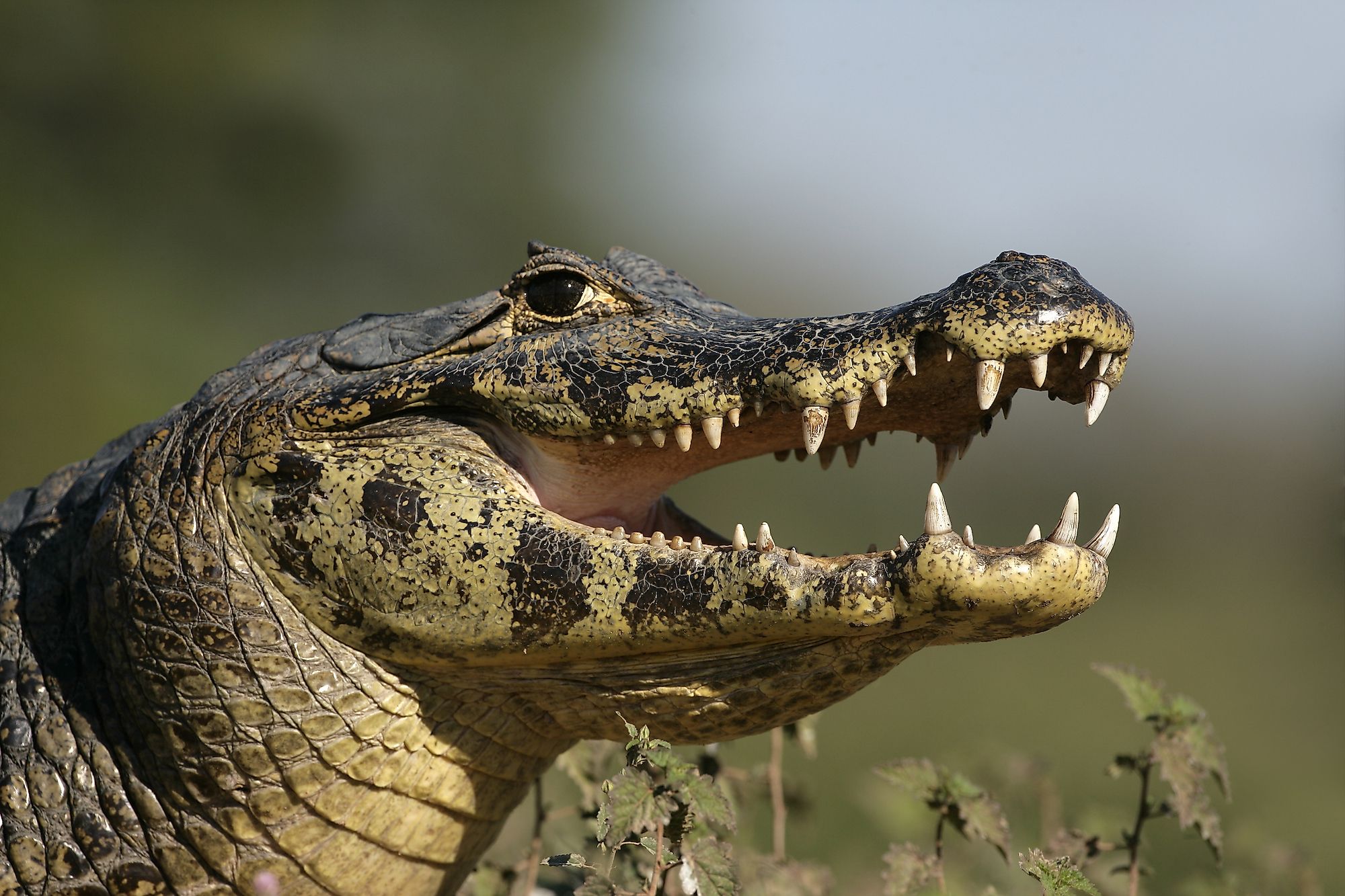
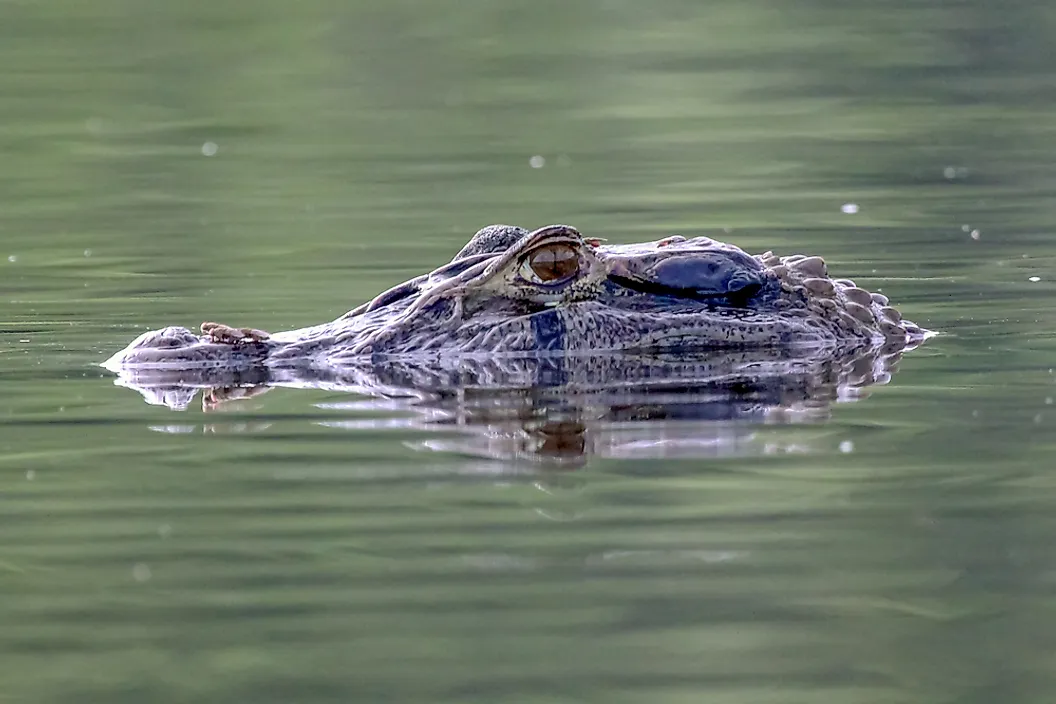
Caimans have thick, tough, scaly skin, and their broad, armored bodies are covered with bony scutes known as osteoderms (or dorsal osteoderms). Their undersides and bellies typically have very strong plates, and their coloration ranges from black to brown to green. Sometimes, especially on their underside, you’ll see tans, creams, whites, yellows, and even some stripes and spots of different colors. Their snout is quite broad and U-shaped, more typical of an alligator's than a crocodile's. Eyes and nostrils high on their heads enable them to submerge their bodies while keeping a low profile without completely surfacing.
A caiman's tail is incredibly strong, powerful, and muscular, and they are laterally compressed to help with propulsion, especially while swimming. Their strong limbs help them move on land to their nesting sites and between bodies of water. Caimans continuously replace their teeth throughout their lives as worn or damaged teeth are shed and replaced by new ones. The new set of teeth will grow into place beneath the existing ones until the old ones begin to shed and fall out. Their upper jaw overlaps their lower jaw, a characteristic of alligatorids. Combined with powerful jaw muscles, this contributes to their strong bite force. Caiman’s eyes are adapted for a semi-aquatic lifestyle; they have a reflective layer that helps them see in low light and a clear third eyelid, known as a nictitating membrane. They also have protective covers, or flaps, that sit over their ears, throat, and nose to prevent water from entering. This allows them to attack and catch prey in the water without the water going down their throats into their lungs. One species of caiman, the spectacled caiman (Caiman crocodilus), has bony protrusions and ridges around the eyes.
Habitat and Range
Caimans in the Pantanal wetlands.
They are native to much of Central and South America. Although they are not native to the United States, introduced populations of spectacled caimans have become established in parts of Florida. Most caimans inhabit freshwater environments such as rivers, lakes, marshes, wetlands, and flooded forests, although some species may also occur in mangrove and brackish-water habitats. They build nests on land using vegetation, mud, and soil, usually close to water.
The black caiman is one of the largest crocodilian species.
The spectacled caiman is the most widespread and abundant caiman species. Relatively small compared to some other caimans, it inhabits a wide variety of freshwater systems, including rivers, streams, wetlands, and flooded forests. The dwarf caiman (Paleosuchus palpebrosus) is one of the smallest caiman species and is commonly found in rainforest rivers, streams, and wetlands. It spends more time on land than many other caimans and is often associated with forested habitats and clear, flowing water. The black caiman (Melanosuchus niger) is the largest living species of caiman. It is typically found in large rivers, lakes, wetlands, and flooded forests throughout the Amazon Basin. The yacaré caiman (Caiman yacare) is a medium-sized crocodilian commonly found in swamps, rivers, lagoons, and wetlands throughout central South America, while the broad-snouted caiman (Caiman latirostris) is recognized by its short, wide snout and is most often found in slow-moving waters such as marshes, swamps, mangroves, and other wetland habitats.
Diet
Black caimans showing their teeth.
Caimans are semi-aquatic predators, hunting both on land and in the water. Young caimans eat small fish and invertebrates, while adult caimans consume a wide variety of prey, including mammals, capybaras, peccaries (wild pigs), turtles, birds, and fish. Given the size of a black caiman, they tend to go for much larger prey on land. Caimans also feed opportunistically, meaning they will hunt and scavenge. As opportunistic feeders, caimans will both hunt live prey and scavenge carrion when available.
Behavior
Caimans gather in a Pantanal waterway.
Adults bellow and roar, especially during breeding. Scientists study crocodilian vocalizations because they may provide clues about the types of sounds some dinosaurs could have produced. Caimans spend more of their time during the day resting in the water, or on the banks of rivers or the shoreline of other bodies of water. They often lie out in the sun for extended periods to sun themselves and regulate their body temperature, and are most active at night, especially when hunting. They have extremely sensitive pressure receptors, known as facial integumentary sensory organs. This allows them to detect ripples in the water, which is crucial for hunting in murky water environments.
They hunt by ambushing, floating completely still, with their eyes and nostrils above the water. When prey comes close, they wait for the perfect moment and strike rapidly from a concealed position, giving the prey no time or warning to escape. They will lunge out of the water, using their strength and speed to knock the unsuspecting prey off balance. If a caiman cannot swallow their prey whole, they will either drown them or perform a movement known as the death roll. The death roll is used to kill their disoriented prey, helping tear apart large prey and gain leverage when handling animals too large to swallow whole. Caimans are fierce and capable predators. On land, caimans can move surprisingly quickly over short distances, although they are generally much faster and more agile in the water. Commonly, caimans range from 6 to 16 feet (1.8 to 4.9 m) in length, depending on the species, and can weigh anywhere from 120 to 1,000 pounds (54 to 454 kg). Large male black caimans often weigh more than 750 pounds (340 kg). They can live between 30 and 60 years old, but most commonly to around 40 in the wild.
Reproduction
A juvenile caiman
Caimans typically reach sexual maturity between 4 and 10 years of age, depending on the species, sex, and environmental conditions. Breeding season also varies depending on species. For example, black caimans generally breed during the dry season, while many spectacled caiman populations breed during the wet season. Females typically lay clutches of around 20-50 eggs, depending on the species. Like many crocodilians, caimans exhibit temperature-dependent sex determination, meaning the nest temperature influences whether hatchlings develop as males or females. Both males and females often mate with multiple other caimans within a single mating season, which can increase genetic diversity among the offspring. Fertilization happens internally, and the females will guard their nests until their eggs hatch. Once they’re born, the mothers will assist them in making their way from the nest into the water safely. Some species tolerate young in certain areas, while others do not.
Threats
A jaguar drags a caiman into the forest.
Despite belonging to an ancient crocodilian lineage, caimans face numerous modern threats. Habitat loss caused by deforestation, wetland drainage, and human development is one of the greatest challenges to many populations. Human-caiman conflict can also occur when people and caimans occupy the same areas. In some regions, caimans are illegally hunted for their skins, meat, teeth, skulls, and other body parts, although legal protections have helped many populations recover. Poorly managed wildlife tourism, habitat disturbance, and direct human interference can negatively affect caiman populations and their habitats.
Adult caimans have relatively few natural predators due to their size, strength, and armored bodies. Jaguars are among their most significant natural predators, particularly in South America, while large snakes such as anacondas may occasionally prey on smaller individuals. Juvenile caimans face far greater risks and can be preyed upon by birds, mammals, snakes, large fish, and other reptiles. Responsible ecotourism and conservation programs can help protect caimans, while habitat destruction and poorly managed human activities may negatively impact their populations.
Anaconda vs caiman
Caimans are crucial to their ecosystems' food webs. They help control freshwater food sources and create balance for other creatures by eating aquatic and shoreline animals. Through their movements, nesting activities, and use of wetlands, caimans can help create and maintain small depressions and waterways that may provide refuge for fish and other wildlife, particularly during dry periods. These channels are known as gator or caiman holes and are crucial in providing a safe water source for many species. This is especially important for their ecosystems during times of drought. As scavengers, they also help remove carcasses, thereby recycling nutrients into the surrounding land and water.