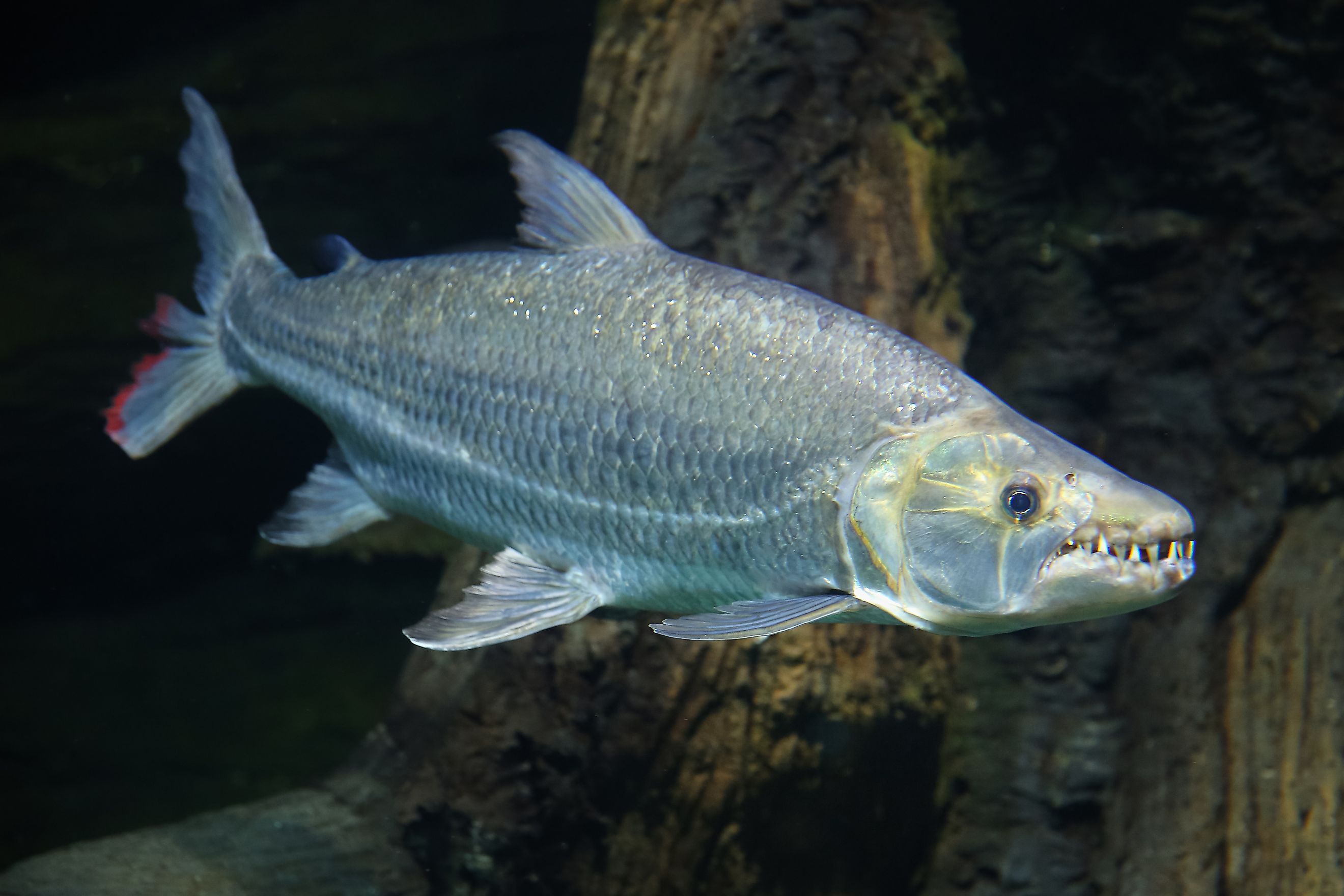
Goliath Tigerfish
Central African locals often refer to the goliath tigerfish as a "demon fish"; some river communities even believe the animal's ghastly disposition stems from the work of evil spirits. Hydrocynus goliath is indeed a ferocious African predator that dominates the freshwater systems of the Congo River Basin and certainly deserves its reputation. In short, this nightmare-inducing aquatic beast typically measures around 4.9 ft (1.5 m) and often weighs a staggering 110 lb (50 kg). Truly, its overall appearance is that of a Hollywood movie monster, with its most prominent feature being its rows of jagged, razor-sharp teeth, measuring up to an inch (2.54 cm) on average. In short, their front teeth are devoted to tearing flesh and/or violently mincing it into smaller pieces.
Range And Habitat

Often found thriving in warmer, deeper, highly oxygenated waters, the goliath (also sometimes referred to as the Giant Tigerfish) is considered to be an apex predator and native to Central and West Africa. It is primarily centered in the Congo River Basin, as well as Lake Tanganyika and the Lualaba River.
The larger geographic overview of their territory would include the Democratic Republic of the Congo (DRC), the Republic of the Congo, and Tanzania. In short, the goliath tigerfish is a true jungle fish, with its water temperature habitat requirements being around an average of 80°F (or 27°C). In fact, it has been said that this fish is "highly sensitive" to water temperatures. This is also a decidedly solitary hunter and tends to cover vast stretches of water; however, daily patrols are carried out in their home rivers. They can also be seen seeking out bankside vegetation during the hot months when it comes time for the mature adults to begin spawning.
Food

Like a shark in freshwater, the goliath tigerfish is primarily piscivorous, feeding on insects, other fish, and fish eggs. Likewise, it is not limited to other fish either; this ungentle giant has been said to also feast on waterbirds, various small mammals, or even baby crocodiles! As juveniles, most will start by feeding on animal plankton and then move on to smaller fish and insects as their development cycle proceeds, much as one would expect. The adults take every opportunity to use their dagger-like teeth to violently rip other animals apart (chunks at a time). In other words, these are not picky eaters (they have no preferred prey of choice); they will gulp down any other fish they can wrap their mouth around. Additionally, it has been said that they can take on any fish that is up to 40% of their body length.
Physical Description

Essentially, the goliath tigerfish looks like a scaled-up version of a Piranha, and both fish belong to the same order of Characiformes. The typical specimen will be an average of 4.9 ft (1.5 m) and weigh up to 110 lb (50 kg), as previously noted.
Actual accounts of fatal attacks on humans are very rare, even though it would appear that they are more than physically capable. Interactions with these fish can result in severe lacerations if they are disturbed, hooked, or otherwise provoked. Again, its most obvious feature is its 32 razor-sharp teeth, which are visible even when its mouth is closed. One could think of these animals as river athletes of sorts, as their torpedo-like (thunniform) bodies are built for sudden, rapid acceleration, general high-speed swimming, and overall agility in the water.
True predators in more ways than one, the biology of the Giant Tigerfish has terrifyingly adapted to further aid them in their tasks. For instance, they possess both keen eyesight for underwater hunting and special organs that detect splashing and fast movements. To further elucidate this, we turn to brainfacts.org, which describes this rather fishy detection system: The goliath tigerfish detects low-frequency vibrations using two specialized systems: its lateral line (a row of sensory cells across its body) and a gas-filled air sac that acts as a sophisticated receiver. In other words, these two systems work in concert, acting as an advanced vibration-detection system.
Behavior

One of the stock-in-trade methods the goliath utilizes when hunting is to perch itself amidst strong river currents, which it uses to ambush prey. For example, it might position itself just below some rapids, then, using its streamlined body, bolt into the rushing water, thereby surprising passersby. While their solitary nature is a given, small packs of 2-5 fish have also been observed. Any type of group behavior is vastly underplayed by the aggression typically shown to one another; however, they are somewhat unhesitatingly cannibalistic. Tigerfish are also known to be extremely fearless hunters, not afraid to take serious risks or even leap out of the water to snag birds. Moreover, and somewhat perplexingly, researchers have noted that the goliath seems wholly unafraid of crocodiles as well.
Reproduction

Goliath tigerfish are not the best parents in the animal kingdom, in all honesty. They will typically leave the nest site immediately after spawning and offer no continued protection or feeding routines for their young. Similarly, they are not monogamous - their mating system is entirely promiscuous, which means no long-lasting pair bonding of any kind. While their solitary, apex-predator nature has already been discussed at length, during the breeding season, females might actually buck that trend and travel in groups and congregate near shores. Speaking of which, a single large female can produce half a million eggs in a season (an inflated figure which is meant to offset the obvious high infant mortality). Their eggs are often hidden among underwater vegetation, which acts as natural camouflage, even for the hatchlings.
Importance to the world

The goliath tigerfish serves as a keystone species, playing a primary role in culling weaker species and preventing overpopulation in its ecosystems. However, its usefulness extends to the land, as Many communities within its range regard it as an important food source, and, of course, it draws much attention from international tourists. In fact, the goliath has been called the "greatest freshwater game fish in the world" by some.
Fun Facts about the Goliath Tigerfish
- Shark-Like Teeth: The goliath tigerfish has 32 razor-sharp, interlocking teeth, each measuring up to 1 inch (2.5 cm). The teeth fit into grooves in the opposing jaw, creating a powerful, trap-like bite when the mouth snaps shut.
- Constant Tooth Replacement: Like sharks, goliath tigerfish continually replace lost or damaged teeth throughout their lives, ensuring they always have a formidable set of weapons for hunting.
- A Giant Among Freshwater Fish: These predators can grow up to 5 feet (1.5 m) long and commonly weigh more than 110 pounds (50 kg). The largest recorded specimen reportedly weighed around 154 pounds (70 kg).
- Fearless Hunters: Unlike many freshwater predators, goliath tigerfish have been observed attacking prey near crocodiles and are known to hunt juvenile crocodiles on occasion.
- Bird Catchers: They are capable of leaping from the water to snatch low-flying birds, a hunting behavior more commonly associated with marine predators.
- Featured on River Monsters: The species gained international attention after appearing on the popular television series, where host Jeremy Wade showcased the fish's immense size and fearsome appearance.