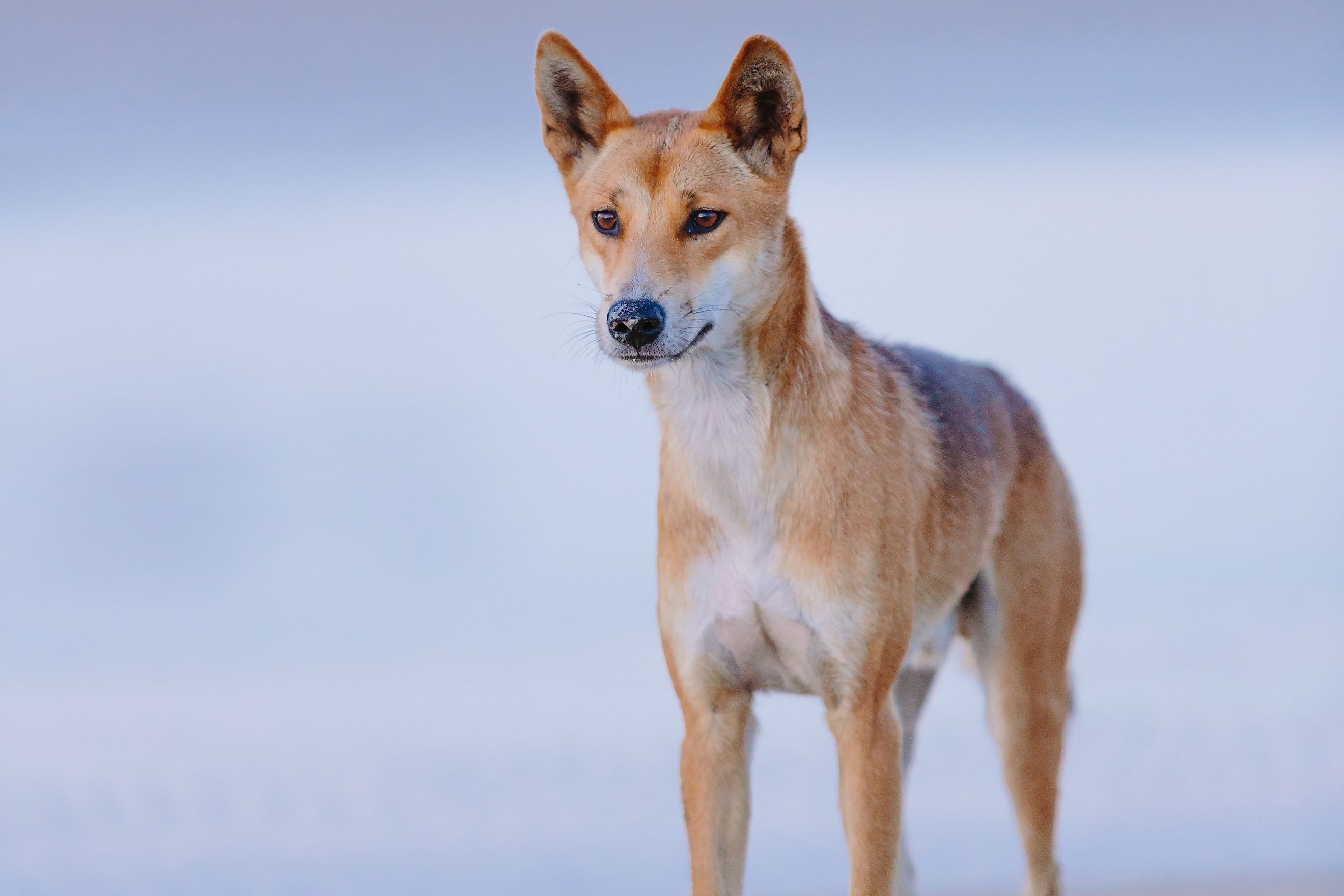
Dingo
The dingo is Australia's largest land predator, a lean, sandy-coated wild canid that arrived on the continent roughly 3,000 to 5,000 years ago and now occupies the top of the food chain. Adults are about the size of a medium dog, weighing 22 to 33 pounds (10 to 15 kg), and they range across most of mainland Australia, holding on across deserts, woodlands, and alpine snow country alike, as well as parts of Southeast Asia. They take prey as small as insects and as large as kangaroos, and they typically live in territorial packs led by a breeding pair. Unlike domestic dogs, dingoes communicate mainly through howling rather than barking.
Two features set the dingo apart from many other carnivores. First, its classification remains disputed. Scientists disagree over whether it should be considered a distinct species, a subspecies, or an ancient breed of domestic dog, and this uncertainty means it does not have a clear IUCN Red List status. Second, its place in modern Australia remains contested. Dingoes are protected as native wildlife in some jurisdictions but killed as livestock pests in others. Their ecological importance, however, is much less disputed. Free-ranging dingoes help suppress feral cats and foxes, control rabbits and overgrazing herbivores, and influence the wider balance of the ecosystems they inhabit.
Taxonomic Classification

The dingo belongs to the kingdom Animalia, phylum Chordata, class Mammalia, and order Carnivora. Its family, Canidae, is the same one that includes wolves, jackals, and domestic dogs. Beyond the family level, its classification becomes unsettled. The dingo has been classified under several names over the years, including Canis familiaris, Canis familiaris dingo, Canis lupus dingo, and Canis dingo. German naturalist Friedrich Meyer first described it in 1793.
The disagreement is not trivial. Some researchers treat the dingo as a distinct species, Canis dingo, pointing to its long isolation and unique traits. Others, including a 2020 review by the American Society of Mammalogists and a detailed taxonomic study the same year, conclude that the correct name is simply Canis familiaris, the domestic dog, arguing there is too little morphological difference and full interfertility between dingoes and dogs. The IUCN Canid Specialist Group takes this view too, treating the dingo as a feral form of the domestic dog. The dingo is closely related to the New Guinea singing dog, and both split early from the lineage that produced today's breed dogs. That ancestry traces back through Maritime Southeast Asia to mainland Asia, and dingoes reached Australia roughly 3,000 to 5,000 years ago.
Physical Description

The dingo is a medium-sized, athletic canid built for endurance rather than power. Head and body length runs about 3.5 to 4 feet (1.1 to 1.2 m), with a bushy tail adding another 12 to 13 inches (30 to 33 cm). Most adults weigh between 22 and 33 pounds (10 to 15 kg), though some populations run lighter. The build is lean and long-legged, with a broad head that is the widest part of the body, a pointed muzzle, and erect ears that can rotate to track sound.
Coat color is typically ginger to sandy yellow, though variations toward reddish, cream, tan, and black do occur. Wild-type animals usually carry pale markings on the chest, feet, and tail tip. On K'gari, off the Queensland coast, dingoes are commonly a golden sandy color and often carry white "socks" on their feet along with a white tail tip. Pups are frequently born with black on the back and tail that fades with age. The dingo differs from breed dogs in more than looks. It has notably flexible wrists and a highly mobile neck, and recent work has even found a distinct plasma chemistry, evidence that this lineage has not passed through the artificial selection that shaped domestic breeds.
Range and Habitat

Dingoes occur across most of mainland Australia and are absent only from Tasmania, which they never reached. Their range is remarkably broad. They live in hot deserts, tropical rainforests, temperate woodlands, grasslands, and even snow-covered alpine country. They tend to favor the edges of forests where woodland meets more open grassland, terrain that offers both cover and hunting ground.
Populations also persist in parts of Southeast Asia, a legacy of the animal's origins in that region. Individual dingoes usually hold to a defined home territory, but they can cover long distances when conditions turn harsh or when young animals disperse to find territory of their own. Dingoes inhabit Australia's arid interior, tropical north, and offshore islands such as K'gari. Genetic studies have identified at least three major lineages, including populations in the northwest, the southeast, and the isolated group on K'gari.
Diet

The dingo is an opportunistic carnivore with a strikingly flexible diet. The bulk of its food is meat, and it takes prey as small as insects and lizards and as large as animals many times its own size. Kangaroos, wallabies, rabbits, rodents, wombats, birds, and reptiles are all standard fare, and in the Northern Territory, dingoes are known to hunt water buffalo. Since introduced species arrived, the dingo's diet has expanded to include feral pigs, goats, deer, hares, cats, and foxes. Coastal and island animals add crabs, fish, and other aquatic prey, and dingoes will also eat fruit and plant matter when hunting is poor.
Hunting strategy scales with the target. A dingo will hunt alone or in a small group for smaller prey, then coordinate as a pack to bring down large animals like adult kangaroos. Hunting peaks at dawn and dusk and continues through the night. During times of plenty, dingoes may cache surplus food by burying it for later. Notably, livestock makes up only a small fraction of the natural diet. Research has long indicated that dingoes prefer wild prey and turn to sheep or cattle mainly when native food is scarce.
Behavior

Dingoes are social animals that live in packs of two to about a dozen individuals, though solitary animals are also common, especially among dispersing young. A stable pack is organized around a dominant breeding pair, and it defends a well-defined territory from neighboring groups. Members communicate through a rich vocabulary of whines, growls, and above all, howls, the wolf-like calls that carry across long distances. Unlike domestic dogs, dingoes rarely bark.
Body language matters as much as sound. A tall, stiff posture signals dominance while a low, crouched one signals submission, and courting animals groom, wrestle, and flick their tails. Dingoes are most active in the cooler hours and generally avoid the heat of the day in hot regions. Studies using GPS collars show that movement patterns shift with sex and social rank, particularly around the breeding season, when subordinate males in particular range more widely beyond the pack's core territory.
Reproduction

Dingoes breed once a year, a key difference from domestic dogs, which can breed twice. In Australia, mating generally falls in autumn, between roughly March and June, while Southeast Asian animals breed later in the year. Gestation lasts about 63 days, and a female gives birth in a den, a cave, a hollow log, or a space beneath a rock ledge, to a litter that usually numbers four to six pups.
Within a pack, breeding is normally restricted to the dominant pair, and the rest of the group helps rear the young. Where subordinate females do produce litters, dominant animals sometimes kill those pups, concentrating the pack's effort on a single brood. Pups are weaned at around two months and begin taking small prey soon after. They typically stay with the family for six to eight months before striking out or remaining as pack members. Sexual maturity comes at roughly one to two years. In the wild, dingoes generally live around five to ten years, though animals in captivity can reach about fifteen.
Importance to the World

As Australia's apex mammalian predator, the dingo plays a role few other animals can fill. After the mainland extinction of the thylacine, or Tasmanian tiger, the dingo effectively became the continent's top land carnivore, a position it took over between roughly 3,000 and 5,000 years ago. From that position, it exerts strong top-down control on the ecosystems around it.
The clearest benefit is the suppression of feral predators. Because dingoes hunt, harass, and displace feral cats and foxes, and because those smaller predators avoid areas where dingoes are active, a healthy dingo population indirectly protects the small and medium-sized native mammals, reptiles, and birds that cats and foxes devastate. Dingoes also prefer large prey such as kangaroos and wallabies, easing grazing pressure and helping vegetation recover, and they curb feral herbivores like goats and rabbits. The dingo also holds deep cultural significance. It has been part of Aboriginal life and traditions for thousands of years and is widely regarded as a cultural keystone species.
Threats and Conservation

The dingo occupies an unusual and precarious position. Because of the ongoing taxonomic debate, it has no clear standalone listing on the IUCN Red List, since the bodies that assess dogs treat it as a feral domestic animal rather than a wild species. That gap in formal status masks real conservation concern for wild-type dingoes.
The single greatest threat is hybridization. Interbreeding with domestic and feral dogs is steadily diluting wild dingo genetics, and in many regions the animals now living wild are partly dog. The second major pressure is direct persecution. Dingoes kill livestock, especially sheep, so they have long been trapped, shot, and poisoned across grazing country. The most dramatic expression of this is the Dingo Fence, which at about 5,614 kilometers (3,488 miles) is one of the longest structures on Earth, built to keep dingoes out of the sheep lands of the southeast. Dingoes have a complicated legal status. They are protected as native wildlife in national parks, Aboriginal reserves, and some states, but are classified as pests and subject to lethal control in other areas. In Victoria, they are also listed as threatened.
Island populations show the stakes clearly. The dingoes of K'gari, numbering only around 70 to 170 animals, may be among the purest strains left because they have not crossbred with domestic dogs to the degree mainland populations have. Yet that same isolation has left them with low genetic diversity and signs of inbreeding, and rising tourism has fueled conflict with people. Conservation of wild dingoes now depends on protecting these remaining pure populations, limiting hybridization, and reconsidering the blanket removal that has reshaped so much of the Australian landscape.
Takeaway
The dingo is better understood as an established apex predator than as a domestic dog that has simply gone wild. Its ecological importance is clear. Where dingoes are present, they help control feral cats, foxes, rabbits, and herbivores that overgraze vegetation, allowing native species to thrive. When dingoes are removed, these natural controls weaken and biodiversity can suffer. For anyone weighing the dingo's reputation as a livestock pest against its role in the ecosystem, this balance is central to the debate.
Two issues will largely shape the future of wild dingoes. One is hybridization, as continued breeding with domestic and feral dogs gradually erodes pure dingo genetics, giving isolated populations such as those on K'gari particular conservation value. The other is management. Dingoes may be protected wildlife in one jurisdiction yet classified as pests in another, making a consistent conservation strategy difficult. A more practical approach would protect remaining pure populations, limit the spread of domestic dog genes, and replace broad lethal control with targeted, evidence-based methods that protect livestock without removing dingoes on a large scale. This would allow the dingo to continue its long-established role as one of Australia's apex predators.
Fun Facts

- They howl but rarely bark. Unlike domestic dogs, dingoes communicate mainly through wolf-like howls, along with whines and growls, and almost never produce the repetitive barking of a pet dog.
- They breed only once a year. Domestic dogs typically cycle twice a year, but dingoes have a single annual breeding season. This is one of several traits used to help distinguish pure dingoes from dog hybrids.
- They are built to climb and grip. Dingoes have unusually flexible wrists and a highly mobile neck, letting them turn their heads far further than a typical dog and scramble over rocks and even up trees and fences.
- They are distinct from dogs at a molecular level. Because dingoes never went through the artificial selection that shaped modern breeds, researchers have found they carry a unique blood plasma chemistry compared with domestic dogs.
- One fence built to stop them is among the longest structures on Earth. The Dingo Fence stretches roughly 5,614 kilometers (3,488 miles) across southeastern Australia, built to keep dingoes out of prime sheep country.
Quick Facts
- Scientific name: Canis familiaris (also given as Canis dingo or Canis lupus dingo; classification disputed)
- Family and order: Canidae; Carnivora
- IUCN status: Not assessed as a distinct species; treated by assessing bodies as a feral domestic dog
- Length: About 3.5 to 4 feet (1.1 to 1.2 m) head and body, plus a 12 to 13 inch (30 to 33 cm) tail
- Weight: About 22 to 33 pounds (10 to 15 kg)
- Lifespan: Around 5 to 10 years in the wild; up to about 15 in captivity
- Diet: Opportunistic carnivore (kangaroos, wallabies, rabbits, rodents, birds, reptiles, feral animals, plus some fruit and plants)
- Range: Most of mainland Australia (absent from Tasmania) and parts of Southeast Asia
- Reproduction: Breeds once a year; roughly 63-day gestation; litter of about 4 to 6 pups
- Notable trait: Australia's largest land predator and a key check on feral cats and foxes