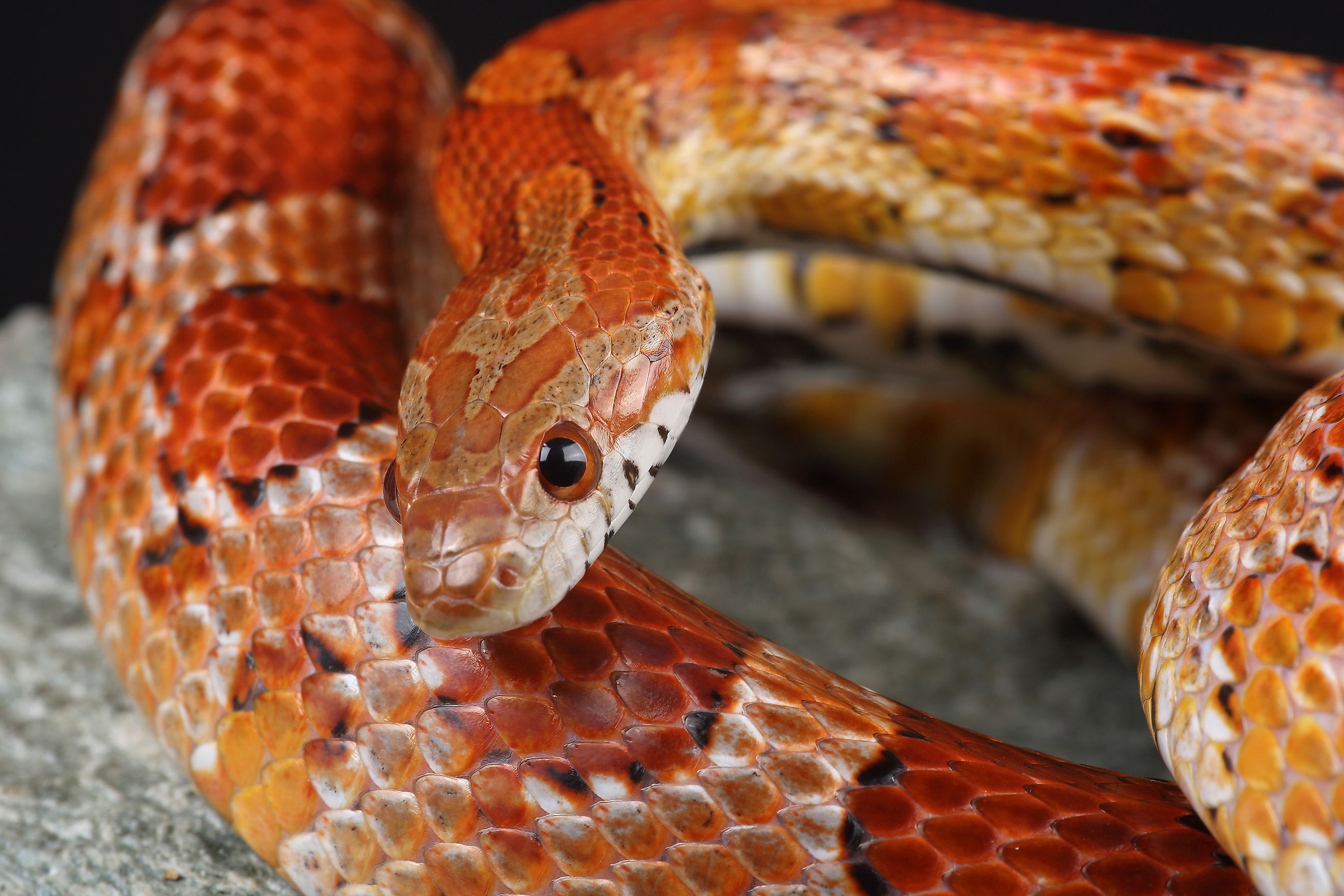
Corn Snake
The corn snake is the animal that turns wary onlookers into reptile keepers. Calm, brilliantly patterned, and rarely inclined to bite, it has become one of the most widely kept reptiles on Earth and the first snake for countless new keepers. Yet the corn snake is far more than a glass-tank animal. It is a wild North American native, a nonvenomous constrictor that has hunted rodents across the fields and forests of the southeastern United States for thousands of years.
The corn snake (Pantherophis guttatus) belongs to the rat snake group within Colubridae, the largest snake family in the world. In the wild, it ranges across the southeastern and south-central United States, where it moves through pine woods, farmland, and abandoned buildings in search of prey. Its orange body, bold red saddles, and black-and-white checkerboard belly make it one of the most recognizable snakes on the continent.
Taxonomic Classification

The corn snake sits in the kingdom Animalia, phylum Chordata, class Reptilia, and order Squamata, the group that contains all lizards and snakes. Within the suborder Serpentes it is a colubrid, a member of the family Colubridae. Carl Linnaeus first described the species in 1766 as Coluber guttatus, and for much of the twentieth century it was known as Elaphe guttata.
That name changed with modern genetics. In 2002, Utiger and colleagues showed that the genus Elaphe was paraphyletic, meaning it lumped together snakes that were not each other's closest relatives. North American rat snakes turned out to be more closely allied with kingsnakes than with the Old World rat snakes they had been grouped alongside, so they were moved into the resurrected genus Pantherophis. The corn snake became Pantherophis guttatus. The Great Plains rat snake, once treated as a subspecies, is now recognized as a separate species, Pantherophis emoryi. The corn snake is also called the red rat snake or red cornsnake, and its story is a textbook case of DNA rewriting a classification that older field guides still list the old way.
Physical Description

The corn snake is a slender, medium-sized snake. Adults typically measure 30 to 48 inches (76 to 122 cm), though the species ranges from about 24 to 72 inches (61 to 183 cm), and the record is a shade over 6 feet (182.8 cm). A large adult weighs roughly 2 pounds (about 0.9 kg), so despite the length these are lightly built animals.
The ground color is usually orange, reddish, gray, or brownish, overlaid with large red-to-brown saddles edged in black, plus smaller matching blotches along the sides. A spear-point marking often sits on top of the head. The belly is the giveaway feature, marked by a bold black-and-white checkerboard pattern that many people compare to the kernels of Indian corn. The pupils are round, the scales are weakly keeled, and there is no rattle and no facial heat pits.
Those details matter, because corn snakes are frequently confused with the venomous copperhead and killed as a result. A copperhead has hourglass-shaped crossbands, vertical cat-like pupils, and heat-sensing pits between eye and nostril. A corn snake has round blotches, round pupils, and no pits. Decades of captive breeding have also produced hundreds of color and pattern variations, called morphs, including amelanistic, anerythristic, and snow forms, which makes this one of the most visually varied snakes in the pet world.
Range and Habitat

Corn snakes are native to the southeastern and south-central United States. Florida marks the southern extent of their range, southern New Jersey the northern edge, and Louisiana the western limit through the Gulf states. They are semi-fossorial, meaning they spend much of their time below ground or under cover, and they occupy a wide spread of habitats. Pine flatwoods, hardwood hammocks, grasslands, rocky hillsides, and the edges of wetlands all suit them.
They are also comfortable around people. Farmland, barns, grain stores, abandoned buildings, and suburban margins provide both shelter and a steady supply of rodents, which is one reason the species remains common across most of its range. Through the pet trade, corn snakes have established small introduced populations well outside their native range, including on several Caribbean islands, where they are treated as a potential concern. In the deep south they share ground with a long list of native reptiles, and Florida in particular is a hotspot for both native snakes and introduced species.
Diet

The corn snake is a rodent specialist, and the common name reflects it. In the days when southern farmers stored harvested ears in wooden corn cribs, mice and rats came for the grain and corn snakes came for the mice and rats. The species eats house mice, wood rats, voles, and similar small mammals, along with birds and their eggs, lizards, and tree frogs. Hatchlings and juveniles lean on lizards and small frogs before graduating to warm-blooded prey as they grow.
Corn snakes are constrictors. They seize prey, throw coils around it, and tighten until the animal can no longer breathe, then swallow it whole. They are strong climbers and will raid bird nests and poultry houses, and they hunt both by ambush and by actively searching burrows and crevices. That appetite for rodents is the foundation of the corn snake's value to farms and homes, a point worth remembering the next time one turns up in a barn.
Behavior

Corn snakes are mostly nocturnal and crepuscular, active at night and around dusk and dawn, especially in warm weather. During the day they shelter under logs, rocks, bark, and in rodent burrows. They are agile climbers and will ascend trees and structures after prey, but they are secretive by nature and depend on camouflage and hiding rather than confrontation.
Like all snakes they are ectothermic, or cold-blooded, so they regulate their temperature by moving between sun and shade. In the cooler northern parts of the range they brumate through winter, the reptile equivalent of hibernation, retreating underground until spring warms the soil. When cornered, a corn snake may vibrate its tail against dry leaves to mimic a rattlesnake, flatten its body, or release a musky secretion, but it rarely bites and calms quickly. That gentle temperament is exactly why the species became a keystone of the pet reptile hobby.
Reproduction

Corn snakes reach sexual maturity at around 18 months, though larger, older animals make more reliable breeders. Mating follows brumation, usually between March and May, and in the far south breeding can occur across a longer season. The species is oviparous, laying eggs rather than bearing live young.
A female typically produces one clutch a year of about 10 to 15 eggs, and clutches can reach 30 in large, well-fed animals. She deposits them between May and July in a warm, humid, hidden spot such as a rotting stump, a log, or a decaying pile of vegetation. The white, cylindrical eggs incubate for roughly two months at around 82 degrees Fahrenheit (about 28 degrees Celsius), and the young hatch between July and September. There is no parental care. Hatchlings emerge around 10 to 15 inches (25 to 38 cm) long and are fully independent from the start. In captivity corn snakes commonly live 15 to 20 years, and the oldest on record reached 32 years and 3 months, while wild snakes generally live considerably shorter lives.
Importance to the World

Ecologically, the corn snake is a natural check on rodent numbers. By preying on mice and rats, it limits animals that damage stored grain, gnaw through structures, and carry disease, which makes it a quiet ally to farmers, gardeners, and homeowners. In turn, corn snakes are prey for hawks, owls, foxes, and larger snakes, so they sit in the middle of the food web as both predator and meal, helping move energy through the ecosystems they inhabit.
Their importance is not only ecological. As one of the most popular pet snakes in the world, the corn snake has introduced millions of people to reptiles and become a gateway to interest in conservation. The species is also a workhorse of scientific and hobbyist genetics, since its many color morphs make it a living lesson in how pigment genes are inherited. Set against that, the habit of killing corn snakes on sight because they resemble a copperhead removes a harmless, free rodent-control service from the landscape for no good reason.
Threats and Conservation

On the global scale, the corn snake is in good shape. The IUCN Red List assessed it as Least Concern in 2015, with a population trend listed as stable and a range and abundance large enough that it is in no danger of extinction as a species. It ranks among the harmless nonvenomous snakes that people needlessly fear, and it is nowhere near the threatened end of the reptile spectrum.
Local pressures are a different story. Habitat loss from development, road mortality, and deliberate killing because of mistaken identity with the venomous copperhead all thin corn snake numbers in places. Collection for the pet trade once added to that pressure, though captive breeding now supplies almost every pet corn snake sold. At the northern edge of the range the losses are sharp enough that New Jersey lists the corn snake as a state Endangered species. The solutions are straightforward. Protect the pine forests, fields, and rocky habitats these snakes depend on, teach people to tell corn snakes and copperheads apart to reduce unnecessary killings, and choose captive-bred animals instead of wild-caught ones.
Takeaway
Strip away the fear that snakes so often provoke, and the corn snake is simply a hard-working native doing quiet good. It clears rodents from barns and fields, feeds the hawks and foxes that hunt it, and asks nothing of people beyond a little room to live. The same gentle temperament that makes it popular in captivity also makes it largely harmless in the wild. It is a snake that prefers to hide rather than confront a threat. Its numbers remain healthy across most of its range, and its outlook stays strong wherever habitat survives and people resist the urge to kill what they mistake for a copperhead. Give it that much understanding, and one of North America's most beneficial reptiles can continue thriving in the fields and forests where it has long played its role.
Fun Facts

- Named in the barn. The name likely comes from the corn cribs where these snakes hunted rodents, and from the belly pattern that echoes multicolored Indian corn. The word "corn snake" has been in use since at least the 1600s.
- Killed by mistaken identity. Corn snakes are harmless, but their orange-and-red pattern gets them confused with the venomous copperhead, and many are killed for a threat they do not pose.
- A rainbow of morphs. Generations of captive breeding have produced hundreds of color and pattern morphs, making the corn snake one of the most variable snakes kept by people.
- Constrictors, not biters. Like their relatives among the world's larger constrictors, corn snakes subdue prey by squeezing rather than with venom.
- Long-lived companions. A well-kept corn snake can live more than two decades, far longer than many first-time keepers expect.
Quick Facts
- Scientific name: Pantherophis guttatus
- Family / Order: Colubridae / Squamata
- IUCN status: Least Concern (assessed 2015, trend stable)
- Length: Typically 30 to 48 in (76 to 122 cm); up to about 6 ft (183 cm)
- Weight: Up to about 2 lb (0.9 kg)
- Lifespan: Commonly 15 to 20 years in captivity, up to 32 on record; less in the wild
- Diet: Carnivore: rodents, birds and eggs, lizards, frogs
- Range: Southeastern and south-central United States, southern New Jersey to Florida and west to Louisiana