Caracal
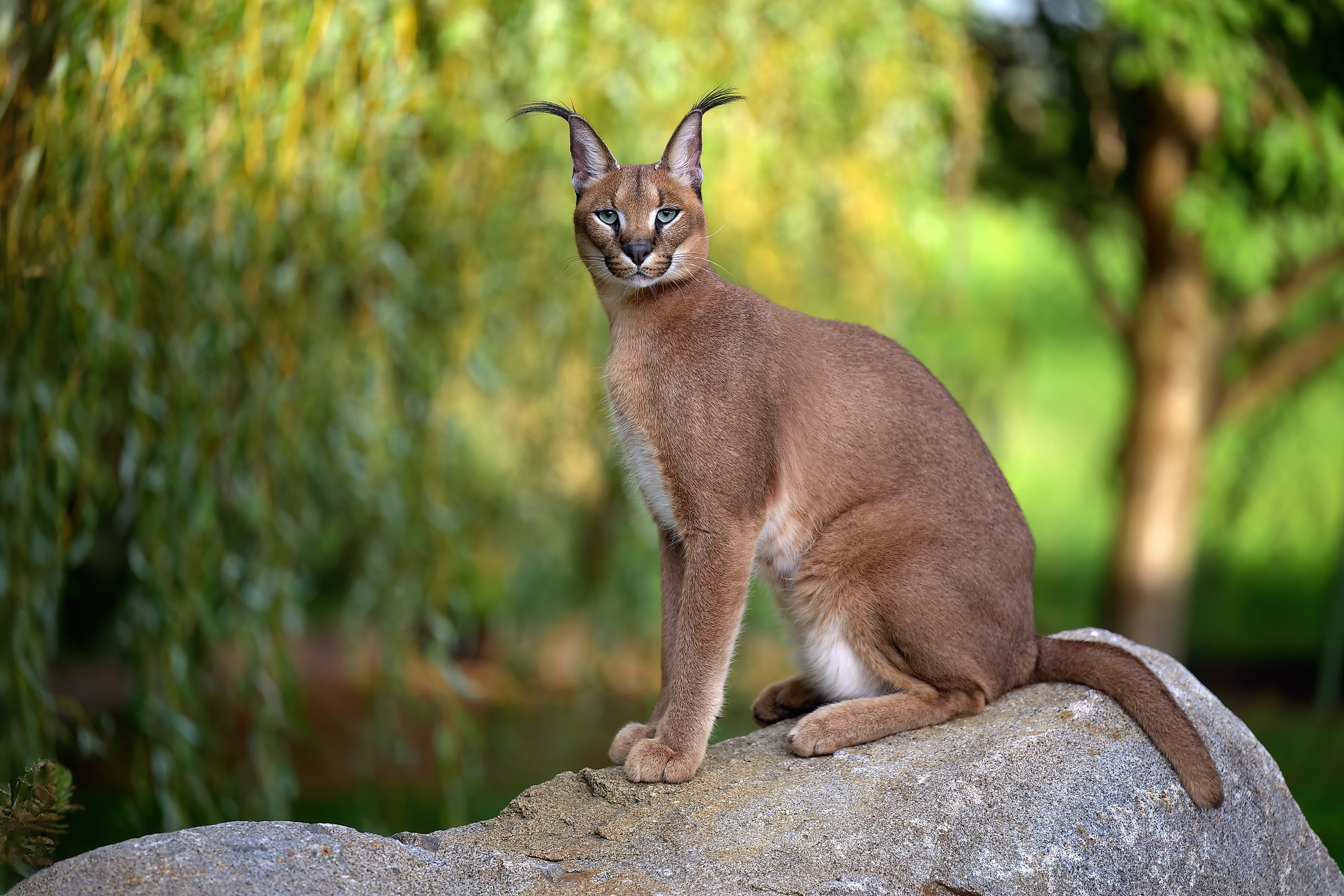
The caracal is the consummate ambush predator of the Old World's dry country, a lean cat that can spring more than 10 feet straight up to swat birds out of the air. Native to Africa, the Middle East, Central Asia, and the arid fringes of Pakistan and northwestern India, it is instantly recognizable by the long black tufts crowning its ears and its uniform reddish coat. Though often called the "desert lynx," the caracal is no lynx at all. It belongs to its own genus and lineage, and its closest relatives are two other African cats.
Compact, powerful, and secretive, the caracal thrives in habitats where many predators struggle to survive, including scrubland, semi-desert, and rocky hills with little cover. It rarely draws attention, hunting mostly after dark and slipping through edge habitats where grassland meets bush.
Taxonomic Classification

The caracal (Caracal caracal) is a member of the family Felidae and subfamily Felinae, within the order Carnivora. German naturalist Johann Christian Daniel von Schreber first described the species in 1776, working from a skin collected at the Cape of Good Hope, and originally placed it in the genus Felis. In 1843 the English zoologist John Edward Gray moved it to its own genus, Caracal, where it remains today.
For much of the 20th century the caracal was grouped with the lynxes or with Felis, but genetic work has overturned that arrangement. Molecular studies confirm the caracal as a monophyletic genus whose nearest relatives are the African golden cat (Caracal aurata) and the serval (Leptailurus serval). Together these three form the Caracal lineage, one of eight major branches of the cat family, which diverged from other felids roughly 11.6 to 6.7 million years ago. The caracal and the African golden cat split from each other more recently, between about 2.9 and 1.2 million years ago.
Taxonomists once recognized as many as eight subspecies. Since 2017, the accepted classification has recognized three subspecies. The Southern caracal (C. c. caracal) occurs across southern and East Africa, the Northern caracal (C. c. nubicus) ranges through North and West Africa, and the Asiatic caracal (C. c. schmitzi) ranges across the Middle East into India.
Physical Description

The caracal is the heaviest of Africa's small cats and among the most powerfully built. Adults stand about 16 to 20 inches (40 to 50 cm) at the shoulder and weigh between 18 and 42 pounds (8 to 19 kg). Body length runs from roughly 24 to 42 inches (61 to 107 cm), with a comparatively short tail of 9 to 13 inches (23 to 33 cm). Males are consistently larger than females, a clear case of sexual dimorphism.
Its coat is short, dense, and a uniform reddish tan to brick color, paler on the belly and throat. The face is marked by two distinct black stripes that run from the forehead toward the nose, along with a dark outline around the mouth. The animal's defining feature, though, is its ears. Each is topped with a tuft of black hair up to about 1.8 inches (4.5 cm) long, and the backs of the ears are black. This coloring gives the cat its name, taken from the Turkish karakulak, meaning "black ear." Around 20 muscles control each ear, letting the caracal pinpoint the faint rustle of prey.
The body is engineered for the leap. Long, heavily muscled hind legs and a flexible spine let the caracal launch more than 10 feet (3 m) into the air to snatch birds in mid-flight. Rare melanistic (all-black) individuals have been recorded, but they are unusual.
Range and Habitat

Few small cats cover as much ground as the caracal. Its range spans much of Africa, the Arabian Peninsula, and Central Asia, reaching east into arid Pakistan and northwestern India. Across its vast range, it favors open, dry habitats such as woodland, savanna, scrub, semi-desert, and rocky hills. It gravitates to edge habitats, especially the transition zones where grassland meets forest, and generally avoids dense equatorial rainforest, which its relative the African golden cat occupies instead. In the mountains of Ethiopia, caracals have been found above 9,800 feet (3,000 m).
The animal's status varies sharply across this range. In southern Africa, particularly northern South Africa and southern Namibia, it is common and its numbers are stable. In North Africa and the savanna belts of West and Central Africa it is rare and patchily distributed, and across much of its Asian range it has become scarce.
Diet

The caracal is a strict carnivore and an opportunistic generalist, taking whatever small to medium prey a region offers. Its prey includes birds, rodents, hares, hyraxes, mongooses, small antelope, and even small monkeys. Though it usually targets prey smaller than itself, the caracal is strong enough to bring down animals two to three times its own size, including young gazelle and antelope.
Its hunting style is patient and explosive. The cat stalks to within about 16 feet (5 m) of its target, then rushes in and kills with a bite to the throat or the back of the neck. Against birds it uses its extraordinary vertical leap, springing into a rising flock and striking with its paws. In arid country the caracal can go without drinking for long stretches, drawing much of the moisture it needs from the bodies of its prey.
Behavior

Caracals are solitary and territorial. Adults live alone except when mating or when a female is raising kittens. Both sexes maintain home ranges, but their territorial patterns differ. Females rarely overlap with other females, while a male's range may overlap with those of several other cats. Recorded home ranges vary widely with habitat, from a few square miles for females to far larger areas for roaming males.
The species is chiefly nocturnal and highly secretive, which makes it difficult to observe in the wild, though in some regions it is active during cooler daylight hours as well. It communicates through scent marking, vocalizations, and the movement of its expressive ears. In parts of Africa the caracal has earned the nickname "little lion" for its boldness. Females have been documented facing down and driving off much larger predators to defend their young.
Reproduction

Caracals breed throughout the year across most of their range, though in the Sahara, births peak in mid-winter. Females typically mate with several males, and gestation lasts roughly 78 to 80 days. A litter usually contains one to three kittens, though as many as six have been recorded.
Kittens develop quickly. They begin taking meat at around four weeks and are weaned between four and six months. Young cats reach independence at about 9 to 12 months and disperse to establish territories of their own. Females reach sexual maturity at 14 to 16 months and males slightly earlier, and a female generally produces one litter a year. In the wild, caracals live about 10 to 12 years. In captivity, free of predators and drought, they can reach 15 to 19 years.
Importance to the World

As a mid-sized predator, the caracal helps regulate populations of rodents, hares, and hyraxes, and its presence signals a functioning dry-country ecosystem. Where it is abundant, it exerts steady pressure on the small mammals that can otherwise damage vegetation and crops.
The caracal also has a notable place in human culture. It appears in ancient Egyptian tomb paintings at Beni Hassan alongside leopards, servals, and wildcats, imagery that scholars connect to the spiritual importance of cats in the region, including the worship of a feline goddess. Today, the caracal lends its name and image to sports teams, military equipment, and conservation campaigns across southern Africa and the Middle East. Its striking appearance has also made it popular among wildlife tourists and photographers. That attention has both benefits and drawbacks, as the same appeal that can generate support for conservation can also increase demand for caracals as exotic pets, linking the animal's public image to its survival in the wild.
Threats and Conservation

Globally, the IUCN Red List classifies the caracal as Least Concern, a status set in its 2016 assessment and based on the cat's wide distribution and healthy numbers across sub-Saharan Africa. That reassuring global picture hides serious regional decline. The species is listed as Critically Endangered in Morocco and Pakistan and as Endangered in Jordan, and in India only about 50 individuals are thought to remain, confined to two populations in Gujarat and Rajasthan.
The caracal faces several well-established threats. Habitat loss and fragmentation continue to reduce its range, while farmers in southern Africa sometimes kill caracals in response to livestock predation. Illegal wildlife trafficking is another concern in the Middle East and Horn of Africa, with an estimated 50 to 100 caracals trafficked out of Somaliland into Gulf states each year for the exotic pet trade. Drought can further worsen the situation by reducing available prey. International trade is regulated under CITES, with Asian populations listed under Appendix I, which prohibits commercial trade, while other populations are covered by Appendix II.
Takeaway
Despite its remarkable athleticism and broad range, the caracal remains one of the world's lesser-known wild cats, often going unnoticed even in areas where it is relatively common. Its ability to survive in harsh conditions has helped it persist, allowing it to cope with heat, drought, and sparse landscapes while avoiding much of the conflict that affects other predators. Yet being overlooked does not make it immune to decline. In areas where its habitat has been lost or fragmented, caracals have vanished before their numbers were properly recorded. Its future will depend on protecting dry habitats, maintaining healthy prey populations, and appreciating the ecological role of a predator so well adapted to life out of sight.
Fun Facts

- Its name means "black ear." "Caracal" comes from the Turkish karakulak, a nod to the black backs and long dark tufts of its ears.
- It gave English an idiom. The phrase "to put the cat among the pigeons" traces back to the caracal, which Persian and Indian royalty trained to leap into flocks of birds while onlookers bet on its catch.
- It can catch birds in mid-air. Powered by long hind legs and a flexible spine, the caracal springs more than 10 feet (3 m) straight up and swats birds down with its paws.
- It punches above its weight. Though a small cat, it can take down prey two to three times its own size, including young gazelle and antelope.
- Its ears are finely tuned. Around 20 muscles control each ear, letting the cat swivel them to pinpoint the faint sounds of hidden prey.
- Black caracals exist. Rare melanistic (all-black) individuals have been recorded in the wild, an unusual departure from the usual reddish-tan coat.
Quick Facts
- Scientific name: Caracal caracal
- Family and order: Felidae; Carnivora
- IUCN status: Least Concern (2016); Critically Endangered or Endangered in parts of North Africa and Asia
- Shoulder height: 16 to 20 inches (40 to 50 cm)
- Weight: 18 to 42 pounds (8 to 19 kg)
- Body length: 24 to 42 inches (61 to 107 cm), plus a 9 to 13 inch (23 to 33 cm) tail
- Lifespan: 10 to 12 years in the wild; up to 15 to 19 years in captivity
- Diet: Carnivore (birds, rodents, hares, hyraxes, small antelope)
- Range: Africa, the Middle East, Central Asia, and arid Pakistan and northwestern India