Cane Toad
The cane toad (Rhinella marina) holds a strange kind of fame. It is one of the largest toads on Earth, a heavyweight amphibian that can tip the scales at more than three pounds, and it carries enough poison in the glands behind its head to kill a dog, a snake, or a crocodile that makes the mistake of biting down. Native to the warm lowlands of Central and South America, it is an unremarkable part of its home ecosystem. Carried around the world by people, it became one of the most destructive invasive species ever recorded.
The story of the cane toad is really two stories. In its native range it is a common, adaptable amphibian that keeps insect numbers in check and feeds a long list of predators that have evolved to handle its toxins. Beyond that range, in places like Australia and the Caribbean, it acts as an ecological wrecking ball, poisoning native wildlife and spreading across landscapes at a pace few animals can match.
Taxonomic Classification

The cane toad belongs to the family Bufonidae, the group commonly known as true toads, within the order Anura (frogs and toads) and the class Amphibia. Its scientific name is Rhinella marina. For most of the twentieth century it was placed in the genus Bufo and written as Bufo marinus, a name still found in older references. Genetic work in the 2000s moved the New World true toads out of Bufo, and the species now sits in the genus Rhinella.
Taxonomy here comes with a twist. Recent studies have split what was long treated as a single species into two. Rhinella marina proper is found east of the Andes in South America, while populations west of the Andes, running through Central America and up into southern Texas, are increasingly recognized as a separate species, Rhinella horribilis, the Mesoamerican cane toad. The two look almost identical from the outside, and telling them apart reliably requires examining skull structure or running genetic tests. Both are commonly called cane toads.
Physical Description

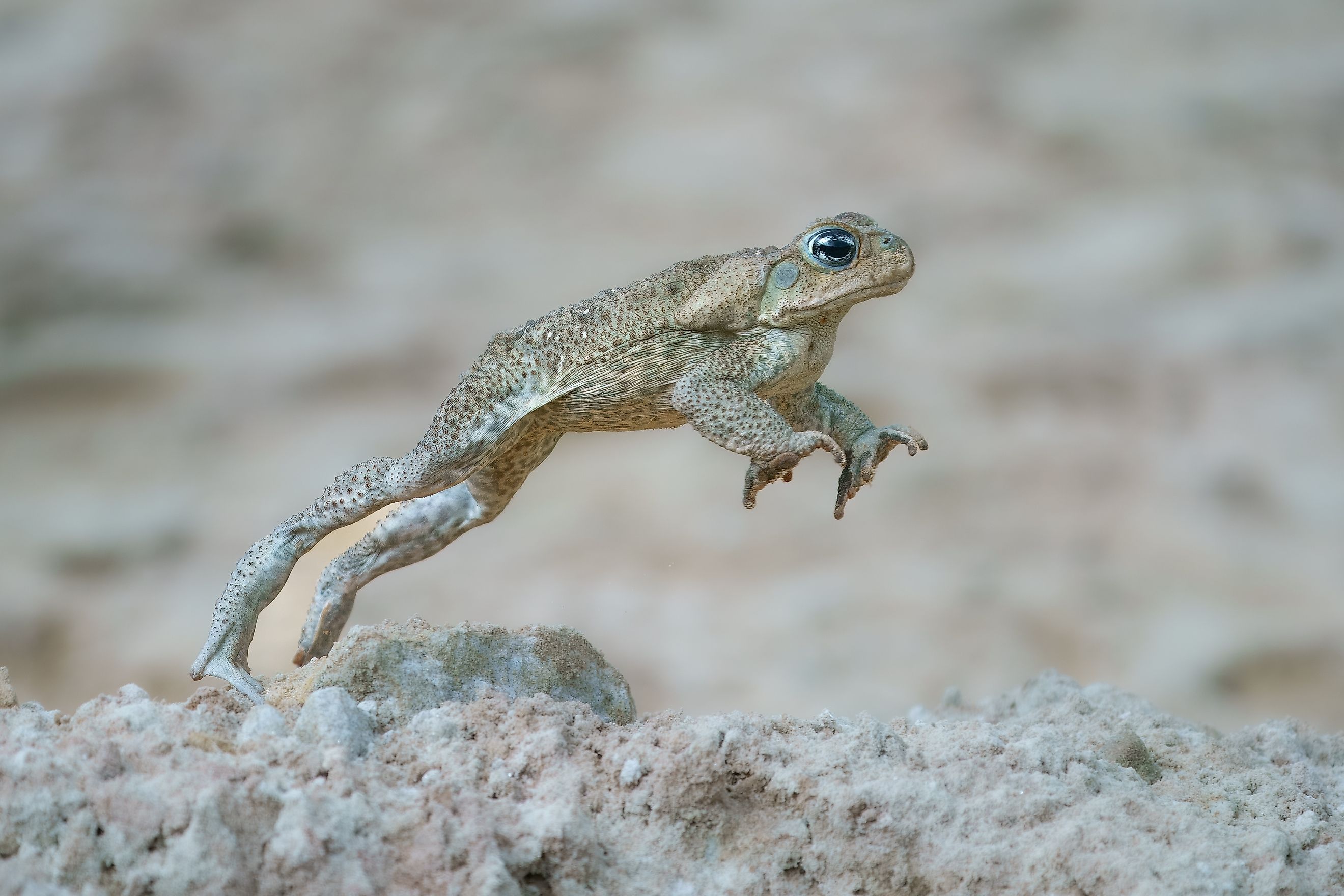
Size is the first thing people notice. The cane toad is a large, heavy-bodied amphibian with dry, warty skin ranging from grey and olive to reddish brown, often marked with darker blotches. Adults commonly measure 4 to 6 inches (10 to 15 cm) snout to vent, but the species can grow much larger. Big females have been recorded at over 9 inches (23 cm) in length, and the heaviest individuals weigh as much as 3.3 pounds (1.5 kg). Females are noticeably bigger than males.
The most important feature sits just behind the eyes. A pair of large parotoid glands runs down each side of the neck and shoulder, and these glands produce the toad's defensive toxin. The venom is a milky secretion loaded with bufadienolides, cardiac glycosides that attack the heart by disrupting the sodium and potassium pump found in animal cells. A predator that bites a cane toad can suffer rapid cardiac failure. The toad also has bony ridges above and between the eyes and short, sturdy legs suited to walking and short hops rather than the long leaps of many frogs. Juveniles are smaller and smoother-skinned, and even the eggs and tadpoles carry toxins, which makes the species dangerous at every stage of its life.
Range and Habitat

The natural range of the cane toad stretches across the tropics of Central and South America, from the Amazon basin north through Colombia, Venezuela, and the Guianas, and up toward Mexico and the southern tip of Texas depending on how the species boundary is drawn. Within this range the toad favors warm, moist lowlands, though it is remarkably flexible about where it lives.
Few amphibians tolerate such a wide spread of conditions. Cane toads turn up in rainforest clearings, along riverbanks and beaches, in grasslands, and throughout farmland and suburban gardens. They can breed in fresh, brackish, or slightly salty water, and they shelter in burrows, leaf litter, and under debris during the heat of the day. This tolerance for disturbed and human-altered habitats is a large part of why the species has established so easily wherever it has been introduced. In Australia it now occupies well over 1.2 million square kilometers of the mainland, and its range continues to push west and south into drier and cooler country that was once thought to be off limits.
Diet

The cane toad is an opportunistic omnivore, which sets it apart from most toads. It eats a broad menu of living prey, including beetles, ants, termites, crickets, spiders, snails, small frogs, lizards, and even small mammals and birds it can fit in its mouth. Unusually for an amphibian, it will also scavenge dead animals and consume plant matter, pet food, and household scraps, a habit that helps it thrive around human settlements.
Cane toads hunt mostly by sitting still and ambushing whatever passes, snapping up prey with a quick flick of a sticky tongue. Larger toads can eat a surprising volume in a single night. This flexible appetite is a double-edged trait. In its native range it helps control insect numbers, but in invaded regions it strips out native invertebrates and competes directly with local frogs and reptiles for food.
Behavior

Cane toads are mainly nocturnal, becoming active at dusk and foraging through the night, though juveniles and toads in cooler climates are often seen by day. They are not territorial and do not migrate in the traditional sense, yet individuals at the leading edge of an invasion behave very differently from those in settled populations. Toads in the native range and in long-established areas tend to stay put, moving only tens of meters between shelters. Toads at the Australian invasion front, by contrast, can cover more than 200 meters in a single night and travel in remarkably straight lines, a behavior that helps drive the rapid spread of the species.
When threatened, a cane toad does not flee so much as stand its ground, inflating its body and relying on its toxins to do the work. Studies in its native range have also shown a sharper sense of navigation than expected, with displaced toads finding their way back home over distances of half a mile or more.
Reproduction

Reproduction is where the cane toad's success becomes clear. Breeding can happen year round in warm, wet conditions and is tied to the rainy season in more seasonal climates. Males gather at the edges of ponds, ditches, canals, and slow streams and call with a long, low trill to attract females. A male grips a female in the amplexus position, and she releases her eggs in long, jelly-like strings while he fertilizes them.
The numbers are staggering. A single female can lay up to about 36,000 eggs in one clutch, far more than most amphibians produce. The eggs hatch into small black tadpoles that are themselves toxic, and the tadpoles develop quickly into tiny toadlets. This combination of enormous output, toxic young, and rapid development lets cane toad populations explode wherever conditions allow. Adults typically live 5 to 10 years in the wild, and considerably longer in captivity.
Importance

In its native ecosystems the cane toad plays an ordinary and useful role. It keeps down insect populations and serves as prey for animals that have evolved the ability to eat it safely, including certain snakes, caimans, and birds. The problem begins when the toad is moved somewhere its predators have no such defenses.
Between the mid 1800s and the 1930s, the cane toad was shipped to more than twenty countries, mostly by the sugar industry, in the hope that it would control beetles that damaged sugar cane. The most famous case is Australia. In 1935, around 100 toads were brought to Gordonvale in Queensland from Hawaii, bred in captivity, and released, with roughly 2,400 let loose in the first wave. The toads largely ignored the cane beetles they were meant to eat, but they found the Australian environment perfectly to their liking. Today their population is estimated at more than 200 million.
The ecological damage has been severe. Native predators such as northern quolls, goannas, freshwater crocodiles, and snakes die when they attack the toxic toads, having never encountered such a poison before. Northern quoll populations have crashed by 75 to 90 percent in some areas following the toads' arrival, and yellow-spotted monitor numbers have fallen by up to 90 percent in invaded regions. These losses ripple through the food web, changing predator and prey balances across northern Australia.
Conservation Status

For a species so damaging elsewhere, the cane toad itself is in no danger. The IUCN Red List assesses Rhinella marina as Least Concern, with a population that is stable or increasing across its wide range. Its adaptability, high reproductive rate, and chemical defenses make it one of the most secure amphibians on the planet at a time when many frogs and toads are in steep decline.
The real conservation challenge is the reverse of the usual one. Rather than protecting the cane toad, wildlife managers work to limit its spread and to protect the native animals it harms. Efforts in Australia include physical removal, exclusion fencing around water points, and a promising approach called conditioned taste aversion, in which native predators are fed small, non-lethal toad baits that teach them to avoid the toads. Programs of this kind have shown encouraging results with quolls ahead of the advancing invasion front. Even so, large-scale eradication remains out of reach, and Australia is likely to be managing its cane toads for generations.
Takeaway
The cane toad shows how much an animal's impact can depend on where it lives. In the forests and wetlands of the Americas, it is a common and adaptable amphibian occupying a familiar ecological role. Introduced to other regions by people who underestimated its ability to spread, those same qualities helped turn it into one of the world's most destructive invasive species. Its resilience, broad diet, and extraordinary reproductive capacity make established populations extremely difficult to control. Its history also demonstrates the long-term ecological consequences that can follow when a species is introduced into an environment where native predators have little experience dealing with it.
Fun Facts

- Toxic from the start. Cane toad eggs and tadpoles are poisonous, so the species threatens predators at every stage of life, not only as an adult.
- A true heavyweight. Exceptional individuals have been reported near or over 9 inches long and heavier than three pounds, ranking the cane toad among the largest toads in the world.
- It failed at its one job. The toads released in Australia to eat cane beetles barely touched them, in part because the beetles lived high on the cane stalks out of easy reach.
- An egg machine. A single female can lay around 36,000 eggs in one clutch, dwarfing the output of most amphibians.
- They walk with purpose. Cane toads at the Australian invasion front travel in unusually straight lines and can cover more than 200 meters in a single night.
Quick Facts
- Scientific name: Rhinella marina
- Family: Bufonidae (true toads)
- Order: Anura
- IUCN status: Least Concern (population increasing)
- Length: commonly 4 to 6 inches (10 to 15 cm), up to about 9 inches (23 cm)
- Weight: up to 3.3 pounds (1.5 kg)
- Lifespan: 5 to 10 years in the wild
- Diet: omnivore (insects, small animals, carrion, and plant matter)
- Native range: Central and South America
- Introduced range: Australia, the Caribbean, Pacific islands, and beyond