Birds That Start With C
The letter C is having a moment in the bird world. It covers the smartest bird on the planet, the most dangerous one, the tallest one in North America, and the single most numerous bird alive, along with a coal-mine canary, a helmet-headed dinosaur relative, and a goose that has declared war on suburban lawns. Here is a field guide to some of the best-known birds whose names begin with C, arranged alphabetically, with the facts that make each one worth a second look.
Canada Goose
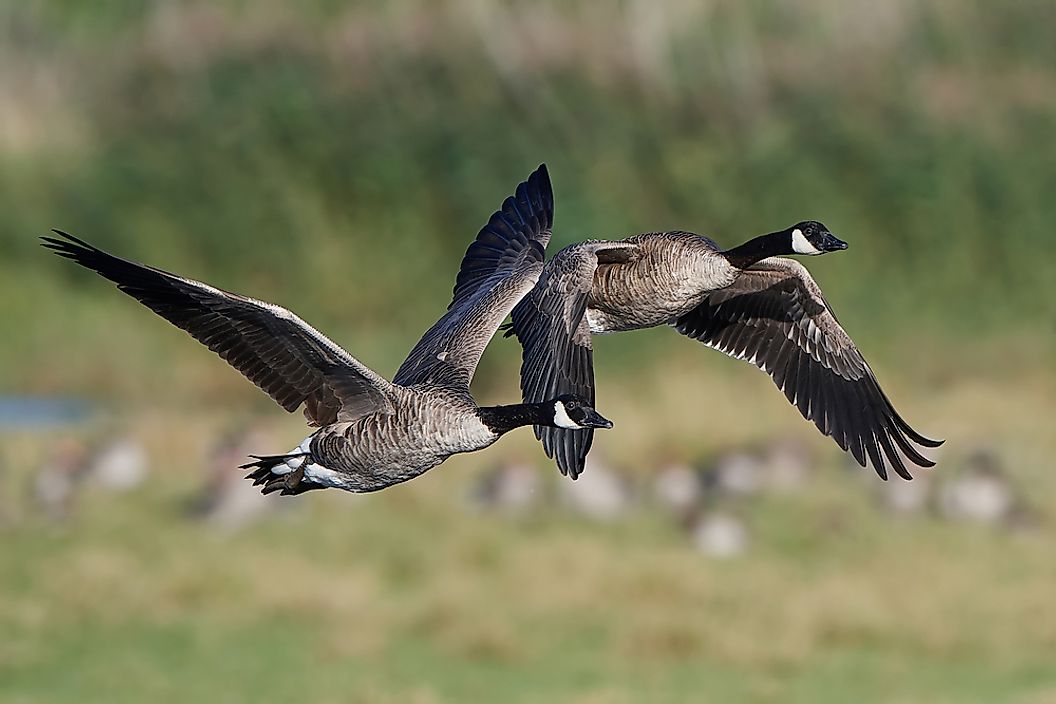
Branta canadensis is native to North America, where it lives near fresh water and, increasingly, on golf courses, office parks, and any lawn it can find. You know the look: black head and neck, white chin strap, brown body. You may also know the temperament, because a nesting Canada goose will hiss, charge, and beat an intruder with its wings without a second thought. They pair for life, migrate in noisy V-formations, and have adapted so completely to human landscapes that many populations no longer bother to fly south at all. Introduced birds now honk their way across Britain and New Zealand, too. One note for the pedants: it is a Canada goose, not a Canadian goose.
Canary

The wild canary, Serinus canaria, comes from the Macaronesian islands off northwest Africa, chiefly the Canary Islands, Madeira, and the Azores, and here is the twist: the islands are not named after the birds. The birds are named after the islands, which the Romans called the Canariae, the Islands of the Dogs. Spanish sailors brought the little finch to Europe in the 1500s, where kings, monks, and eventually everyone bred it into hundreds of varieties prized for color and song. Its most famous job, though, was underground. Well into the 20th century, coal miners carried caged canaries as living gas detectors, since the sensitive bird would collapse from carbon monoxide long before the men felt a thing, buying them time to escape.
Cardinal

Few birds are as instantly recognizable as the male northern cardinal, Cardinalis cardinalis, a jolt of pure red with a black mask and a pointed crest. Females wear a subtler warm brown, and both sexes sing, which is unusual among North American songbirds. The cardinal does not migrate, so its red stays put against the winter snow, and it is popular enough to be the official state bird of seven states, more than any other species. It also has a famous blind spot: in spring, a territorial cardinal will attack its own reflection in a window or a car mirror for hours, convinced it is fighting off a rival that simply will not quit.
Carrier Pigeon

The carrier pigeon is really the humble rock dove, Columba livia, bred for a superpower: it can be carried hundreds of miles from home and still find its way back, navigating by the sun, by smell, by landmarks, and by an ability to sense Earth's magnetic field. Humans have exploited that homing instinct for thousands of years to run messages, and pigeons have earned actual military medals for it. One First World War bird, Cher Ami, delivered a message that saved a trapped American battalion despite being shot through the chest. The birds also have a strange escape trick: their feathers pull out easily, so a predator that grabs one often ends up with nothing but a mouthful of down.
Cassowary

If any bird could pass for a small dinosaur, it is the southern cassowary, Casuarius casuarius, a flightless ratite of the rainforests of northeastern Australia and New Guinea. It stands up to 6 feet tall, wears a tall horn-covered helmet called a casque, and carries a dagger-like inner claw up to 5 inches long. That claw, plus a kick delivered at up to 30 miles per hour, has earned it the title of the world's most dangerous bird, capable of seriously injuring a person. And yet it spends its days quietly eating fallen fruit and, in the process, scattering seeds across the forest, which makes it one of the most important gardeners in its ecosystem. The males are the doting single parents, incubating the eggs and raising the striped chicks alone.
Chickadee

The chickadee, genus Poecile, is a tiny, round, absurdly bold songbird of North American woods, roughly 5 inches of pure curiosity that will investigate anything, including you. It is named for its call, and that call is cleverer than it sounds: the chick-a-dee-dee-dee alarm actually encodes the size of a threat, and the more dee notes a chickadee tacks on, the more dangerous the predator it has spotted. These birds also cache thousands of seeds each fall and remember where they hid them, growing fresh brain cells to manage the job. The best-known of the seven or so species is the black-capped chickadee, but the family also includes the Carolina, boreal, mountain, chestnut-backed, and Mexican chickadees.
Chicken
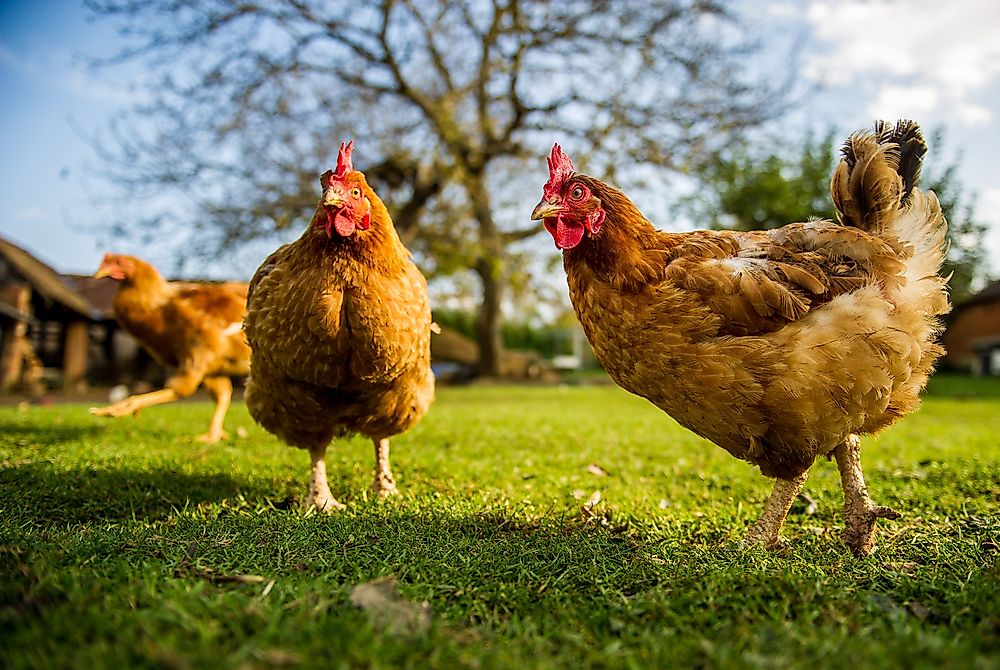
There is no contest for most numerous bird. The domestic chicken, Gallus gallus domesticus, numbers somewhere around 26 billion at any given moment, which means chickens outnumber people on Earth by more than three to one. Every one of them descends from the red junglefowl of Southeast Asia. Roosters get the flowing tail, the fleshy comb, and the dawn crowing, while hens do the laying, incubating a clutch for about 21 days. Chickens are poor fliers but surprisingly complex communicators, with more than two dozen distinct calls. And for the record, their closest relatives trace back through the dinosaur lineage, so the barnyard bird pecking at your feet is about as close as you will get to standing next to a small, clucking theropod.
Cockatiel

The cockatiel, Nymphicus hollandicus, is the smallest member of the cockatoo family and one of the most popular pet birds in the world, native to the arid interior of Australia. Its crest works like a mood ring: straight up when the bird is startled or excited, flattened tight when it is angry or on the defensive, and held at a relaxed half-mast when all is well. Males are the better whistlers and can learn to reproduce tunes and a few words, while the long tail can run to half the bird's total length. Selective breeding has produced more than 20 color mutations, so the wild gray-and-yellow bird now also comes in whites, pearls, and pieds.
Cockatoo

Cockatoos, the 21 species of the family Cacatuidae, are the punks of the parrot world: mostly Australasian, mostly loud, and topped with a showy crest they can raise and lower at will. They are less colorful than other parrots but more than make up for it with personality and staying power, as some cockatoos live 60 years or more. They are also genuinely clever. Wild Goffin's cockatoos fashion and use tools, and a famous captive named Snowball proved that cockatoos can keep a beat and dance to music, something once thought uniquely human. The main threat to many species is the loss of the big old hollow trees they need for nesting.
Condor
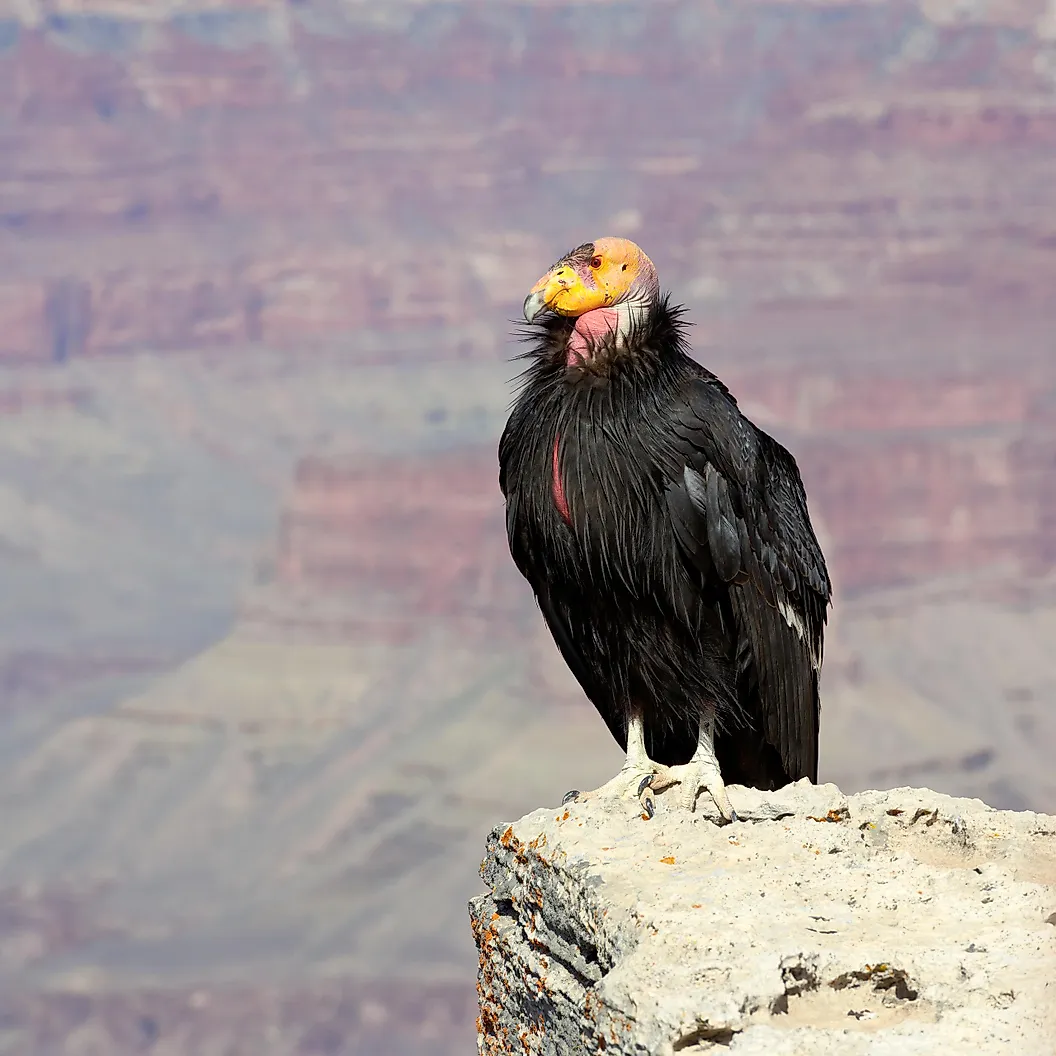
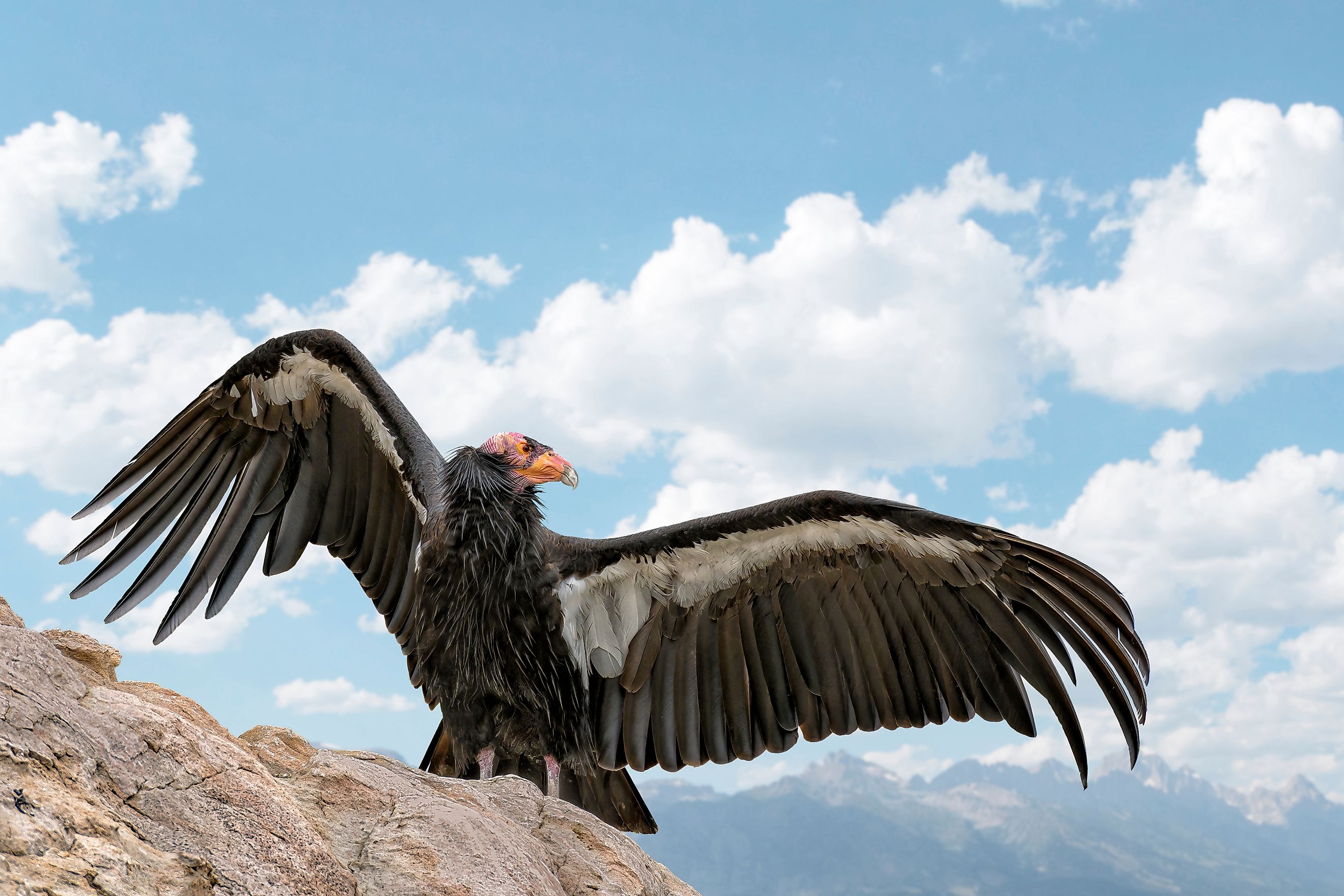
Two birds share the name condor, and both are enormous New World vultures. The Andean condor, Vultur gryphus, has one of the largest wingspans of any land bird at around 10 feet, riding mountain thermals for hours without a single flap. The California condor, Gymnogyps californianus, is North America's largest land bird, and it is a conservation legend. By 1982, just 22 remained on Earth, and biologists took the desperate step of capturing every last wild one for a captive-breeding program. It worked. There are now several hundred, many of them flying free again over the American West. Both birds have bald heads, which is not a fashion choice but a practical one, since a featherless scalp is far easier to keep clean while feeding inside a carcass.
Coot
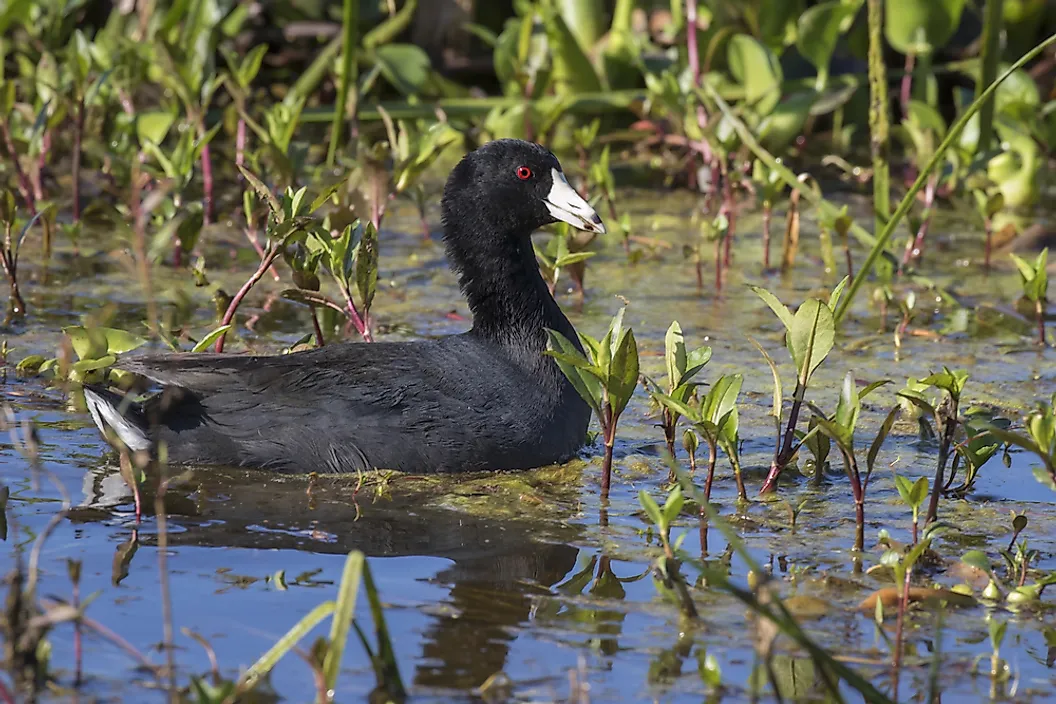
For a bird that swims like a duck, the coot, genus Fulica, is not a duck at all but a member of the rail family, and it gives itself away below the waterline. Instead of webbed feet, a coot has long toes edged with broad, lobed flaps of skin that fold back with every step, letting it both paddle strongly and stomp around on land and matted vegetation. Above the surface, the dark slate-gray body and bright white bill and forehead shield are the giveaways, and that white shield is the origin of the old phrase "as bald as a coot." There are about ten species worldwide. They are aggressive, noisy, and territorial, prone to rearing up and kicking at rivals, and because they are heavy-bodied with short wings, a coot cannot simply spring into the air. It has to sprint flapping across the water for a good stretch before it gets airborne.
Cormorant

Cormorants, the roughly 40 species of the family Phalacrocoracidae, are sleek, dark, hook-billed fishing birds found on coasts and lakes worldwide. Here is their defining quirk: unlike most water birds, a cormorant's feathers are not waterproof. That is a feature, not a flaw, because waterlogged feathers cut buoyancy and let the bird dive deep after fish, but it does mean that after every fishing session the cormorant must stand with its wings spread wide to dry, the classic scarecrow pose you see on docks and pilings. Humans have put that skill to work for centuries. In parts of China and Japan, fishers still work with trained cormorants, a snug ring around the bird's throat stopping it from swallowing the biggest catch.
Crane
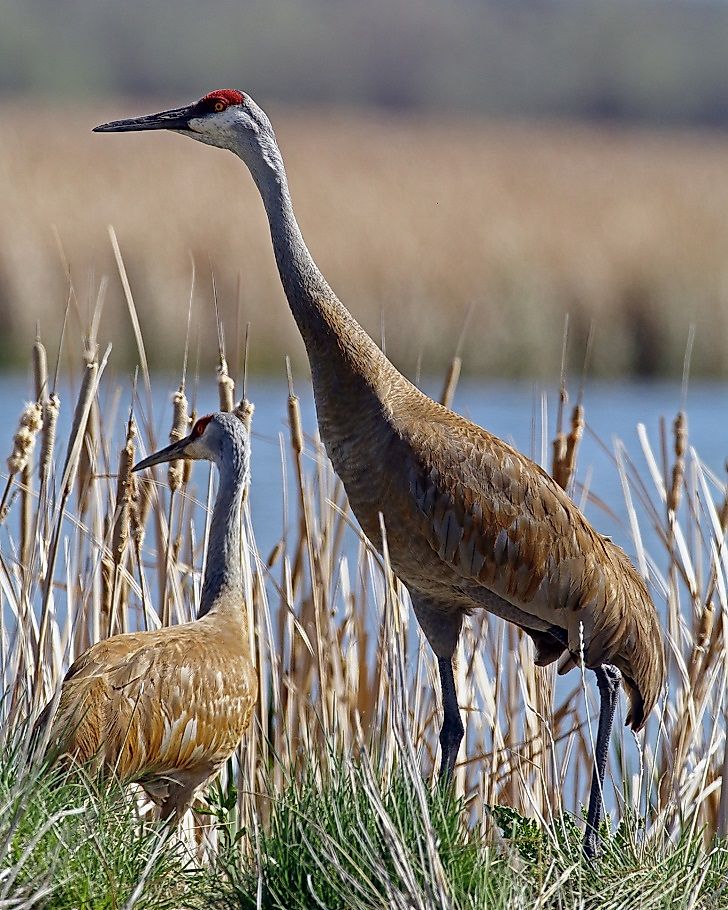
Cranes, the tall wading birds of the family Gruidae, are famous for two things: their height and their dancing. North America has two species. The sandhill crane, Antigone canadensis, gathers by the hundreds of thousands on Nebraska's Platte River each spring in one of the continent's great wildlife spectacles, and its fossil record stretches back millions of years, making it one of the oldest living bird species. The whooping crane, Grus americana, is the tallest bird in North America at nearly 5 feet, and among its rarest. Hunting and habitat loss cut it to around 21 birds by 1941. Decades of work, including teaching captive-raised chicks to migrate by leading them behind an ultralight aircraft, have nudged the population back toward 800. Both species pair for life and greet each other with leaping, bowing courtship dances.
Crow

The crow, of the genus Corvus, is a glossy black bird with a brain to rival a primate's. Crows recognize and remember individual human faces, hold grudges, use and even make tools, drop nuts into traffic so passing cars will crack them, and gather noisily around their dead in a way that looks unsettlingly like a funeral. The roughly 45 species in the genus, which also takes in ravens, rooks, and jackdaws, have spread to nearly every corner of the globe. They are omnivores that will eat almost anything, they raise their young cooperatively, and there is solid evidence they can plan for the future, a skill once thought rare outside humans and great apes.
Cuckoo

Cuckoos, the family Cuculidae, are slender, long-tailed birds found nearly worldwide, but the family is best known for a spectacular con. Many cuckoos are brood parasites: rather than build a nest, the female lays her egg in the nest of a completely different, usually smaller species and flies off. The cuckoo chick tends to hatch first, then instinctively shoves the host's own eggs and chicks out of the nest, and the baffled foster parents wear themselves out feeding a single monster chick that soon dwarfs them. Not every cuckoo is a cheat, though, and plenty of species raise their own young. And yes, the bird's two-note call is exactly the sound the clock is imitating, which is more than most birds can claim.
Curlew
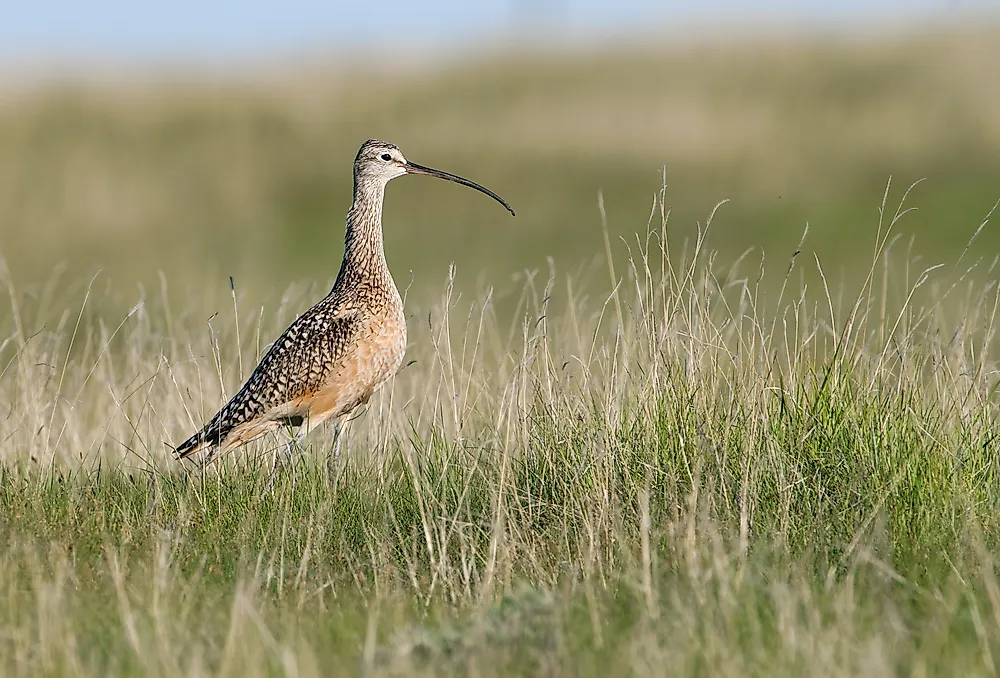
You will know a curlew, genus Numenius, by its bill: a long, slender, downward-curving probe that looks almost comically oversized, and is perfect for reaching deep into mud and sand after worms and shellfish. These are large, streaky-brown wading birds of grasslands, estuaries, and mudflats, and they take their English name from the haunting, rising cur-lew call that carries across open country. The eight or so species include the Eurasian curlew, the largest wading bird in Europe, and the long-billed curlew, North America's largest shorebird, whose bill can be longer than its head and neck combined. Curlews are also a conservation cautionary tale: several species have declined sharply, and the Eskimo curlew, once abundant, has not been reliably seen in decades and is likely extinct.
The Common Thread
For a single letter, C covers a lot of ground: a bird smart enough to hold a grudge, one dangerous enough to make headlines, one numerous enough to outnumber us several times over, and a few, like the whooping crane and the California condor, that came within a couple of dozen individuals of vanishing and clawed their way back. If nothing else, the list is a reminder of how much variety hides behind an ordinary letter of the alphabet, and how many of these birds are quietly living out their strange lives in the trees, ponds, and lawns right outside the window.