Banded Sea Krait
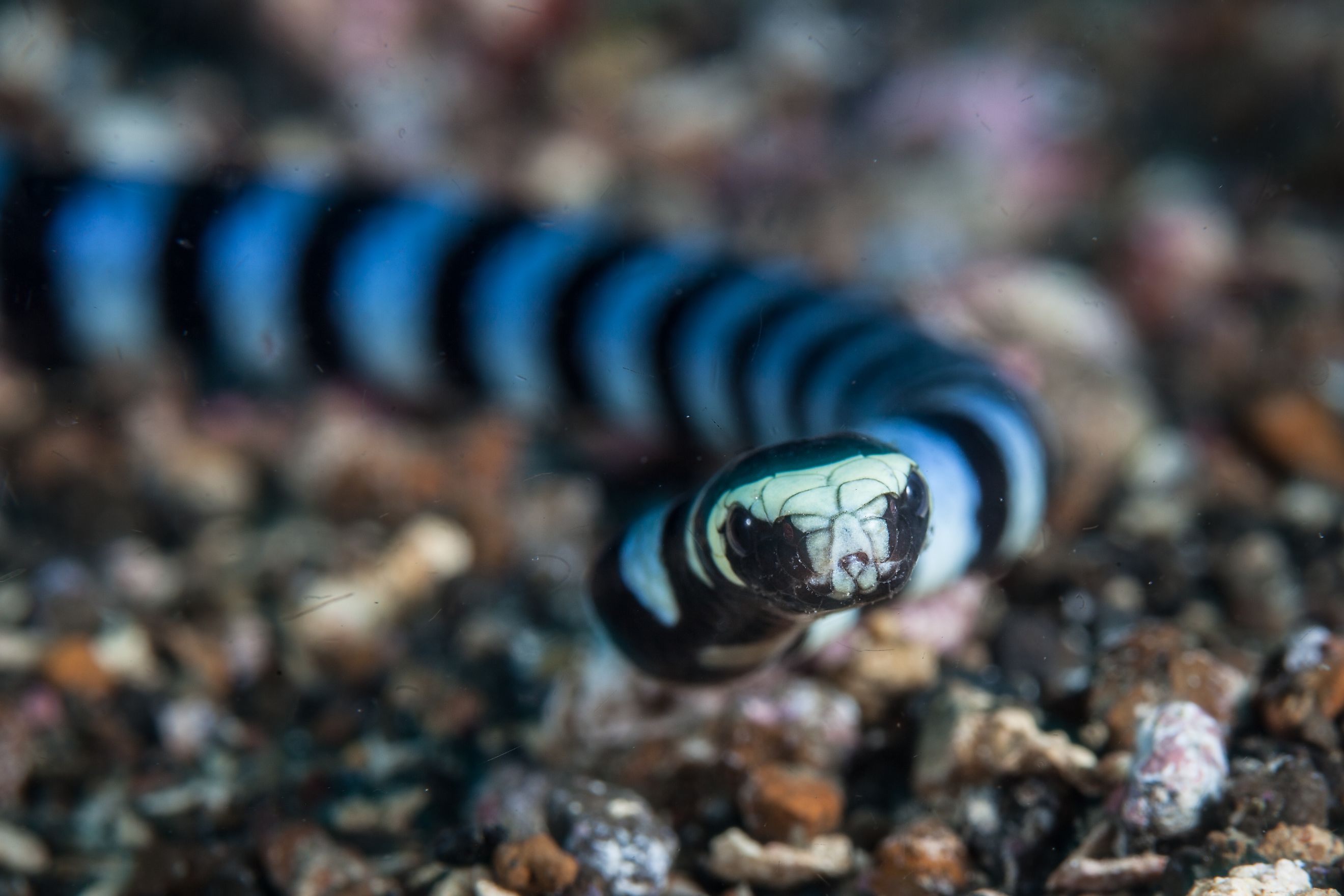
The banded sea krait (Laticauda colubrina) is a venomous, semi-aquatic snake found on coral reefs and rocky shorelines throughout the tropical Indo-Pacific. It is easily identified by the bold black bands that ring its bluish-gray body, its pale yellow snout, and the flattened, paddle-shaped tail it uses to swim. Unlike most marine snakes, it has never fully abandoned the land. It hunts eels in the water but returns to shore to rest, digest, shed its skin, mate, and lay its eggs. This dual life, combined with a potent venom paired with an unusually docile temperament, makes it one of the most distinctive reptiles of the reef.
Taxonomy and Classification

The banded sea krait belongs to the genus Laticauda, a small group of about eight species that biologists place within the cobra family, Elapidae. Some taxonomists elevate the sea kraits to their own subfamily, Laticaudinae, in recognition of how distinct they are from other marine snakes. The name most people attach to "banded sea krait" is Laticauda colubrina, sometimes called the yellow-lipped or colubrine sea krait for the pale yellow coloring on its snout and upper lip. Two close relatives, the blue-lipped sea krait (Laticauda laticaudata) and the erabu or Chinese sea krait (Laticauda semifasciata), share the banded pattern and are occasionally lumped under the same common name.
The crucial distinction to grasp is that sea kraits are not the same as true sea snakes. True sea snakes, in the subfamily Hydrophiinae, have severed nearly all ties to land. They give birth to live young at sea and often cannot move effectively on solid ground. Sea kraits, by contrast, retain the enlarged belly scales that let them crawl, and they must return to shore for essential parts of their lives. In evolutionary terms, sea kraits represent an earlier, more conservative stage in the long move out of the land and into the sea, one that has proven remarkably durable.
Physical Description

The banded sea krait is instantly recognizable. Its body is ringed with alternating bands of glossy black and pale bluish-gray or silver, a pattern that runs the length of its body. The number of bands varies by species and individual, but the effect is always vivid, serving as a warning to would-be predators. The head is often marked with yellow, and in Laticauda colubrina the upper lip and snout carry the characteristic pale coloring that gives the species its "yellow-lipped" name.
The most telling adaptation is the tail. Flattened laterally into a broad paddle, it propels the snake through water with an efficient side-to-side undulation. The nostrils sit high on the snout and can be sealed shut when the animal dives, and specialized salt glands beneath the tongue allow it to expel the excess salt it takes in while feeding and swimming. Despite these marine refinements, the snake keeps the wide ventral scales of a terrestrial serpent, which is why it can still slither across rock and sand with ease, a feat true sea snakes cannot manage.
Sexual dimorphism is pronounced. Females are substantially larger and heavier than males, a size difference tied directly to their hunting habits and reproductive demands. This divergence shapes much of the species' behavior and ecology.
Range and Habitat

Banded sea kraits range across the warm, shallow waters of the Indo-Pacific, from the coasts of eastern India and Sri Lanka through Southeast Asia and Indonesia, north to southern Japan, and east into the islands of the tropical Pacific, including Fiji and other Oceanic groups. They favor coral reefs and clear coastal waters where eels are plentiful, and they are strongly associated with small islands and rocky shorelines that offer suitable places to come ashore.
Their attachment to land defines where they can live. A sea krait needs accessible beaches, rock crevices, sea caves, or coastal forest to rest, digest, shed its skin, mate, and lay eggs. Some islands host dense aggregations, with hundreds or even thousands of individuals gathering on a single shore. This reliance on terrestrial refuges makes the species sensitive to disturbances that fully marine snakes might shrug off.
Diet and Hunting

The banded sea krait is a specialist predator with a narrow menu, eating eels and little else. Moray and conger eels make up the bulk of its diet, and the snake hunts them by probing the cracks and crevices of the reef where these fish shelter. Once it locates prey, it delivers a venomous bite, waits for the toxin to take effect, and then swallows the eel whole, usually headfirst.
Here, the size difference between the sexes becomes ecologically meaningful. Larger females hunt big conger eels in more open water, while the smaller males pursue slender moray eels wedged into tight reef spaces. By targeting different prey, the two sexes reduce competition with one another and effectively divide the reef's resources. Sea kraits are also known to forage cooperatively with certain reef fish, such as goatfish and trevally, which trail the snake and snatch smaller creatures flushed from hiding as it searches. After a substantial meal, the krait returns to land to digest in safety, sometimes remaining ashore for days.
Venom and Danger to Humans

Drop for drop, the venom of the banded sea krait is formidable. It is a neurotoxin that attacks the nervous system, causing paralysis by blocking the signals between nerves and muscles, and laboratory measures place its potency well above that of many notorious land snakes. In an eel, that venom brings a swift end to a struggling, powerful prey animal.
Toward humans, however, the banded sea krait is astonishingly mild-mannered. It shows little inclination to bite even when handled, and its small mouth and short fangs make it difficult for it to deliver an effective bite to a person in the first place. Divers, fishers, and snorkelers frequently encounter these snakes at close range with no incident. Bites do occur, most often when a snake is grabbed, trodden on, or tangled in fishing nets, and when venom is injected the consequences can be severe, so the animal warrants respectful distance rather than fear. The best approach is simple. Observe and admire it from a safe distance without disturbing it.
Reproduction and Life Cycle

Reproduction is the clearest reminder that the banded sea krait remains bound to the land. Unlike true sea snakes, which bear live young at sea, sea kraits are egg-layers. After mating, females deposit clutches of eggs in the damp shelter of rock crevices, sea caves, or coastal vegetation, where the eggs incubate on shore. This dependence on terrestrial nesting sites ties the species' survival to the health of island shorelines.
Mating aggregations can be dramatic, with numerous males converging on individual females. The pronounced size gap between the sexes plays a role here too, as larger females can produce more eggs. Hatchlings emerge already equipped for their dual existence, capable of both swimming and crawling from the outset, and they must fend for themselves immediately. Growth is gradual, and individuals may live for many years, returning again and again to the same stretches of coast throughout their lives.
Behavior, Predators, and Conservation

For all its venomous power, the banded sea krait is prey as well as predator. Sharks, large predatory fish, and birds such as sea eagles take sea kraits, and the snake's bold banding is thought to advertise its toxicity as a deterrent. On land it faces additional risks, which is part of why it seeks concealed resting spots.
The species is currently listed as Least Concern, reflecting its wide range and generally healthy populations. That status, however, masks real local pressures. In some regions sea kraits are harvested in large numbers for their skins, meat, and use in traditional products, and populations tied to particular islands can decline sharply under such exploitation. Coastal development, disturbance of nesting shores, and entanglement in fishing gear pose further threats. Because the banded sea krait depends on both a thriving reef and an undisturbed shoreline, it serves as a useful indicator of the overall health of tropical coastal ecosystems.
Takeaway
The banded sea krait stands out because it succeeds in two environments that most reptiles must choose between, hunting eels across the reef while depending on the shoreline to reproduce, digest, and rest. That dual life shapes everything about it, including its paddle-shaped tail and salt-expelling glands and its need for undisturbed islands where it can lay eggs. Its potent venom demands respect, but its calm temperament means encounters with people almost never end in harm, provided the animal is left alone. For anyone observing one in the wild, the practical rules are straightforward. Keep a respectful distance, never handle it, and give it plenty of room to move between water and land. More broadly, because the species relies on both a healthy reef and an intact coast, the presence of thriving sea kraits is a good sign that the wider coastal ecosystem is in balance.
Fun Facts

- Sea kraits can seal their nostrils shut with valve-like flaps before diving, keeping seawater out while they hunt in the reef.
- They "sneeze out" salt. Special glands beneath the tongue collect excess salt from seawater and expel it, letting the snake stay in the ocean without dehydrating.
- Males and females essentially eat at different tables. Larger females chase big conger eels in open water while smaller males probe reef cracks for slender morays, so the sexes rarely compete for the same meal.
- Reef fish like goatfish and trevally sometimes tag along on a hunting krait, snapping up small prey the snake flushes out of hiding.
- Despite carrying venom more potent than many land snakes, the banded sea krait is so gentle that divers regularly swim alongside it without incident.
- On some Indo-Pacific islands, sea kraits gather ashore in the hundreds or even thousands to rest, shed their skin, and lay eggs.
Quick Facts
- Scientific name: Laticauda colubrina (the yellow-lipped or colubrine sea krait is the species most often called the "banded sea krait")
- Family: Elapidae (the same family as cobras, mambas, and coral snakes)
- Length: Females commonly reach 4.5 feet (1.4 m); males are smaller, typically under 3 feet (0.9 m)
- Distribution: Tropical Indo-Pacific waters, across the eastern Indian Ocean and the western Pacific
- Habitat: Coral reefs, coastal waters, and rocky or forested islands
- Diet: Almost exclusively eels, especially moray and conger eels
- Venom: Powerful neurotoxin, several times more potent than a cobra's by some measures
- Temperament: Extremely docile; bites on humans are rare
- Reproduction: Egg-laying (oviparous); eggs are deposited on land
- Lifespan: Estimated at several years to over a decade in the wild
- Conservation status: Least Concern, though locally vulnerable to habitat loss and harvesting