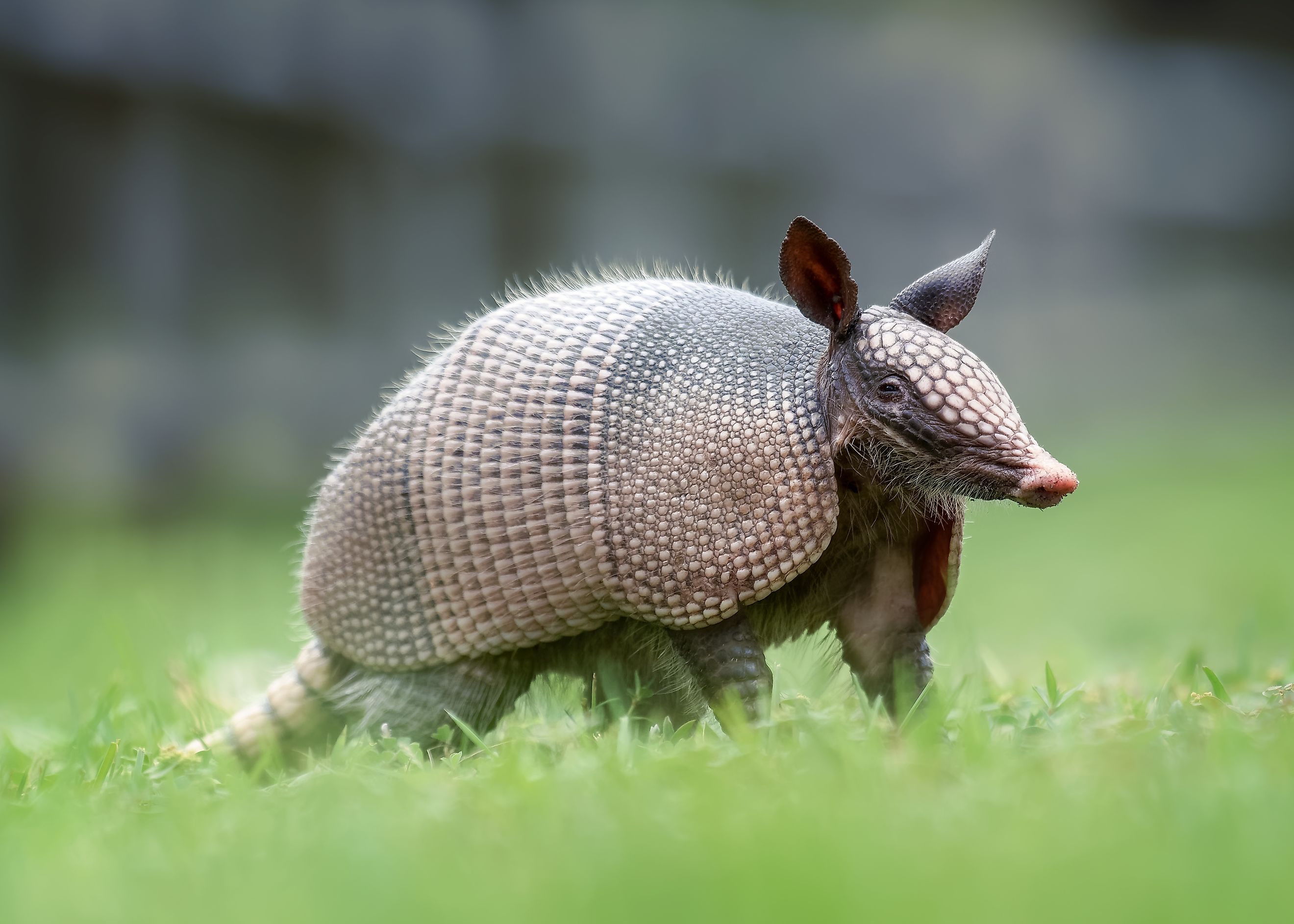
Armadillo
The armadillo is the only living mammal that wears a shell of bone. That armor, made of overlapping plates fused to the skin and topped with a tough layer of keratin, gives the animal its name, which comes from the Spanish word for little armored one. No other mammal alive today carries anything quite like it.
Armadillos are small to medium burrowing mammals found only in the Americas. They live as far south as the deserts of central Argentina and as far north as the pine woods of the southern United States, and they include roughly twenty living species that vary enormously in size. The smallest is tinier than a chipmunk, while the largest can outweigh a large dog. What unites them is the armored carapace, a set of powerful digging claws, and a diet built largely around insects.
Related to sloths and anteaters rather than to any armored reptile, armadillos sit on one of the oldest and strangest branches of the mammal family tree. They are worth knowing not only for their armor but for a reproductive trick found in almost no other mammal, a part in the spread of a human disease, and a remarkable talent for crossing rivers.
Taxonomic Classification

Armadillos make up the order Cingulata, which sits within the superorder Xenarthra alongside the anteaters and the tree sloths. Xenarthra is an ancient New World lineage, and armadillos are its only armored members. Scientists currently recognize about twenty to twenty-one living species spread across roughly nine genera.
These species fall into two families. The family Dasypodidae now contains just one living genus, Dasypus, the long-nosed armadillos, which includes the familiar nine-banded armadillo. Every other living species belongs to the family Chlamyphoridae, a group that holds the giant armadillo, the three-banded armadillos, the hairy armadillos, the naked-tailed armadillos, and the tiny fairy armadillos. This split reflects modern DNA work, and several armadillos were reclassified over the past decade as genetic evidence reshaped older arrangements based on anatomy alone.
The order has deep roots in South America. For most of the past sixty million years the continent was an island, and armadillos and their relatives evolved there in isolation. Their extinct cousins, the glyptodonts, grew to the size of a small car and carried a rigid domed shell. When the Isthmus of Panama connected the two American continents around three million years ago, armadillos were among the animals that spread northward.
Physical Description

The defining feature of every armadillo is its carapace, a shield of bony plates called osteoderms that form in the skin itself and are covered by small horny scutes. In most species the shell is divided into a solid shoulder shield, a solid hip shield, and a series of flexible bands across the middle that let the animal bend. The number of bands helps separate the species, and it gives several of them their common names, the three-banded, the six-banded, and the nine-banded among them.
Size varies more within this one group than in almost any comparable set of mammals. The pink fairy armadillo of Argentina measures only about 3.5 to 4.5 inches (9 to 12 cm) long and weighs around 4 ounces (120 g), small enough to sit in a cupped hand. At the other extreme, the giant armadillo can measure about 5 feet (150 cm) in total length and weigh up to roughly 120 pounds (54 kg). Between them sit species of nearly every intermediate build.
Beneath the armor, armadillos share a common body plan. They have short, powerful legs, and their forefeet carry large curved claws built for digging. Their eyesight is poor, so they navigate mainly by a sharp sense of smell. Their teeth are unusual as well, reduced to simple peg-like structures without enamel and suited to a soft diet of insects rather than to grinding tough plants.
Range and Habitat

All armadillos are native to the Americas, and the great majority live in South America, especially in the grasslands, dry forests, and scrublands of Argentina, Brazil, Paraguay, and Bolivia. Only two species range farther north than Panama. The northern naked-tailed armadillo reaches Central America, and the nine-banded armadillo has pushed deep into the United States.
That northward march is one of the fastest range expansions recorded for any American mammal. The nine-banded armadillo crossed into Texas in the nineteenth century and has since spread across the southern states. Recent surveys place it throughout Missouri, into southern Iowa, and across parts of Kansas, Illinois, Indiana, Kentucky, Tennessee, and the Carolinas, with distribution models suggesting room for further expansion. Cold winters, not competition, appear to set the northern limit, because armadillos store little fat and cannot tolerate long freezes.
Within their range, armadillos favor habitats with loose, diggable soil. They occupy rainforest, savanna, semi-desert, and riverbank alike, provided the ground allows them to burrow.
Diet

Armadillos are chiefly insectivores, and ants, termites, beetles, and grubs form the bulk of most species' diets. An armadillo hunts largely by smell, sweeping its snout across the ground and then digging rapidly to expose prey. The giant armadillo is a specialist that tears open termite mounds and ant nests with its enormous foreclaws, while smaller species take a broader mix of invertebrates.
Many armadillos round out this diet with other foods when they can find them, including worms, small vertebrates, eggs, carrion, and some fruit and plant matter. That flexibility is one reason the nine-banded armadillo thrives across so many habitats. A foraging armadillo can consume thousands of insects in a single meal, which makes the group a meaningful check on insect populations wherever it lives.
Behavior

Most armadillos are solitary and active by night or at dusk, though they will forage earlier on cold or overcast days. The center of an armadillo's life is its burrow. Using their claws, they dig extensive dens that shelter them from heat, cold, and predators, and a single animal may maintain several burrows across its territory.
Their armor is a defense, but only the two three-banded armadillos can curl into a complete sealed ball, tucking head and tail together so that nothing soft is exposed. Every other species has too many rigid plates to close up fully and instead relies on digging, fleeing, or wedging itself into a burrow when threatened.
One of the most surprising armadillo behaviors involves water. An armadillo can hold its breath for several minutes and walk straight across the bottom of a stream. To cross a wider or deeper body of water, it gulps air into its stomach and intestines until it is buoyant enough to float, then paddles across.
A well-known quirk of the nine-banded armadillo is its startle response. When surprised, it leaps almost straight up into the air. This reflex may help it escape ground predators, but it is a poor match for cars, and the vertical jump is one reason so many are struck on roads.
Reproduction

Armadillo reproduction includes one of the strangest quirks in all of mammal biology. The nine-banded armadillo almost always gives birth to four young that are identical, all the same sex and all clones of one another, because a single fertilized egg splits into four embryos. This pattern, called monozygotic polyembryony, is regular and predictable in this species and is virtually unknown elsewhere among mammals.
Adding to that, the nine-banded armadillo can delay its pregnancy. After mating in summer, the female can hold the fertilized egg in a state of arrested development for months before it implants, so that birth lines up with favorable conditions. Young are born with soft, leathery armor that hardens as they grow, and they stay with the mother for a few months before setting off alone. In the wild, armadillos commonly live seven to twenty years, and some reach beyond twenty in captivity.
Importance to the World

Armadillos shape their habitats in several ways. As heavy consumers of ants, termites, and beetles, they help hold insect numbers in check. As diggers, they turn and aerate soil and create burrows that snakes, burrowing owls, and small mammals later use for shelter. Losing an armadillo from a landscape removes both a pest controller and an engineer of underground real estate.
Armadillos also hold a peculiar place in medicine. The nine-banded armadillo is one of the very few animals besides humans that can carry the bacterium responsible for leprosy, and its relatively low body temperature suits the microbe well. That susceptibility has made the species a valuable research model for studying the disease and testing treatments, even as it has also made wild armadillos a real source of human infection in parts of the southern United States. Handling or eating armadillos carries a small but measurable risk, though most human leprosy worldwide has nothing to do with them.
Conservation and Threats

Armadillos as a group are not uniformly threatened, and their fortunes vary sharply by species. The nine-banded armadillo is listed as Least Concern, and its population is rising as it colonizes new ground. Several other species are also common. But the more specialized armadillos are in trouble.
The giant armadillo is classified as Vulnerable by the IUCN, and researchers estimate its numbers have fallen by at least thirty percent over roughly three decades, driven by deforestation, hunting for meat, wildfires, and collisions with vehicles. The Brazilian three-banded armadillo is also Vulnerable, having lost much of its dry-forest home. The two fairy armadillos, both burrowing desert specialists, are listed as Data Deficient, meaning scientists lack even the basic information needed to judge their status, although sightings have grown rarer over time. Across the order, habitat loss and the conversion of wild land to agriculture are the dominant pressures.
Takeaway
The armadillo is a survivor from an ancient branch of mammals, wrapped in armor no other living mammal can match and equipped with talents as strange as cloning its young and walking underwater. Common species such as the nine-banded armadillo are thriving and even expanding, while specialists such as the giant and the fairy armadillos are a reminder of how much can still be lost. Protecting the soils and dry forests they depend on is the surest way to keep the full strange variety of these armored diggers on the map.
Fun Facts

- A name built from armor. The word armadillo comes from Spanish and means little armored one, a nod to the bony shell that no other living mammal possesses.
- Identical quadruplets almost every time. A nine-banded armadillo usually produces four young from a single egg, so the litter is a set of natural clones of the same sex.
- They walk on the bottom of rivers. An armadillo can hold its breath for several minutes and stroll across a streambed, or gulp air to inflate itself and float across deeper water.
- A living clue to leprosy. The nine-banded armadillo is one of the only wild animals that carries the leprosy bacterium, which has made it an important subject in medical research.
- Cousins the size of cars. The armadillo's extinct relatives, the glyptodonts, grew as large as a small automobile and lumbered about under a rigid domed shell.
- A high jumper. Startle a nine-banded armadillo and it springs several feet straight up, a reflex that unfortunately puts it in the path of car bumpers.
Quick Facts
- Common name: Armadillo (Spanish for little armored one)
- Order: Cingulata, within the superorder Xenarthra, alongside sloths and anteaters
- Families: Dasypodidae and Chlamyphoridae
- Living species: About 20 to 21, across roughly 9 genera
- Size: About 4 inches (10 cm) in the pink fairy armadillo, up to 5 feet (150 cm) in the giant armadillo
- Weight: About 4 ounces (120 g) in the smallest species, up to roughly 120 pounds (54 kg) in the giant armadillo
- Diet: Mainly insects such as ants and termites, plus other invertebrates, small animals, eggs, and some plant matter
- Lifespan: Commonly 7 to 20 years in the wild, sometimes longer in captivity
- Range: The Americas, concentrated in South America, with the nine-banded armadillo reaching well into the United States
- IUCN status: Varies by species; Least Concern for the nine-banded armadillo, Vulnerable for the giant and Brazilian three-banded armadillos