Animals With More Than One Heart
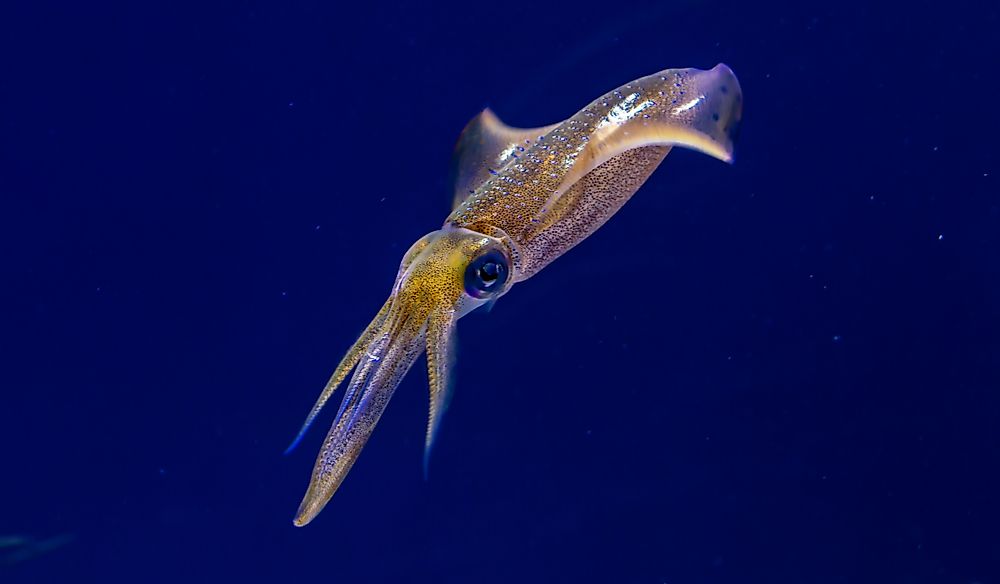
- Octopuses, squid and cuttlefish all run on three hearts.
- Hagfish have four or five, depending on which anatomist you ask.
- Earthworms have none at all, technically, which is the most interesting answer on this page.
- Scientists are studying cockroach and hagfish hearts to help design solutions for human heart disease.
The human body runs on one four-chambered pump doing all the work, which feels like the obvious design until you look at what else is out there. Evolution has produced a startling range of alternative plumbing, and most of it does not resemble ours in the slightest. Some animals split the job across three organs. Some add auxiliary pumps to their legs, wings and antennae. Some manage a functioning circulatory system with no heart whatsoever, and one of the most famous multi-heart animals on the internet turns out not to have hearts at all. Below are the animals that beat the count, the ones that opted out, and the reason any of it evolved in the first place.
A warning about numbers before we start. Heart counts in this field depend heavily on what you agree to call a heart, which is why published figures for the same animal often disagree.
Earthworms

Every list like this one says earthworms have five hearts. The number is wrong twice over.
What an earthworm actually has is five pairs of aortic arches, ten structures rather than five, encircling the gut in segments seven through eleven. They contract rhythmically to push blood from the dorsal vessel into the ventral vessel. And they are not really hearts, which is why zoologists tend to call them pseudohearts.
The dorsal vessel supplies most of the forward thrust, so no single arch is the primary pump. Earthworms breathe through moist skin, and once oxygen diffuses into the blood the dorsal vessel and the arches distribute it. The rhythm is coordinated by motor neurons in the ventral nerve cord rather than by the arches themselves, which means an earthworm's circulation is closer to a peristaltic conveyor belt than to anything with a pulse.
Cockroaches

A cockroach has one heart, and that heart has thirteen chambers arranged in a line. This gets misreported as thirteen hearts roughly as often as the earthworm gets its five.
Waves of peristaltic contraction move haemolymph, the insect equivalent of blood, from the tail toward the head. The chambers work in series rather than independently, and the haemolymph is mainly carrying nutrients rather than oxygen, because insects deliver oxygen through a separate network of air tubes.
The design has a property engineers noticed. Because the chambers run in sequence, the failure of one section reduces efficiency without stopping flow. That principle informed a 2009 prototype artificial heart built at IIT Kharagpur as a set of concentric onion-like layers, though current human devices have largely moved to rotary pumps instead.
Octopus, Squid And Cuttlefish

Three hearts, and it is not an octopus quirk. It is the standard blueprint for the whole group of advanced cephalopods, the coleoids, which includes the giant Pacific octopus, which means squid and cuttlefish are built the same way.
Two branchial hearts sit at the base of the gills and pump deoxygenated blood into them. The newly oxygenated blood returns to a single systemic heart, which sends it out to the body. Each branchial heart is a single chamber, they always come in pairs, and because they only ever handle venous blood they operate under largely anaerobic conditions.
They also do a second job that has nothing to do with pumping. Branchial hearts appear to be involved in synthesizing hemocyanin, and each one connects to an appendage that filters the animal's primary urine using the pressure the heart generates. These are hearts that double as kidneys.
Why Cephalopods Need The Extra Pumps

The answer is that their blood is bad at its job.
Cephalopods carry copper-based hemocyanin rather than iron-based hemoglobin. It is less efficient in warm, oxygen-rich water, though it outperforms hemoglobin in the cold, low-oxygen conditions many cephalopods live in. Crucially, hemocyanin floats freely in the plasma instead of being packed inside cells, which is why cephalopod blood is blue and why there is so much less oxygen per unit volume.
Then there is the pressure problem. Researchers measuring free-swimming Octopus dofleini recorded systolic pressure around 4.5 mmHg and diastolic around 2.96 mmHg. A healthy human runs somewhere near 120 over 80. An octopus is circulating blood at a small fraction of our pressure, using a fluid that carries less oxygen, which is precisely why it needs three pumps instead of one.
It gets more improbable. Contraction of the general body muscles helps maintain that diastolic pressure, in much the same way human leg muscles help push venous blood back toward the heart. An octopus is partly pumping its own blood by moving.
Nautilus, The Cephalopod That Opted Out
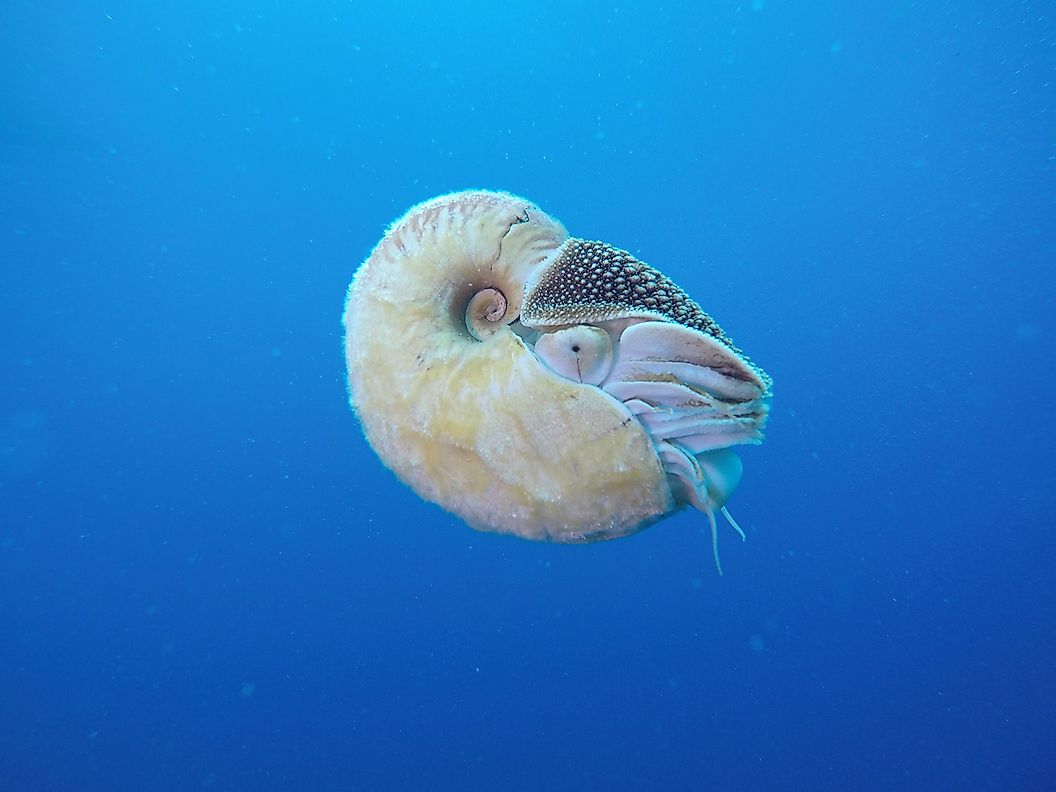
The nautilus is the spiral-shelled outlier, and it gets by on a single systemic heart and a slow, sedentary life.
The interesting part is the evolutionary trail. Branchial hearts may have evolved from the pericardial glands still found in modern nautiluses, which means the octopus's two extra hearts probably began as excretory tissue and were repurposed into pumps. Older textbooks placed nautiluses in a group called the Tetrabranchiata, described as having four gills, four hearts and four kidneys against the Dibranchiata's two gills, three hearts and two kidneys. That distinction has since been shown to be wrong, which is a good reminder of how unsettled this counting exercise is.
Hagfish

Hagfish hold the vertebrate record, and nobody agrees on what the record is.
The conservative count is four: a systemic branchial heart plus three accessory pumps, the portal, the cardinal, and a paired caudal system, all boosting venous return from different regions. Other accounts put it at five, describing a three-chambered systemic heart alongside two accessory hearts, one portal heart and one caudal heart. The disagreement is about classification rather than anatomy.
Either way the accessory pumps sit on the venous side, helping blood get back to the main heart, which is a problem vertebrates our size solve with muscle movement and one-way valves.
The genuinely remarkable claim is about oxygen. Pacific hagfish hearts can keep beating and then recover fully after 36 hours with no molecular oxygen at all at 10 degrees Celsius, an anoxia tolerance no other vertebrate comes close to. Hagfish live on carrion in deep, oxygen-poor mud, and they carry between 5 and 16 pairs of gills depending on lineage.
Oysters

Nobody expects the oyster, which is part of why it is worth including.
The Pacific oyster runs one systemic heart plus two accessory hearts. The accessory pumps are tiny and they change size dramatically as they work, measuring about one millimetre across during contraction and expanding to roughly five millimetres when relaxed. For a creature most people encounter on ice with a lemon wedge, that is a surprisingly busy circulatory system.
Insects Have Hearts In Their Legs
The cockroach is the insect everyone names, but the more startling fact applies to insects generally.
An insect's dorsal vessel circulates haemolymph through the main body cavity, and that is where it stops. It cannot push fluid into long dead-end structures like antennae, legs, wings, mouthparts and abdominal appendages. So insects evolved accessory pulsatile organs, which entomologists straightforwardly call auxiliary hearts, positioned at the base of those appendages.
These are genuinely independent pumps. In more primitive insects, arteries running off the dorsal vessel supply the antennae. In higher insects those arteries were decoupled and given their own autonomous pumps, assembled from muscle and elastic tissue recruited out of entirely unrelated organ systems. A cricket has dedicated pulsatile organs at the base of each of the four valves of its ovipositor.
Depending on how generously you count, a housefly has more hearts than a hagfish.
The Animals With No Heart At All

The other end of the spectrum is just as strange, and arguably more so.
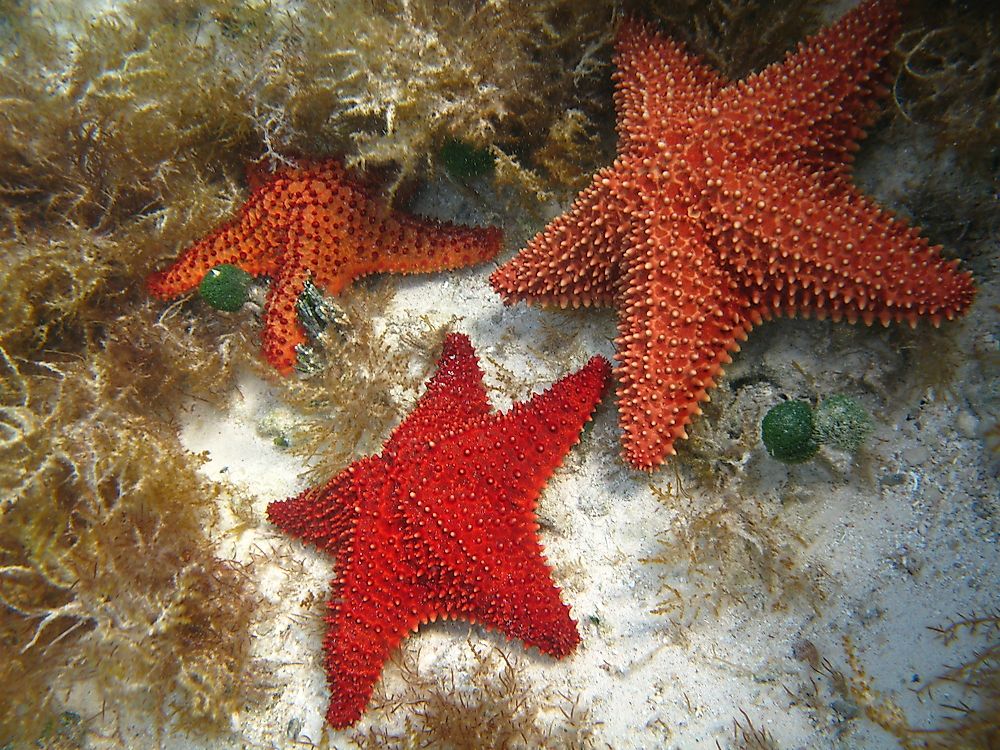
Starfish, class Asteroidea, have no heart and no blood. They run a hydraulic water-vascular system that pumps filtered seawater through a network of canals, which also drives the thousands of tube feet they walk on. The circulatory fluid is the ocean.
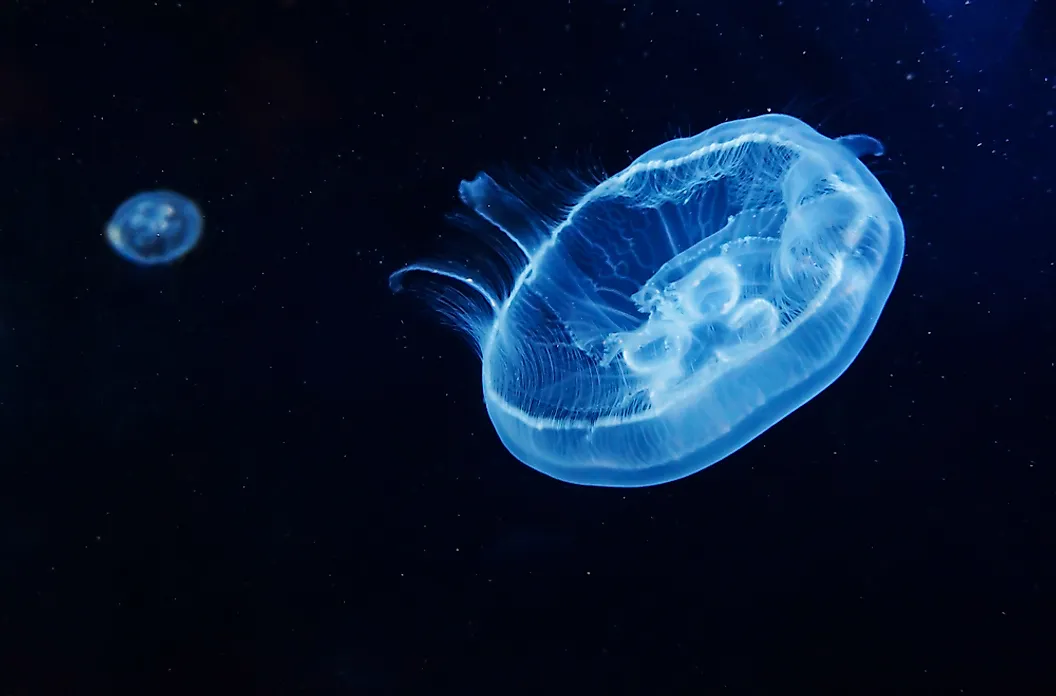
Jellyfish have no heart either, and no blood, brain or bones. Their bodies are thin enough that oxygen and nutrients diffuse directly across the tissue. Sponges and flatworms use the same solution. Once an animal is small enough or flat enough, a pump becomes unnecessary equipment.
What Medicine Wants From Them
None of this is idle trivia, which is the reason cardiologists keep reading invertebrate anatomy papers.
The cockroach's serial-chamber design is attractive because it degrades gracefully instead of failing outright, and that is exactly the property you want in an implanted device. The hagfish is attractive for the opposite reason: a heart that can sit through 36 oxygen-free hours and then restart normally is a direct model for what happens to human cardiac tissue during a heart attack or during the window when a donor organ is being transported.
The blunt version is that evolution has already run several million experiments on how to move fluid around a body without one big pump, and only recently has anyone thought to take notes.
The Honest Count
The reason these lists never agree is that heart is a word borrowed from human anatomy and then applied to organs that are not doing the same job.
Cephalopods are the clean case: three discrete, chambered, muscular pumps. Hagfish are messier, four or five depending on whether you count a paired system as one structure or two. Earthworms and cockroaches are misreported almost universally, one having none and the other having exactly one. And insects would win the whole contest outright if auxiliary pumps counted, which most people decide they do not.
The defensible answer is that the octopus, squid and cuttlefish have three, the hagfish has the most among vertebrates, and the earthworm, that reliable star of primary school biology, does not technically have a heart to its name.