Alligator Gar
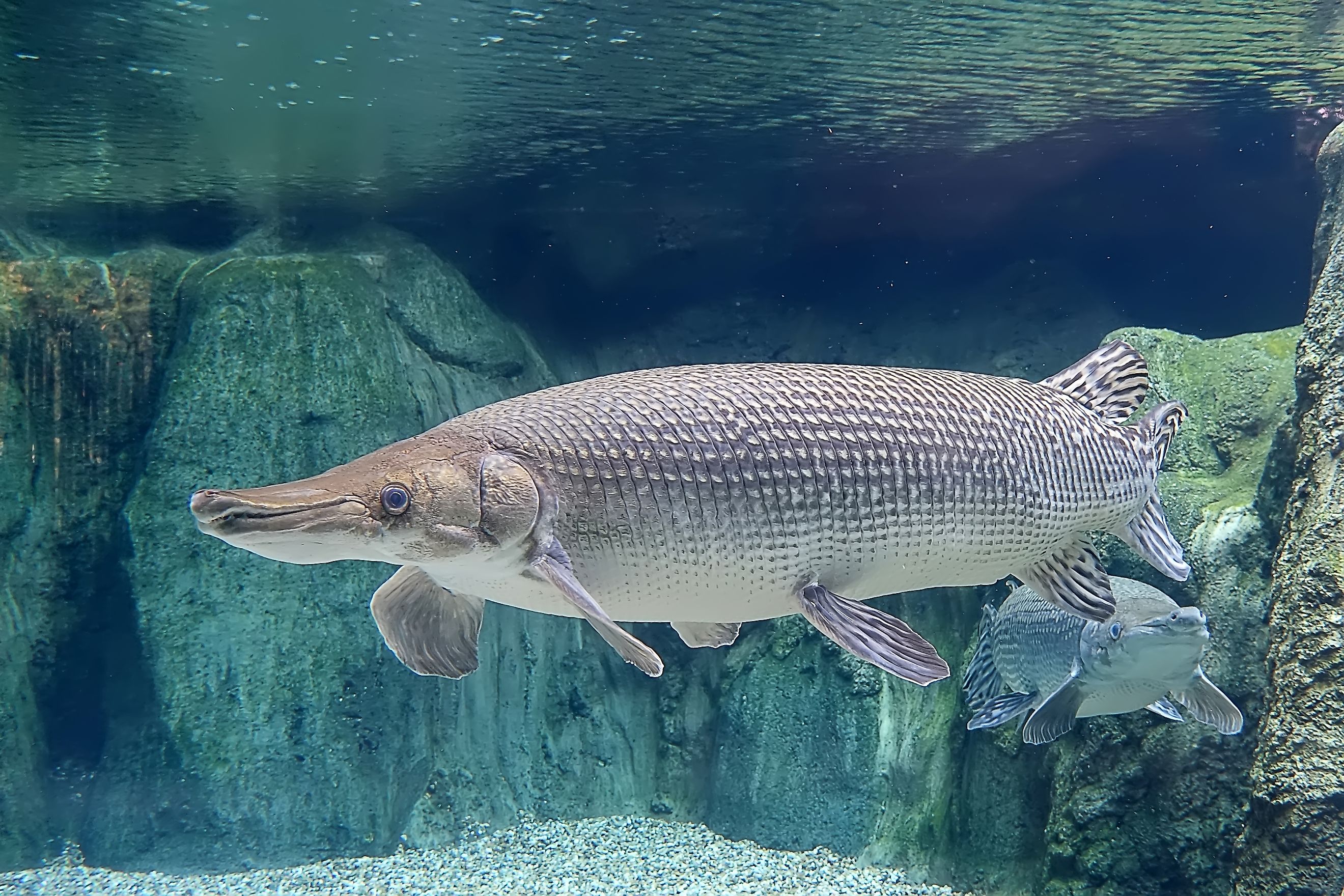
The alligator gar is the giant of North America's fresh waters, a torpedo-shaped predator that can exceed 8 feet (2.4 m) and weigh more than 300 pounds (136 kg). Named for the broad, tooth-lined snout that recalls the American alligator, it ranks as the largest member of the gar family and one of the biggest freshwater fishes on the continent. Scientists often call it a living fossil, because its lineage stretches back more than 100 million years to the Early Cretaceous.
Found across the rivers, lakes, and coastal bayous of the southeastern United States and into Mexico, this armored fish has survived largely unchanged while the world around it transformed. Its diamond-shaped scales are so hard that early anglers reportedly struggled to pierce them, and Native peoples once shaped them into arrowheads and body armor. For all its fearsome looks, the alligator gar poses no danger to swimmers and has never been linked to an attack on a human.
Taxonomic Classification

The alligator gar belongs to the family Lepisosteidae, the gars, within the order Lepisosteiformes and the ray-finned class Actinopterygii. Its scientific name is Atractosteus spatula, first described by the French naturalist Bernard Germain de Lacépède in 1803. The species sits in the genus Atractosteus alongside two tropical relatives, the Cuban gar and the tropical gar, while four other living gar species fall into the closely related genus Lepisosteus. Together these seven species make up every gar alive today, and all of them live only in North and Central America.
Gars occupy an ancient branch of the fish family tree. They belong to the clade Ginglymodi within the infraclass Holostei, and their closest living relatives are the bowfins. Researchers frequently describe gars as primitive fishes because they retain features from early ancestors, including a spiral valve intestine similar to the one found in sharks. The fossil record of the group reaches back to the Early Cretaceous, more than 100 million years ago, which explains the living fossil label so often attached to the species.
Physical Description

Mature alligator gar commonly measure about 6 feet (1.8 m) and weigh over 100 pounds (45 kg), though exceptional individuals grow far larger. Anecdotal reports describe fish approaching 10 feet (3 m) and weights near 350 pounds (159 kg). The largest specimen ever officially recorded was caught by accident in a fisherman's net on Lake Chotard, Mississippi, in February 2011. It measured 8 feet 5 inches (2.57 m), weighed 327 pounds (148 kg), and was later estimated to be between 50 and 95 years old.
The body is long, cylindrical, and built like a torpedo, colored olive to brown above and paler below. The defining feature is the broad snout, shorter and wider than that of other gars, lined with two rows of large teeth on the upper jaw. That alligator-like head gives the fish its name. Covering the body are hard, diamond-shaped ganoid scales that interlock into a flexible armor. These scales carry a mineralized, enamel-like coating that makes them tough enough to blunt tools, and they held real value for Native peoples who worked them into arrowheads, ornaments, and protective plates. This is usually the most distinctive feature anyone notices first, and it is the reason the alligator gar looks almost reptilian in the water.
Range and Habitat

The alligator gar's stronghold is the southeastern United States, especially Texas and the lower Mississippi River basin. Its range extends along the Gulf Coast and reaches south into Mexico. Historically the fish ranged farther north into the Ohio and Missouri River systems, but that range has contracted over the past century as rivers were altered.
Alligator gar favor large, slow rivers, oxbow lakes, reservoirs, swamps, and bayous. They are unusually tolerant of salt for a freshwater fish, a trait known as being euryhaline, and they move readily into brackish estuaries and coastal bays. This flexibility lets them exploit habitats that most large freshwater predators cannot use. Warm, sluggish backwaters with plenty of vegetation suit them best, since these waters concentrate the prey they ambush and provide the flooded plant cover their young need to survive.
Diet

The alligator gar is an ambush predator that hangs motionless near the surface or among vegetation before lunging at passing prey. Fish make up the bulk of its diet throughout life, but the species is an opportunist that will take almost anything it can catch. Adults have been documented eating blue crabs, small turtles, waterfowl and other birds, and small mammals, along with carrion when the chance arises.
Young alligator gar start on plankton, insect larvae, and small invertebrates before graduating to fish and larger vertebrates as they grow. The fish's long, tooth-studded jaws are ideal for seizing and holding slippery prey, and its patient, sit-and-wait style conserves energy between meals. At the top of its food web, an adult alligator gar has few natural enemies, though American alligators occasionally kill and eat them.
Behavior

Alligator gar are mostly solitary and spend long stretches lurking near cover, waiting for food to drift within reach. One of their most striking traits is the ability to breathe air. Their swim bladder connects to the gut and works much like a primitive lung, letting them gulp oxygen at the surface. This adaptation allows them to survive in warm, stagnant, poorly oxygenated water that would suffocate many other large fish, and it explains why they are often seen rolling at the surface on hot days.
Despite their menacing appearance, these fish are calm and pose no threat to people, and there are no verified records of an alligator gar attacking a human. During spring floods, adults undertake lateral migrations, moving out of the main river channels and onto inundated floodplains to feed and spawn before returning to deeper water as the flood recedes. This seasonal use of the floodplain is central to the animal's life cycle and, as it turns out, to its survival as a species.
Reproduction

Alligator gar breed in spring and early summer, when rising water temperatures and seasonal flooding trigger spawning. Females move into shallow, flooded vegetation where several males gather to fertilize the eggs as she releases them. A single large female can produce thousands of sticky, bright green eggs that cling to submerged plants. The parents provide no care once spawning is finished.
The eggs carry a potent defense. They are toxic to mammals, birds, and invertebrates such as crayfish and blue crabs, though harmless to most other fish. This toxicity likely protects the eggs from predators drawn to the splashing of spawning adults. People should never eat or handle the roe, since it is poisonous to humans as well. Hatchlings emerge within a few days and cling to vegetation with an adhesive organ on the head until their yolk sacs are absorbed, after which they begin to hunt on their own.
Growth is fast at first, and young fish can reach 10 to 12 inches (25 to 30 cm) within their first year. Males typically mature around 6 years of age and females around 10, and the species is famously long-lived. Wild alligator gar routinely pass 50 years, and females in Texas have been aged at up to 95 years. Because females spawn successfully only under precise flood conditions, and may do so only a few times in a long life, every good spawning year matters for the population as a whole.
Importance to the World

As an apex predator, the alligator gar helps regulate the balance of the freshwater systems it inhabits. By preying on abundant fish, including invasive species in some waters, it keeps prey populations in check and supports the overall health of river and lake ecosystems. Biologists also treat the fish as an indicator species, since a thriving gar population signals a functioning floodplain and clean, connected waters.
The alligator gar's cultural significance dates back centuries, while its economic value has grown more recently. Indigenous peoples used its armored scales to make tools and ornaments, and today the species supports a growing trophy fishery. Once dismissed by anglers as a rough or trash fish, it is now a prized catch that attracts fishing guides, aquariums, and wildlife tourists across its range.
Threats and Conservation

The IUCN Red List assesses the alligator gar as Least Concern, meaning the species as a whole is not currently at high risk of extinction. That global picture hides real trouble at the regional level, where many populations have declined sharply, and the fish has already vanished from parts of its former northern range.
The greatest threats are habitat loss and the damming and leveeing of rivers, which cut the fish off from the floodplains it needs to spawn. Because alligator gar depend on well-timed, sustained flooding to reproduce, altered river flows can quietly erase successful spawning years. Overharvest is a further concern, since the fish's slow maturity and infrequent spawning make depleted populations very hard to rebuild. Pollution from urban, industrial, and agricultural sources adds still more pressure. In response, wildlife agencies in states such as Texas and Florida have introduced harvest limits and spawning research, and Florida added the species to its candidate list for state protection in 2025.
Takeaway
The alligator gar is a survivor in the truest sense, a heavily armored predator whose design has weathered more than 100 million years of change. Its size, its air-breathing biology, its toxic eggs, and its long life set it apart from nearly every other freshwater fish in North America. Yet the same traits that make it remarkable, its slow maturity and its reliance on natural flood cycles, also make it vulnerable to the way people reshape rivers. Protecting the floodplains and free-flowing water that alligator gar need will decide whether this ancient giant continues to patrol southern waters for another century.
Fun Facts

- Living fossil. The gar lineage dates back more than 100 million years to the Early Cretaceous, and the fish has changed little since.
- Built-in armor. Its interlocking, diamond-shaped ganoid scales are so hard that Native peoples fashioned them into arrowheads and breastplates.
- Air breather. A lung-like swim bladder lets the alligator gar gulp air and survive in warm, oxygen-poor water that would kill most large fish.
- Poisonous eggs. Alligator gar roe is toxic to mammals, birds, and crustaceans, and it should never be eaten by people.
- Record breaker. The largest one ever recorded weighed 327 pounds (148 kg) and stretched 8 feet 5 inches (2.57 m).
Quick Facts
- Scientific name: Atractosteus spatula
- Family: Lepisosteidae (order Lepisosteiformes)
- IUCN status: Least Concern
- Length: Commonly around 6 feet (1.8 m), up to 10 feet (3 m) reported
- Weight: Often over 100 pounds (45 kg), record of 327 pounds (148 kg)
- Lifespan: More than 50 years, up to 95 in females
- Diet: Carnivore, mainly fish plus crabs, birds, and small mammals
- Range: Southeastern United States and Mexico, Gulf Coast drainages