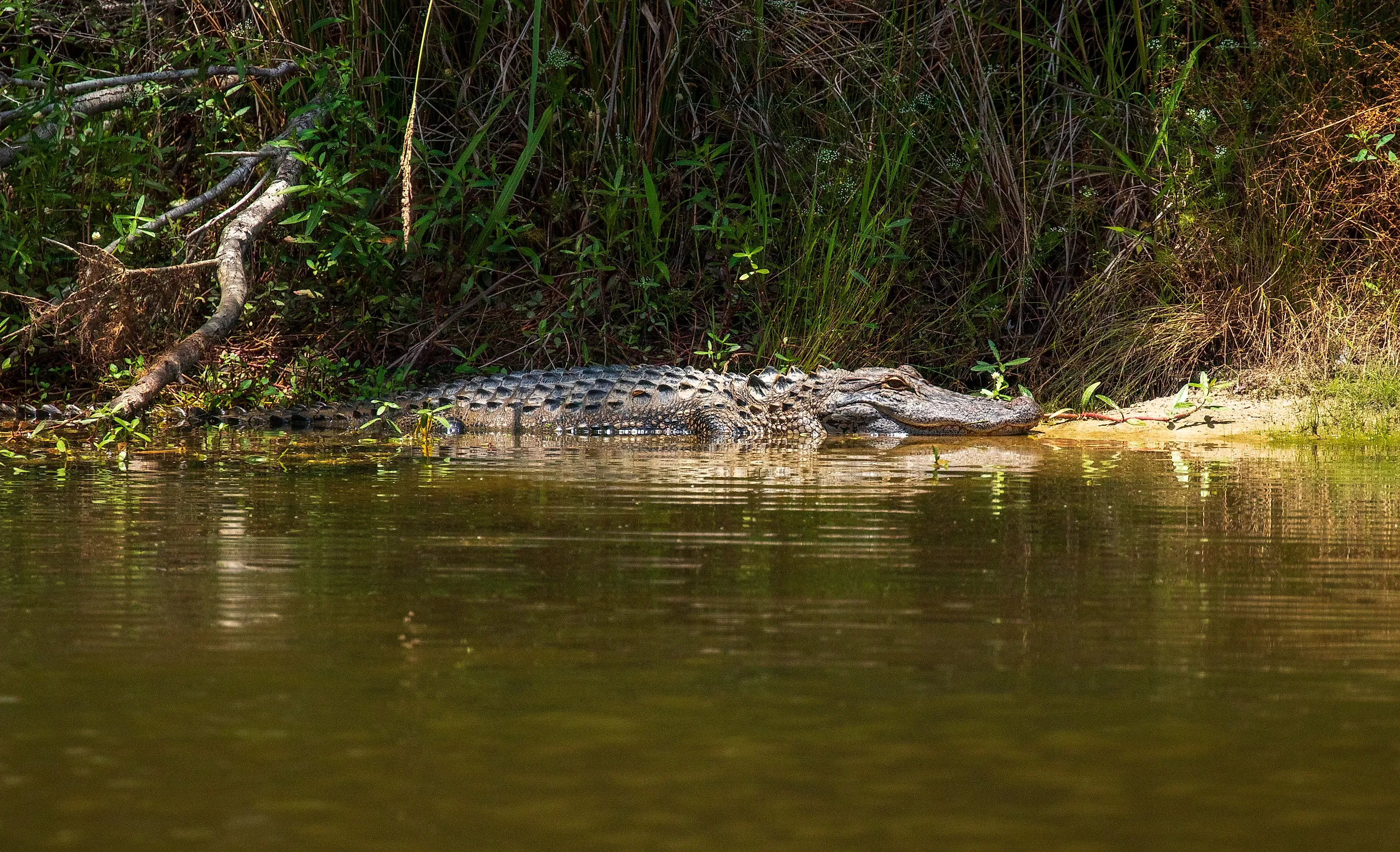
The Actual Northern Limit Of The American Alligator
American alligators reach their natural northern limit in northeastern North Carolina, just below their northern neighbor Virginia on the Atlantic Coast, where wild populations persist within about 10 miles of their border. At North Carolina's Merchants Millpond State Park in Gates County, paddlers move through the same cypress and tupelo wetlands where alligators live, at about 36°26' N. Farther south along its coast, encounters become more common, with wildlife officials responding to reports of alligators in neighborhood ponds, drainage ditches, near homes, and occasionally in swimming pools.
Alligators have appeared north of that boundary, but a sighting does not necessarily extend the species' natural range. Historical records include escaped or released animals, and individual alligators have survived unexpectedly cold conditions far outside their normal distribution.
The real puzzle is why people can encounter wild alligators within miles of Virginia, yet the species still fails to establish a breeding population across the state line.
The answer involves more than whether an adult can survive a winter. A permanent population needs enough warm weather for young alligators to feed, grow, reach maturity, nest, hatch, and eventually produce another generation.
At the Northern Edge

Merchants Millpond State Park gives the alligator's northern boundary a physical address. The park protects a 760-acre millpond and the adjoining wetlands of Lassiter Swamp, an environment where paddlers and alligators share the same waterways.
The millpond has a long commercial history. In this northeastern corner of North Carolina, Bennetts Creek flows through the wetlands surrounding the park. In 1811, Norfleets Millpond was built downstream on Bennetts Creek. Gristmills, a sawmill, a farm-supply store, and other businesses later turned the area into a center of trade in Gates County, eventually giving Merchants Millpond its name.
The geography surrounding the park makes the alligator's boundary stand out. The Pasquotank River basin extends north into the Great Dismal Swamp on the Virginia-North Carolina border, and the Nottoway and Blackwater rivers flow south from Virginia to form the Chowan River. Both river systems ultimately drain into Albemarle Sound. Yet the alligator population does not follow those waterways north.
The North Carolina Wildlife Resources Commission (NCWRC) reports that the state's greater number of cold-weather days shortens the annual growing season. Alligators grow more slowly, reproduce less frequently, and become increasingly scarce toward the northern end of their range.
The water continues into Virginia. The breeding population does not.
Alligators Can Survive a Freeze

Freezing weather does not automatically kill an adult American alligator. The animals reduce their activity as temperatures fall and can remain submerged for long periods as their metabolism slows.
A 1982 study conducted in South Carolina by researchers at the Savannah River Ecology Laboratory recorded two large adult male alligators reaching body temperatures barely above freezing. One recovered after its body temperature fell to about 41°F. Another reached 39.2°F and died about three days later. Rather than establishing a single lethal temperature, the researchers placed the critical lower range for the animals they studied somewhere between 39.2°F and 41°F.
Researchers documented another cold-weather survival strategy in Craven County, North Carolina. During freezing conditions, alligators remained submerged but kept the tips of their snouts above the surface. As ice formed around them, their exposed nostrils maintained access to air. Eight of the nine alligators observed when ice was present displayed this behavior.
The researchers called it an "icing response" and suggested that the duration of cold weather may matter more to the species' northern boundary than the severity of an individual freeze.
A Shorter Season Means Less Time to Grow

Surviving winter is only part of the challenge. Alligators are ectotherms. These are animals that cannot generate enough internal heat to regulate their own body temperature. Alligators rely on external heat for feeding, metabolism, and growth.
Studies of alligator physiology report that feeding stops when temperatures fall below about 61°F. Near the northern end of the range, alligators may go at least six months without feeding.
The consequences accumulate over a lifetime. Alligators may take about 18 years to reach sexual maturity in North Carolina, compared with about 10 years in Louisiana, where the warm season lasts longer. Those additional years delay when young alligators can begin contributing offspring to the population.
An adult may survive a few days of ice, but a population needs enough warm months for its young to eat, grow, mature, and reproduce.
Temperature Determines Sex

Temperature starts shaping an alligator's life even before it hatches.
American alligators have temperature-dependent sex determination. Unlike mammals, sex is not determined by sex chromosomes at fertilization. Instead, temperatures surrounding the eggs during a critical period of development influence whether hatchlings become male or female.
A 1994 study by Jeffrey Lang of the University of North Dakota and Harry Andrews of the Madras Crocodile Bank examined temperature-dependent sex determination across 11 crocodilian species, including the American alligator. Their research confirmed a female-male-female pattern in alligators. Cooler incubation temperatures produce females, intermediate temperatures produce males, and higher temperatures shift production back toward females. The researchers found 100% male production between about 90.5°F and 91.4°F, and temperatures at or below 88.7°F produced females. At temperatures at or above 95°F, females were again produced.
Temperature shapes when alligators nest and how their young develop. At Rockefeller Wildlife Refuge in Louisiana, Ted Joanen and Larry McNease studied nesting from 1964 through 1987 and found that warmer spring temperatures corresponded with earlier nesting. Their incubation experiments linked temperature with hatchling size and growth during the first 18 months.
Near the northern limit, temperature affects more than whether an adult survives winter. It follows the alligator into the nest and influences the next generation.
Warming Nests and Shifting Sex Ratios

University of Georgia researchers monitored 86 wild American alligator nests at Kennedy Space Center in Florida and Tom Yawkey Wildlife Center in South Carolina over eight years. They found that warmer years corresponded with higher average nest temperatures. Their models estimated that nest temperatures could rise about 2.9°F to 6.7°F by 2100 if female alligators do not compensate by changing their nesting behavior.
For an animal whose offspring sex depends on incubation temperature, a few degrees can have large consequences. The researchers projected generally male-skewed offspring ratios around 2050. By 2100, however, the results varied according to location and climate scenario, ranging from heavily male to heavily female populations.
That apparent contradiction comes from the alligator's female-male-female temperature response. Moderate warming can move nest temperatures into the male-producing range, and greater warming can push them through that range and back toward female production.
The study does not establish that warming is already extending the American alligator's permanent range into Virginia. Instead, it demonstrates how changing temperatures could alter one of the reproductive conditions that helps determine where alligator populations can persist.
Sightings in Virginia

Alligators have appeared in Virginia, but a sighting is not the same thing as a natural breeding population.
The Smithsonian Environmental Research Center identifies the southern portion of Albemarle Sound in North Carolina as the probable natural northern boundary of the American alligator. Its records report no paleontological evidence that alligators naturally occurred in Virginia and no documented breeding population there.
Human activity has complicated the historical record. Baby alligators were once widely sold as pets, and unwanted animals sometimes ended up far outside the species' natural range. Smithsonian records describe probable releases around the former Naval Amphibious Training Base in Princess Anne County, Virginia, where servicemen kept alligators as pets and mascots.
US Geological Survey records document eight American alligator occurrences in Virginia between 1969 and 2008, and none resulted in an established population. Among the earlier records were alligators at Lake Smith in Virginia Beach in 1969, Lake Anna in 1978, and Aquia Creek in Stafford County in 1982.
Individual alligators can survive much farther north. Smithsonian records describe one captured near Pittsburgh, Pennsylvania, in 1949 that was believed to have survived six or seven winters. Yet Pennsylvania did not become part of the species' natural range because one animal managed to survive there. The same distinction applies to Virginia, where an individual occurrence does not establish a breeding population.
When Alligators and People Meet

Human-alligator encounters become more common farther south along North Carolina's coast, particularly in New Hanover and Brunswick counties, where growing communities overlap established alligator habitat.
On May 27, 2026, the NCWRC reported that its Wildlife Helpline biologists were receiving multiple alligator calls per day and making a number of site visits each week. May and June coincide with mating season, when alligators become more mobile at the same time more people are spending time outdoors.
Reports include alligators in neighborhood retention ponds and drainage ditches. More urgent calls have involved animals against houses, beneath vehicles, inside garages, in swimming pools, and blocking public roads.
The agency reports that most cases involving alligators approaching people or displaying behavior described as aggressive can be traced to people feeding them. Once an alligator associates humans with food, it can lose the natural wariness that normally keeps the two apart.
At Merchants Millpond, park guests can reduce that risk by following the NCWRC's "zoom and room" advice to photograph alligators from a safe distance and use a camera's zoom rather than approaching them. No one should ever attempt to capture or handle an alligator.
Pets at the park must remain on a leash no longer than 6 feet, and the NCWRC recommends keeping them away from the water's edge. Food scraps, bait, and fish remains should never be left where they could attract an alligator.
Where the Alligator's Range Really Ends

Merchants Millpond and northeastern North Carolina mark more than the coldest place an alligator can survive. Isolated animals have endured winters much farther north, but survival alone does not establish a natural range.
Virginia still has no documented natural breeding population, although changing temperatures could alter some of the conditions that currently limit the species.
The northern limit is not simply the farthest place where an alligator can stay alive.
It is the farthest place where wild alligators can keep producing the next generation.