Why Alligators Only Live In Two Places On Earth
A cattle rancher checking a stock pond in east Texas and a rice farmer working the wetlands of China's lower Yangtze River have almost nothing in common, except for one strange fact. Both of them live near wild alligators. Those two regions, the American Southeast and a small pocket of eastern China, are the only places on the planet where alligators still exist in the wild. You will not find them in Africa, in Australia, or anywhere across Europe and the rest of Asia. For a lineage of reptiles whose relatives have been around since the age of the dinosaurs, that is a very small corner of the world to occupy.
Two Species, Two Continents, Nothing in Between

There are only two living alligator species, and each one keeps to its own side of the Pacific. The American alligator ranges across the coastal plain of the Southeast, from the Carolinas down through Florida and west into eastern Texas. It is the giant of the pair, with big males regularly passing eleven feet and some pushing past fourteen. Louisiana and Florida alone hold the bulk of a population now estimated in the millions.
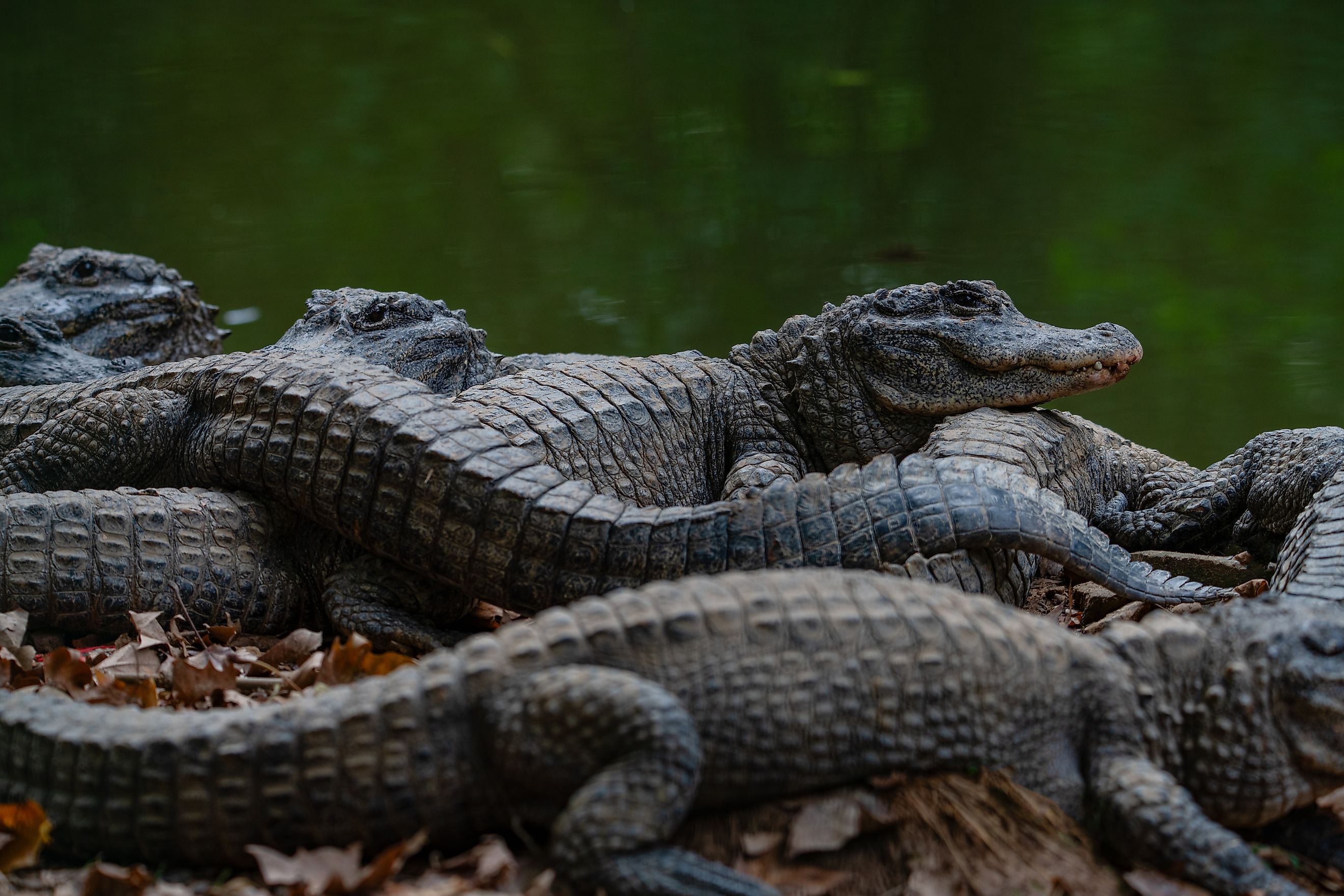
Its counterpart is the Chinese alligator, and the contrast is hard to overstate. It survives in a shrinking band of wetlands along the lower Yangtze, mostly in Anhui Province. A large one measures around five feet. Where the American species is thriving, the Chinese alligator is critically endangered, with a wild population that surveys have put anywhere from roughly one hundred to a few hundred animals, propped up by captive breeding and reintroduction. Two species, then, sitting on opposite edges of the northern hemisphere with an entire ocean and continent between them.
They Used to Be Almost Everywhere

The odd thing is that alligators were not always this rare or this scattered. Their branch of the crocodilian family tree first appeared in North America late in the age of dinosaurs, then spread widely as the climate warmed over the following tens of millions of years. Fossil relatives turned up across Europe and Asia, and the record suggests these animals crossed between North America and Asia on more than one occasion. During the warm stretches of the early Cenozoic, crocodilians of one kind or another lived far into what are now temperate and even cold regions.
In other words, the modern map is the leftover of a much bigger range. What we see today is not where alligators started. It is what remained after the world changed around them.
Why the Rest Disappeared

The turning point was cooling. Starting around 34 million years ago and continuing in waves after that, global temperatures dropped and the warm, humid belts that crocodilians depend on pulled back toward the equator. Most crocodilian lineages retreated with them into the tropics. The alligatoroids that had settled in Europe eventually died out entirely, leaving no descendants there at all.
Alligators handled the cold better than most of their relatives, which is a big part of why they held on where others could not. An American alligator can wait out a freeze by slowing its body down and keeping its snout above the surface even as ice forms around it. That tolerance let the lineage cling to two warm-temperate refuges long after the tropics-only crocodilians had abandoned those latitudes. It also explains why the dominant crocodilian of the Southeast is a gator rather than a crocodile, a distinction worth understanding if you ever confuse the two animals in the field.
Why They Never Spread Back

Once the two populations were stranded, there was no easy way for them to reconnect or expand overseas. Alligators are freshwater animals, and they lack the salt-secreting glands that let saltwater crocodiles drink from the sea and island-hop across open water all the way from India to Australia. An alligator simply cannot make that kind of crossing. Its range is a relic, held in place by biology rather than pushed outward by it.
The same limits show up even inside the United States, where the gator's range stops at fairly hard edges rather than continuing westward across the continent. If you have ever wondered where those edges fall and why, it comes down to the same mix of temperature and water that shaped the global picture, and it is the reason alligators drop out of the landscape west of Texas.
What About Caimans?

Anyone who has traveled in Central or South America might object here, because there are plenty of alligator-like reptiles basking on riverbanks from Mexico to Argentina. Those are caimans. They belong to the same family as alligators, Alligatoridae, and they are close cousins, but they sit in different genera. The name alligator, in the strict sense, applies only to the genus that contains the American and Chinese species. So the broader family does reach the American tropics through its six or so caiman species. A true alligator, though, is still just those two, in those two places.
Two Survivors, Two Very Different Futures

The story of the alligator is really the story of two relics that took opposite paths in the modern age. The American alligator was hunted to the edge in the twentieth century, then recovered so completely after legal protection that it now counts as one of the clearest wins in American wildlife conservation. The Chinese alligator got no such reprieve. Its wetlands were drained and farmed until only fragments were left, and its survival now depends heavily on captive breeding. Both animals are living proof of how far alligators once ranged, and how narrowly that range has been squeezed down to two quiet corners of the world.