Which Animals Cannot Walk Backwards?
Backing up is such a basic skill that most animals never think about it. A cat reverses out of a tight spot, a horse steps back on command, and a crab has made moving sideways and backward its entire personality. Yet a short list of creatures genuinely struggle to throw it in reverse, and the real reasons are stranger than the myth suggests. The honest answer to which animals cannot walk backwards is this: fewer than the internet claims, but at least one truly cannot. The undisputed champion of forward-only travel is the kangaroo. Its usual sidekick, the emu, is a more complicated case, and a surprising number of the usual suspects turn out to reverse just fine.
The Kangaroo: Forward Only, No Exceptions

The kangaroo is the one animal that earns its place on this list without an asterisk. It belongs to the family Macropodidae, a name that means "big foot," and those oversized hind feet are the whole story. On land, a kangaroo's legs work only in unison, both feet pushing off together like a pogo stick, which is efficient enough to carry a red kangaroo at more than 30 miles per hour in bounds of over 25 feet. That same spring-loaded design cannot run in reverse, because backing up would demand a completely different sequence of tendon loading and muscle firing that the anatomy simply does not have.
The tail seals the deal. Thick, muscular, and heavy, it works as a counterweight during hops and as a genuine fifth limb at slow speeds, when the animal shifts into a curious "pentapedal" walk, planting its tail and swinging both legs forward between its arms. Run that motion in reverse and the kangaroo would trip over its own counterbalance. These marsupials can reposition a foot to scratch, and they can move their legs independently in exactly one situation, while swimming, but a controlled backward walk is off the menu. When a kangaroo needs to go the other way, it does the sensible thing and turns around.
The Emu: Guilty by Association
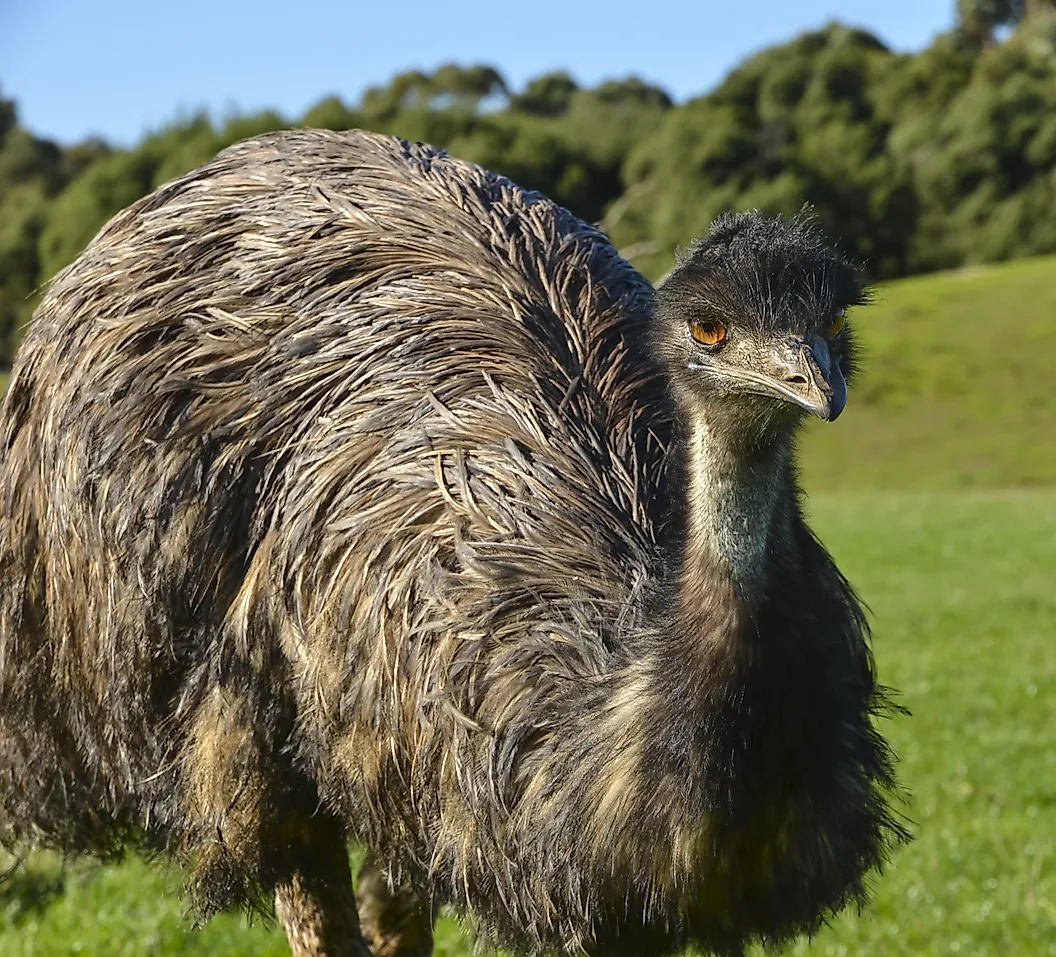
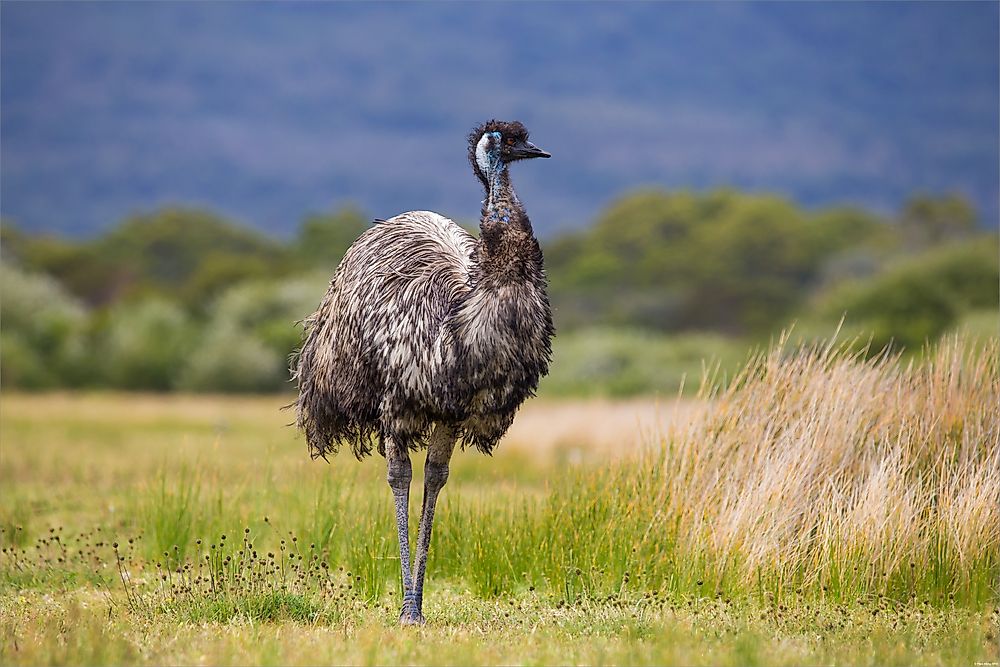
The emu, Dromaius novaehollandiae, is the world's second-tallest bird after the ostrich and Australia's largest native bird, built for one thing above all: running forward. On long, powerful legs it can sprint at around 30 miles per hour across open country. It also shares the kangaroo's reputation for being unable to reverse, and this is where the story gets shakier.
Unlike the kangaroo, the emu's inability is more folklore than fact. The bird is clumsy in reverse and rarely bothers, and the popular explanation, that its knee joints physically forbid it, is not well supported. In practice, an emu can shuffle a few steps backward when it needs to. It earns its spot on the list mostly by tradition and by keeping famous company, not because biology forbids it. If you ever want to see the difference between "cannot" and "would rather not," the kangaroo and the emu are the perfect pair. For the record, the bird is not to be confused with its taller African relative; the emu and the ostrich are separate species on separate continents.
Why Are Both on the Australian Coat of Arms?
The kangaroo and the emu have flanked Australia's coat of arms since 1912, standing on either side of the central shield beneath the motto "Advance Australia." The popular story is that the two were chosen precisely because neither can easily walk backwards, making them the ideal emblem for a nation determined to keep moving forward.
It is a lovely idea, and only partly true. The animals were picked first because they are large, instantly recognizable, and found only in Australia, which made them natural choices to hold up a shield at matching scale. The "always moving forward" symbolism attached itself afterward and fit the motto so neatly that it stuck. It is also, as we have seen, a little generous to the emu. Australians have embraced the meaning regardless, and it endures as one of the more memorable justifications behind any national emblem.
Wrongly Accused: Animals That Reverse Just Fine

Plenty of lists pad themselves out with animals that reverse perfectly well. The American alligator is a favorite wrongful conviction. On land it belly-crawls, and when it wants to move quickly it lifts its body clear off the ground in a "high walk." Neither gait locks it into forward motion, and an alligator startled at the water's edge will happily reverse straight back into the safety of the water, tail first.

Penguins get accused too, presumably because their forward waddle looks so committed. In reality a penguin can waddle backward, pivot on the spot, and, when it really wants to travel, drop onto its belly and toboggan across the ice, pushing with its feet. The lesson is that looking ungainly is not the same as being unable. Most animals that seem like they cannot back up simply have better things to do than prove it to us.
So, Which Animals Really Can't?
Strip away the folklore and the list is short. The kangaroo is the genuine article, an animal so specialized for forward hopping that reverse was never part of the design. The emu is the traditional runner-up, more "won't" than "can't." Almost everyone else on the usual lists, alligators and penguins included, can reverse when it suits them. Evolution rarely bothers to build a reverse gear when simply turning around works just as well, which is exactly why the animals that truly cannot back up are so rare, and so oddly famous for it.