Tarsier
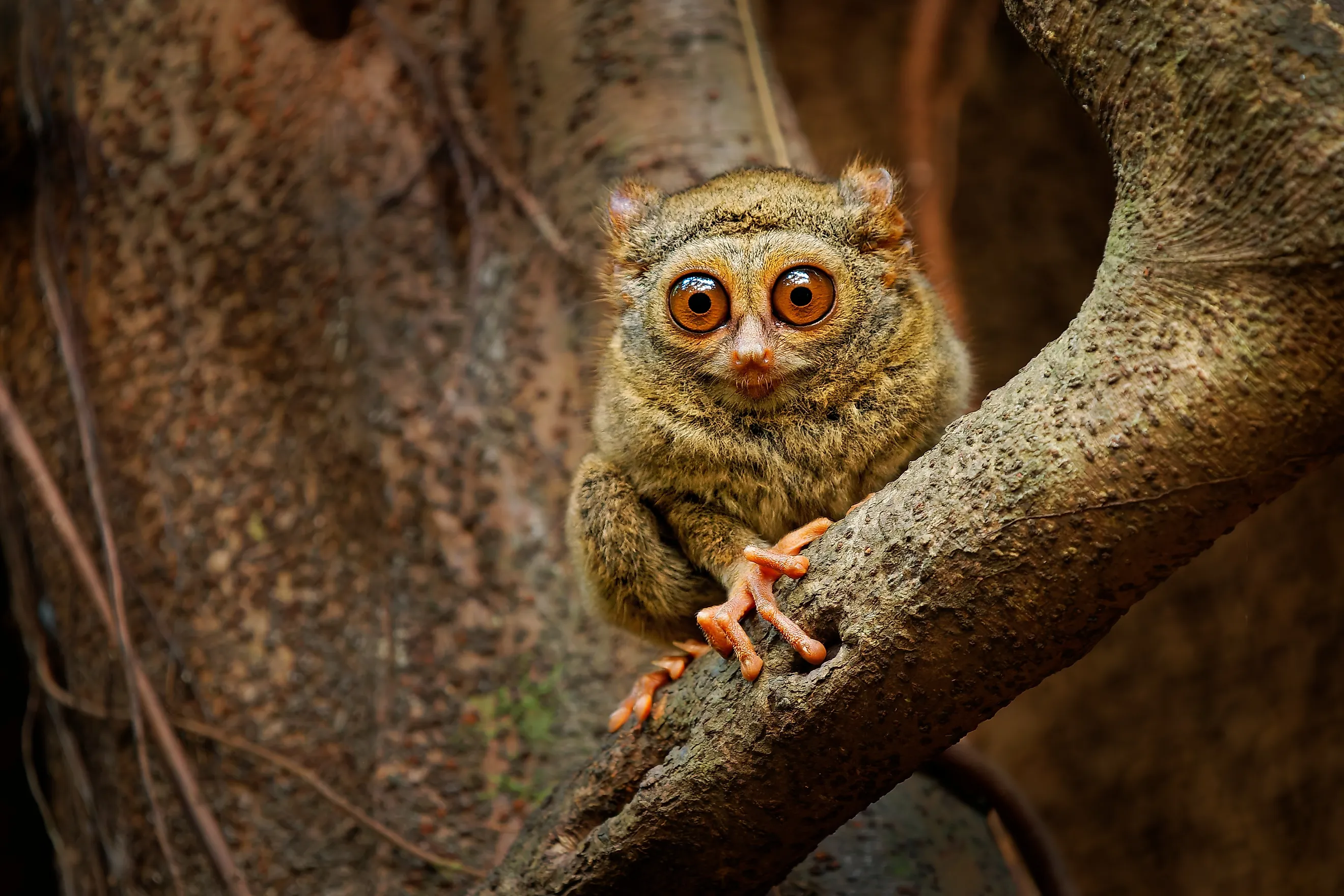
Ounce for ounce, the tarsier may be the most extreme-looking primate alive. Each of its eyes is roughly the size of its entire brain and, relative to body size, they are the largest eyes of any mammal on Earth. Scale those proportions up to a human and you would be walking around with eyeballs the size of grapefruits.
Tarsiers are tiny, nocturnal, tree-clinging primates of the family Tarsiidae, and every living species is found on the islands of Southeast Asia, including the Philippines, Borneo, Sumatra, Sulawesi, and their smaller neighbors. They belong to an ancient lineage whose basic body plan has barely changed in about 45 million years, which makes them a living window into the deep past of the primate order that also produced monkeys, apes, and us.
What makes them worth a closer look is not just the eyes. Tarsiers are the only primates on the planet that eat nothing but live animal prey, they can rotate their heads roughly 180 degrees in each direction, and some species chatter to each other in pure ultrasound, a private channel pitched far above what human ears can detect. This profile covers where they fit on the primate family tree, how their strange anatomy works, and why several species are now sliding toward extinction.
Taxonomic Classification

Tarsiers sit in the order Primates, in their own infraorder, Tarsiiformes, whose only surviving family is Tarsiidae (Gray, 1825). Taxonomists have long argued about where they belong, because tarsiers are an intermediate form between two familiar groups. Like a lemur, they are small, nocturnal, and keenly scent-driven, but their dry, hair-covered nose, their eye structure, and their placenta align them with monkeys, apes, and humans. Modern classifications place them among the haplorhine primates, on the same branch as the simians rather than with the lemurs and lorises.
Most authorities now split the living tarsiers into three genera, each anchored to a distinct region. Tarsius covers the Sulawesi tarsiers of Indonesia, Cephalopachus holds the western, or Horsfield's, tarsier of Borneo, Sumatra, and nearby islands, and Carlito contains the Philippine tarsier, Carlito syrichta. A widely used revision by Groves and Shekelle in 2010 formalized this three-genus arrangement. Species counts vary because tarsiers are cryptic and difficult to study at night. Britannica recognizes about 13 species, while some primate specialists count 14 or more. Researchers also expect further splits as DNA studies and analysis of their calls continue.
Physical Description

A tarsier is a study in exaggeration. The head and body measure only about 3.5 to 6.3 inches (9 to 16 cm), and the naked, scaly tail roughly doubles that at about 5.3 to 10.8 inches (13.5 to 27.5 cm). A typical adult weighs just 2.8 to 5.8 ounces (80 to 165 g), so a tarsier fits comfortably in a human palm. The pygmy tarsier of Sulawesi is the smallest of the group, and the Philippine tarsier ranks among the smallest primates in the world, though several mouse lemurs of Madagascar are smaller still.
The eyes dominate everything. Each eyeball is about 0.6 inches (16 mm) across, close to the size of the brain behind it, and unusually the eyes cannot move in their sockets. To look around, a tarsier swivels its whole head, turning it roughly 180 degrees in either direction like an owl. Unlike many night-active mammals, tarsiers lack the reflective tapetum lucidum behind the retina, and they compensate with a retina packed with light-gathering rod cells. Behind those eyes sits a small brain with a greatly enlarged visual cortex to handle all that input.
The rest of the animal is built for launching. Two elongated ankle bones, the tarsals, give the family its name and act like biological springs. The hind limbs are far longer than the forelimbs, the fingers and toes are long and slender, and the digits end in rounded, gripping pads that let the animal cling to vertical trunks. The fur is soft and velvety, gray to buff or brown depending on species. Females are slightly smaller than males in some Sulawesi species, a modest example of sexual dimorphism.
Range and Habitat

Tarsiers live only on islands in Maritime Southeast Asia. The Philippine tarsier occupies the southeastern Philippines, especially Bohol, Samar, Leyte, and parts of Mindanao. The Sulawesi tarsiers are spread across Sulawesi and its satellite islands, while the western tarsier ranges through Borneo and Sumatra. Fossils show the group was once far more widespread, reaching Europe, North Africa, Asia, and North America, so today's island populations are the scattered survivors of a lineage that has retreated over millions of years.
Their preferred habitat is forest with dense, low vegetation. They live in primary rainforest where it remains intact, but can also be found in secondary growth, scrub, bamboo stands, and the bushy edges of plantations. Population densities are generally highest in less disturbed forest. In the Philippines, tarsiers range up to roughly 2,460 feet (750 m) in elevation, and the spectral tarsier of Sulawesi typically forages in the lower canopy, often within a few feet of the ground. Tarsiers are also biogeographically notable because they occur on both sides of Wallace's Line, the faunal boundary that separates Asian and Australasian animal groups, a distribution few land mammals share.
Diet

The tarsier's most notable trait is its diet. It is the only primate that is entirely carnivorous. Nearly every other primate mixes in fruit, leaves, gum, or seeds, but tarsiers eat only live animal prey. Insects make up the bulk of the menu, including beetles, moths, crickets, katydids, and cockroaches, and larger species readily take small vertebrates such as lizards, snakes, frogs, and even small birds snatched out of the air.
The hunting style matches the anatomy. A tarsier waits on a vertical perch, scanning with its enormous eyes and swiveling ears that rotate independently to pinpoint the faint rustle of prey. When it locks on, it launches, grabs the prey in both hands, and delivers a bite with sharp, pointed teeth. Because it relies on such a specialized, protein-rich diet, a tarsier needs a steady supply of live insects and small animals, and its gut is short and simple, tuned for meat rather than plant matter. That dietary rigidity is one reason tarsiers do so poorly when people try to keep them.
Behavior and Reproduction

Tarsiers are nocturnal and arboreal, spending the day asleep in dense tangles of vegetation or hollow trees and emerging at dusk to hunt. They move by vertical clinging and leaping, springing between trunks and branches. Those spring-loaded ankles let them cover remarkable distances for their size, with leaps of several feet between perches and reports of jumps up to about 16 feet (5 m) in a single bound.
Social life varies by species. Philippine and western tarsiers are largely solitary and territorial, marking their patches with scent from urine and glandular secretions, while several Sulawesi species, including the spectral tarsier, live in small family groups, defend territories, and greet the dawn with loud duet songs as pairs return to shared sleeping trees. Communication runs into frequencies humans cannot hear. Researchers have recorded Philippine tarsiers producing calls near 70 kHz and detecting sound up to around 91 kHz, and studies of the spectral tarsier describe chirps, twitters, choruses, doubles, and whistles, some of them pure ultrasound. This high, private channel may let mothers and infants or mated pairs communicate without alerting predators. The same head-swiveling motion they use to spot prey also helps them keep an eye out for danger, much like an owl.
Reproduction is slow and heavily invested. In the well-studied spectral tarsier, females carry a single offspring for about six months and often breed twice a year. The newborn is unusually well developed, with a full coat of fur, open eyes, and the ability to cling and climb within just a day of birth. Tarsier infants are the largest relative to the mother's body mass of any primate, weighing roughly a fifth of the mother at birth, with much of that weight in the head, eyes, and brain. Mothers nurse for around 80 days, sometimes parking the infant on a branch or carrying it in the mouth while foraging. Lifespans reach well into the teens.
Importance to the World

As the primate order's only pure carnivores, tarsiers occupy an ecological niche no other primate fills. Night after night they consume large numbers of insects, including crop and forest pests, which places them among the natural pest controllers of Southeast Asian forests. Their sensitivity to habitat quality also makes them useful indicators. Healthy tarsier populations often point to forests with thriving insect life and little disturbance, while their decline can signal broader problems within the ecosystem.
Tarsiers matter to people as well. In the Philippines, the tarsier has become a symbol of the country's biodiversity and a centerpiece of ecotourism, particularly on Bohol, where sanctuaries draw visitors from around the world and give local communities a financial reason to protect forest habitat. Scientifically, the family is prized for its position near the root of the haplorhine primates, offering clues to how the ancestors of monkeys and apes lived, saw, and hunted tens of millions of years ago.
Threats

Conservation status differs across the family, but the trend lines mostly point down. The Philippine tarsier is listed by the IUCN Red List as Near Threatened, most recently assessed in 2020, with a decreasing population and protection under Appendix II of CITES. Several Sulawesi species carry heavier ratings of Vulnerable, Endangered, or Critically Endangered, and the Siau Island tarsier has appeared on lists of the world's most endangered primates. Wild population figures are hard to pin down, though estimates have put surviving Philippine tarsiers anywhere from a few thousand down to the low thousands on Bohol.
The pressures are familiar for a forest specialist. Habitat loss from deforestation, agriculture, and development is the largest threat, fragmenting the low, bushy forest tarsiers depend on and isolating populations. Because their diet is so narrow, a decline in insects, driven partly by pesticides, cuts directly into their food supply. The illegal pet trade is another serious drain, made worse by the fact that tarsiers are extremely stress-prone and fare badly in captivity, where many die young and captive breeding remains difficult. The same trade pressure falls on other small nocturnal Asian primates such as the slow loris. Handling by tourists compounds the stress on wild individuals. Conservation efforts, including sanctuaries on Bohol and habitat-protection programs, aim to keep these primates on the map, but their high infant mortality and specialized needs make recovery slow.
Takeaway
The tarsier packs an impressive range of adaptations into a body small enough to fit in your hand, including light-sensitive eyes, a swiveling head, powerful spring-like legs, a meat-only diet, and calls that can reach frequencies beyond human hearing. Those specializations make it one of the most distinctive primates alive and a rare survivor of a lineage older than the monkeys. They also make it fragile. With forests shrinking, insect prey thinning, and the pet trade still active, the future of the tarsier depends on protecting the specific island habitats it cannot live without, which is why several species now rank among the primates most in need of conservation.