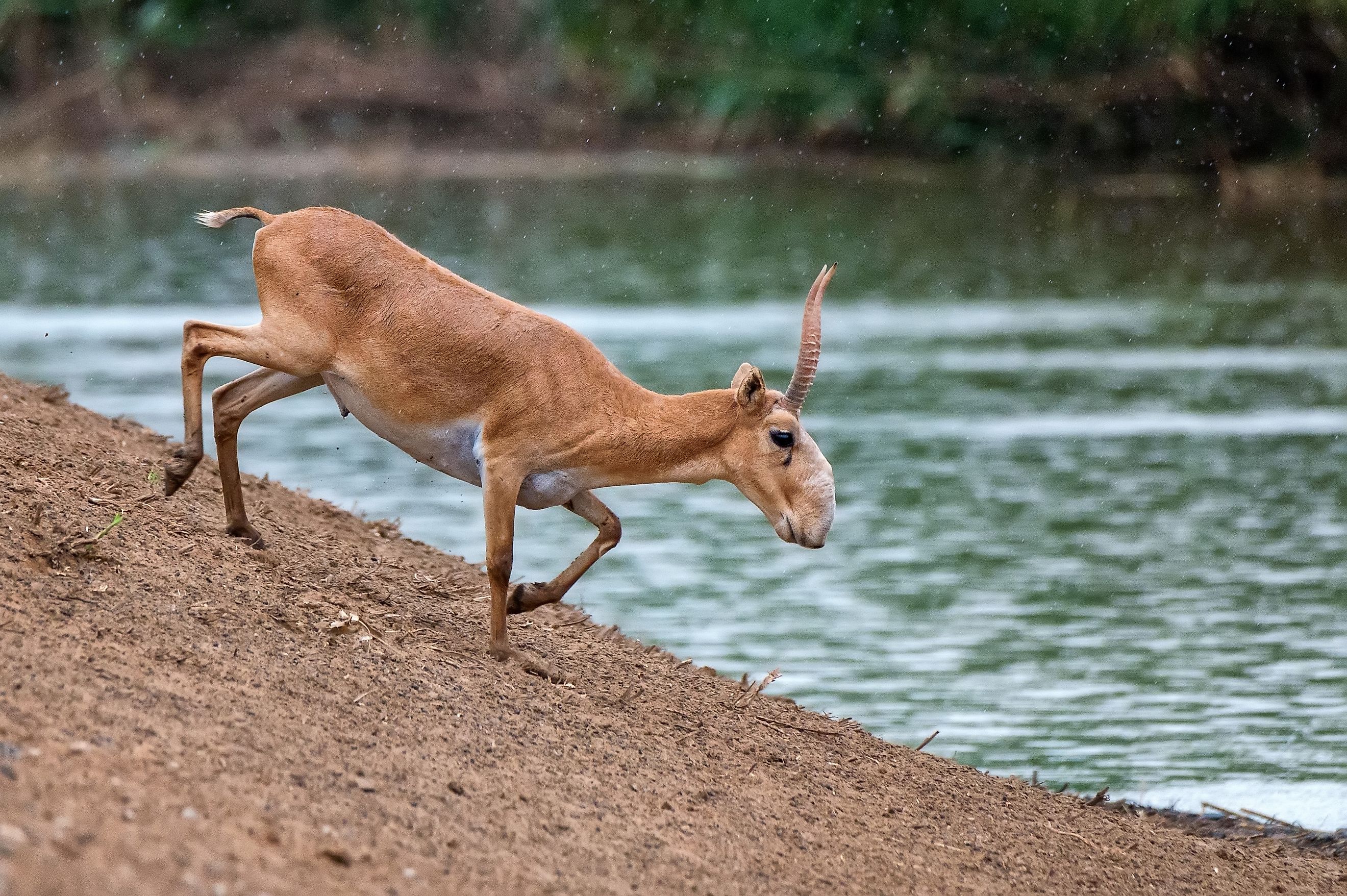
Saiga Antelope
The saiga antelope, or simply the saiga, is a medium-sized species of antelope native to the Eurasian Steppe. After recovering under Soviet-era protections, saiga populations collapsed by about 95% following the dissolution of the Soviet Union, largely because of intense poaching. Their subsequent recovery led the International Union for Conservation of Nature to reclassify the species from Critically Endangered to Near Threatened in 2023. By 2025, national reports estimated more than 2.8 million saigas in Kazakhstan alone, with smaller populations surviving elsewhere in Central Asia and Russia.
Biology and Description

Saiga are hoofed mammals characterized by their long heads, drooping snouts, and curved, ridged horns found on the males of the species. A saiga’s nose hangs down over their mouth. At the end of their bulbous snout, their nose curves outward and down in two pronglike nostrils, which almost look like two small trunks. The admittedly odd-looking structure of its nose helps to warm and moisten the cold, dry air of the steppe and filter out dust. Their big noses also provide them with a strong sense of smell, critical for a prey species like the saiga that needs to be able to detect lurking predators.
Saiga are about the size of a goat, with four lithe legs, a long neck, and a short tan coat of fur that turns shaggy and white in the winter. An adult saiga typically stands around 30 inches tall at the shoulder, and weighs between 68 and 95 pounds. Male saigas are typically larger than the females of the species, who are roughly ¾ the size of the males.
Saiga belong to the family Bovidae, the family that includes antelopes, gazelles, cattle, bison, sheep, goats, and more. As a group, bovids are distinguished by their horns, which are typically found on both males and females, as well as by their famous four-chambered stomachs, which help them digest rough plant matter. Bovids use this digestive system to break down cellulose, a structural carbohydrate found in plant cell walls. Microorganisms in the rumen, the first and largest stomach compartment, ferment fibrous plant material. The animal later regurgitates partially digested food as cud and chews it again.
Habitat
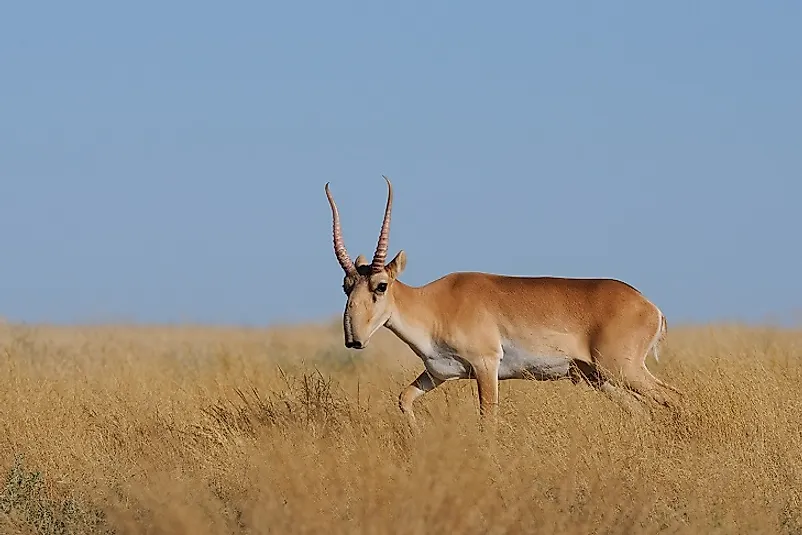
Saiga are native to the Eurasian Steppe, a massive stretch of grassland that reaches from Hungary in the West to Mongolia in the East. Saiga prefer open areas with few trees, spaces that provide them with ample brush and low vegetation which they feed on. Historically, saigas occupied a vast range across the Eurasian steppes. Today, the principal wild populations are concentrated in Kazakhstan, Russia, western Mongolia, and parts of Uzbekistan.
Behavior

Saiga are herd creatures, usually living in groups of 30-40 individuals, though these numbers balloon during migrations. Saiga are timid and skittish, bolting at speeds of up to 50 miles per hour at the first sign of danger, often scattering their herds. In daily life, Saiga graze the deserts and grasslands of the steppe, keeping a watchful eye out for predators. They meander about, seeking sources of water, and forage for food.
Saiga are herbivores, feeding on the various shrubs and low-lying vegetation of the deserts of the steppe. Their diet is fairly varied, and includes grasses, desert plants, onions, herbs, lichens, and shrubs. Throughout the year, they will migrate in search of food and water, and in the fall they will move south in huge numbers to avoid winter snow. These greener pastures, so to speak, provide the resources and safety needed for the saiga mating season.
Once the herds of saiga have reached the southern ranges of their habitats, the mating season, or rut, begins. This generally happens throughout late November and December. During these months, a male saiga will attempt to control a group, or harem, of 30 to 50 females, though some sources say these groups might be as small as 5 to 10. The male will try to keep these females within his reach, even using his horns to fight off other males that try to woo them away. These confrontations can be deadly, but saiga are willing to risk their lives to protect their claim to mates.
Although they are no strangers to competition, saigas, like any herd animal, are social creatures. Their huge noses help them filter out dust and dry air and detect danger, while also serving as amplifiers, allowing them to create loud snorts and vocalizations. These loud sounds tell a female that a snorting male is large and healthy, qualities necessary for a suitable mate.
At the end of the mating season, many of the males, exhausted from fighting, mating, and migrating, will perish. Once the mating season has concluded, those who have survived begin to travel. Huge herds containing between 10 and 2,000 males will migrate first, in early spring. As the males move out, herds of females follow, splitting off to give birth together in late April and May. The gestation period of a female saiga is about 139 to 152 days. First-year mothers commonly give birth to a single calf, while older females frequently produce twins.
Young saigas spend the first four months of their lives nursing, though they begin to eat grass at around a week old. Females reach sexual maturity at the age of 7 or 8 months, while the males take a lot longer, reaching sexual maturity at the age of 2 years. The typical lifespan of a saiga in the wild is around 10 to 12 years.
Threats

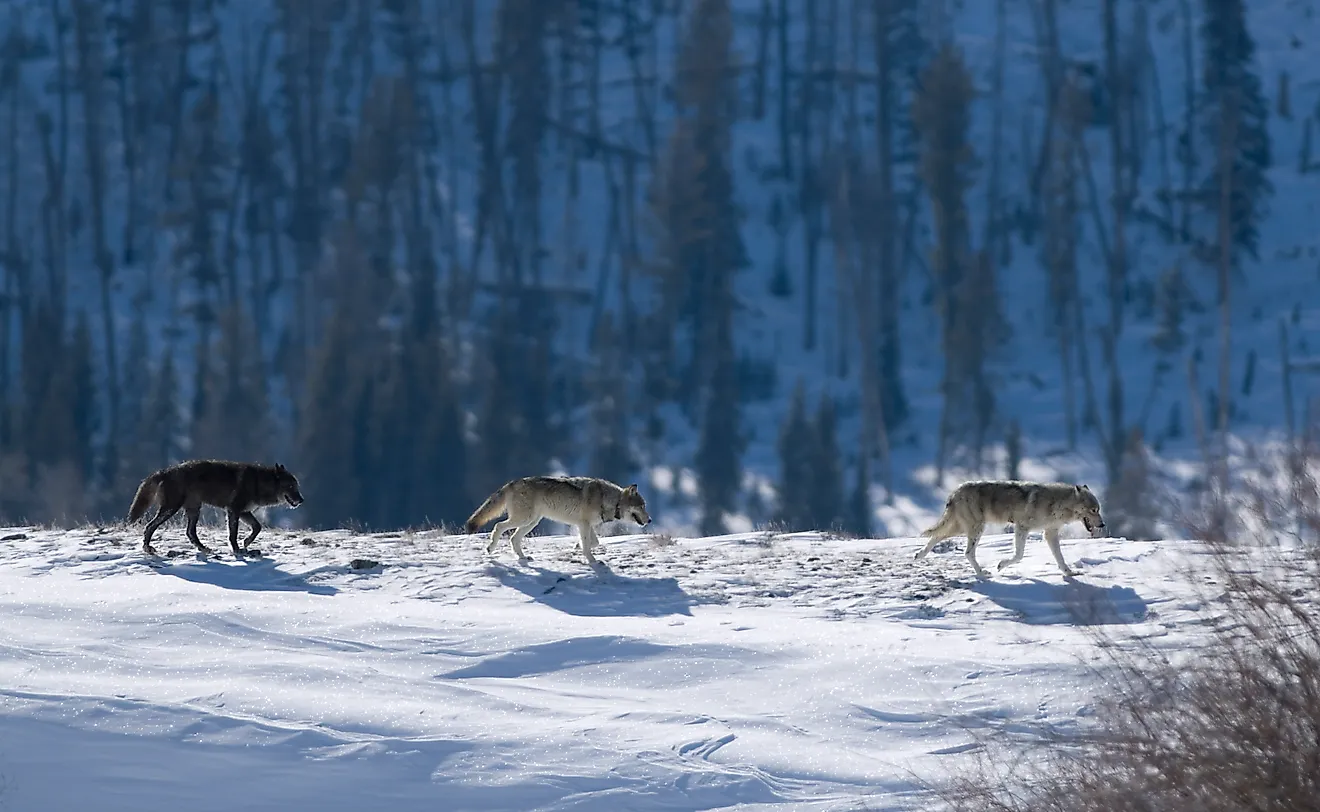
Though a combination of anti-poaching laws and conservation efforts has helped stabilize the Saiga population in the past few years, saiga populations still face many dangers. As is the case for any prey species, saiga are hunted by local predators, including wolves and foxes. Fires, changing agriculture patterns, shifts in weather, and habitat loss also pose threats to saiga populations. However, hunting and poaching are among the greatest dangers to saiga.
In the late 19th and 20th centuries, saiga hunting exploded. The antelopes were killed for their hides and meat, as well as for their horns, which were an ingredient in traditional Chinese medicine. Throughout the 20th century, regulations outlawed or restricted saiga hunting in the Soviet Union, but the nation’s collapse in the 1990s left a vacuum. With few left to regulate poachers, and with an unstable economy that made people more desperate, poaching of the creatures rose again, this time nearly wiping the saiga out. Since the 2000s, bacterial outbreaks and harsh winters have exacerbated the problem and lowered the saiga population even more.
Hope Springs
There is, however, hope. In the past few decades, anti-poaching laws, conservation efforts helped stabilize populations. Conservation efforts came from local and international groups and governments, including Altyn Dala Conservation Initiative, NABU, Wildlife Conservation Society, WWF-Mongolia, and the Saiga Conservation Alliance, as well as from the United Nations. Social change contributed too. As local economies stabilized, citizens of the nations in which the saiga lived began to see the creatures as a resource to be respected and protected, rather than used.
Those attitudes have made a real difference, and the conservation efforts have borne fruit. Today, the saiga is no longer classified as Critically Endangered. The IUCN lists it as Near Threatened, and recent national reports place the global population well above 2.8 million. Though they are still in danger due to human activity, disease, and the looming impacts of climate change, for now the saiga population is on the rebound.