Red Wolf
Red wolves once ranged across the eastern United States before they were declared extinct in the wild in 1980. Their release back into North Carolina seven years later made them the first large carnivore in the country to return after such a declaration. Thanks to that recovery program, 23 to 24 adult and subadult red wolves, plus a number of pups, now live in the wild. Every one of them ranges across a single peninsula on the North Carolina coast. Red wolves still have a fight to survive, but their story isn't over yet.
Physical Description

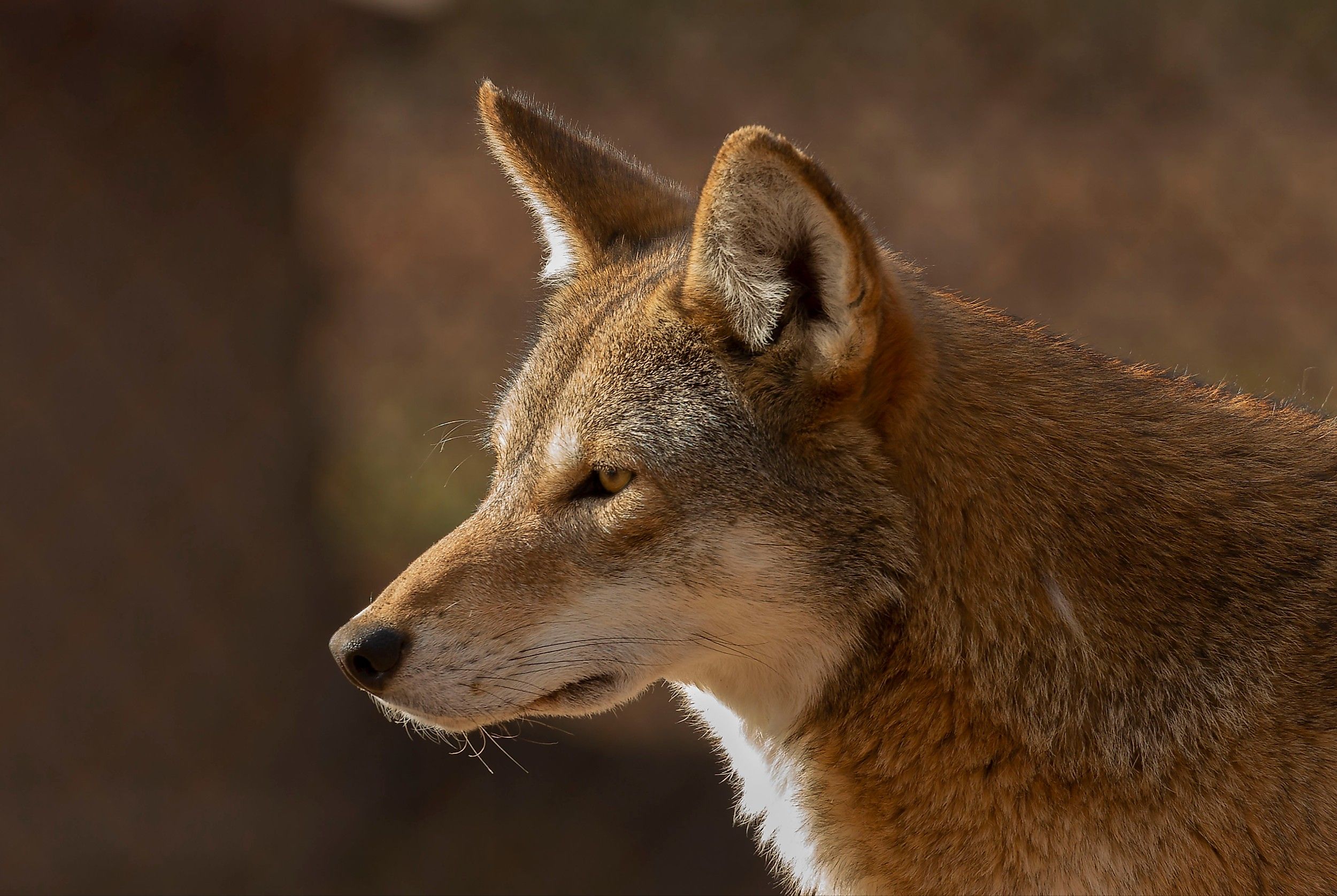
The red wolf (Canis rufus) is a lean canid, often with a black-tipped bushy tail. Their coats are mostly brown and buff with some black along their backs. Around the muzzle, behind the ears, and on the backs of the legs, most wolves carry a reddish tint.
Overall, they fall between the gray wolf and the coyote in size. The average red wolf measures about four feet (1.2 meters) nose to tail and stands 26 inches (66 centimeters) at the shoulder. They weigh anywhere between 45 and 80 pounds (20 to 36 kilograms). Males average about 60 pounds, while females stay around 50 pounds.
That in-between size fed a long argument over what the red wolf actually is. Some genetic studies have described it as a wolf and coyote mix rather than a species in its own right. A 2019 National Academy of Sciences review concluded that the red wolf is a distinct species, and that is the position the U.S. Fish and Wildlife Service manages under today.
Habitat

At one time, the red wolf had a huge range through the southeastern United States. It covered the Atlantic and Gulf Coasts, reached north to the Ohio River Valley and central Pennsylvania, and extended as far west as central Texas. With that much ground to cover, the species adapted to a wide range of habitat types.
By the 1970s, the last naturally occurring population was holding on in the coastal prairie and marsh of southeastern Texas and southwestern Louisiana. Red wolves are habitat generalists. They can live in most settings as long as prey is available, which is why the reintroduced wolves took to a landscape of swamps, pocosin wetlands, and farm fields.
Today, the only wild population of red wolves is found in eastern North Carolina on the Albemarle Peninsula. The recovery area covers five counties, and home ranges within it range from about 20 to 80 square miles (52 to 207 square kilometres), depending on how much prey is available. Red wolves have lost 99.7 percent of their historical territory, a steeper loss than that of any other large carnivore.
Behavior

Red wolves sit somewhere between coyotes and gray wolves when it comes to behavior. They are shy and elusive but highly social with one another. They live in tight-knit family packs of about five to eight members, mostly a lifelong breeding pair and their offspring from different years. Almost all young wolves leave between one and two years old to find a mate and a territory of their own.
They communicate using vocalizations. The howl of a red wolf is higher-pitched and more coyote-like than the howl of a gray wolf, and it tends to last longer than a coyote call. They also use yips, barks, and growls to communicate within the pack.
Red wolves avoid interaction with humans. They are secretive and shy when people are nearby, and they are most active at dusk and dawn. When it comes to other canids, though, they will defend their established range with vigor.
Inside the pack, they are social creatures. They sleep close with pack mates, and each member helps tend to the young pups in the den.
Reproduction and Life Cycle

Red wolves usually breed for the first time at two or three years old. They mate once a year in late winter, and the gestation period lasts about 60 to 63 days. Litters average two to six pups, though bigger ones turn up regularly. The four wild litters born in the spring of 2026 held two, six, seven, and eight pups.
Red wolves mate for life, and both parents raise the young with help from offspring of previous years. Pups usually arrive in April or May in dens hidden among hollow trees, sandy knolls, stream banks, or piles of forest debris. Other members of the pack help protect and feed them.
These wolves live about six to eight years in the wild, and up to roughly 15 in captivity. Disease, malnutrition, and predation mean fewer than half the pups born in the wild reach adulthood.
Diet and Hunting Techniques
Like all wolves, the red wolf is a carnivore. Their diet varies depending on what is available. They mostly hunt smaller mammals, like raccoons, rabbits, rodents, and nutria. However, they also take slightly larger prey such as white-tailed deer.
Often these wolves hunt alone, using their long legs and sharp hearing to pounce on small mammals hidden in thick grass or underbrush. To bring down bigger prey, a few members of the family pack will work together. They also hunt the edges of the landscape, traveling along forest margins, overgrown firebreaks, and early successional habitat where rodents and rabbits are most abundant.
Red wolves scavenge too. When prey is hard to find, they will eat the remains of a larger predator's kill or even roadkill. A wolf looking for food can cover 20 miles (32 kilometres) in a day and eats two to five pounds of food daily.
Status
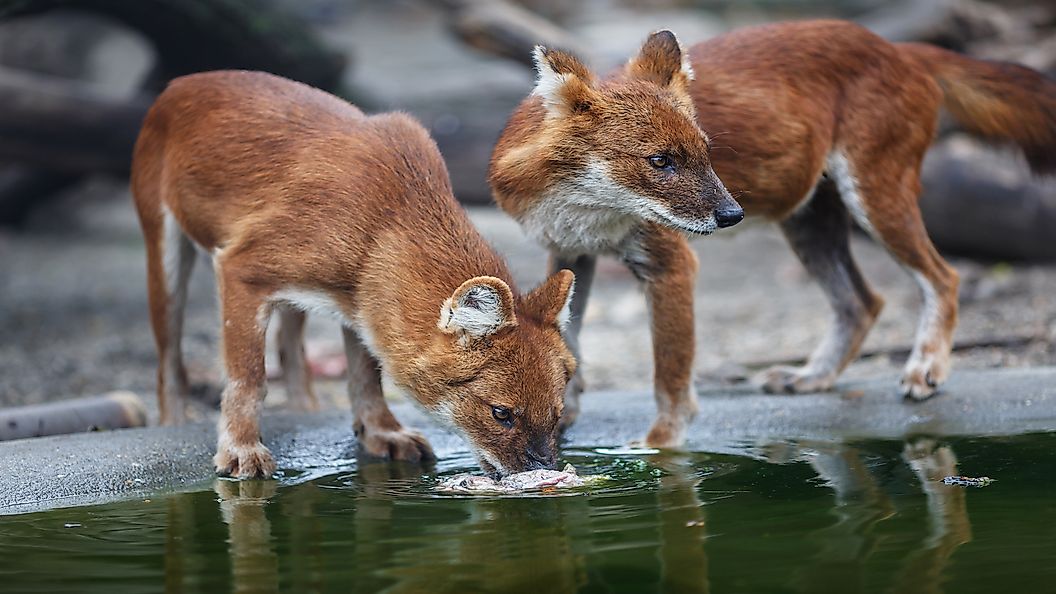
The International Union for Conservation of Nature lists the red wolf as critically endangered. As of July 2026, there are only 23 to 24 adult and subadult red wolves in the wild, and 22 of those carry radio collars. Another 12 to 16 pups were on the landscape at the end of the 2026 breeding season. Pup survival in the wild runs about 50 percent, so they aren't counted in the adult numbers until they get there.
Four family groups range across the recovery area right now. They are the Milltail group, the West Alligator River National Wildlife Refuge group, the Boundary group, and the Pungo group. The U.S. Fish and Wildlife Service tracks all four, with help from private landowners who welcome the wolves onto their property.
When new pups are born, they are quickly captured for vaccinations, and a small abdominal transmitter is implanted. The transmitter allows biologists to track their location as they grow and helps them keep disturbance away from the den area. It also tells researchers when a pup dies, which is how most pup mortalities get detected at all.
Human Intervention
Red wolves were pushed to the brink in the 1970s by habitat loss and decades of predator control. Between 1973 and 1980, the U.S. Fish and Wildlife Service trapped more than 400 wild canids along the Texas and Louisiana coast. Only 17 of them proved to be pure red wolves, and 14 became the founders of a captive breeding program at Point Defiance Zoo and Aquarium in Tacoma, Washington. The species was declared extinct in the wild in 1980.
Biologists released the first captive-born wolves at Alligator River National Wildlife Refuge in 1987. That made the red wolf the first large carnivore in the United States to be declared extinct in the wild and then reintroduced. The methods became a template for later work with gray wolves in Yellowstone, Mexican wolves, California condors, and black-footed ferrets. The wild population reached roughly 120 animals by 2012 before it fell apart. Every wolf in North Carolina today descends from those 14 founders.
About 295 red wolves live in captive facilities under the Saving Animals From Extinction (SAFE) program, and those animals feed the wild population. Biologists sometimes cross-foster pups, moving them between a captive litter and a wild litter born within a few days of it. In the spring of 2026, staff from the Saint Louis Zoo flew three pups to Alligator River and slipped them into a wild den, carrying four wild-born pups back the same evening. The goal is genetic diversity, since unrelated bloodlines are scarce in both populations.
Red wolves are a keystone species in their ecosystem, just like their larger gray wolf cousins. They keep smaller prey populations from ballooning out of control. With the wild population still this small, it is too early to say how much of that role they have taken back.
Humans remain the leading cause of death. Vehicle strikes and gunshots account for most of it, and some wolves are killed after being mistaken for coyotes. Interbreeding with coyotes is the other major threat, and it gets worse as the population shrinks and breeding adults are lost. Biologists respond by sterilizing resident coyotes and leaving them in place, where they hold territory without producing hybrid litters. Climate change adds pressure of its own, since much of the Albemarle Peninsula lies within a few feet of sea level.
Conservation Matters
The recovery program is the only reason the red wolf still exists, and it is also a measure of how narrow the margin is. Every wolf alive carries the genetics of 14 founders, and the entire wild population fits inside five counties on one low-lying peninsula. Numbers have crept up since the 2020 low, with more pups born in 2026 than in any year since 2013, but a single bad season of gunshot and vehicle deaths among breeding adults can erase that progress. What happens to the species now depends less on the wolves than on the drivers, hunters, and landowners who share the peninsula with them.