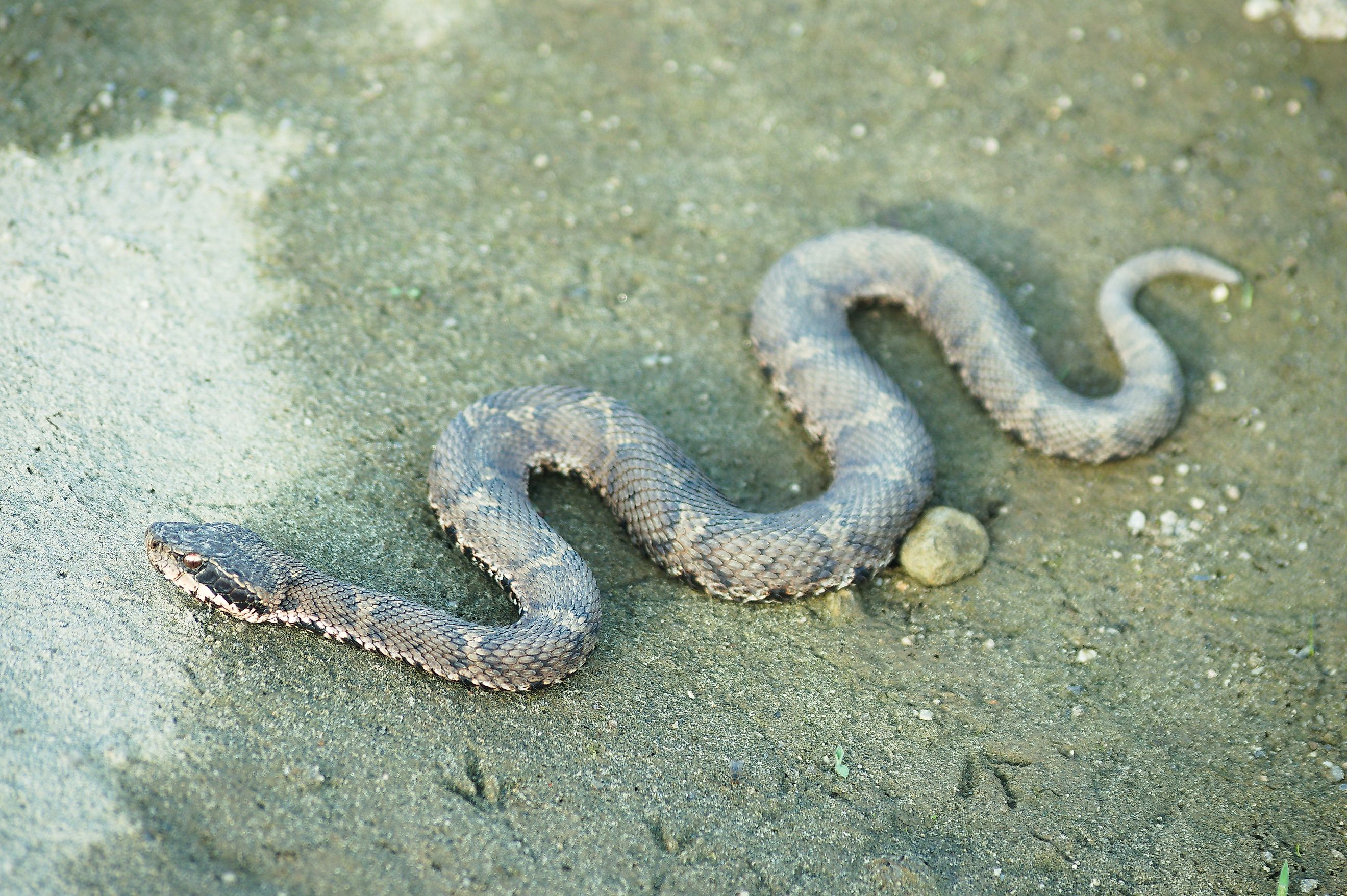
Mamushi
The mamushi is one of Japan's most medically important snakes, with thousands of bites reported across the country each year. Although it rarely grows longer than a human arm, this stout-bodied pit viper possesses potent venom and has earned a fearsome reputation through centuries of contact with rural communities. In Japanese, its name has become synonymous with a danger that is easy to overlook.
Known scientifically as Gloydius blomhoffii, the mamushi belongs to the pit viper subfamily, a group defined by the heat-sensing organs set between the eyes and nostrils. It occupies fields, forest edges, rice paddies, and low mountain slopes, precisely the places where people live and work. That overlap explains why the mamushi appears so often in folklore, folk medicine, and safety warnings passed down through the generations.
Taxonomic Classification

The mamushi sits within the kingdom Animalia, phylum Chordata, class Reptilia, and order Squamata, the vast group that contains all snakes and lizards. Within the snakes it falls in the family Viperidae and the subfamily Crotalinae, the pit vipers. Its genus is Gloydius, and its accepted scientific name is Gloydius blomhoffii.
The species was first described in 1826 by the German naturalist Heinrich Boie, who placed it in the now-obsolete genus Trigonocephalus. For much of the twentieth century it was grouped under Agkistrodon, the genus that includes the American copperheads and cottonmouths, before being moved to Gloydius as researchers refined the classification of Asian pit vipers. The species name honors Jan Cock Blomhoff, a Dutchman who directed the trading colony at Nagasaki between 1817 and 1824.
Taxonomy here has shifted considerably. The mamushi was once thought to contain four subspecies, but modern work treats it as a single, monotypic species. Several populations formerly folded into Gloydius blomhoffii, including forms in Korea and on some outlying islands, have since been recognized as separate species. Anyone comparing older and newer references should expect the range and subspecies details to differ as a result.
Physical Description

The mamushi is a small to medium snake with a thick, muscular build. Adults usually measure 18 to 32 inches (45 to 81 cm) in total length, and the longest reliably recorded individual reached about 36 inches (91 cm). Body mass ranges from roughly 1 to 5 ounces (35 to 150 g), giving the snake a heavy, stocky look relative to its modest length. Females tend to grow larger overall, while males carry proportionally longer and thicker tails.
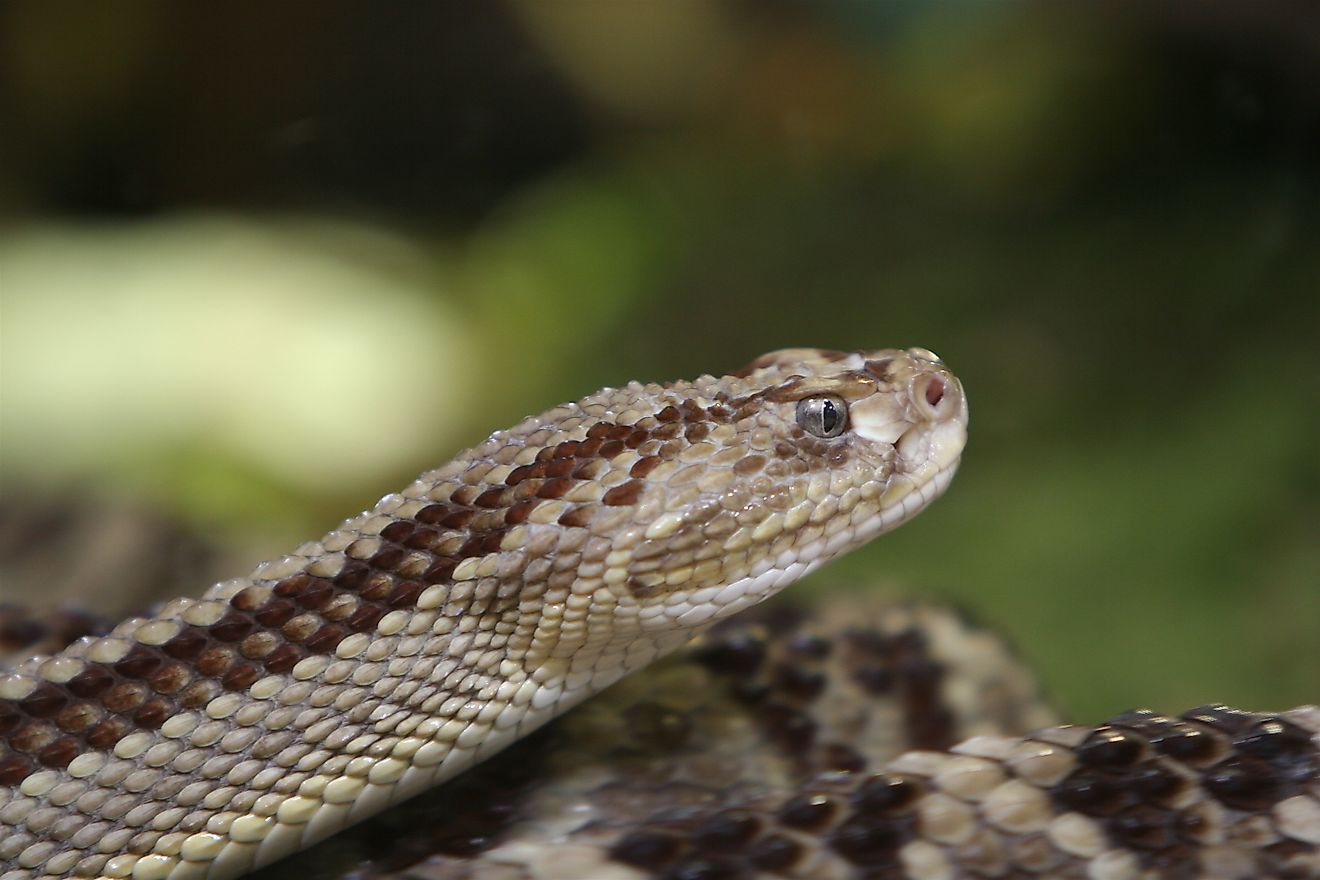
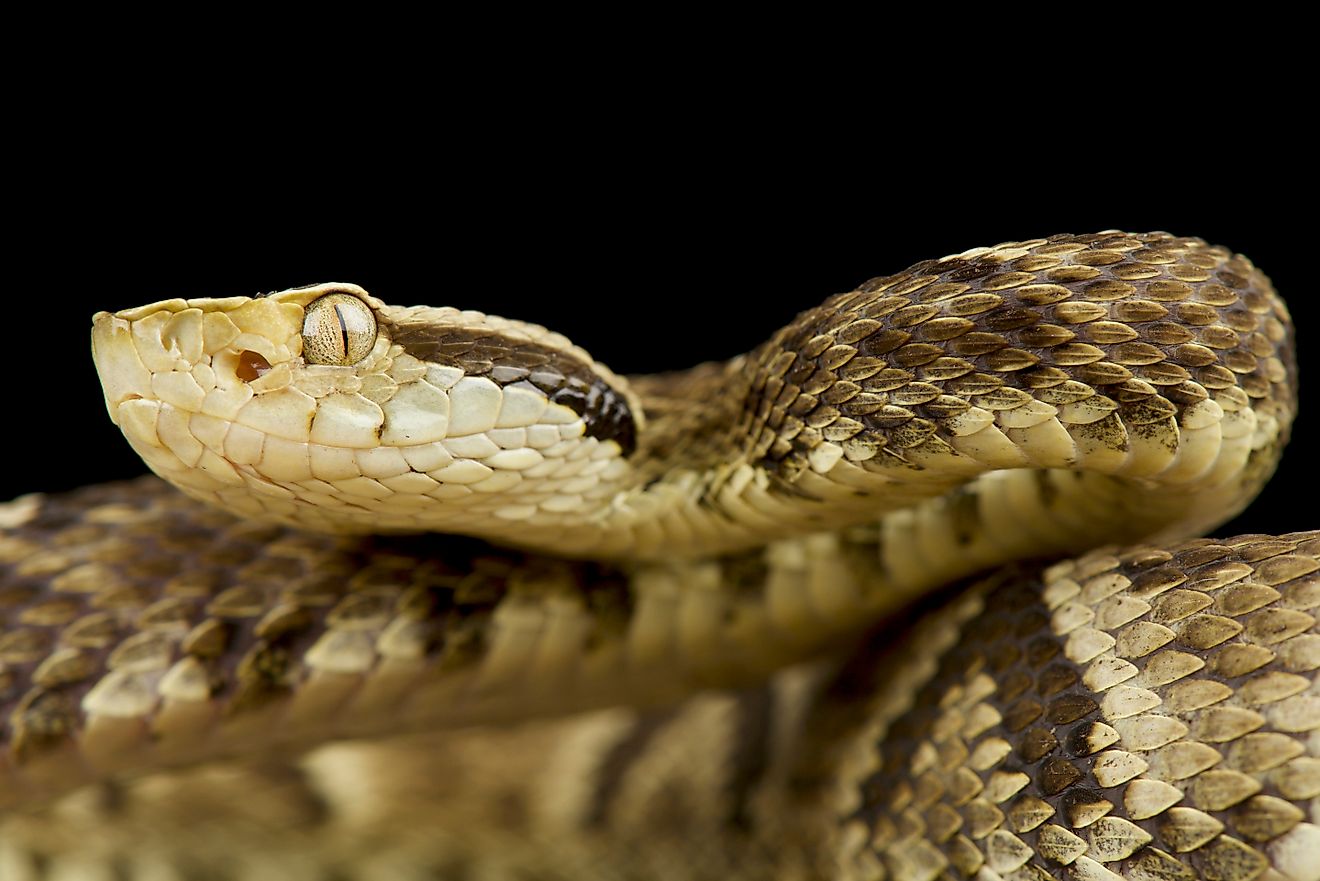
The head is broad and distinctly triangular, set off from the body by a narrow neck, a shape common to many vipers. Between each eye and nostril lies a loreal pit, a heat-sensitive organ that detects the infrared warmth of prey. The pupils are vertical and elliptical, an adaptation typical of ambush hunters active in low light. Retractable fangs in the upper jaw fold back when not in use and swing forward to deliver venom during a strike.
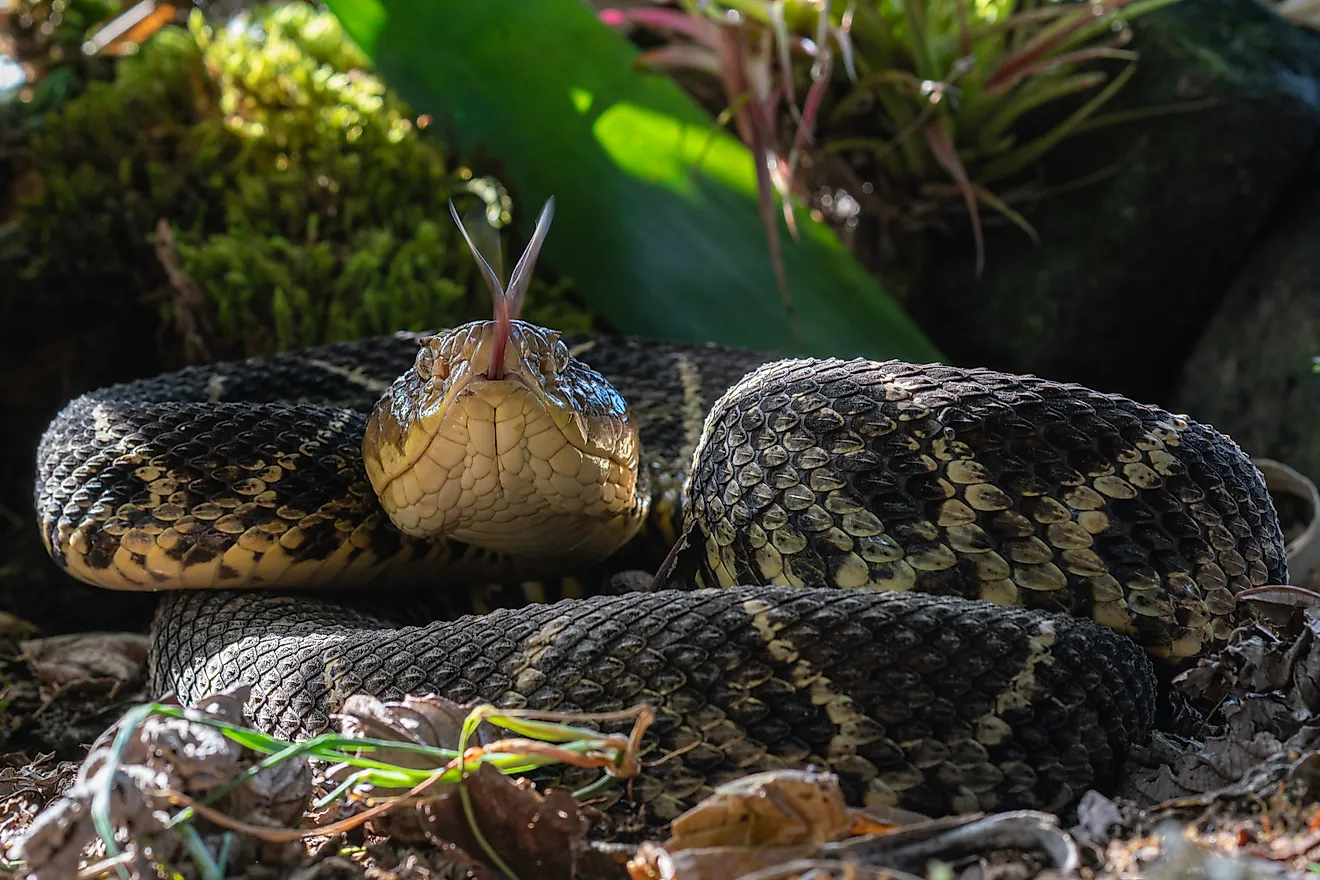
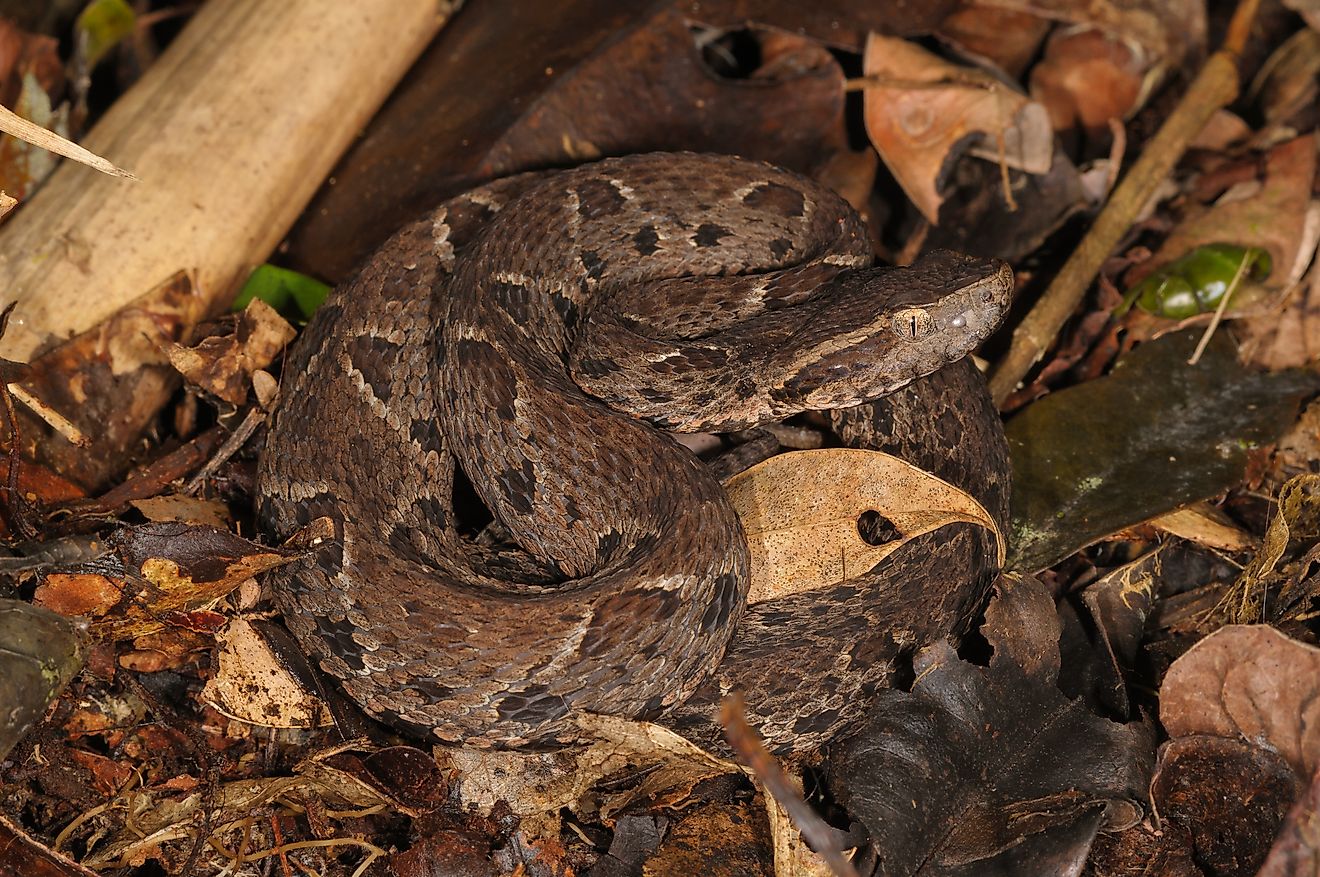
Coloration varies from pale gray to reddish-brown or yellow-brown, overlaid with a row of rounded lateral blotches. These markings are edged in black and frequently carry paler centers, producing a pattern that breaks up the snake's outline against leaf litter and soil. The dorsal scales are strongly keeled, giving the body a rough, matte finish rather than a glossy sheen. This camouflage is highly effective, and many bites occur simply because the animal goes unseen until a person steps too close.
Range and Habitat

The mamushi is widely distributed across Japan, occurring on the main islands of Honshu, Kyushu, Shikoku, and Hokkaido. It is notably absent from the far southwestern Ryukyu Islands, where the habu (Protobothrops flavoviridis) fills a similar role. Related pit vipers once classed as mamushi extend into Korea and parts of China, though current taxonomy assigns many of those populations to other species in the genus Gloydius.
Within Japan the snake favors a mix of open and sheltered ground. It thrives in rice paddies, farmland margins, grassy fields, marshes, and the brushy edges of forests, and it ranges from coastal lowlands up into montane terrain. Proximity to water is a recurring theme, since damp ground supports the frogs and small mammals the mamushi hunts. This preference for cultivated and semi-natural landscapes places the species in constant contact with people, a defining feature of its natural history.
Diet

The mamushi is a patient ambush predator. Rather than actively pursuing prey, it coils in cover and waits, relying on its heat-sensing pits and camouflage to detect and surprise passing animals. When a target comes within range, the snake strikes, injects venom, and then tracks the dying prey before swallowing it whole.
Its diet centers on small vertebrates. Rodents and other small mammals form a major share, alongside frogs, lizards, small birds, and occasionally insects. Young mamushi often take a higher proportion of amphibians and lizards, shifting toward mammals as they grow. By preying heavily on rodents in and around farmland, the mamushi provides a natural check on animals that would otherwise damage crops and stored grain.
Behavior

Mamushi are largely solitary and spend much of their time concealed. Activity patterns shift with the seasons. During the warm months the snake is chiefly nocturnal or crepuscular, hunting through the cooler hours of night and twilight. In the cool days of early spring it becomes more active during daylight, basking to raise its body temperature before the summer heat arrives.
Like all reptiles, the mamushi relies on external warmth to regulate its metabolism, so it moves between sun and shade to hold a workable temperature. It is not an aggressive animal by nature and prefers to stay hidden or retreat when possible. Bites usually happen when the snake is trodden on, cornered, or handled, at which point it defends itself with a rapid strike. In colder regions the species enters a period of winter dormancy, sheltering underground until temperatures climb again.
Reproduction

The mamushi reaches sexual maturity at around two to three years of age. Courtship takes place in the early spring, and rival males may engage in ritual combat, raising and intertwining their bodies as each tries to overpower the other for access to a female.
One of the more striking aspects of mamushi biology is that it does not lay eggs. Instead the female retains the developing young inside her body and gives birth to live offspring, a reproductive mode seen in many vipers. Litters generally number between 2 and 13 young, born in the late summer and autumn window from August through October. Females often breed only once every two or three years, an interval that reflects the heavy energetic cost of producing well-developed neonates. The young are independent from birth and carry functional venom immediately, allowing them to hunt small prey without parental care.
Importance to the World

Ecologically the mamushi works as a mid-level predator that links smaller animals to larger ones. By feeding on rodents, amphibians, and reptiles, it helps regulate those populations, and in agricultural areas its appetite for rats and mice offers a measurable benefit to farmers. In turn the snake serves as prey for raptors and mammalian carnivores, moving energy up the food chain.
The mamushi also holds a notable place in human culture and medicine. Its venom is the subject of ongoing research into blood-clotting disorders and pain management, since viper venoms contain complex proteins that affect the circulatory and nervous systems. In parts of rural Japan the snake has long been harvested for food and traditional tonics, most famously the potent infused liquor known as mamushi-zake. Folklore casts the animal as a symbol of both danger and, in some stories, good fortune, a reminder of how deeply it is woven into rural life.
Threats

The IUCN Red List classifies the mamushi as Least Concern, with a population regarded as stable. As a widespread and adaptable species that tolerates human-altered landscapes, it faces no immediate risk of extinction across its range.
That said, the mamushi is not free of pressure. Habitat loss from development, road mortality, and collection for food and folk medicine all take a local toll, and intensive farming can reduce the prey and cover the snake depends on. Because it lives so close to people, it is also killed on sight out of fear. None of these forces currently threatens the species as a whole, but they shape its fortunes at the regional level and warrant continued attention.
Takeaway
The mamushi is a small snake with an outsized presence. Compact, well-camouflaged, and armed with medically significant venom, it thrives in the very landscapes people cultivate, which accounts for both its fearsome reputation and its steady toll of bites each year. Yet it is far more than a hazard. As a rodent-controlling predator, a subject of venom research, and a fixture of Japanese folklore and folk medicine, the mamushi earns its place in the ecosystems and cultures of eastern Asia. Its stable conservation status suggests it will remain a familiar, if wary, neighbor for generations to come.
Fun Facts

- Named for a Dutch trader. The species name blomhoffii honors Jan Cock Blomhoff, who ran the Dutch trading post at Nagasaki in the early nineteenth century.
- It gives birth to live young. Unlike most snakes, the mamushi does not lay eggs and instead delivers fully formed, venomous neonates in late summer and autumn.
- A snake in a bottle. A traditional Japanese liquor called mamushi-zake is made by steeping a whole mamushi in alcohol, and it is prized in folk medicine as a tonic.
- Built-in heat vision. The pits between its eyes and nostrils sense infrared radiation, letting the snake detect warm-blooded prey in complete darkness.
- Thousands of bites a year. The mamushi bites an estimated two to three thousand people annually in Japan, making it the country's most medically important snake.
Quick Facts
- Scientific name: Gloydius blomhoffii
- Family: Viperidae (subfamily Crotalinae, the pit vipers)
- Order: Squamata
- IUCN status: Least Concern (stable population)
- Length: 18 to 32 inches (45 to 81 cm), with a record of 36 inches (91 cm)
- Weight: roughly 1 to 5 ounces (35 to 150 g)
- Lifespan: up to about 12 years in captivity
- Diet: carnivore (rodents, frogs, lizards, small birds, insects)
- Reproduction: live-bearing, 2 to 13 young per litter
- Range: Japan (Honshu, Kyushu, Shikoku, Hokkaido), with relatives in Korea and China