Mako Shark
The mako is the sprinter of the shark world. Widely regarded as the fastest shark in the ocean, the shortfin mako has been clocked in short bursts at speeds commonly cited around 45 miles per hour (72 km/h), and it can launch its entire body clear of the surface in leaps of up to 20 to 30 feet (6 to 9 m). That combination of raw speed and power lets it chase down some of the quickest fish in the sea.
The name "mako" covers two closely related species of mackerel shark, the familiar shortfin mako (Isurus oxyrinchus) and the lesser-known longfin mako (Isurus paucus). Both are large, warm-bodied, open-ocean predators found in temperate and tropical waters worldwide. The shortfin is the one that draws headlines, prized by sport anglers and studied for its remarkable physiology.
The mako is worth knowing not only for its athleticism but for its plight. Slow to mature and heavily fished for its meat and fins, both species are now classified as Endangered. This profile covers what the mako is, how it lives, and why its future is uncertain.
Taxonomic Classification

Makos belong to the order Lamniformes and the family Lamnidae, the mackerel sharks. This puts makos among some of the ocean's most notable predators, as their family also includes the great white shark, the porbeagle, and the salmon shark. All share a torpedo-shaped body and the ability to keep their muscles warmer than the surrounding water, a trait that sets them apart from most other sharks.
The genus Isurus, Greek for "equal tail," contains the two living mako species. The French naturalist Constantine Rafinesque first described the shortfin mako (Isurus oxyrinchus) in 1810. The species name comes from the Greek for "sharp nose," a nod to the pointed snout. The longfin mako (Isurus paucus) is the second species, distinguished by its longer pectoral fins, larger eyes, and darker coloring around the mouth. The common name "mako" comes from the Maori word for shark. Because the two species overlap in range and look broadly similar, longfin makos are often misidentified, and far less is known about them.
Physical Description

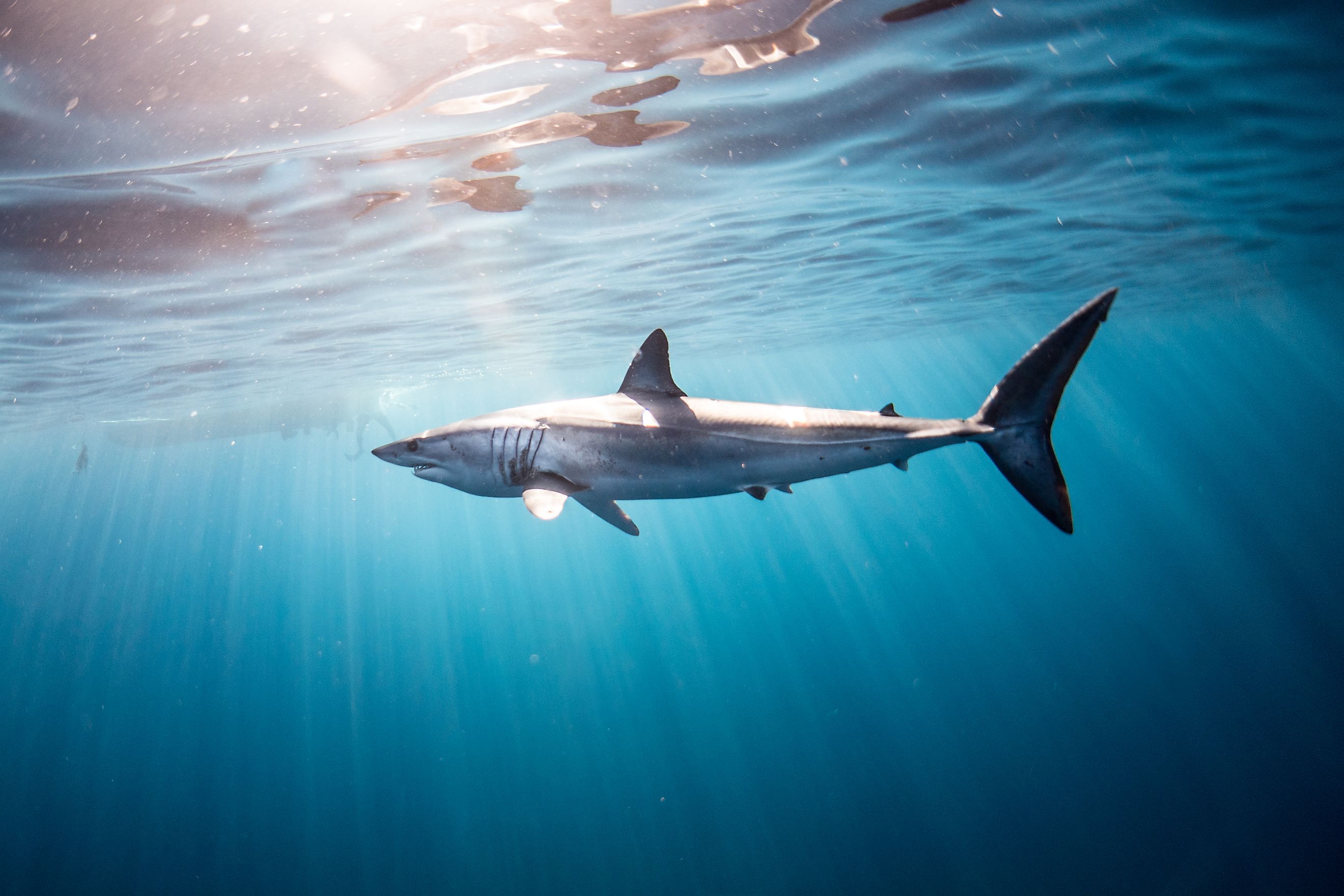
The shortfin mako is built for speed. Its body is a smooth, cylindrical spindle that tapers to a sharply pointed snout, and its crescent-shaped tail sits on a slender base with a lateral keel that steadies it at high speed. Their coloration follows a classic open-ocean pattern, with a deep metallic blue back that fades into a silvery-white belly, creating a sharp contrast between the two. Larger individuals tend to be darker overall.
Most adult shortfin makos measure between about 6.5 and 9.5 feet (2 to 2.9 m), with females growing noticeably larger than males. Exceptional individuals reach roughly 12 to 13 feet (3.7 to 4 m), and the largest reliably recorded specimens approach 14.6 feet (4.45 m). Large makos are powerful animals, with some individuals weighing more than 1,000 pounds (450 kg). The heaviest recorded catch on rod and reel exceeded 1,200 pounds (545 kg).
Several adaptations power the mako's speed. Its skin is covered in tiny tooth-like scales called dermal denticles that reduce drag, and the shark can subtly adjust their orientation to control water flow. Like other mackerel sharks, the mako uses a counter-current heat-exchange system that traps heat generated by its muscles, keeping its core several degrees above the surrounding sea. Warm muscles contract faster and more powerfully, which helps explain how the mako outpaces cold-blooded rivals. Its teeth are long, narrow, and smooth-edged, curved slightly backward and visible even when the mouth is closed. They are shaped for gripping slippery, fast prey rather than sawing through it.
Range and Habitat

The shortfin mako is a true oceanic wanderer, found in temperate and tropical seas throughout the Atlantic, Pacific, and Indian Oceans, as well as the Mediterranean and other marginal seas. In the western Atlantic, its range extends between the Grand Banks off Canada and the waters off Argentina. In the Pacific, it occurs between the Aleutian Islands and the coast of Chile. Prime sport fisheries have long operated off southern California, New Zealand, South Africa, and Japan.
Makos favor open water rather than the coast, though they move inshore where the continental shelf is narrow and deep water lies close to land. They generally stay in the upper part of the water column, from the surface down to around 1,640 feet (500 m), and prefer water warmer than about 60°F (16°C). These are highly migratory animals. Tagged shortfin makos have crossed more than 1,725 miles (2,776 km) of open sea, following prey and shifting water temperatures across entire ocean basins.
Diet

The mako's speed is a hunting tool, and it is aimed at fast targets. Shortfin makos feed heavily on quick, powerful pelagic fish such as mackerel, tuna, bonito, and swordfish, along with squid and other sharks. Marine mammals and sea turtles turn up in their stomachs occasionally, but the core of the diet is fish that most predators simply cannot catch.
As an apex predator of the open ocean, the mako typically attacks from below and behind, using its speed to close the gap before prey can react and striking at the flanks and fins. Encounters with swordfish, which are large and well armed with their bills, can be dangerous for the shark. Makos have been found with broken swordfish bills lodged in their bodies, evidence that these hunts do not always go the predator's way.
Behavior

Makos are active, roaming predators rather than ambush hunters that lie in wait. They swim more or less constantly, a necessity for a shark that relies on forward motion over its gills to breathe. That restless energy is evident in one of the mako's most distinctive behaviors, its tendency to breach the surface. When feeding or when hooked, a shortfin mako can rocket out of the water in spectacular vertical leaps, sometimes clearing 20 feet (6 m) or more.
These are largely solitary animals, ranging alone across vast stretches of ocean. Their reputation for aggression is well earned when they are provoked. Hooked makos are notoriously combative, known to leap repeatedly, damage boats, and injure anglers. Unprovoked attacks on people are rare, in part because makos live far offshore and seldom cross paths with swimmers. Divers who have met them report a distinctive figure-eight swimming pattern and an open-mouthed approach before an animal turns aggressive.
Reproduction

The mako's slow, low-output reproduction lies at the heart of its conservation problem. Males reach maturity at around 7 to 9 years old, but females may not breed until 18 to 21 years of age. Females then reproduce only about once every three years, one of the slowest cycles among sharks.
Makos are ovoviviparous, meaning the young develop inside the mother and hatch internally rather than being laid as eggs. There is no placental connection. Instead, developing pups are nourished by feeding on unfertilized eggs in the uterus, a practice called oophagy. After a gestation of roughly 15 to 18 months, the female gives birth to a live litter of 4 to 25 pups, each already 24 to 28 inches (60 to 70 cm) long and fully capable of hunting. Shortfin makos are estimated to live around 28 to 32 years. Late maturity, long pregnancies, and small litters mean populations recover very slowly once they decline.
Importance to the World

As a fast, wide-ranging apex predator, the shortfin mako helps regulate the populations of the fish and squid it hunts, and it removes the sick and slow, which keeps prey populations healthier over time. Predators near the top of the food web exert a stabilizing pull on the ecosystems below them, and the loss of a species like the mako can ripple downward in ways that are hard to predict.
The mako also matters to people. It is one of the most prized game fish in the world, celebrated for the fight it puts up, and it appears in Ernest Hemingway's novel The Old Man and the Sea. Commercially, its meat is considered among the best of any shark and sells at high value, and its fins feed the shark-fin trade. That economic value comes with a downside. It makes the mako a target for fishing, and this pressure has helped push the species toward the brink, along with other threatened ocean predators.
Threats

Both mako species are classified as Endangered on the IUCN Red List, a status set in the 2019 assessment when they were moved up from Vulnerable. The IUCN's global analysis estimated a median population decline of roughly 46.6% over three generation lengths, a span of about 72 to 75 years, with the highest probability pointing to a reduction of 50% to 79%. There is no single agreed figure for total mako numbers, but the trend is downward across most of the animal's range.
The main driver is overfishing. Makos are caught both as a target species and as bycatch in longline and gillnet fisheries chasing tuna and swordfish, then kept for their valuable meat and fins. Their late maturity and slow breeding leave them unable to replace losses quickly. Conservation measures are catching up, if slowly. In 2019 the shortfin mako was listed on Appendix II of CITES, which regulates international trade, and in 2021 the International Commission for the Conservation of Atlantic Tunas (ICCAT) agreed to prohibit retaining North Atlantic shortfin makos, giving the badly depleted Atlantic population a chance to recover. Enforcement across the mako's global range remains the central challenge.
Takeaway
Fast, warm-muscled, and perfectly shaped for a life spent chasing swift prey across open water, the mako is one of the most highly adapted predators in the ocean. Yet the same traits that make it a prized catch, combined with a reproductive cycle among the slowest of any shark, leave it acutely vulnerable to overfishing. With both species now Endangered and recovery measured in decades rather than years, the mako's long-term outlook depends on whether international fishing limits can hold. Protecting the fastest shark in the sea is, in the end, a test of how quickly people can act.
Fun Facts

- The peregrine of the sea. The shortfin mako is widely considered the fastest shark, with burst speeds often cited around 45 mph (72 km/h). Directly measured speeds from tagged wild makos are lower, but its acceleration is still exceptional.
- Warm-blooded, sort of. Makos keep their muscles warmer than the surrounding water using a counter-current heat exchange system, the same trick used by tuna and great white sharks.
- Airborne hunters. A feeding or hooked mako can leap 20 to 30 feet (6 to 9 m) straight out of the water.
- Womb-mate meals. Before birth, mako pups feed on unfertilized eggs inside the mother, a strategy known as oophagy.
- A name from the sea. "Mako" comes from the Maori language, where it simply means shark.
Quick Facts
- Common name: Mako shark (shortfin and longfin)
- Scientific name: Isurus oxyrinchus (shortfin), Isurus paucus (longfin)
- Family / order: Lamnidae (the mackerel sharks) / Lamniformes
- IUCN status: Endangered (both species, 2019 assessment), with a decreasing population trend
- Length: commonly 6.5 to 9.5 feet (2 to 2.9 m); large individuals reach 12 to 13 feet (3.7 to 4 m), rarely 14.6 feet (4.45 m)
- Weight: large individuals exceed 1,000 pounds (450 kg); the heaviest on record topped 1,200 pounds (545 kg)
- Lifespan: roughly 28 to 32 years
- Top speed: burst speeds commonly cited around 45 mph (72 km/h), making it the fastest known shark
- Diet: carnivore, feeding on fast pelagic fish such as mackerel, tuna, and swordfish, plus squid and other sharks
- Range and habitat: open water of temperate and tropical seas worldwide, from the surface to about 1,640 feet (500 m)