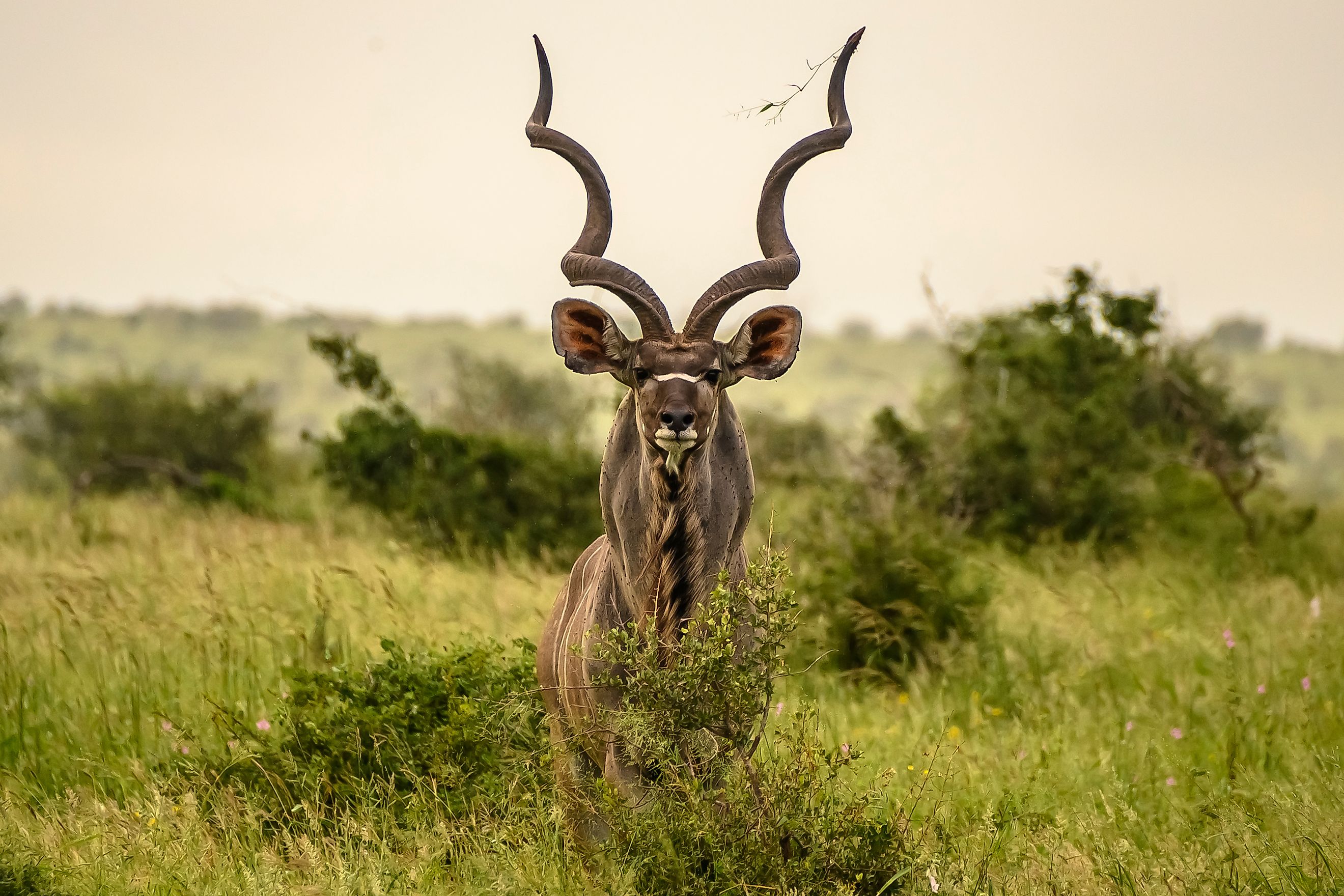
Kudu
Known for their mesmerizing spiral horns and humongous leaf-shaped ears, kudu are two species of African antelope in the genus Tragelaphus. Among them, you'll meet the greater kudu (Tragelaphus strepsiceros) and lesser kudu (Tragelaphus imberbis), equally amazing in their own ways. The "greater" species is among the largest antelope species on the planet, while the "lesser" excels in stealth and camouflage. Beyond their superlative titles, here's what you need to know about these magnificent creatures.
Description of the Greater and Lesser Kudu

The greater kudu is often described as the second-largest antelope after the eland. Adults stand about 40 to 60 inches (100 to 150 cm) tall at the shoulder and can weigh between 260 and 700 pounds (120 to 315 kg), with males considerably larger than females. Their tall legs and slender bodies are coated in short fur that can range between reddish-brown and blue-gray. Lining their sides are usually six to 10 thin white stripes, which provide camouflage among brush and woodland vegetation.
Greater kudu have additional white markings around the face, and males develop a fringe of hair beneath the chin. Their most striking feature is a pair of enormous spiraling horns. These can grow to about 6 feet (1.8 m) along their curve and commonly make about two and a half twists.
Like their larger cousins, lesser kudu have tall, nimble legs, a narrow torso, a long neck, and a pointed face with large ears. They are much smaller than greater kudu, standing about 35 to 43 inches (90 to 110 cm) at the shoulder and weighing between 130 and 230 pounds (60 to 105 kg).
The fur of a lesser kudu also varies by sex and age. Females and young animals have reddish-brown coats, while adult males develop a grayish-brown coloration as they mature. A lesser kudu's sides usually have 11 to 14 vertical white stripes branching away from a white stripe along the back. This greater number of stripes is one of the easiest ways to distinguish a lesser kudu from its larger relative. Adult males bear spiraling horns that can reach about 3.5 feet (1.1 m) and twist roughly two and a half times.
Habitat

Kudu are native to the brushlands of East Africa and South Africa. Greater kudu have the broader range of the two species and occur across much of southern Africa as well as scattered parts of eastern Africa. They favor woodland, scrub, and thickets that provide enough cover for them to disappear quickly when threatened. In some parts of eastern Africa, populations are fragmented and concentrated in wooded or mountainous areas.
The lesser kudu has a more restricted range in East Africa. It occurs in countries including Ethiopia, Kenya, and Tanzania, with populations also present in Somalia, South Sudan, and Uganda. Lesser kudu are especially associated with dry scrubland and dense thornbush. They avoid wide-open landscapes, relying heavily on thick vegetation for both food and protection.
Behavior

Kudu are most active around dusk and dawn, although lesser kudu can remain active well into the night. They move beneath thickets and through the cover of shrubs and low trees while feeding, then rest in dense vegetation during hotter or brighter parts of the day. Their diet consists mainly of browse, including leaves, shoots, and twigs. They also eat herbs, fruit, and some grasses when available.
Kudu are bovids, members of the same family as cattle, sheep, and goats. Like other bovids, they are ruminants. Plant material is processed through a specialized four-chambered stomach, and partly digested food can be regurgitated and chewed again as cud.
Lesser kudu female groups often contain only two or three animals, while temporary groups can become larger when food is plentiful. Males become increasingly independent as they mature and commonly live alone or in small bachelor groups. Adult males spend much of the year apart from females and join them primarily for breeding.
Despite their formidable horns, kudu are not especially aggressive animals. Greater kudu bulls may establish dominance through displays in which they position themselves to emphasize their size. When physical contests do occur, evenly matched males can lock horns and push against one another. Their spirals can occasionally become entangled, creating a potentially deadly situation if the animals cannot separate. Lesser kudu also fight only rarely.
Escape and Migration

Kudu do not make long, predictable seasonal migrations like wildebeest. Instead, they can shift their local movements as food and water conditions change. Greater kudu may spend more time near rivers and other areas with abundant vegetation during the dry season, then use a wider range of woodland after seasonal rains.
Kudu rely heavily on camouflage to protect themselves from predators. When frightened, they may stand completely still, allowing their vertical stripes to blend with branches, shadows, and tall vegetation. Their large ears also give them an early warning of approaching danger. Lesser kudu produce a sharp barking call when startled, alerting nearby animals before fleeing.
Once a kudu decides to run, its long legs make it a powerful escape artist. Lesser kudu have been recorded making bounding leaps more than 6.5 feet (2 m) high, while greater kudu are also capable jumpers despite their much greater body mass. Predators include leopards, African wild dogs, and spotted hyenas. Lions can also prey on greater kudu, particularly where the two species share habitat.
Reproduction and Life Cycle

Breeding behavior varies according to species and location. Greater kudu in southern Africa tend to breed seasonally, with births timed so that young arrive when vegetation is abundant. After a gestation lasting roughly eight to nine months, a female usually gives birth to a single calf.
The mother does not immediately bring her newborn back to the herd. A greater kudu calf spends its first weeks hidden in vegetation, where its small size and striped coat help conceal it. Its mother returns periodically to nurse it. The calf gradually begins accompanying her and is usually weaned at about six months. Young males eventually leave the female group, while daughters may remain associated with their mothers for longer.
Lesser kudu follow a similar strategy. A female separates from her group before giving birth to a single calf after a gestation of roughly seven and a half to eight months. The newborn remains concealed for an extended period before beginning to follow its mother regularly. Lesser kudu can become sexually mature at about 15 to 18 months, although males generally do not become socially successful breeders until they are several years old.
The horns of a male lesser kudu begin developing during its first year. As the animal matures, the horns lengthen and form the tight spirals that characterize adult bulls. Lesser kudu can live about 10 to 15 years in the wild, while kudu maintained under human care have sometimes lived considerably longer.
Conservation
Humans have long hunted kudu for their meat and hides. The spectacular horns of males have also been used as musical instruments, containers, and ceremonial objects. The greater kudu is currently listed as Least Concern on the IUCN Red List. It remains widespread, particularly in southern Africa, although populations have disappeared or declined in some parts of its historical range. The lesser kudu is considered Near Threatened, and its populations are declining in parts of its range. Habitat loss and hunting remain important pressures.
Dense vegetation remains one of the kudu’s best defenses against both natural predators and human hunters. Their stripes, large ears, cautious behavior, and ability to remain motionless can make even a large male remarkably difficult to see in the African bush. For an animal capable of standing nearly 5 feet (1.5 m) at the shoulder and carrying horns approaching 6 feet (1.8 m) in length, disappearing into a patch of scrub is perhaps the kudu’s most impressive talent.