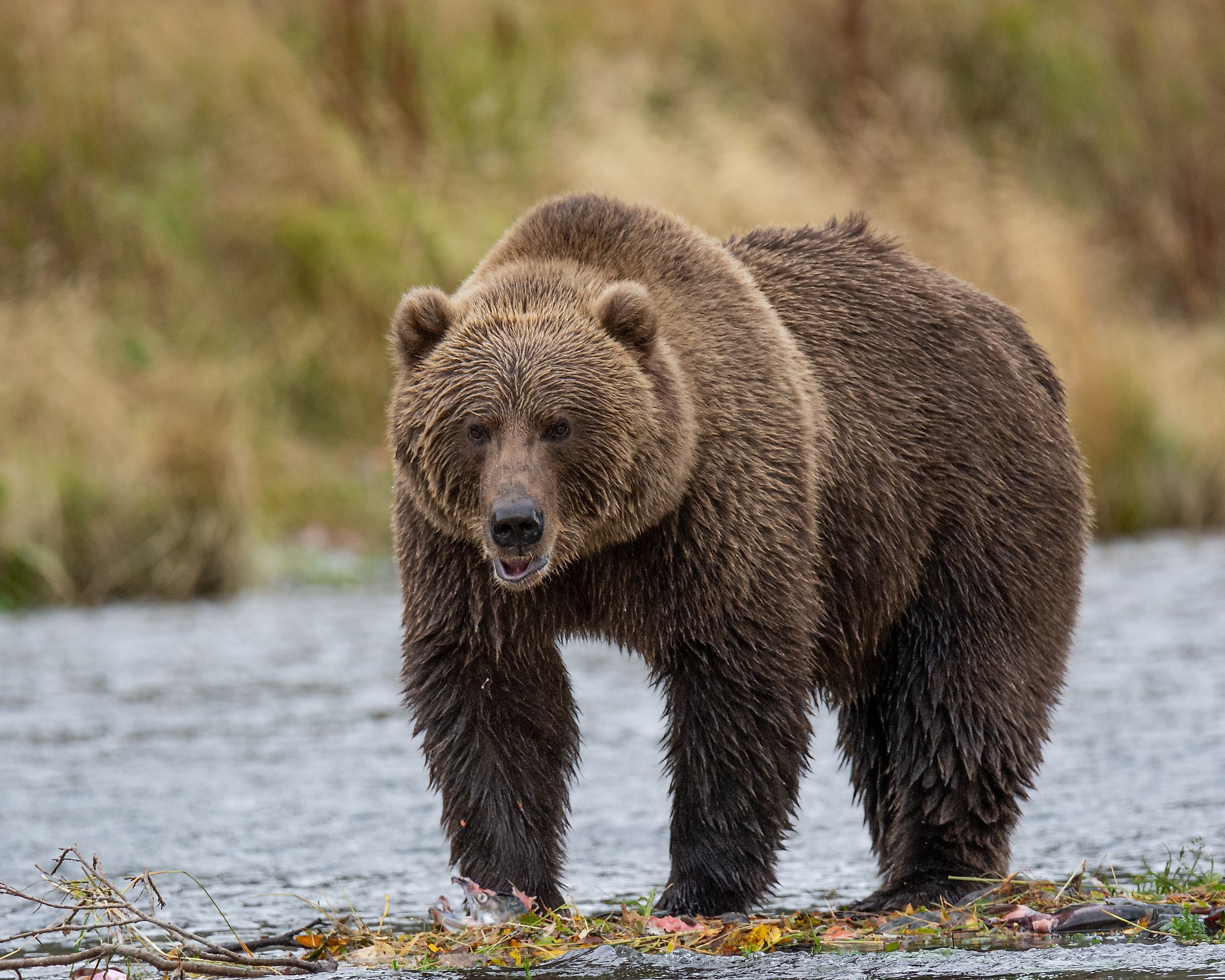
Kodiak Bear
The Kodiak bear (Ursus arctos middendorffi) is the largest subspecies of brown bear on Earth, and together with the polar bear it ranks as one of the two largest land carnivores alive today. A large male can weigh up to 1,500 pounds (680 kg), stand roughly 5 feet (1.5 m) at the shoulder on all fours, and reach over 10 feet (3 m) upright. Weight of that scale places the animal in a class occupied by almost no other terrestrial predator.
Kodiak bears are found in only one place, the Kodiak Archipelago in southwest Alaska. They have lived in isolation there since the end of the last ice age, roughly 12,000 years ago. That long separation produced a population distinct enough to be recognized as its own subspecies, described by naturalist Clinton Hart Merriam in 1896.
Roughly 3,500 of these bears occupy the archipelago today, one of the densest brown bear populations anywhere in the world. This profile covers how the Kodiak bear reached its size, what it eats, how it breeds, and why a healthy count still leaves it exposed to specific long-term risks.
Taxonomic Classification

The Kodiak bear belongs to the family Ursidae and the order Carnivora. Its full scientific name is Ursus arctos middendorffi. The genus is Ursus, the species is arctos, which refers to the brown bear, and middendorffi identifies the subspecies. Clinton Hart Merriam described it in 1896 and named it for the Baltic German zoologist Alexander von Middendorff. In the Alutiiq language of the archipelago's Indigenous people, the bear is called Taquka-aq.
It is one of the two North American brown bear subspecies recognized by the U.S. Fish and Wildlife Service, the other being the mainland grizzly (Ursus arctos horribilis). Physically, the Kodiak bear closely resembles other brown bears, and the main difference is size. Genetic work indicates the Kodiak population has been isolated long enough to show measurably lower genetic diversity than mainland brown bears, a direct result of its island confinement.
Physical Description

Adult males, known as boars, commonly weigh 700 to 1,000 pounds (318 to 454 kg) for much of the year. Exceptional individuals can reach or exceed 1,500 pounds (680 kg) in the fall. Adult females, called sows, run about 20 percent smaller in frame and 30 percent lighter, typically weighing 450 to 650 pounds (204 to 295 kg). A large boar measures about 5 feet (1.5 m) at the shoulder, standing on all fours, and over 10 feet (3 m) when upright on its hind legs.
These weights are not constant. A Kodiak bear can increase its body mass by 20 to 30 percent between late June, when it tends to be leanest, and late fall, when it enters the den. For a large male that swing can mean several hundred additional pounds of fat laid down for hibernation.
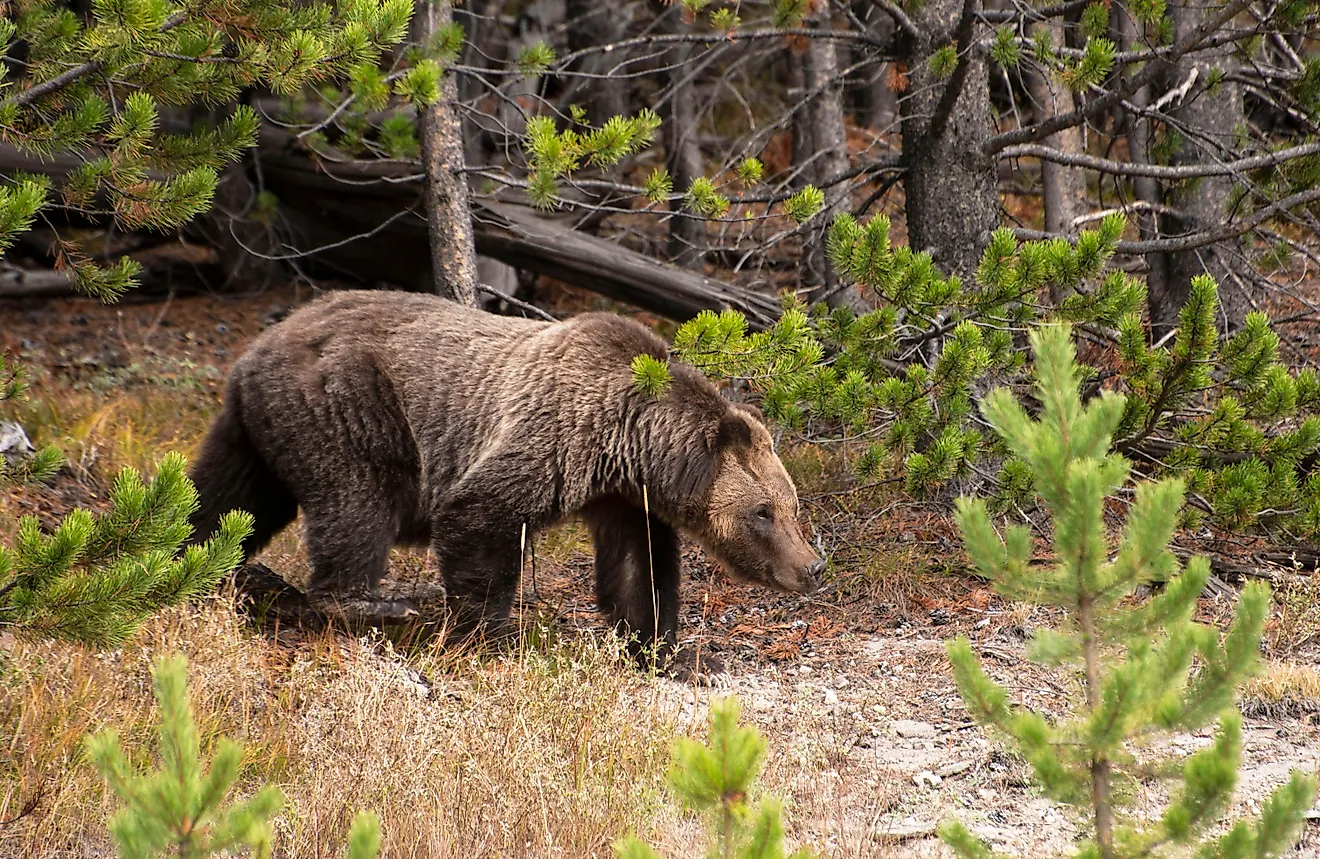
Coat color spans blond and tan, orange-brown, and dark brown, with silver-tipped guard hairs that give many individuals a grizzled look. Coloration varies across the archipelago, with lighter bears more common among females and in the southern islands. Cubs frequently show a white ring around the neck that can persist for up to two years. A pronounced shoulder hump, built from the muscle that powers the forelimbs, drives the digging of dens and roots, and the foreclaws are long and curved, often 3 to 4 inches (roughly 8 to 10 cm). The skull is broad and heavy, with boars harvested in the early 21st century averaging about 25 inches (64 cm) in combined length and width.
Range and Habitat

Kodiak bears occur naturally in just one region, the Kodiak Archipelago off the coast of southwest Alaska, including the main islands of Kodiak, Afognak, and Shuyak, along with nearby smaller islands. The archipelago stretches about 177 miles (284 km) and offers a maritime environment of mountains, spruce forest, tundra, wet meadows, and salmon streams. Much of the range falls within the Kodiak National Wildlife Refuge, which protects roughly 1.9 million acres.
The habitat is productive rather than harsh. Milder maritime winters, dense vegetation, berries, and salmon runs supported by roughly 350 streams give the bears an unusually rich food base for such a northern latitude. That productivity, not sheer land area, is what allows the archipelago to hold one of the highest brown bear densities on record.
Diet

Kodiak bears are omnivores whose diet shifts sharply through the year. Salmon is the mainstay of its diet, with U.S. Fish and Wildlife Service analysis estimating that it makes up about 64 percent of what Kodiak bears eat, while plant matter accounts for roughly 26 percent. Five salmon species run through the archipelago's streams, including sockeye, coho, chum, pink, and a smaller number of chinook, giving bears a long feeding window from summer into fall.
In spring, emerging bears feed on sedges, forbs, and the winter-killed carcasses of other animals. Summer brings berries and the first salmon. Through late summer and fall, during the feeding surge known as hyperphagia, bears concentrate on salmon and continue eating berries and beach foods to build fat before denning. When feeding on abundant fish, bears often strip only the most calorie-dense parts (skin, brain, and eggs) and leave the rest. Deer, mountain goats, and elk live on the islands but contribute little to the diet. Marine invertebrates, birds and their eggs, rodents, and occasional carrion round out the menu.
Behavior

For most of the year Kodiak bears are solitary, but they set that pattern aside where food concentrates. During salmon runs, dozens of bears may gather along a single productive stream, tolerating close quarters in a loose hierarchy governed by size and temperament. Outside these gatherings, adults keep to home ranges that vary with sex and food supply. A large male's range can exceed 100 square miles (260 km2), while females hold smaller areas and show strong fidelity to the ground where they were raised.
Denning drives the annual cycle. Most bears enter dens between October and December and emerge from April into May. Males leave first, often in early April, while sows with new cubs may stay until late June. Kodiak bears den at lower elevations than interior Alaskan grizzlies, rarely above 2,500 feet (760 m), and for a shorter span, sometimes only four to five months, because the maritime climate and lingering food make a long dormancy unnecessary. Some large males skip denning altogether in mild years.
Reproduction

Kodiak bears reproduce slowly, which shapes how the population responds to pressure. Females reach sexual maturity around age five and mate in May or June. Fertilized eggs undergo delayed implantation, developing only after the female dens in the fall, and cubs are born in the den in January or February. Newborns weigh less than a pound, arrive with closed eyes and little hair, and emerge in May or June at 15 to 20 pounds (7 to 9 kg). Typical litters hold two or three cubs.
Cubs usually remain with their mother for three years, during which she does not breed again, so a given female produces a litter only every three to four years at most. Survival is far from guaranteed. More than a quarter of cubs die before becoming independent, with attacks by adult males, including cannibalism, being a significant cause of mortality. Bears that strike out on their own at ages three to five face high mortality as well. Those that survive can live for many years, with the oldest recorded wild sow reaching 34 years and the oldest boar living to 27.
Importance to the World

As a top predator and a mover of salmon, the Kodiak bear helps drive its ecosystem. Bears carry salmon from streams into the forest and leave carcasses and waste behind, transferring marine-derived nutrients that fertilize vegetation well away from the water. Because the species is long-lived, wide-ranging, and sensitive to habitat change, biologists treat bear numbers as an indicator of the wider health of the archipelago.
The economic role is substantial. Bear viewing draws visitors from around the world to Kodiak and adds significantly to Alaska's economy, and regulated trophy hunting supports a managed guiding industry. The bear also holds deep cultural importance for the Alutiiq people, who historically hunted it for food, clothing, and tools and left the skull in the field as a mark of respect.
Threats

The brown bear as a species is listed as Least Concern on the IUCN Red List (2017 assessment), and the IUCN does not assess the Kodiak subspecies on its own. By local measures, the Kodiak population is in strong condition. The Alaska Department of Fish and Game estimates around 3,500 bears and reports that the population is healthy, with numbers stable or increasing across most of its range. Hunting is tightly regulated, requires sealing of hides and skulls, and operates within limits considered sustainable.
Takeaway
A healthy count does not remove long-term risk. The population's island isolation and low reproductive rate leave it vulnerable to disruption, and brown bears have already been depleted across much of Europe and North America. The chief concerns for Kodiak are climate change and its potential effect on salmon runs, energy development and associated road building, and rising human activity that increases the odds of bear-human conflict. Management on the archipelago aims to keep the population stable while reducing conflict along the road system near the city of Kodiak.
Fun Facts

- They share a record with the polar bear. The Kodiak bear and the polar bear are the two largest land carnivores alive, reaching similar top weights by different routes.
- They are island specialists. Kodiak bears live nowhere on Earth except the Kodiak Archipelago, where they have been isolated for about 12,000 years.
- Cubs are tiny at birth. A newborn weighs under a pound, though its father may weigh more than 1,000 pounds (450 kg).
- They gorge before winter. A bear can add 20 to 30 percent to its body weight between midsummer and denning.
- Salmon is the engine. Roughly 64 percent of the Kodiak bear's diet is salmon, the fuel behind its exceptional size.
Quick Facts
- Scientific name: Ursus arctos middendorffi
- Family / Order: Ursidae / Carnivora
- IUCN status: Species (Ursus arctos) listed Least Concern, 2017; subspecies not separately assessed; Kodiak population healthy and stable to increasing
- Size: Up to about 5 ft (1.5 m) at the shoulder on all fours; over 10 ft (3 m) upright
- Weight: Males up to 1,500 lb (680 kg); females about 20 percent smaller and 30 percent lighter
- Lifespan: Commonly 20 to 25 years in the wild; up to 34 recorded
- Diet: Omnivore (about 64 percent salmon, 26 percent plants)
- Range: Kodiak Archipelago, southwest Alaska