Jararacussu
The jararacussu is the largest and most heavily built member of the lancehead genus Bothrops, a group of pit vipers responsible for most serious snakebites in South America. A big adult can stretch beyond 7 feet (2.2 m) and carry one of the most abundant venom loads of any snake on the continent. It is a thick-bodied ambush hunter of warm, humid forests, and it has earned a fearsome reputation among the people who share its range.
Found across the Atlantic Forest belt of eastern and southern Brazil and the neighboring countries, the jararacussu spends its days hidden in leaf litter and its nights waiting near water for prey to wander close. It is both a public health concern and, thanks to its powerful venom, a prized subject of medical research.
Taxonomic Classification

The jararacussu carries the scientific name Bothrops jararacussu, first described by the Brazilian scientist Joao Baptista de Lacerda in 1884. It belongs to the family Viperidae and the subfamily Crotalinae, the pit vipers, named for the pair of heat-sensing pits set between the eye and nostril on each side of the head. Its genus, Bothrops, holds the lanceheads, a group of roughly 50 species that account for the majority of dangerous snakebites across Central and South America. Within that genus the jararacussu stands out as the bulkiest and among the longest.
The common name comes from the Indigenous Tupi and Guarani languages. "Jararaca" refers to a related lancehead, and the suffix "-cussu" (from wassu or guasu) means large, so jararacussu translates roughly as "big jararaca." The animal answers to a long list of regional names in Brazil, among them surucucu-dourada, urutu-dourado, and patrona. Some of those names are also applied to unrelated snakes, which is a frequent source of confusion. No subspecies are currently recognized.
Physical Description

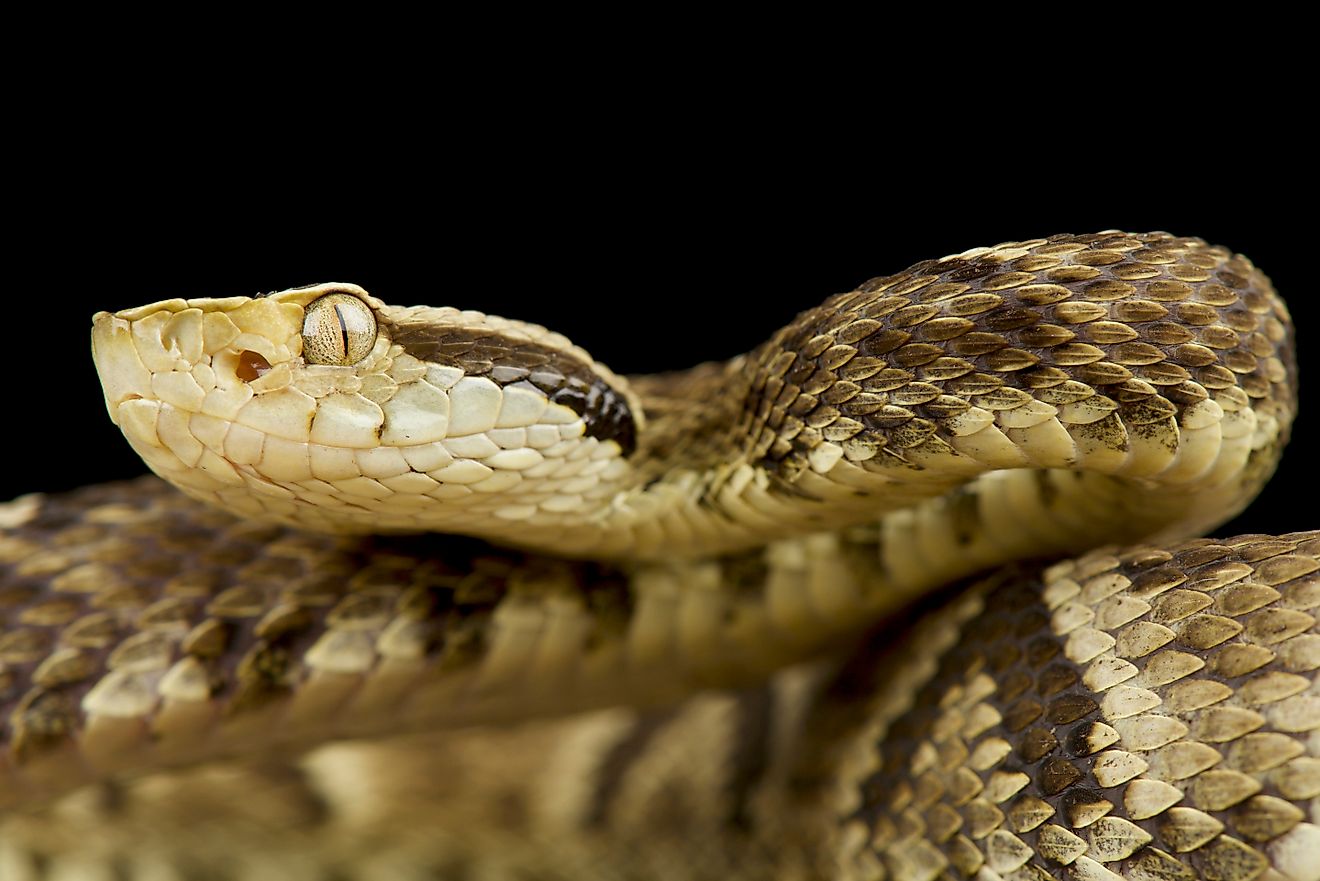
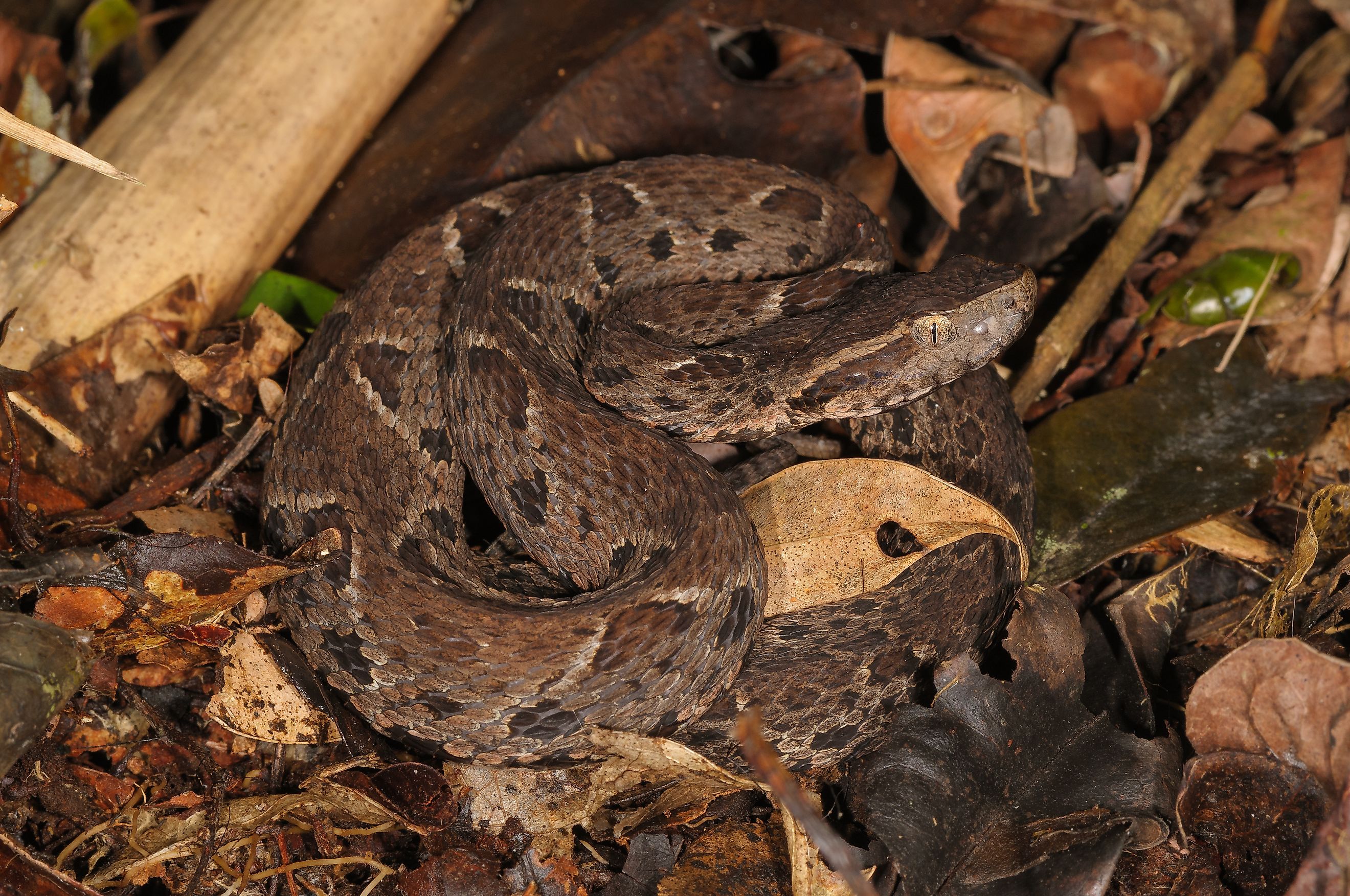
Most adults measure between 5 and 6 feet (1.6 to 1.8 m), and exceptional individuals reach about 7.2 feet (2.2 m), making the jararacussu the largest species in its genus. The body is thick and muscular, and the head is broad, flat, and clearly wider than the neck, ending in the pointed snout that gives the lanceheads their name.
Coloration is highly variable. The ground color may be olive, yellowish brown, or nearly black, overlaid by a series of dark, pale-edged bands that meet along the spine to form a row of shapes resembling the letter X or C. This pattern breaks up the snake's outline against leaf litter and shadow, so a resting animal can be very hard to spot. The eyes are moderate in size with vertical, elliptical pupils, and the dorsal scales are strongly keeled, giving the body a rough, matte texture rather than a glossy sheen.
The fangs are large for the animal's size, reaching about 1 inch (2.5 cm), and they fold back flat against the roof of the mouth when not in use, swinging forward to strike. Females grow noticeably larger than males and produce more venom, a difference closely tied to the different prey the two sexes tend to take.
Range and Habitat

The jararacussu is native to South America, concentrated in the Atlantic Forest region of eastern and southern Brazil, where its range reaches Bahia in the north and Santa Catarina in the south. It extends inland and south into Paraguay, southeastern Bolivia, and the province of Misiones in northeastern Argentina.
It favors warm, humid, low-lying environments. Typical habitat includes Atlantic and semi-deciduous forest, along with swampy ground, riverbanks, and the margins of streams and ponds. The species has a strong association with water and is often encountered in damp places where frogs and small mammals are plentiful. Because so much of the Atlantic Forest has been cleared for agriculture and cities, the snake also turns up in plantations, farmland, and the tangled vegetation bordering rural settlements, which brings it into contact with people.
Diet

The jararacussu is an ambush predator that relies on stealth rather than pursuit. It coils in a chosen spot, often near water or along an animal trail, and waits for prey to pass within striking distance. The heat-sensing facial pits let it detect warm-blooded animals in complete darkness, and the strike is fast, delivering venom that begins subduing the prey almost at once. After a successful bite the snake often releases larger prey, tracks it by scent as the venom takes hold, and then swallows it whole.
Adults feed mainly on rodents and other small mammals, along with frogs and the occasional other vertebrate. Young snakes take a different menu, focusing on frogs and other cold-blooded prey. Juveniles have a pale tail tip that they wriggle like a small grub or worm to lure curious frogs within reach, a behavior known as caudal luring. As the snake grows and its diet shifts toward mammals, the tail-luring fades. That change in diet across the animal's life helps explain why the venom of adults differs in chemical makeup from the venom of juveniles.
Behavior

The jararacussu is largely nocturnal and terrestrial, passing the day hidden under vegetation, logs, or leaf litter and becoming active after dark. Juveniles are more inclined to climb and can be semi-arboreal, while heavy adults stay close to the ground. As a sit-and-wait hunter it spends long stretches motionless, conserving energy between meals.
The species has a reputation for being irritable and quick to defend itself. A cornered jararacussu may inflate its body, flatten its head, and strike hard and repeatedly. Even so, like other pit vipers it would rather avoid a fight and usually freezes or retreats when it can, trusting its camouflage to keep it unseen. Most bites in people happen when a hidden snake is stepped on or picked up, not through unprovoked attack.
Reproduction

The jararacussu is ovoviviparous, which means the female retains her eggs inside her body and gives birth to fully formed, independent young rather than laying eggs in a nest. Litters are large for a snake, commonly numbering between 16 and 20 offspring, and bigger females can produce more. Newborns arrive fully equipped with working fangs and potent venom, and they must fend for themselves from the first day, receiving no parental care.
The pale tail tip used for caudal luring is present at birth and is most valuable to these small, frog-hunting juveniles as they learn to feed. Lanceheads of this size are thought to live for well over a decade in the wild, and longer still under the protected conditions of a research or breeding facility.
Importance to the World

As an abundant mid-level predator, the jararacussu helps control populations of rodents and other small animals across its range. Rodents spread disease and damage crops, so a steady population of ambush hunters like this snake provides a natural check that benefits both wild ecosystems and the farmers living nearby.
The animal's greatest importance to people, though, comes from its venom. The jararacussu yields an unusually large amount of venom, and that venom is a rich store of biologically active molecules that scientists study closely. Its powerful muscle-destroying toxins, known as bothropstoxins, rank among the most examined snake toxins in the world and serve as tools for research into how venoms injure tissue and how that injury might be blocked. Compounds isolated from Bothrops venoms have also informed drug development, and work on this species continues to support both antivenom production and basic medical science. The snake is therefore at once a public health hazard and a valuable scientific resource.
Threats and Conservation

The jararacussu is one of the more dangerous snakes in its range, and its bite is a serious medical emergency. The venom combines tissue-destroying, blood-affecting, and muscle-destroying components. A bite can cause intense local pain, swelling, and necrosis, along with disordered blood clotting, internal bleeding, shock, and kidney failure. Because a large adult can inject a great deal of venom, and because its most damaging muscle toxins are not fully neutralized by standard antivenom, envenomation by this species is treated with particular urgency. Anyone bitten needs prompt hospital care and the correct antivenom without delay.
For the snake itself, the outlook is more reassuring. The International Union for Conservation of Nature lists Bothrops jararacussu as Least Concern, based on its 2019 assessment. The species remains fairly common and occurs in many protected areas across its range, and no major threats are recognized at the global scale. Local populations do face pressure from the steady loss of Atlantic Forest habitat and from direct killing by people who fear it, and in parts of its southern range, including Argentina, it is treated as more vulnerable at the national level. Taken as a whole, however, the jararacussu remains widespread and secure for now, a formidable predator holding its own in one of the most heavily altered forests on Earth.
Takeaway
The jararacussu is the heavyweight of the lanceheads, thick-bodied and armed with inch-long fangs and one of the largest venom loads of any viper, yet it survives by patience and camouflage rather than aggression, lying still for hours until a meal wanders close. Its life story reads as a slow transformation, from a small, frog-luring juvenile that dangles a pale tail tip as bait into a rodent-hunting adult whose venom chemistry shifts to match its changing diet.
That same venom makes the snake both feared and valued. A bite is a serious medical emergency across the forests of eastern South America, and at the same time the animal's muscle-destroying toxins have become important tools in laboratories working on antivenom and human medicine. For now the jararacussu remains common and secure, listed as Least Concern, even as the Atlantic Forest it depends on continues to shrink.
Fun Facts

- The biggest lancehead. The jararacussu is the largest member of the genus Bothrops, outsizing famous relatives such as the common jararaca by a wide margin.
- Its name means "big jararaca." The word comes from Tupi and Guarani, blending the name of a smaller lancehead with a suffix that simply means large.
- It fishes with its tail. Young jararacussus wiggle a pale tail tip to mimic a worm, drawing frogs close enough to strike, a trick called caudal luring.
- A venom heavyweight. A single large individual can yield up to 1,000 mg of dry venom in one milking, among the highest outputs recorded for any viper.
- Inch-long fangs. Its hinged fangs reach about 1 inch (2.5 cm) and fold flat against the roof of the mouth when the snake is not striking.
- Females outmatch males. Female jararacussus grow larger than males and produce more venom, a difference linked to the different prey each sex hunts.
Quick Facts
- Scientific name: Bothrops jararacussu
- Family: Viperidae, subfamily Crotalinae (pit vipers)
- Order: Squamata
- Described by: Joao Baptista de Lacerda, 1884
- IUCN status: Least Concern (2019 assessment)
- Length: up to about 7.2 feet (2.2 m)
- Fang length: up to about 1 inch (2.5 cm)
- Venom yield: up to 1,000 mg dry weight per milking
- Diet: rodents and small mammals as adults, frogs and other cold-blooded prey as juveniles
- Reproduction: ovoviviparous, typically 16 to 20 young per litter
- Lifespan: well over a decade in the wild
- Range: eastern and southern Brazil, Paraguay, southeastern Bolivia, northeastern Argentina
- Habitat: Atlantic and semi-deciduous forest, swampy ground, and riverbanks