Indigo Snake
Strong, intelligent, and ravenous, indigo snakes rule the longleaf pine forests in the southeastern United States. While always on the hunt to feed their insatiable appetites, these large, non-venomous snakes are mostly harmless to humans despite their intimidating appearance and are often mistaken as threats and routinely killed out of fear. Beneficial to people by keeping rodent and venomous snake populations in check, indigo snakes are listed as threatened as the large tracts of land they require to survive are being destroyed, fragmenting their habitat and reducing their populations.
Taxonomic Classification

The indigo snake (Drymarchon corais) is also called the yellow-tail cribo. It is a non-venomous member of Colubridae, the largest of the snake families. Until recently, all Drymarchon were classified as subspecies of D. corais. North and central populations have since been assigned to separate species. These include Drymarchon couperi, the eastern indigo snake. They also include Drymarchon melanurus, the Middle American indigo snake, whose subspecies D. m. erebennus is the Texas indigo. Two South American species, Drymarchon margaritae and Drymarchon caudomaculatus, round out the currently recognized set. A Gulf Coast population was described in 2016 as a separate species called Drymarchon kolpobasileus. A 2019 genetic study found evidence of gene flow and male-biased dispersal rather than two distinct lineages, and returned that name to synonymy with D. couperi. The genus name comes from ancient Greek. Drymos means forest, oak woodland, or copse, and archon means ruler or commander, for a literal meaning of Lord of the Forest.
Range And Habitat

Indigo snakes are native to the Americas, ranging across the southeastern United States, through Central America, and deep into South America. Because the genus Drymarchon covers multiple species of indigo snake, their ranges and habitats vary by location. The eastern indigo snake is restricted mostly to peninsular Florida and southeastern Georgia. It was extirpated from Alabama and Mississippi during the twentieth century, and historical records from South Carolina are considered doubtful by most herpetologists. The Texas indigo snake is found only in southern Texas and northeast Mexico. The Middle American indigo snake ranges across Mexico, through Central America, and into northwest South America. The yellow-tailed indigo snake is found in the tropical regions of South America, including the Amazon Basin. Indigo snakes are highly adaptable when it comes to habitat but generally require large, continuous tracts of land because they have vast home ranges. Radio-tracking in southeastern Georgia put average annual male home ranges at roughly 1,300 acres, with the largest measured range covering nearly 3,800 acres. In the southeastern US they inhabit longleaf pine sandhills, scrubby flatwoods, and dry prairies. In the tropics and subtropics, they prefer moist hardwood hammocks, rainforests, coastal dunes, and the edges of agricultural land.
Food

Indigo snakes are non-venomous apex predators with one of the most varied, opportunistic diets of any snake species. These carnivores will pursue and kill virtually any animal they can overpower and swallow whole. A review of 185 prey records for the eastern indigo found that four categories accounted for roughly 85 percent of everything eaten. Other snakes led the list at about 45 percent, a habit known as ophiophagy. That includes highly venomous pit vipers like rattlesnakes, copperheads, and cottonmouths. Laboratory work on indigo blood serum found that it inhibits both the tissue-destroying and the blood-cell-destroying components of copperhead venom, which supports a century of field reports that these snakes shrug off pit viper bites. They will also eat smaller indigo snakes. Rodents and juvenile gopher tortoises each made up about 15 percent of prey records, and frogs and toads another 14 percent. Other documented prey includes lizards, young freshwater turtles, marsh rabbits, birds and bird eggs, fish, invertebrates, and occasionally carrion. Indigo snakes are not constrictors. They use their physical strength and powerful jaws to pin struggling prey against a firm surface, sometimes violently beating it to stun or kill it before swallowing it whole headfirst.
Physical Description

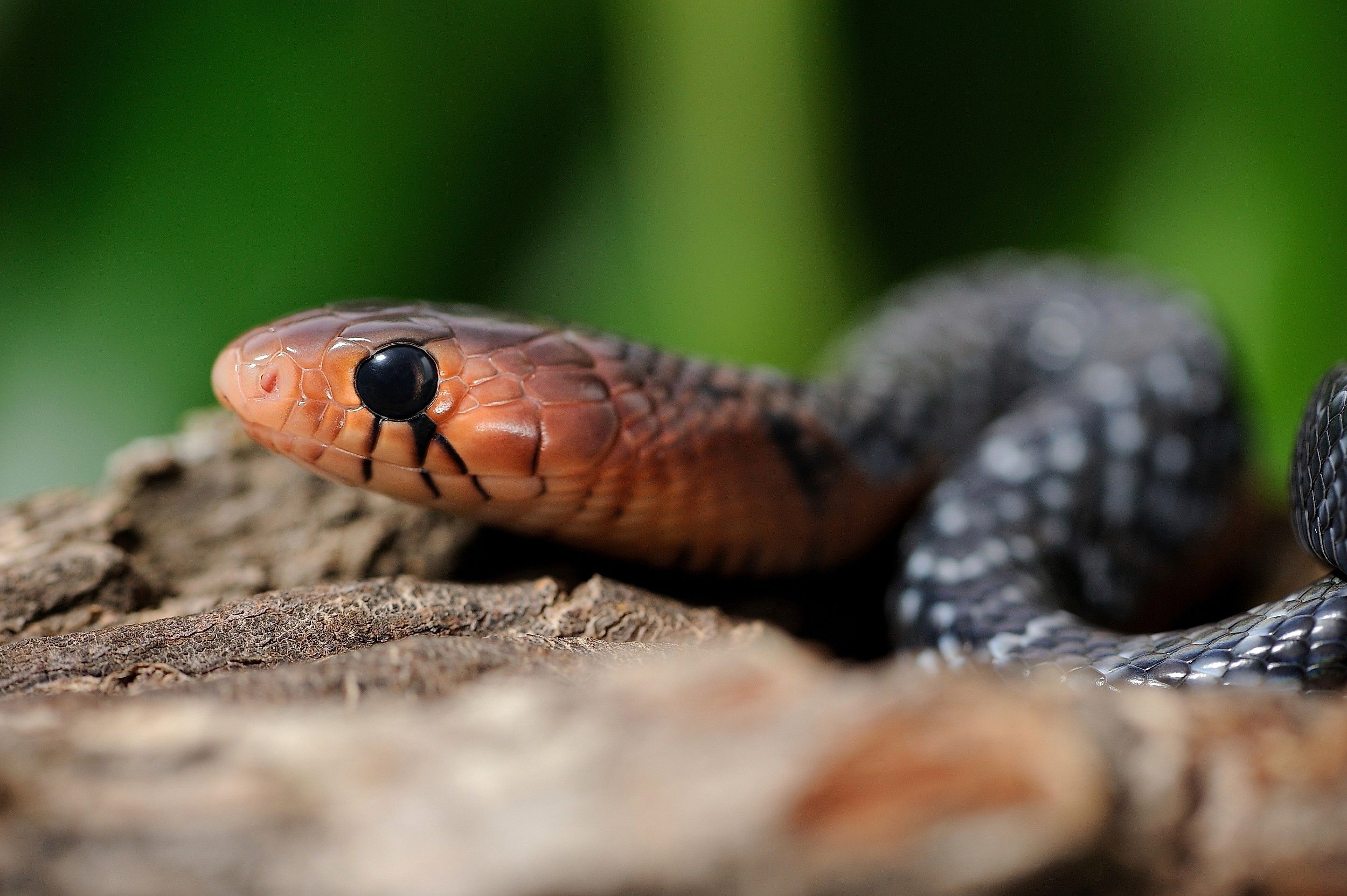
The eastern indigo snake is the longest snake native to the United States, and the genus as a whole is easily distinguished by its size and coloration. Appearance varies slightly by species, but they all share a robust, muscular build and highly reflective scales. Adults commonly reach five to seven feet in length, the longest reliably measured individuals top eight and a half feet, and large males can weigh more than 10 pounds. Unlike many snake species, in which females are larger, indigo snakes are sexually dimorphic in reverse: males grow significantly larger than females. Their bodies are a deep, glossy jet-black or gunmetal blue. When sunlight reflects off their smooth scales, they give off an iridescent purple or blue-green sheen, which gives this snake its common name. Many individuals, particularly the eastern indigo, carry a distinct wash of cream or reddish-brown around the chin and throat. The Texas variation differs slightly, showing a gradient: shiny brownish scales on the front half of the body that darken to jet black toward the tail. Their scales are large and smooth, enhancing their glossy appearance. The head is only slightly wider than the neck, with dark eyes and strong, powerful jaws.
Behavior

Indigo snakes exhibit active, calculating behaviors that set them apart from most other snakes. They are diurnal, terrestrial, and wide-ranging foragers noted for their visual awareness. To hunt, studies show indigo snakes rely heavily on visual cues and motion to spot prey rather than scent or tongue-flicking. They usually hunt on the ground but are very capable of climbing shrubs and trees or entering the water to pursue prey. Typical daily movements are modest and measured in tens of yards, though the seasonal totals are remarkable. One tracked male in Georgia relocated about 13 miles over two years. These snakes burn energy faster than ambush hunters like pythons and boas, which keeps them foraging almost continuously. They are docile toward humans and pose little threat. They seldom bite people, even defensively, preferring instead to flee into cover and avoid conflict. Indigo snakes are commensals of the gopher tortoise, meaning they benefit from the tortoise's work without harming it. In North America, they regularly occupy gopher tortoise burrows, using these underground dens to survive winter brumation, and will sometimes share the same shelter space with the tortoises and even rattlesnakes without conflict.
Reproduction

Most of what is known about the indigo snake's reproduction comes from studies of the eastern indigo snake. Mating and reproductive cycles are highly synchronized with changing seasons, and unlike most other North American reptiles that breed in spring, these snakes are winter breeders. Mating peaks between November and January, though it can begin as early as October and continue into March. The onset of cooler temperatures and shorter days triggers adult snakes to migrate and concentrate on upland sand ridges. When a female ovulates, she releases a skin pheromone that leaves a scent on the ground, which a male will track over long distances. If multiple males converge on a single female's scent, they will engage in intense combat, though the contests are ritualized and rarely leave permanent injury. Females also appear to store live sperm for long periods, potentially longer than four years, delaying fertilization until conditions favor egg development. That four-year figure rests on a single captive record, and some researchers suspect parthenogenesis rather than sperm storage explains it. A female lays a single clutch of four to 14 eggs between late April and early June. The eggs are large for a colubrid snake, at three to four inches long and about an inch wide, and are laid in abandoned gopher tortoise burrows or rotting logs. They require about 90 days to hatch, and the neonates pip out of their shells in August or September. Hatchlings measure about 16 to 24 inches, are immediately independent, and grow fast enough to reach breeding size in three to five years.
Importance to the World
The presence of indigo snakes indicates a balanced food web in their habitat. As non-venomous apex predators, indigo snakes sit at the top of their local food chains. They consume a considerable amount of prey and, in doing so, prevent any single species from overpopulating and exhausting local resources. Perhaps most important to humans is that they are among the few natural predators capable of hunting and killing pit vipers, helping keep venomous snake populations in check near agricultural and urban areas. By eating large numbers of mice, rats, and cotton rats, indigo snakes also reduce the transmission of rodent-borne illnesses such as hantavirus.
Threats

The U.S. Fish and Wildlife Service classifies the eastern indigo snake as a threatened species. Because a single male snake can range across thousands of continuous acres, the species is acutely vulnerable to habitat loss and fragmentation. Commercial and residential development remains the single greatest threat to indigo snake populations, as seen in Alabama and Mississippi, where the snakes were wiped out by urbanization and the destruction of longleaf pine forests. Development and agriculture consumed roughly 97 percent of the Southeast's longleaf pine forest. Road mortality is a second major threat, and vehicle deaths spike in winter when cooler temperatures trigger the breeding migration. Collection for the pet trade thinned wild populations before federal listing, and rattlesnake hunters have long poured gasoline into gopher tortoise burrows to flush out diamondbacks, which kills everything sheltering below ground. The gopher tortoise matters here too, because winter survival in the northern part of the range depends on tortoise burrows, and indigo snakes cannot dig their own dens. That tortoise is federally listed as threatened in the western part of its range and protected by state law everywhere else it occurs. General human fear and lack of education about indigo snakes and other reptiles also result in people killing them on sight, not knowing they are harmless to humans and genuinely useful to have around.
Recovery Efforts
The Lords of the Forest need protection if they are to survive as a species, and help is underway. Listed as threatened under the US Endangered Species Act since 1978, the eastern indigo snake cannot legally be captured, harmed, or killed without a permit. Penalties range from $25,000 for civil violations to $50,000 plus possible imprisonment for criminal violations. Under the federal protection measures that apply in Florida and Georgia, construction crews working in indigo habitat must be trained to recognize the snake, and any sighting on a site stops clearing work until the animal leaves on its own or the Fish and Wildlife Service says work can resume. Similar attention is going to the gopher tortoise, which the indigo snake relies on for shelter. The most encouraging news comes from the reintroduction program. Captive-bred snakes from the Orianne Center for Indigo Conservation have been released each year since 2017 at The Nature Conservancy's Apalachicola Bluffs and Ravines Preserve in the Florida Panhandle, and for longer than that at Conecuh National Forest in southern Alabama, both places where the species had been gone for decades. More than 500 snakes have gone back into the wild. Wild-born hatchlings have now turned up at both sites, which means released animals are surviving, finding mates, and reproducing on their own.