Devil Scorpionfish
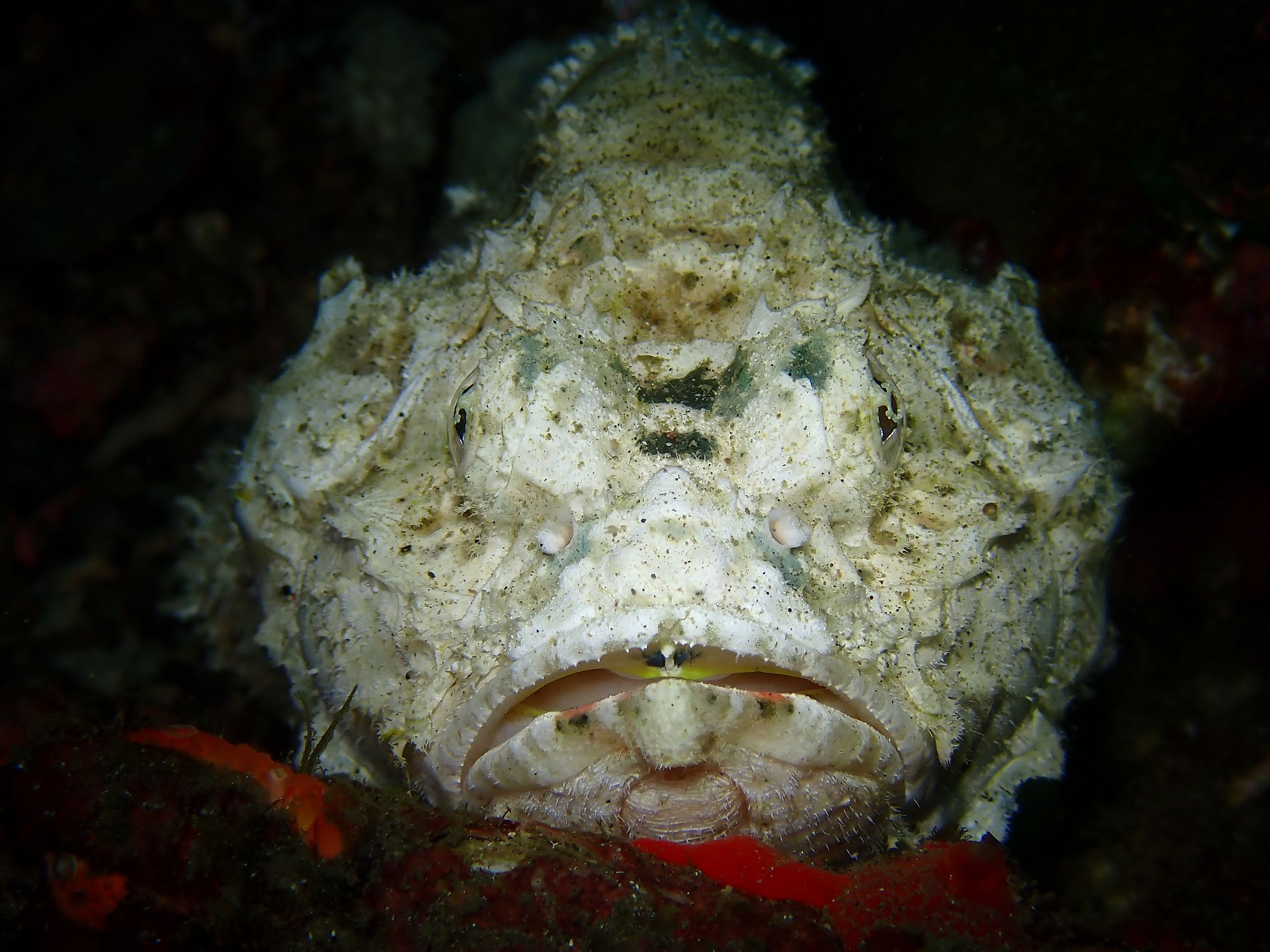
Few reef fish work as hard to be overlooked as the devil scorpionfish. This stout, warty ambush hunter spends its days sitting perfectly still on the seabed, disguised as a lump of algae-covered rock, waiting for a meal to swim within reach. It carries a row of venomous spines along its back, and its Latin name, diabolus, meaning "devil," hints at the painful reputation that follows it.
The devil scorpionfish (Scorpaenopsis diabolus) is a bottom-dwelling predator of warm coastal waters across the Indian and Pacific Oceans and the Red Sea. It is also widely known as the false stonefish, a nod to how closely it mimics one of the ocean's most dangerous fish. For divers, snorkelers, and waders, it is a creature worth learning to recognize, because stepping on one is a mistake few people forget.
Taxonomic Classification

The devil scorpionfish belongs to the family Scorpaenidae, the scorpionfishes, a large group of venomous, spiny, bottom-dwelling marine fish. Its full scientific name is Scorpaenopsis diabolus, placing it in the genus Scorpaenopsis alongside relatives such as the bearded scorpionfish (Scorpaenopsis barbata) and the tasseled scorpionfish (Scorpaenopsis oxycephalus). As a ray-finned fish in the class Actinopterygii, it shares its basic body plan with the vast majority of living fish species.
The French zoologist Georges Cuvier first formally described the species in 1829, originally naming it Scorpaena diabolus. Curiously, the type locality was recorded as the northern Bay of Biscay off France, which is almost certainly an error, since the fish occurs only in the Indo-West Pacific. The species name diabolus translates as "devil" and most likely refers to the venomous spines that arm its back. Early naturalists noted a strong local fear of the fish. Writing in 1829, Cuvier and Valenciennes recorded that people in the Moluccas Islands of Indonesia treated it as a bad omen and blamed its venom for two human deaths.
Physical Description

The devil scorpionfish is a compact, heavily built fish that grows to about 12 inches (30 cm) in length. It has a broad head, a wide mouth, and a distinctive humped back that tapers toward the tail. That hump is one of the most reliable ways to identify the species once a diver learns to look for it. The skin is rough and covered in low cone-shaped bumps, short spines, and fleshy tassels that break up the animal's outline and help it vanish against rock and coral.
Coloration is highly variable and tuned to the surroundings. Most individuals are a mottled mix of gray and white marked with reddish-brown blotches, which allows the fish to blend into rubble, weed, and coralline algae. Because the fish sits still for long stretches, algae and other small organisms often settle and grow on its body, adding another layer of disguise. The animal also sheds an outer cuticle of skin now and then, which clears away parasites in the process.
The dorsal fin carries 12 venomous spines backed by 8 to 10 soft rays, while the anal fin has 3 spines and 5 to 6 soft rays. The most striking feature stays hidden until the fish feels threatened. The undersides of its broad pectoral fins are boldly marked in orange, black, and white, and the devil scorpionfish can suddenly flash them as a warning to anything that comes too close.
Range and Habitat

The devil scorpionfish has a wide distribution across the tropical Indo-Pacific. In the west it reaches the coasts of South and East Africa and the Red Sea, and in the east it turns up around Japan, Hawaii, French Polynesia, Australia, and New Caledonia. Within that vast area it favors shallow, warm coastal waters, though it has been recorded at depths of around 230 feet (70 m).
This is a fish of the reef floor rather than open water. It settles among rubble, on weed-covered rocks, and on surfaces encrusted with coralline algae, turning up on reef flats, in lagoons, and along the seaward faces of reefs. Often it lies partly buried under a thin layer of sediment, with only its eyes and back exposed. Its preference for shallow water is part of what makes it a hazard, because it can rest in the exact spots where people wade and swim.
Diet

The devil scorpionfish is a patient ambush predator rather than an active hunter. Instead of chasing food, it stays motionless and lets its camouflage do the work, waiting for prey to wander within striking distance. When a target comes close enough, the fish opens its large mouth with explosive speed and pulls in the victim along with a rush of water.
Its diet is made up largely of small fish and invertebrates such as crustaceans. The wide mouth allows it to swallow surprisingly large items, and in practice the fish will take almost anything that fits inside it. This sit-and-wait strategy costs very little energy, which suits an animal built for stillness rather than speed.
Behavior

Nearly everything about the devil scorpionfish is organized around remaining unseen. It spends most of its time resting on the bottom, relying on camouflage both to catch prey and to avoid becoming prey itself. This stillness is so complete that even experienced divers can swim right past one without noticing it.
When the disguise fails and a predator or a curious diver presses too close, the fish stops hiding and switches to a warning. It flares its pectoral fins to reveal the bright orange, black, and white patches on their inner surfaces, a sudden splash of color that signals danger. If that display does not work, the venomous dorsal spines remain as a last line of defense. The devil scorpionfish does not use those spines to attack. The venom is purely defensive, delivered only when something presses down on the spines.
Reproduction

Reproduction in the devil scorpionfish is not as thoroughly documented as in many commercially important fish, but the broad outline is known. The species is oviparous, which means it reproduces by laying eggs. Males and females release sperm and eggs into the water at the same time, so fertilization happens externally in open water rather than in a nest.
The resulting larvae drift near the surface as part of the plankton before eventually settling to the bottom to take up the resting lifestyle of the adults. Precise figures for maturity age, breeding season, and natural lifespan remain poorly studied, a common gap in knowledge for cryptic reef species that are hard to track in the wild.
Importance to the World

As a mid-level predator on tropical reefs, the devil scorpionfish helps regulate populations of small fish and invertebrates, contributing to the balance of the reef community. Its own camouflage also makes it part of the food web in subtler ways, since it competes and coexists with other ambush hunters for the same hiding spots and prey.
For people, the fish matters mainly as a medical and safety concern. Its resemblance to the far more dangerous reef stonefish (Synanceia verrucosa) means beachgoers and divers are wise to treat any suspicious lump on the seabed with respect. A sting from the devil scorpionfish is intensely painful and can cause swelling and other symptoms, so prompt wound care and medical attention are important after any encounter. The fish appears only occasionally in the specialist aquarium trade, where its appetite and venom make it a demanding animal to keep.
Threats

The devil scorpionfish is currently listed as Least Concern on the IUCN Red List, the category used for species that are widespread and not facing an immediate risk of extinction. Its enormous range across the Indo-Pacific, combined with its tolerance for a variety of reef habitats, works in its favor. The species is not targeted by major fisheries and has no significant commercial value that would drive heavy exploitation.
That said, no reef animal is completely insulated from the pressures facing tropical seas. Coral reef degradation, warming and acidifying oceans, coastal development, and pollution all threaten the habitats this fish depends on. For now the devil scorpionfish remains common throughout its range, and its conservation outlook is stable.
Takeaway
The devil scorpionfish has evolved an extraordinary ability to disappear against the reef. Its warty, algae-covered skin allows it to blend into its surroundings, while its habit of remaining motionless helps it avoid detection by both predators and prey. When an opportunity arises, it can strike with surprising speed, making it an effective ambush predator. Venomous spines provide an additional layer of defense and give the species its ominous name. Widespread and currently considered secure, it remains a largely hidden presence on tropical reefs, although its camouflage makes caution important for anyone moving through shallow waters.
Fun Facts

- It pretends to be something deadlier. The devil scorpionfish is nicknamed the false stonefish because it closely mimics the reef stonefish, one of the most venomous fish in the sea.
- It glows under the right light. The species shows biofluorescence, re-emitting blue or ultraviolet light as red, which may help with camouflage or with communication among its own kind.
- Its name comes from an old superstition. Nineteenth-century naturalists reported that islanders in the Moluccas viewed the fish as a bad omen and avoided it entirely.
- It flashes bright colors to warn enemies. The dull-looking fish hides vivid orange, black, and white patches on the undersides of its fins and reveals them only when startled.
- It sheds its skin. The devil scorpionfish periodically molts an outer layer of skin, which helps rid its body of algae buildup and parasites.
Quick Facts
- Common names: Devil scorpionfish, false stonefish, false scorpionfish
- Scientific name: Scorpaenopsis diabolus
- Family: Scorpaenidae (scorpionfishes)
- Genus: Scorpaenopsis
- IUCN status: Least Concern
- Size: Up to about 12 inches (30 cm) long
- Depth range: Shallow coastal water down to about 230 feet (70 m)
- Diet: Carnivorous, feeding on small fish and invertebrates
- Range: Tropical Indo-Pacific, including East and South Africa, the Red Sea, Japan, Hawaii, and French Polynesia
- Habitat: Reef flats, lagoons, and seaward reef slopes with rubble and algae
- Defenses: 12 venomous dorsal spines and a startling pectoral-fin display
- First described: By Georges Cuvier in 1829