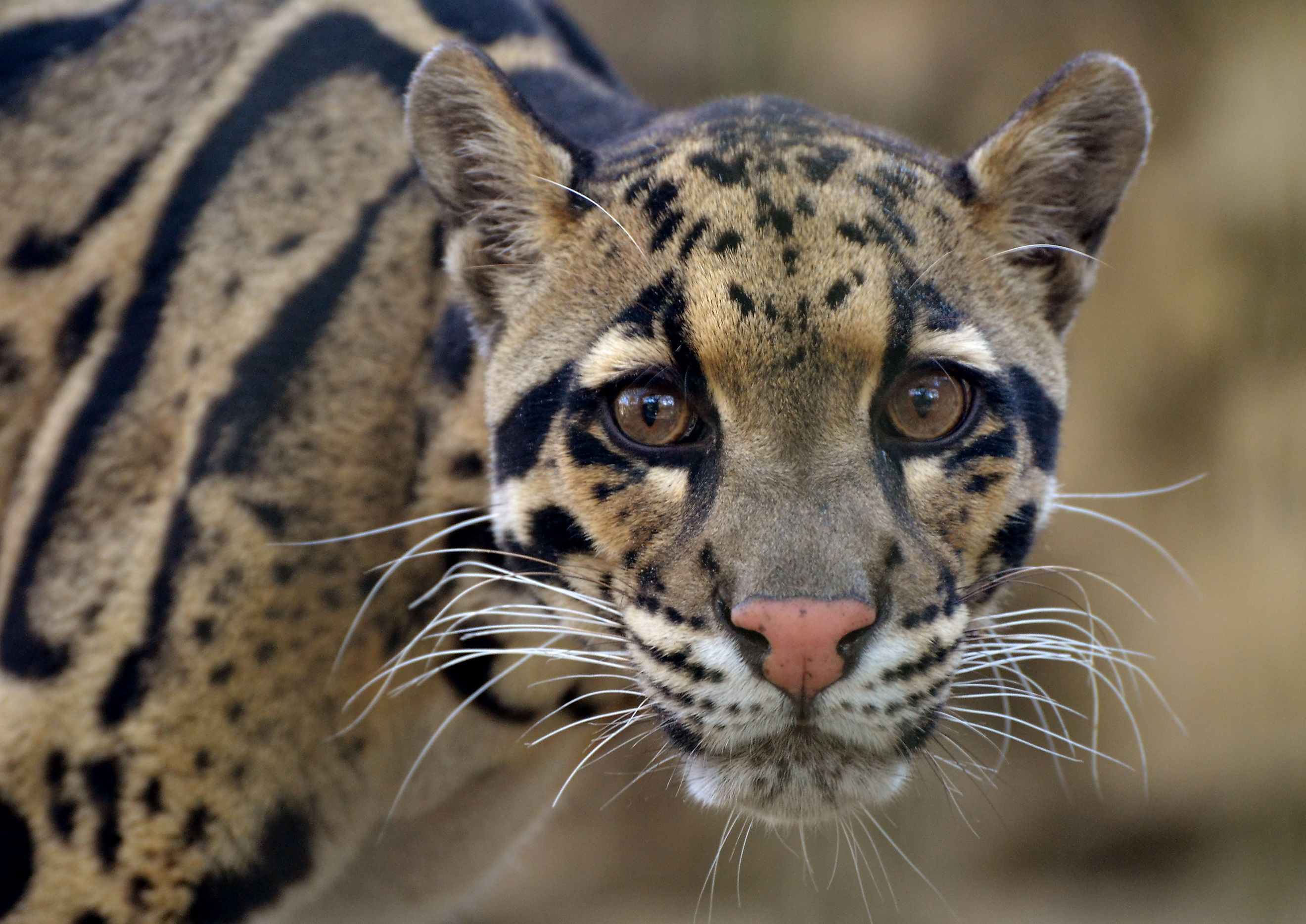
Clouded Leopard
Hidden within the forests of South and Southeast Asia, the clouded leopard remains one of the most mysterious wild cats on Earth. Its unusually long canine teeth, flexible ankle joints, broad paws, and tail that can nearly equal its body length make it one of the most specialized climbers in the cat family. Yet modern research has revealed that this elusive predator spends far more time on the forest floor than scientists once believed. Habitat loss, poaching, prey depletion, and the widespread use of wire snares continue to threaten populations, leaving many aspects of their behavior and ecology still unknown. Here's what we do know.
Taxonomic Classification

Although often grouped alongside lions, tigers, leopards, and jaguars, the clouded leopard belongs to its own genus, Neofelis. It's one of only two living species within the genus, the other being the Sunda clouded leopard (Neofelis diardi), which inhabits Borneo and Sumatra. Until 2006, the two were classified as a single species. However, genetic analyses and differences in skull structure and coat patterning demonstrated that the island populations were distinct enough to warrant recognition as a separate species.
Today, the mainland clouded leopard (Neofelis nebulosa), which lives in forests across the Himalayan foothills, mainland Southeast Asia, and southern China, is generally regarded as a monotypic species, meaning no living subspecies are formally recognized. It occupies an important evolutionary position within the cat family. While it belongs to the same subfamily (Pantherinae) as the roaring big cats mentioned above, it diverged from their common ancestor millions of years earlier and possesses a unique combination of characteristics found in neither the smaller cats nor the genus Panthera.
Physical Description

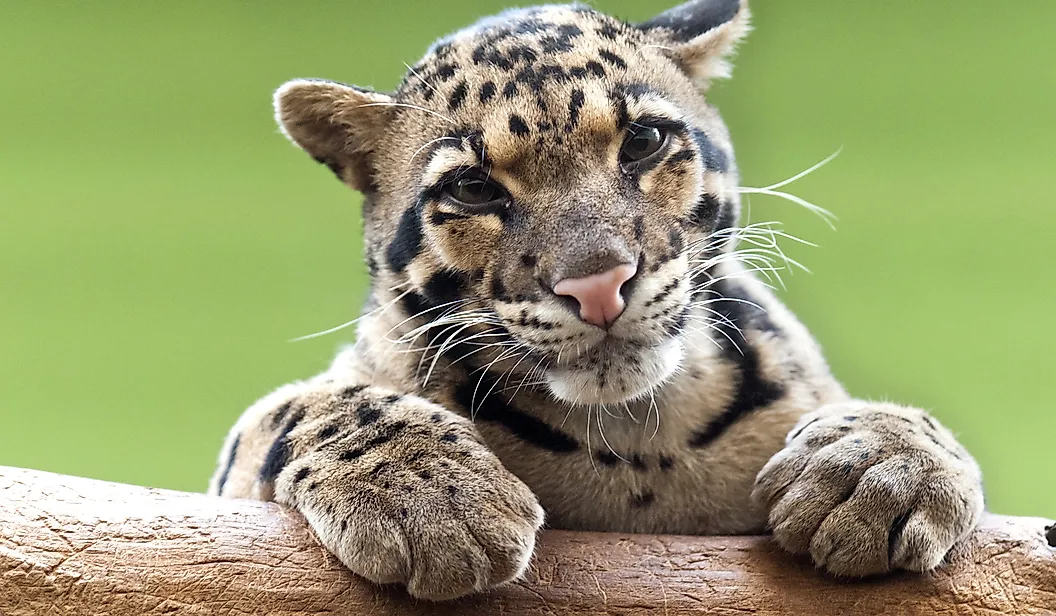
The clouded leopard takes its common name from the large, irregular markings covering its coat. Each "cloud" generally has a dark outer border surrounding a paler center. Background color runs through yellowish-brown, tawny, silver-gray, and dark, earthy brown. Black spots cover the face and lower limbs, two heavy dark bars run along the back of the neck, and the long tail is marked with dark bands.
Adults generally weigh between 35 and 51 pounds (16 to 23 kilograms), with a head and body length of approximately 27 to 43 inches (69 to 109 centimeters). The tail adds another 24 to 36 inches (61 to 91 centimeters) and may approach the length of the head and body combined. Males are generally larger than females.

That tail is not decorative. It acts as a counterbalance while the cat moves across narrow branches. Short, sturdy legs keep its center of gravity low, while broad paws improve its grip. Its hind legs are longer than its forelegs, helping it climb and leap through uneven forest terrain. Clouded leopards also possess unusually mobile ankle joints. They can rotate their hind feet enough to descend a vertical trunk headfirst and hang beneath branches, supporting their weight on the rear feet while the front paws grasp.
Its most dramatic feature is inside its mouth. Clouded leopards have the longest upper canine teeth in proportion to skull and body size of any living felid. The canines may reach around 1.6 inches (4 centimeters), while the animal can open its jaws to an angle of approximately 100 degrees. The combination has inspired comparisons to extinct saber-toothed cats, although clouded leopards are not their direct modern descendants.
Range and Habitat

The mainland clouded leopard can be found across a broad but increasingly fragmented area of South and Southeast Asia. The range covers the Himalayan foothills of Nepal and Bhutan, northeastern India, Bangladesh, Myanmar, Thailand, Laos, Cambodia, Vietnam, Peninsular Malaysia, and southern China. Although historical records also exist from Taiwan, the species is now considered locally extinct after the last confirmed record in 1983.
Clouded leopards live in a surprising variety of habitats. They have been recorded in tropical evergreen rainforests, deciduous forests, selectively logged forests, dry woodlands, and montane forests at elevations reaching about 11,500 feet (3,500 meters). However, one of the greatest challenges facing researchers is simply determining where clouded leopards still survive. Their naturally low population densities and preference for dense vegetation make them among the most difficult wild cats to study.
According to the IUCN Cat Specialist Group, the mainland clouded leopard now occupies only about 36% of its historical range. Deforestation, expanding agriculture, road construction, and infrastructure development continue to divide forests into smaller, isolated fragments. These barriers reduce breeding opportunities and increase encounters with people, leaving remaining populations more vulnerable to local extinction.
Diet and Hunting

Clouded leopards are strict carnivores. Confirmed and reported prey include muntjacs and other small deer, macaques, gibbons, slow lorises, squirrels, pangolins, wild pigs, pheasants, rodents, and birds. A clouded leopard has even been documented killing a binturong, another strong, tree-climbing Southeast Asian mammal.
For many years, scientists believed clouded leopards hunted almost exclusively in the forest canopy because of their remarkable climbing ability. Modern radio-tracking and camera-trap studies have changed that view. While they frequently climb to rest or to pursue prey found in the trees, they also spend considerable time moving and hunting on the ground. This flexibility allows them to exploit prey living at multiple levels of the forest, taking monkeys and squirrels in the canopy as well as deer, porcupines, and wild pigs below.

The animal usually hunts alone. Like many cats, it approaches prey quietly before making a short, forceful rush or pounce. Its long canines may help it penetrate deeply during a killing bite, although scientists have not conducted enough direct field observations to describe one universal hunting technique.
There has never been a comprehensive, range-wide study of the clouded leopard's diet. Much of the available information comes from isolated observations, prey remains, fecal evidence, or records collected while studying other animals. As a result, long lists of possible prey should not be mistaken for proof that every population eats the same things. Clouded leopards sometimes kill poultry, goats, or other small livestock. Such incidents can bring them into conflict with rural communities, especially where wild prey has been depleted or forests have been converted into farmland.
Behavior

The clouded leopard is among the most elusive members of the cat family, and much of its behavior remains poorly understood. Most sightings come from camera traps rather than direct observation, meaning many aspects of its daily life are still being pieced together through long-term field research.
Once believed to be almost entirely nocturnal, clouded leopards are now considered cathemeral, meaning they may be active during both the day and night. Camera-trap and radio-telemetry studies have shown that activity often peaks in the early morning and again after dusk, although this varies between locations. Researchers believe factors such as prey availability and competition with larger predators, as well as human disturbance, all influence when they are most active. In areas where they coexist with tigers and larger leopards, clouded leopards may adjust their activity to avoid encounters.
Like most wild cats, clouded leopards are primarily solitary outside of the breeding season. Adult males and females maintain home ranges that can overlap, but they generally avoid prolonged contact with one another. Communication relies heavily on scent rather than direct interaction. Clouded leopards leave chemical signals by spraying urine, rubbing their cheeks and bodies against trees, scratching bark with their claws, and scraping the ground. These scent marks help advertise an individual's presence and reproductive status while reducing the need for potentially dangerous confrontations. Their vocal repertoire includes growls, hisses, mews, and a friendly chuffing sound used during non-aggressive meetings. Unlike lions and tigers, clouded leopards cannot produce a true roar.
Reproduction and Life Cycle

Most detailed reproductive information comes from clouded leopards living under human care. The cats generally reach sexual maturity at around two years of age. After mating, the female undergoes a gestation period of approximately 85 to 93 days, although some published studies have reported pregnancies lasting up to 99 days. She then gives birth in a secluded den, such as a hollow tree or a sheltered rock crevice.
Clouded leopard litters usually contain one to three cubs, although larger litters have been recorded. Newborns weigh roughly 5 to 10 ounces (150 to 280 grams), are blind, and depend completely on their mother. Their eyes generally open after about 10 to 14 days. Teeth begin appearing at around three weeks, and cubs may leave the nest at approximately five weeks. Weaning occurs at around three to three-and-a-half months, while full independence may not come until 18 to 24 months. Once fully grown, they leave to establish territories of their own, continuing the species' largely solitary lifestyle. The cats may live between 15 and 17 years in human care. However, their wild lifespan is poorly documented and is likely affected by external factors such as hunting pressure and prey availability.
Ecological and Scientific Importance
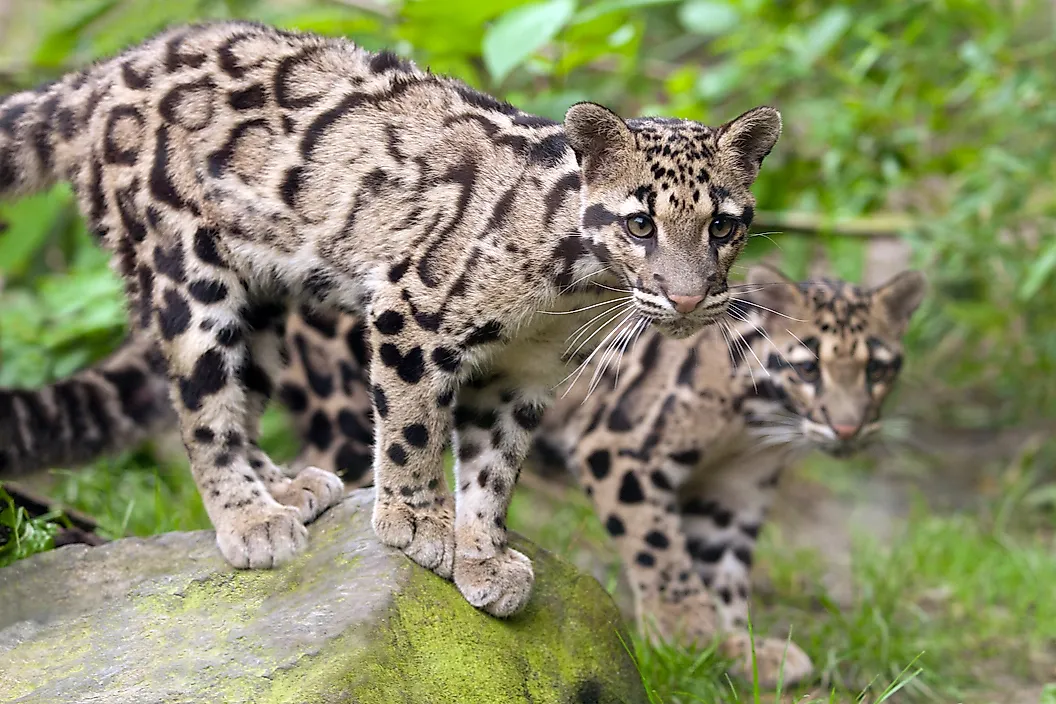
As one of the largest native predators inhabiting many forests across South and Southeast Asia, the clouded leopard occupies an important position in its ecosystem. By preying on mammals and birds as varied as squirrels, monkeys, small deer, and wild pigs, it forms part of the complex predator-prey relationships that shape healthy forest communities. Although researchers have not quantified its ecological impact across its entire range, predators such as the clouded leopard can influence prey abundance and behavior, helping maintain balanced food webs over time.
Beyond its ecological role, the clouded leopard has become an important species for scientific research. Its unique anatomy, including the longest canine teeth relative to skull size of any living cat, and its exceptional climbing adaptations provide valuable insight into the evolution of the cat family. Conservation breeding programs have also advanced techniques such as artificial insemination and cryopreservation, helping researchers improve reproductive management for endangered felids both inside and outside human care.
Threats and Conservation

The IUCN classifies the mainland clouded leopard as Vulnerable. Estimates of the number of mature animals vary enormously, with published figures between roughly 1,600 and 29,000, reflecting how little is known. The IUCN Cat Specialist Group reports that the true number may fall between 3,700 and 5,580 mature individuals. These should be treated as estimates rather than a precise global census. Habitat loss remains one of the most visible threats. Between 2000 and 2018, habitat strongholds for the mainland species declined by an estimated 34%. Forest has been cleared or divided for agriculture, commercial plantations, roads, hydropower, settlements, and other infrastructure.
Illegal hunting may be an even more immediate danger. Clouded leopards are killed for their patterned skins, teeth, bones, meat, and use in traditional medicine. Live animals are also trafficked for the exotic-pet trade. Indiscriminate wire snares set for wild pigs and deer can kill clouded leopards even when they are not the intended target. Hunting a clouded leopard's prey is also a significant issue. A forest may remain standing yet become incapable of supporting clouded leopards if deer, primates, porcupines, and wild pigs have been emptied from it. This "empty forest" problem is particularly serious in parts of Southeast Asia where commercial hunting supplies local or regional wildlife markets. Long-term conservation will require connected forests, effective anti-poaching patrols, reduced demand for wildlife products, protection of prey, cooperation across international borders, and better population monitoring.
Keeping the Forests Connected
The clouded leopard is known for its long tail, flexible ankles, broad paws, and oversized canines, which make it unlike any other living cat, but those adaptations cannot protect it from snares, wildlife trafficking, prey loss, and disappearing habitat. Preserving the species will require more than isolated reserves. It will depend on keeping Southeast Asia's forests connected, populated with prey, patrolled, and protected well enough for this elusive predator to remain hidden within them. Every new field study not only improves understanding of this remarkable predator but also helps guide conservation efforts aimed at ensuring it continues to roam the forests where it has evolved for millions of years.