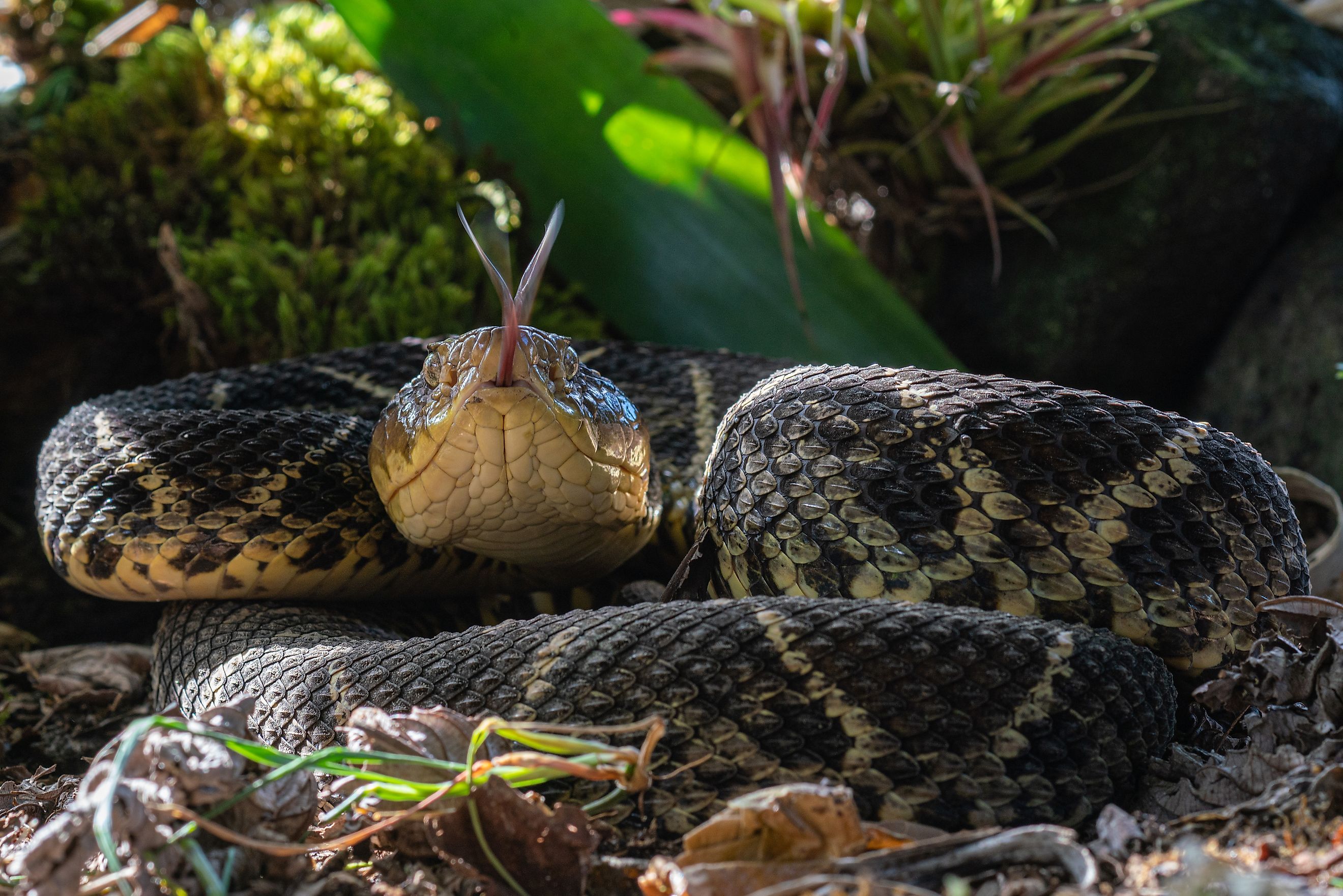
Central American Bushmaster
The Central American bushmaster (Lachesis stenophrys) is the longest venomous snake in Central America and one of the longest vipers anywhere on Earth. Adults routinely stretch beyond 6.5 feet (2 m), and exceptional individuals have approached 12 feet (3.6 m), a scale that sets this pit viper far apart from the region's other serpents. It moves across the rainforest floor as a patient ambush hunter, and it carries a reputation shaped by potent venom, long fangs, and a habit of vanishing into leaf litter.
This snake belongs to the genus Lachesis, a small group of large tropical pit vipers found only in the Americas. It lives in the wet lowland forests of the Caribbean slope, ranging through southern Nicaragua, Costa Rica, and Panama. Encounters are uncommon, because the species is nocturnal, secretive, and thinly spread across remote terrain, which means many people who live near it will never see one.
Taxonomic Classification

The Central American bushmaster sits within the family Viperidae and the subfamily Crotalinae, the pit vipers. Its full scientific name is Lachesis stenophrys, described by the American herpetologist Edward Drinker Cope in 1876. In the older literature the animal appeared as a subspecies of the South American bushmaster under the name Lachesis muta stenophrys, but work by Zamudio and Greene in 1997 elevated it to full species rank, a change now widely followed. No subspecies are currently recognized.
The genus Lachesis contains four species. Alongside the Central American bushmaster stand the South American bushmaster (Lachesis muta), the black-headed bushmaster (Lachesis melanocephala) of southwestern Costa Rica, and the Chocoan bushmaster (Lachesis acrochorda) of northwestern South America. Together these snakes hold the title of the longest vipers in the world. The species name stenophrys comes from the Greek words for narrow (stenos) and brow (ophrys), a reference to the scales above the eyes.
Physical Description

Average adults measure between roughly 6.2 and 6.9 feet (1.9 to 2.1 m), and the species commonly grows past 6.5 feet (2 m). Larger specimens can exceed 10 feet 10 inches (3.3 m), and a Costa Rican individual recorded by the naturalist Raymond Ditmars reached 11 feet 4 inches (3.49 m). Historical records cited by the herpetologist Alejandro Solorzano put the maximum length near 11 feet 10 inches (3.6 m). Mature animals frequently weigh more than 8.8 pounds (4 kg), and males tend to run slightly longer than females.
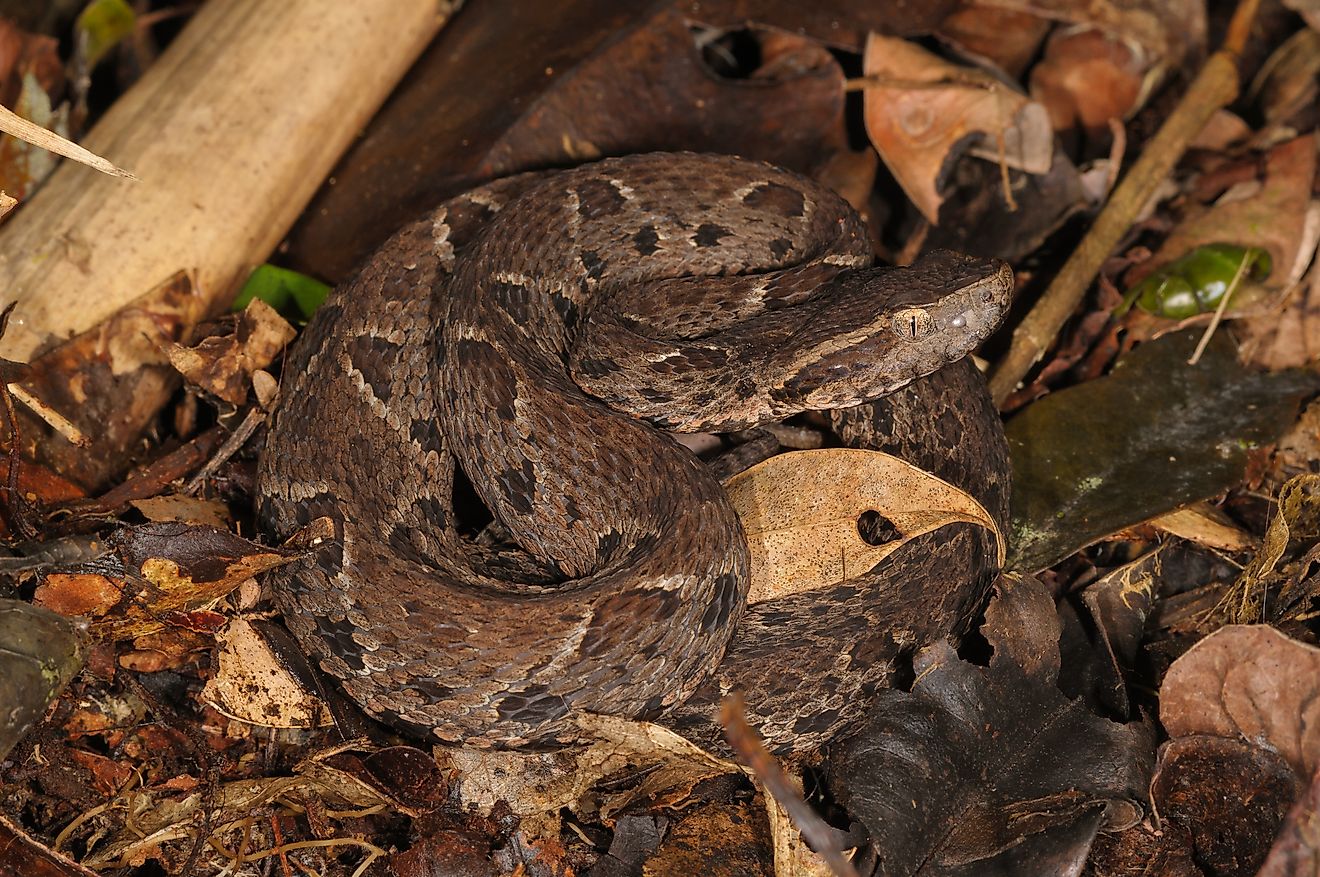
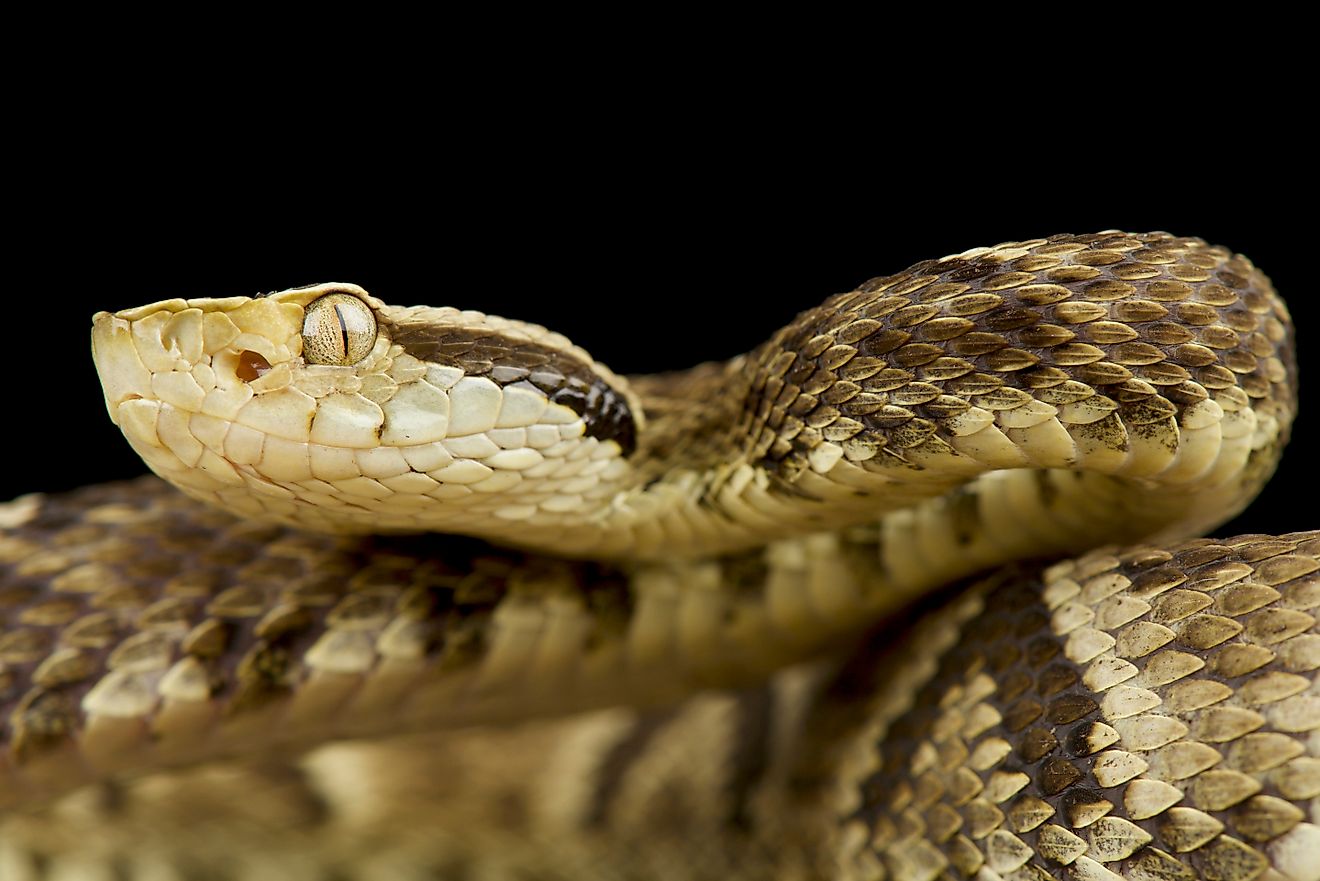
The base color is light brown or cream, overlaid with a series of dark rhomboidal or diamond-shaped markings that break up the outline against the forest floor. The head is broad and rounded, and the snout is not raised. One of the most distinctive features is the skin texture. The dorsal scales are strongly keeled and stand up in sharp points, a rough surface often compared to the thorny bark of the jabillo tree. A pronounced ridge runs down the middle of the back and grows most obvious along the final quarter of the body. The tail narrows to a small horny spine.
Like all pit vipers, this snake carries a pair of heat-sensing pits set between the eyes and the nostrils. These organs detect the body warmth of nearby prey and allow precise strikes in near-total darkness. The fangs are long, hollow, and hinged, folding back against the roof of the mouth when not in use and swinging forward to drive venom deep into a target. This fang design lets a bushmaster deliver venom with unusual reach for a snake of its build, and the volume it can inject in a single bite ranks among the largest of any viper.
Range and Habitat

The Central American bushmaster occupies the wet lowlands of the Caribbean side of Central America. Its range runs through southern Nicaragua, the Atlantic lowlands of Costa Rica, and into Panama, and it also reaches the Pacific lowlands of central and eastern Panama. The type locality, the place where the species was first formally collected, is Sipurio in Limon Province, Costa Rica.
This is a snake of hot, wet forest. It favors tropical rainforest and lower montane wet forest where yearly rainfall averages between about 79 and 157 inches (2,000 to 4,000 mm), which counts as heavy to extremely heavy precipitation. It generally stays below about 3,300 feet (1,000 m) in elevation. In the drier parts of Nicaragua the species can turn up in gallery forests and seasonally dry woodland, though even there it stays close to water. Its dependence on warmth and humidity is tied to its unusual breeding biology, because its eggs need a hot, damp environment to develop.
Diet

The Central American bushmaster is a carnivore that feeds mainly on small mammals, especially rodents. As an ambush predator it does not chase its meals. Instead it settles along a game trail or near a burrow and waits, sometimes for weeks, for a warm-blooded animal to pass within striking range. The heat-sensing pits guide the strike, and the long fangs inject a large dose of venom that quickly subdues the prey.
A slow metabolism supports this patient style of hunting. A large bushmaster can go for long stretches between meals, which suits an animal that may not encounter suitable prey very often on the thinly populated forest floor. After a successful strike the snake tracks the dying animal by scent and swallows it whole, then retreats to digest in cover.
Behavior

This is a nocturnal, terrestrial, and solitary snake. It spends the day hidden in leaf litter, under root tangles, or inside burrows dug by armadillos and other mammals, then becomes active after dark. For most of its life it operates as a sit-and-wait hunter, holding a single ambush post for extended periods rather than roaming widely.
Despite its size and dangerous venom, the Central American bushmaster is reclusive and tends to avoid people. Its first line of defense is camouflage, and a motionless snake can be almost impossible to spot against the forest floor. When alarmed it may vibrate the tip of its tail rapidly, a behavior shared with rattlesnakes, though the bushmaster has no rattle to make sound. If cornered it can deliver a fast and serious defensive strike, so caution is essential wherever the species lives.
Reproduction

Reproduction is where the Central American bushmaster departs most sharply from other pit vipers. Nearly all pit vipers give birth to live young, but the four bushmasters are the only members of the group that lay eggs. This egg-laying habit ties the snakes to warm, humid forest, because the eggs need steady heat and moisture to develop.
The species also shows a level of parental care that is unusual among snakes. After laying her clutch, a female bushmaster remains coiled with the eggs and guards them through incubation rather than abandoning them. This behavior has been documented during captive breeding at Costa Rican institutions. The commitment of a guarding female adds another layer of interest to an animal already set apart by its size and its eggs.
Importance to the World

As a top-level predator of rodents and other small mammals, the Central American bushmaster helps regulate prey populations across its forest habitat. Snakes that remove large numbers of rodents provide a natural check on animals that can otherwise multiply quickly, and this role gives the bushmaster real ecological value in the rainforests it occupies.
The species carries weight in human medicine as well. Bushmaster venom is potent and produced in large volume, and it acts strongly on the blood, disrupting normal clotting and damaging tissue. Because bites are severe, venom from Lachesis stenophrys is used to raise the polyvalent antivenom produced by the Instituto Clodomiro Picado in Costa Rica, a product that protects people across Central America. In this way the snake that poses a danger to rural communities also supplies part of the cure.
Threats and Conservation

The International Union for Conservation of Nature lists the Central American bushmaster as Near Threatened, based on its 2021 assessment. The species is naturally uncommon, and researchers suspect its numbers are declining. The main pressures come from the loss, fragmentation, and degradation of its lowland forest habitat as land is cleared for farming and development.
Because the snake depends on unbroken tracts of hot, wet forest and breeds slowly compared with live-bearing vipers, it is sensitive to habitat change. Protecting large blocks of Caribbean lowland rainforest is the surest way to keep populations stable. The animal's low natural density means that even modest habitat loss can have an outsized effect on how many bushmasters a region can support.
Takeaway
The Central American bushmaster is an unusually large and distinctive pit viper. It can reach nearly 12 feet (3.6 m) in length, yet it spends much of its time coiled and still, relying on camouflage rather than speed to avoid detection. Unlike most of the more than 200 species of live-bearing pit vipers, it lays eggs, with the female remaining near the nest to guard the clutch. Its venom also has an important medical role, as it is collected for the production of antivenom used to treat bites in Nicaragua, Costa Rica, and Panama.
Nearly every aspect of the species' survival is tied to the wet Caribbean lowland forests it inhabits. Its Near Threatened status is largely the result of habitat loss as rainforest is cleared for farmland. Because the bushmaster occurs naturally at low densities and reproduces slowly, it has little ability to withstand the continued loss and fragmentation of its habitat. In intact rainforest, it helps regulate rodent populations as a top predator. When those forests are broken into smaller fragments, however, the bushmaster is among the species that can disappear with them.
Fun Facts
- One of the world's longest vipers. The bushmasters are the longest vipers anywhere on the planet, and the Central American species can approach 12 feet (3.6 m).
- An egg-laying rarity. Almost every pit viper gives live birth, yet bushmasters are the only ones that lay eggs.
- A guarding mother. Female bushmasters coil around their clutch and protect the eggs through incubation, a rare trait among snakes.
- Named for a Fate. The genus name Lachesis comes from one of the three Fates of Greek myth, the figure said to measure the length of each human life.
- Heat vision in the dark. Pits between the eyes and nostrils let the snake sense the body heat of prey and strike accurately in total darkness.
- A weeks-long ambush. A bushmaster may hold a single hunting spot for weeks, waiting for prey to wander within reach.
Quick Facts
- Common name: Central American bushmaster
- Scientific name: Lachesis stenophrys
- Family: Viperidae, subfamily Crotalinae (pit vipers)
- Order: Squamata
- IUCN status: Near Threatened (2021)
- Length: average 6.2 to 6.9 feet (1.9 to 2.1 m), up to about 11 feet 10 inches (3.6 m)
- Weight: often more than 8.8 pounds (4 kg)
- Lifespan: roughly 10 to 20 years, longer under human care
- Diet: carnivore, mainly small mammals and rodents
- Reproduction: egg-laying, with female parental care
- Range: Caribbean lowlands of Nicaragua, Costa Rica, and Panama, plus Pacific lowlands of central and eastern Panama
- Habitat: tropical rainforest and lower montane wet forest below about 3,300 feet (1,000 m)