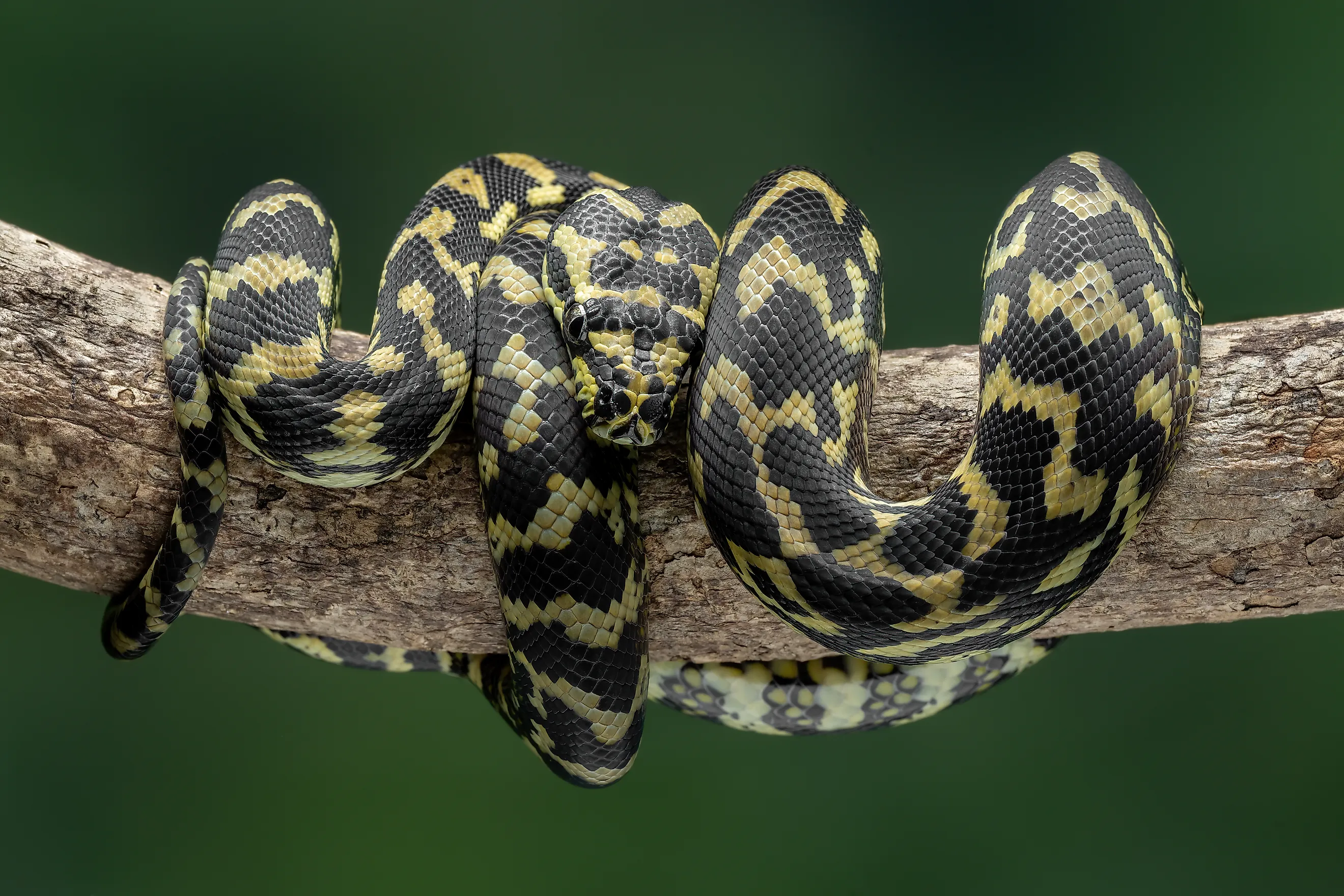
Carpet Python
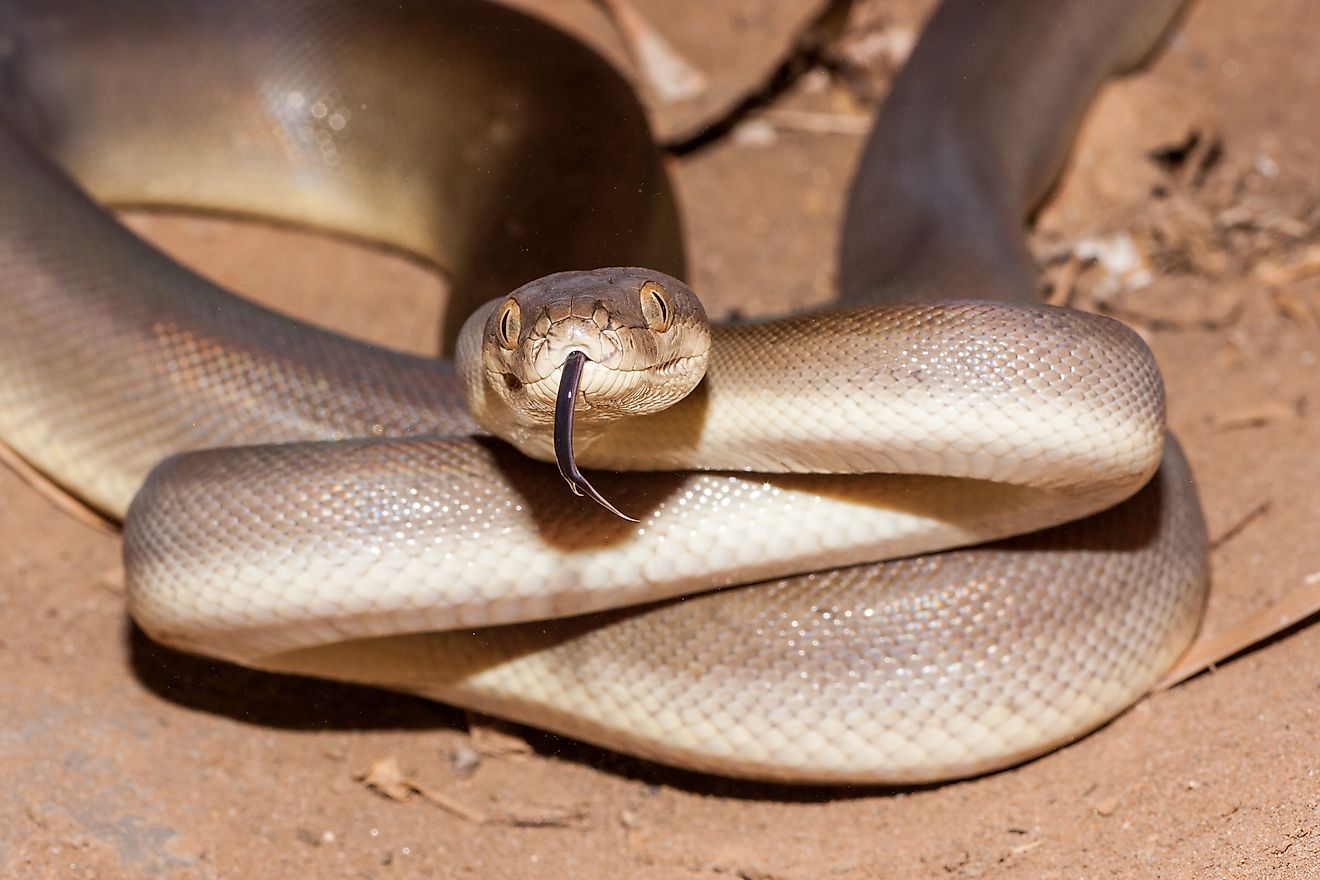
Carpet python (Morelia spilota) populations exist across Australia, Indonesia, New Guinea, the Solomon Islands, and the Bismarck Archipelago, making them one of the most geographically widespread pythons in the world. Across their range, they have adapted their color and scale patterns to blend within various environments. Named for the intricate, woven-looking blotches that run the length of their bodies, these snakes are among the most visually diverse constrictors. This single species has produced at least six recognized subspecies, each shaped by an ecologically distinct region of the lands they inhabit.
Taxonomic Classification

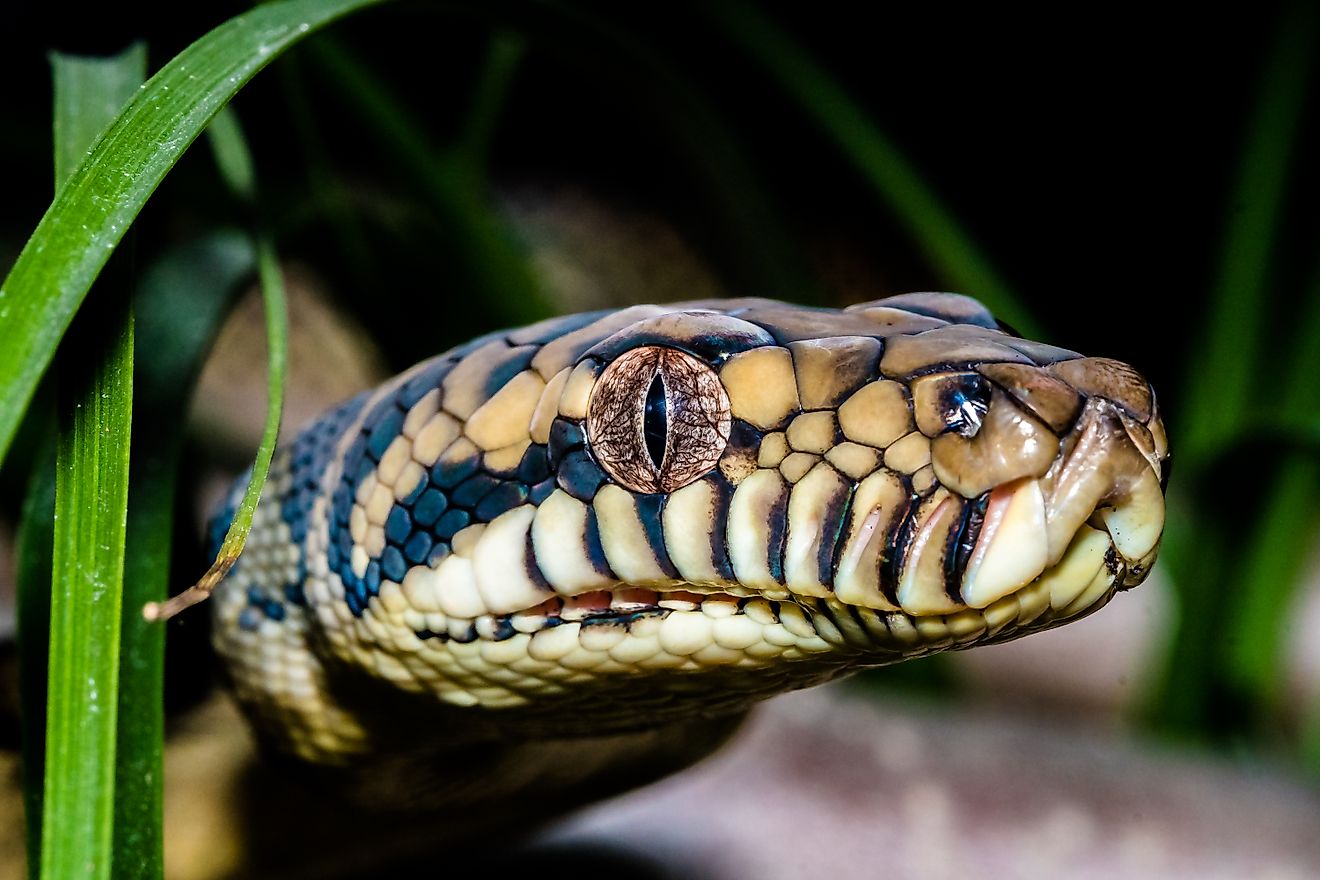
Carpet pythons belong to the species Morelia spilota, part of the family Pythonidae, the group that includes the largest constricting snakes on Earth. Taxonomic authorities recognize at least six subspecies, distinguished mainly by geography and coloration rather than by major differences in anatomy. Their scale coloration differences can be quite stark from subspecies to subspecies. The jungle carpet python (Morelia spilota cheynei), for instance, features almost neon yellow and black scales, while the Murray-Darling carpet python (Morelia spilota metcalfei) is a subdued tan and greyish-brown. A closely related species, the Centralian carpet python (Morelia bredli) occupies the arid center of Australia and is sometimes discussed alongside the group.
Genetic studies published since 2015, such as work by Ciavaglia and colleagues, have questioned where the boundaries between some subspecies truly lie. A prime example is the Papuan carpet python (traditionally categorized as Morelia spilota harrisoni), which major databases like the Integrated Taxonomic Information System (ITIS) frequently fold in with the Darwin carpet python (Morelia spilota variegata). Because of these ongoing scientific debates, researchers continuously update the group's classification as new genomic data comes to light.
Range and Habitat

Few pythons anywhere inhabit as broad a range of climates as Morelia spilota. Their six recognized subspecies are spread out, occupying many different environments. Within Australia, coastal carpet pythons (Morelia spilota mcdowelli) dominate the forests and suburban fringes of eastern Australia, extending from Cape York into New South Wales. They are semi-arboreal animals, spending much of their time wound around tree branches.
The jungle carpet python, Morelia spilota cheynei, is concentrated in the tropical rainforest around the Atherton Tablelands in North Queensland and the surrounding wet lowland forests between Cairns and Townsville. The inland or Murray-Darling subspecies, Morelia spilota metcalfei, favor the river red gum forests of the Murray-Darling Basin, where they shelter among fallen timber near slow-moving water.
Darwin carpet pythons (Morelia spilota variegata) range across the Top End and the Kimberley of northwest Australia, tolerating dry, rocky escarpment country that would be a much less suitable habitat for other python within the carpet python subspecies. The southwestern subspecies (Morelia spilota imbricata) occupies forest and coastal habitat across southwestern Western Australia, including offshore islands where it has adapted to coastal heath, granite outcrops, and low shrubland. The nominate species of the group, the diamond carpet python (Morelia spilota spilota) holds the most southerly distribution of any python on the planet, reaching into the cooler ranges of the Blue Mountains and Gippsland.
The species' range extends beyond the Australian coastline. The Papuan, or Irian Jaya, carpet python (often classified as Morelia spilota harrisoni, although its taxonomic status remains debated) occupies pockets of dry tropical savanna along New Guinea's southern coast, on both the Indonesian and Papua New Guinean sides of the island. This population was probably isolated when rising sea levels severed the Australia-New Guinea land bridge at the end of the last ice age.
Physical Description

Adult carpet pythons commonly measure six to 10 feet in length, though the coastal subspecies grows largest, with confirmed individuals reaching 13 feet. The smallest of the subspecies, Morelia spilota variegata, often does not grow past six and a half feet.
Weight varies with subspecies and prey availability, with large coastal individuals reaching up to 33 pounds. Coloration differs dramatically across the group. Jungle carpet pythons display high-contrast yellow and black banding. Diamond pythons carry a lattice of pale, cream-colored spots across a near-black background. The Darwin subspecies shows a beige or olive base overlaid with darker, irregular blotches. This variation allows each subspecies to blend into the specific leaf litter, bark, vegetation, and rock coloration of their home range.
Their bodies are dense and muscular, built for climbing as readily as constriction. Rows of heat-sensing pits line the lower jaw, letting a python detect a warm-blooded animal's body heat in complete darkness. Their skulls contain flexible ligaments rather than fixed joints, allowing the jaw to stretch wide enough to swallow prey far larger than the head itself would suggest is possible.
Diet

These snakes are opportunistic carnivores, and the size of a given subspecies largely determines the size of their prey. The coastal carpet python regularly takes possums, flying foxes, and even wallabies in some coastal populations. The smaller subspecies, including the jungle and the Darwin carpet pythons, rely more heavily on catching rodents, small birds, and skinks. Juveniles of every subspecies begin on frogs, lizards, and small mammals before working up to larger prey as they grow.
Catching prey relies almost entirely on ambush rather than pursuit. A python typically positions themself along a tree branch, fence line, or roof beam, remaining motionless until prey passes within striking range. Rows of heat-sensing pits along the lower jaw let the snake detect a warm-blooded animal even in total darkness. This adaptation provides a critical advantage given how much finding a meal happens nocturnally. Once a strike connects, the snake secures their grip with backward-curving teeth, coils rapidly around the animal, and uses constriction to cut off blood flow and breathing before swallowing the prey whole, head-first.
Because digestion is metabolically demanding, a python that has just eaten a large meal may not need to eat again for several weeks. These individuals typically spend their post-meal days basking in a sunny place to raise their body temperature, which speeds digestion and shortens the recovery period before the next meal.
Behavior

Carpet pythons are largely solitary and nocturnal, most active from dusk through the night. Daytime hours are typically spent sun bathing or sheltering in rock crevices, hollow logs, or dense foliage depending on the subspecies and local climate. The jungle carpet python, for instance, is particularly arboreal in nature, and often spends their time searching for prey and resting within the canopy.
When threatened, their default response is stillness or retreat rather than confrontation. Biting is a last resort, and while they are not venomous, their bite is known to be quite painful. These snakes rely heavily on their camouflage patterning to avoid detection in the first place.
Carpet pythons are not strictly territorial and do not actively defend a set boundary from other pythons. They typically coexist peacefully, only competing directly during the breeding season when males engage in wrestling matches to win mating rights.
In the cooler ranges of the southeast, diamond carpet pythons enter a winter dormancy called brumation, for up to five months sheltering in rock crevices, hollow logs, and dense leaf litter rather than hibernating outright. Radio telemetry research on wild diamond pythons by David Slip and Richard Shine of the University of Sydney found that individuals still emerge on mild days to warm their bodies in the sun, rather than remaining continuously dormant. They return to sustained activity only once spring temperatures climb consistently.
Reproduction

Females lay clutches ranging from 10 to 50 leathery eggs, typically between October and December, concealing them inside hollow logs, crevices, or depressions in loose soil. Unlike most reptiles, they remain with their eggs through the entire incubation period. They will coil tightly around the clutch and generate heat through rhythmic muscular contractions that researchers describe as shivering thermogenesis.
Incubation lasts about 40 to 60 days, depending on the subspecies and ambient temperatures. Females typically maintain a nest temperature near 88 degrees Fahrenheit. Because brooding snakes do not feed during this period, they rely entirely on fat reserves built up in the preceding months. Some individuals periodically leave their nests to warm themselves in the sun and recover body heat before returning to the eggs.
Hatchlings emerge at about 15 inches in length and receive no further care once free of the egg. They disperse independently within days and begin locating and overpowering small prey almost immediately.
They grow quickly over their first several years and typically reach sexual maturity between three and five years of age. A specific wild hatch-success rate has not been well documented for the species, though hatchling and juvenile carpet pythons face heavy predation pressure in their first year or two of life before growing large enough to face fewer natural predators. Carpet pythons that survive to adulthood can live more than 20 years in the wild.
Threats

Habitat loss remains the most persistent pressure on carpet python populations. Land clearing for agriculture and suburban development steadily reduces forest corridors, riverine woodlands, and rocky outcrops that different subspecies depend on. Vehicle strikes on roads represent a second major source of mortality, particularly during the warmer, wetter months when snakes move more frequently across open ground at night. Targeting by humans also occurs when people mistake them for a venomous species.
While the species as a whole is not considered endangered, some subspecies are at more risk of population decline than others. In Victoria, the Murray-Darling carpet python is classified as endangered, primarily due to habitat loss and targeting by humans. The IUCN also lists the southwestern carpet python as near threatened. Some wild populations are also under pressure from the exotic pet trade.
Importance to the World

As one of the largest native predators across its Australian and New Guinea range, the carpet python plays an outsized role in the food chain regulating populations of rodents, possums, and birds across the ecosystems they occupy. This function carries particular weight in landscapes where introduced rats and mice have established themselves alongside native wildlife. These snakes help limit the spread of the invasive rodent species and keep the ecosystem more balanced in favor or native wildlife.
Carpet pythons also hold deep cultural significance among many Aboriginal Australian communities, where large ancestral snakes feature prominently in stories tied to the creation of rivers, waterholes, and the physical shape of the land itself. Versions of the Rainbow Serpent story, told across numerous Aboriginal nations, describe a great ancestral snake whose movement across the country carved out watercourses and marked the location of sacred sites. This dual identity, as both an ecological regulator and an enduring cultural figure, reflects how completely carpet pythons are woven into the story of the lands they inhabit.
A Pattern Woven Into the Ecosystem
Carpet pythons have successfully spread across an impressive range of environments by adapting their diet, coloration, and scale pattern, rather than specializing. Their patterns, as varied as the landscapes they inhabit, mark them as one of the most geographically diverse pythons in the world rather than a single, uniform species. Habitat pressure, road development, and new ecological threats continue to shift across Australia and its neighboring islands. The future of carpet pythons will remain closely tied to the health of the forests, waterways, and woodlands they have called home for millions of years.