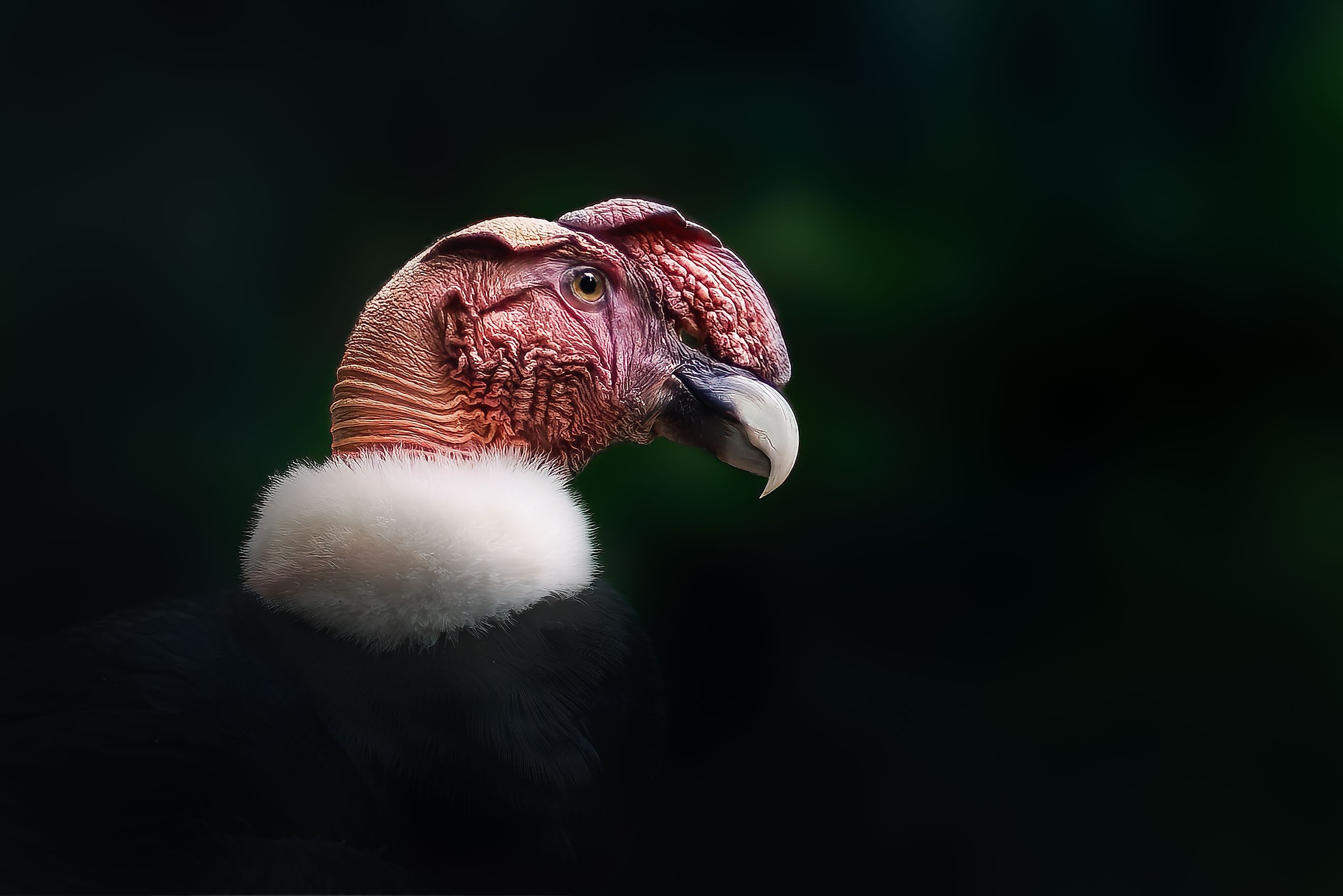
Andean Condor
The Andean condor ranks among the largest flying birds on Earth, and few animals command the open sky quite like it. With a wingspan reaching nearly 11 feet (3.3 m), this enormous vulture rides the mountain winds of South America with barely a flap, gliding for hours across the peaks and coastlines of the Andes.
Scientifically named Vultur gryphus, the Andean condor is a New World vulture and the only living member of its genus. It ranges along the Andes mountains and the neighboring Pacific coast, running the length of the continent between Venezuela in the north and Tierra del Fuego at the southern tip. As a scavenger, it feeds almost entirely on carrion, and it plays a quiet but essential part in keeping its ecosystem clean.
Beyond its size, the Andean condor carries deep cultural weight. It stands as a national symbol for several South American nations and features heavily in Andean folklore and mythology. Yet this remarkable bird now faces mounting pressure, and understanding it means looking at both its biology and its uncertain future.
Taxonomic Classification

The Andean condor belongs to the family Cathartidae, the New World vultures, a group that also includes the California condor, the turkey vulture, and the king vulture. Swedish naturalist Carl Linnaeus first described the species in 1758 in the tenth edition of his Systema Naturae, giving it the name Vultur gryphus that it still carries today.
Within its family, the Andean condor stands alone as the sole surviving species in the genus Vultur. Scientists have long debated where New World vultures belong in the broader bird family tree. Once grouped with storks, they are now generally placed in the order Accipitriformes alongside hawks and eagles, though the classification of this group has shifted several times as DNA evidence has accumulated. No widely recognized subspecies exist, and despite its enormous range across the length of South America, the Andean condor is treated as a single species throughout.
Physical Description

Everything about the Andean condor speaks to scale. Adults reach a wingspan of up to 10 feet 10 inches (3.3 m), the longest of any land bird and among the widest of any bird capable of flight. Body length measures 3 feet 3 inches to 4 feet 3 inches (100 to 130 cm), and the heaviest individuals tip the scales at roughly 33 pounds (15 kg). That mass makes the condor one of the heaviest flying birds alive, and it explains why the species leans so heavily on rising air to stay aloft.
Adult plumage is mostly glossy black, set off by a broad ruff of white feathers around the base of the neck. Males also show large white patches across the upper wings. The head and neck are nearly bald, colored a dull reddish tone, and the bare skin can flush and shift shade with the bird's mood.
The Andean condor is one of the few birds of prey in which males and females look distinctly different. Unusually, the male is the larger sex, and he wears a dark fleshy comb, or caruncle, on the crown of his head along with wattles on the neck. Females lack the comb entirely. Eye color separates the sexes as well, with males showing brown irises and females red ones. This clear sexual dimorphism sets the Andean condor apart from nearly all of its New World vulture relatives.
Range and Habitat

The Andean condor lives along the spine of the Andes and the adjacent Pacific coast, a range that stretches down the western edge of South America. Its territory covers seven countries. In the north it spans Venezuela and Colombia, then runs south through Ecuador, Peru, and Bolivia. It reaches its southern limit in Chile and Argentina, at the islands of Tierra del Fuego.
Open, non-forested country suits the condor best, since clear sightlines help it spot carcasses from great height. It favors high alpine terrain, windswept grasslands, rocky cliffs, and coastal areas where ocean breezes and thermal currents provide reliable lift. The species has been recorded nesting at elevations up to about 16,000 feet (5,000 m), usually on inaccessible rock ledges well out of reach of ground predators.
Historically the condor's range was far wider and its numbers far greater. Populations have thinned across much of the Andes, and the largest remaining stronghold now lies in the mountains of northwest Patagonia. Coastal regions remain important too, offering a steady supply of food where marine animals wash ashore.
Diet

As a vulture, the Andean condor is above all a scavenger, and carrion forms the overwhelming majority of its diet. It prefers large carcasses, feeding readily on dead deer, cattle, llamas, alpacas, rheas, and other sizable animals. Along the coast, condors turn to dead marine life such as beached seals and fish. On occasion they will raid the nests of other birds for eggs or helpless chicks, but active hunting is rare.
Finding food across such vast, rugged country is a challenge, and the Andean condor solves it partly by watching others. It locates carrion by sight and by trailing smaller scavengers to a meal. In particular, it follows vultures of the genus Cathartes, such as the turkey vulture, which track the faint smell of ethyl mercaptan given off by early decay. The smaller vultures find the body, but they cannot tear through the tough hide of a large carcass. The powerful condor opens it, and both benefit, an arrangement that amounts to mutual dependence between the species.
When a large meal is available, the Andean condor eats to excess, gorging on as much as 15 pounds (7 kg) of meat in a single sitting. After such a feast it may rest for days before it needs to feed again. Its featherless head is well suited to this messy work, since bare skin stays far cleaner than feathers would when the bird reaches deep inside a carcass.
Behavior

The Andean condor is a diurnal bird, active by day and reliant on daylight and rising air to travel. Rather than flap continuously, which its great weight makes costly, it soars. The bird launches from a high perch, catches a thermal or a gust deflected off a cliff face, and then glides for hours, circling upward and covering enormous distances with only occasional wingbeats. The upturned tips of its wings reduce drag, a feature that aircraft designers have studied and borrowed.
Condors often gather at favored roosting cliffs and at carcasses, where a loose social order takes shape. Dominant birds claim first access to a meal, and younger or lower-ranking individuals wait their turn. Away from food, the species is far-ranging, with individuals covering long daily circuits in search of the next carcass.
The bare head plays a social role as well as a practical one. Because the skin flushes and changes color with the bird's emotional state, condors can signal to one another during courtship and confrontation. These displays, combined with postures and calls, help order the interactions of birds that may otherwise spread across huge stretches of mountain country.
Reproduction

Few large birds reproduce as slowly as the Andean condor, and this measured pace shapes much of its life history. Individuals do not reach sexual maturity until they are around five or six years old, and some studies place it later still. Once mature, condors form monogamous pairs that mate for life.
Breeding takes place high on cliff ledges, where a pair lays its eggs among a few loose sticks rather than building a true nest. A clutch usually holds a single egg, occasionally two, colored a pale bluish white. Both parents share incubation, which lasts roughly 54 to 58 days. Because raising a chick demands so much, most pairs breed only once every two years.
The young condor develops slowly. It depends on its parents for many months after hatching, learning to fly and feed before it can strike out on its own, and the family bond can persist well past fledging. This slow reproduction is balanced by an exceptionally long life. Andean condors can live more than 70 years, and captive birds have survived past 75, which ranks them among the longest-lived birds in the world.
Importance to the World

As one of the largest scavengers in the Americas, the Andean condor performs a service that keeps whole ecosystems healthy. By stripping carcasses down to bone, condors remove decaying flesh that would otherwise fester and breed disease. Their feeding helps limit the spread of dangerous pathogens, including the agents of anthrax and botulism, protecting other wildlife and people alike.
This clean-up role also recycles nutrients back into the environment, returning what a dead animal holds to the wider web of life. In that sense the condor works as an apex scavenger, a natural sanitation crew operating across some of the harshest terrain on the continent.
The bird's importance reaches beyond ecology. For the peoples of the Andes, the condor has stood for centuries as a figure of power and spiritual meaning. It serves as a national symbol of Argentina, Bolivia, Chile, Colombia, Ecuador, and Peru, and it appears throughout regional myth, art, and ceremony.
Threats and Conservation

Despite its size and its lack of natural predators, the Andean condor is in trouble. The IUCN Red List classifies it as Vulnerable, having uplisted the species from Near Threatened in 2020 as evidence of decline mounted. Recent estimates put the population at roughly 6,700 mature individuals, with about 10,000 birds in total, and the overall trend is downward.
Poisoning stands out as the gravest danger. Condors often die after feeding on carcasses laced with poison or riddled with lead from hunters' ammunition, a form of secondary poisoning that can kill many birds at a single tainted carcass. Because the species reproduces so slowly and lives so long, its populations recover only with great difficulty once numbers fall.
Direct persecution adds to the toll. Some farmers view condors as a threat to livestock, a belief that is largely unfounded given the bird's scavenging habits, and they shoot or poison the birds as a result. Habitat loss and a shrinking supply of large carcasses compound the pressure. Conservation programs, including captive breeding and release efforts run by zoos and wildlife groups, have worked to bolster wild populations, and reducing the use of lead and poison remains central to the bird's long-term survival.
Takeaway
The Andean condor is a bird of superlatives, from its record wingspan to its long life and its command of the mountain sky. It is also a bird of quiet importance, cleaning the land, guarding against disease, and standing as a living emblem for much of a continent. Its slow, deliberate way of life served it well for millions of years, yet that same slowness now leaves it exposed to threats that spread faster than the species can recover. Protecting the Andean condor means protecting the balance it helps maintain, and its future will depend on whether people across its range choose to keep the poison out of its food and the sky open for its wings.
Fun Facts

- Longest wings of any raptor. The Andean condor's wingspan of nearly 11 feet (3.3 m) is the widest of any bird of prey on the planet.
- A blushing head. The bare skin of the condor's face and neck can change color as the bird's mood shifts, a rare form of visual signaling among birds.
- Built for gliding, not flapping. The upturned wingtips that help condors soar so efficiently have inspired features used on modern aircraft wings.
- A meal to remember. A single condor can gorge on around 15 pounds (7 kg) of meat at once, then go days without needing to eat.
- Decades in the sky. With lifespans passing 70 years, and more than 75 in captivity, Andean condors are among the longest-lived birds known to science.
Quick Facts
- Scientific name: Vultur gryphus
- Family: Cathartidae (New World vultures)
- Order: Accipitriformes
- IUCN status: Vulnerable (population decreasing)
- Population: about 6,700 mature individuals
- Wingspan: up to 10 feet 10 inches (3.3 m)
- Length: 3 feet 3 inches to 4 feet 3 inches (100 to 130 cm)
- Weight: up to 33 pounds (15 kg)
- Lifespan: over 70 years, more than 75 in captivity
- Diet: carnivore, feeding primarily on carrion
- Range: the Andes and Pacific coast of South America, Venezuela south to Tierra del Fuego