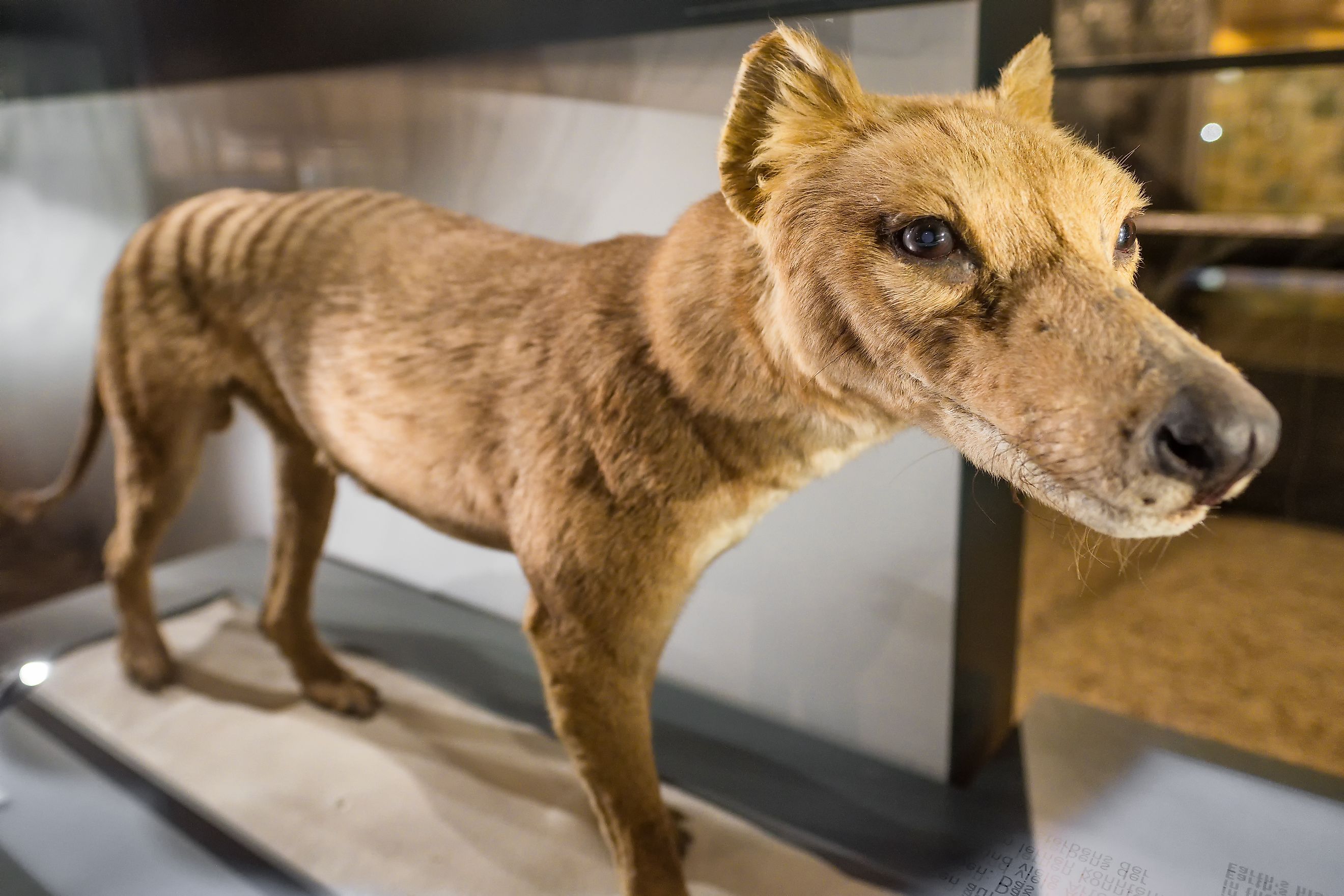
Tasmanian Tiger
Tasmanian tigers, or thylacines, were some of Australia’s most iconic and elusive marsupials, now extinct. Termed "tigers" due to their dark stripes, these interesting creatures were dog-like in their appearance and thought to have been wiped out by the introduction of European settlers in Tasmania in the early twentieth century. They lived as nocturnal predators that took advantage of sleeping and unsuspecting prey, relying on their stamina rather than speed or agility. These creatures, which lived thousands of years ago throughout mainland Australia and New Guinea before being wiped out by dingos, remain an icon of Tasmanian pride. The last living Tasmanian tiger died in captivity in 1936.
Taxonomic Classification

Thylacinus cynocephalus, or more commonly known as the Tasmanian tiger or Tasmanian wolf, is an extinct carnivorous marsupial native to mainland Australia and the island of Tasmania. Mainland Australia's population died out around 3,000 years ago, but these creatures continued to live in Tasmania until European settlement in the early twentieth century. Tasmanian tigers belong in the genus Thylacinus, which is from the order Dasyuromorphia. This genus is defined as a carnivorous (meat-eating) marsupial (pouch-having) animal. Similar to the kangaroo, Tasmanian tigers have pouches to carry their young. A Tasmanian tiger’s pouch is backward-facing, meaning that it opens towards the rear legs. Though these animals may be extinct, the study of them leads to more awareness of one of Australia’s most iconic animals, which is even the muse for some Aboriginal rock paintings.
Range and Habitat

As previously stated, Tasmanian tigers lived in mainland Australia and the island of Tasmania. They thrived in a variety of habitats, including wetlands, grasslands, and dry eucalypt forests. Having so many habitats to choose from allowed Tasmanian tigers to easily travel while in pursuit of prey. These animals maintained primarily nocturnal schedules and traversed terrain in the night in search of prey that was often asleep. Their longer bodies and legs with padded feet would have fooled people into believing that they were as agile as dogs or wolves, but they had stiff movements that made them rather slow-moving.
Diet

The diet of a Tasmanian tiger consisted of a range from kangaroos to smaller birds and rodents. In the manner of most carnivorous predators, Tasmanian tigers took down a majority of their prey by focusing on the neck of their prey. This attack immediately disarms prey as they begin to suffocate and suffer from blood loss. If Tasmanian tigers were hungry enough, they were seen tearing into the ribcage of animals to get to the heart, lungs, and lesser organs like the liver. Younger pups were seen to commonly scavenge on the findings of a hunt rather than take on kills independently. While European farmers frequently killed Tasmanian tigers, believing that they threatened their livestock, there is little record of Tasmanian tigers actually killing livestock.
Some cite the Tasmanian tiger’s inability to adapt to taking on larger prey as one cause of their extinction. This is uncommon with similar marsupials and increases the amount of competition over their limited prey populations. Tasmanian tigers often relied on their stamina while hunting, given their slower movements. They had to be able to outlast the struggle of their prey to secure a hunt due to their inability to catch prey by surprise with their speed.
Physical Description

Tasmanian tigers are often noted for their dog-like appearance. Their larger head and slender body lead viewers to label their look similar to that of a dog or a wolf. Their skulls are cited as being almost identical to those of wolves, which is seen in the structure of their slender snouts and deeply set eyes. They had sandy colored short fur with 15-20 black stripes running down the middle of their back to their tail. Tasmanian tigers had shorter, rounded ears, powerful hind legs, stiff tails that reached the floor, and padded feet. They had an appearance almost similar to that of an African painted dog in their slender body and painted fur.
While their jaws were powerful enough to rip into the throats of their prey, they were not quite strong enough to get into the ribcage of even younger sheep. This proved to be fatal for Tasmanian tigers as it limited them to only being able to successfully hunt smaller prey, making the competition for their food sources much larger.
Reproduction

Tasmanian tigers became sexually mature around the ages of 2 to 3 years old. They were thought to have breeding seasons that occurred in winter and spring. Being that they were marsupials, babies were born hairless and incredibly tiny, about the size of a grain of rice. Litter sizes were 3 to 4 pups, and the babies would live in the backward-facing pouch until they were about three months old. These babies would have striped fur and depend on the warmth and safety of the pouches to successfully develop.
Importance to the World

Tasmanian tigers are often noted for their ability to adapt to changes, which allowed them to be the only surviving member of the Thylacinidae family to survive until modern times. Their uncommon carnivorous status as marsupials also made them interesting to scientists, especially given their scrappy ability to survive on solely smaller prey. This allowed them to elevate the biodiversity in Australia, which is crucial in maintaining dynamic equilibrium in ecosystems.
Biodiversity is a crucial element in ecosystems as it allows for the balance of predators and competition, the utilization of different available habitats, and the avoidance of the overhunting of certain prey. Tasmanian tigers served their ecosystems well in each of these facets. They had varied diets that allowed them to scavenge for most available food sources. Lastly, they were also able to adapt easily to a wide variety of habitats, allowing them to easily change territories when necessary. These traits allowed the Tasmanian tigers to not only thrive in their ecosystems but also hold a valuable place in them.
Threats

Given that Tasmanian tigers are extinct, their only threats can be listed as the reasons for their extinction. Tasmanian tigers in Mainland Australia are often thought to have been out-hunted by dingos. This competition is believed to have widely reduced their numbers. With the introduction of European settlers to Tasmania, where dingos never reached, came the feuding between Tasmanian tigers and their livestock. As previously mentioned, Tasmanian tigers had problems while encountering larger prey. While they could easily bite into the necks of prey, which led to their suffocation and dangerous blood loss, they could not quite break into the ribcage of even smaller sheep. This meant that many prey would become half-attempted slaughterings by the Tasmanian tigers. This angered the farmers as their livestock was reduced by these failed hunters, and they often hunted the Tasmanian tigers themselves. Australia is thought to be home to one of the highest rates of most threatened mammal populations, and the Tasmanian tiger is no exception.
Other factors that contributed to the decline of Tasmanian tiger populations were the destruction of their habitat by the influx of European settlers and devastation of wildlife, and the introduction of diseases such as distemper-like viruses, also brought in by the Europeans through means of their dogs. The last Tasmanian tiger died in captivity in 1936 at Hobart Zoo in Tasmania.
Though Tasmanian tigers are gone, they are not forgotten. They remain a beloved symbol of Tasmanian pride, and some genetic engineers even believe this species may be a candidate for "de-extinction" in decades to come. For now, these shy and elusive marsupials are remembered as a special part of the Tasmanian landscape.