Malayan Pit Viper
Malayan pit viper · HTML
The Malayan pit viper is one of Southeast Asia's most medically important snakes, responsible for a large share of serious snakebites across Thailand and neighboring countries. It is a stout, ground-dwelling viper marked by a sharply triangular head, an upturned snout, and a bold pattern of dark, black-edged triangles running down a reddish or brown body. Where most snakes flee at the first sign of a footstep, this one tends to hold its ground, and that single habit explains much of why it bites so many people.
Known to science as Calloselasma rhodostoma, it is the only species in its genus and ranges from Thailand and Indochina south into northern Peninsular Malaysia and across to the Indonesian island of Java. It is a lowland specialist, at home in dry forest, bamboo thickets, plantations, and the overgrown edges of farmland, which is exactly the ground where it crosses paths with rural workers.
Taxonomic Classification

The Malayan pit viper belongs to the family Viperidae and the subfamily Crotalinae, the pit vipers, a group defined by the heat-sensing loreal pits set between the eyes and the nostrils. It was first described by the naturalist Heinrich Kuhl in 1824, originally under the name Trigonocephalus rhodostoma. For much of the twentieth century it sat within the genus Agkistrodon alongside the North American moccasins and copperheads, which explains one of its older common names, the Malayan moccasin.
Today it stands on its own as Calloselasma rhodostoma, the single member of a monotypic genus, and no subspecies are currently recognized. Genetic work places Calloselasma among a basal group of Old World pit vipers that also includes Deinagkistrodon, Hypnale, Garthius, and Tropidolaemus. The genus name refers to its scales, while the species name points to the pale, pinkish lining of its mouth, the "rose mouth" that early describers noticed.
Physical Description

This is a medium-sized viper with a heavy, muscular build and a short tail. Adults average around 30 inches (76 cm) in total length, and females run noticeably larger than males, sometimes reaching about 39 inches (100 cm) against roughly 30 inches (76 cm) in males. Larger individuals occasionally approach or exceed 36 inches (91 cm).
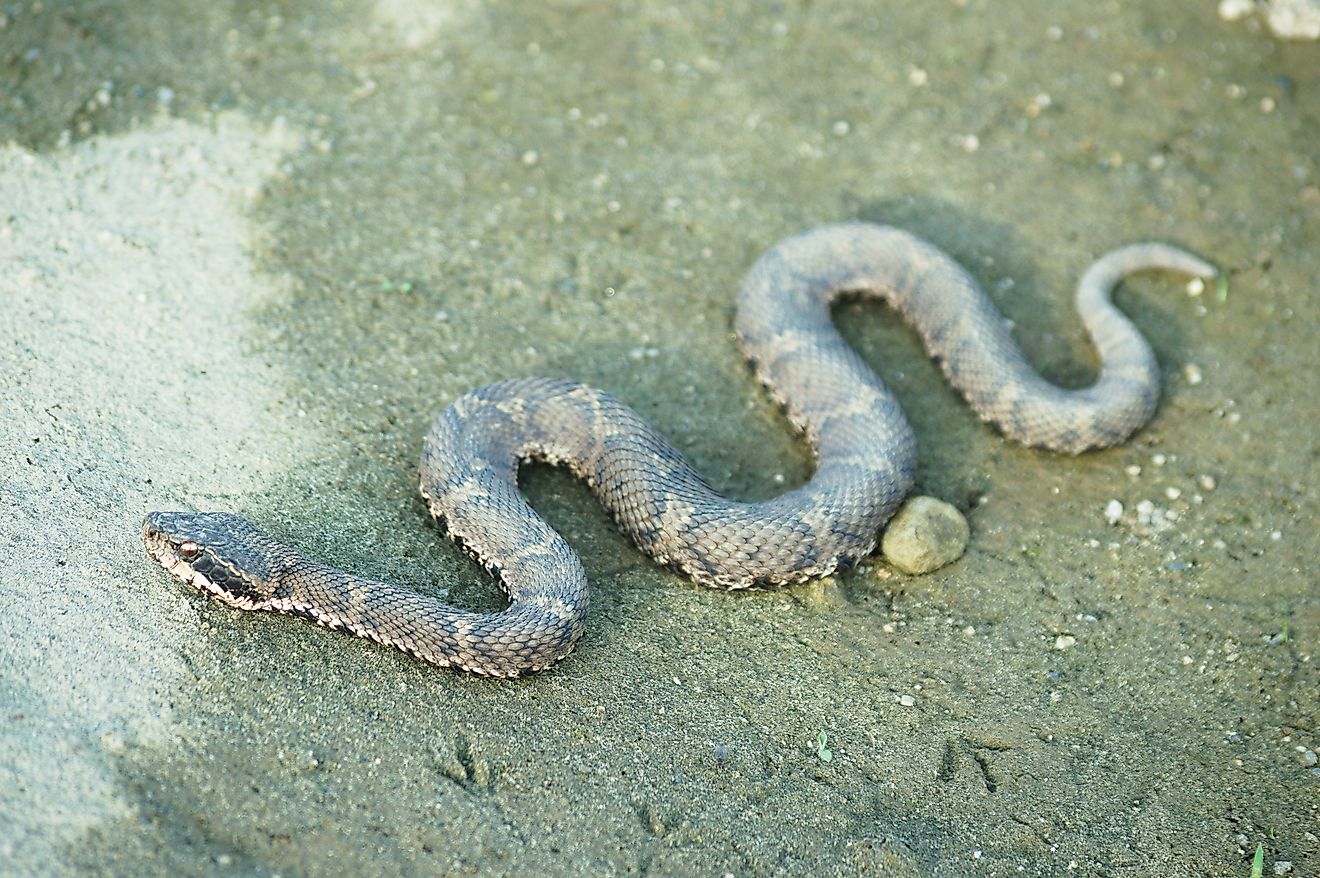
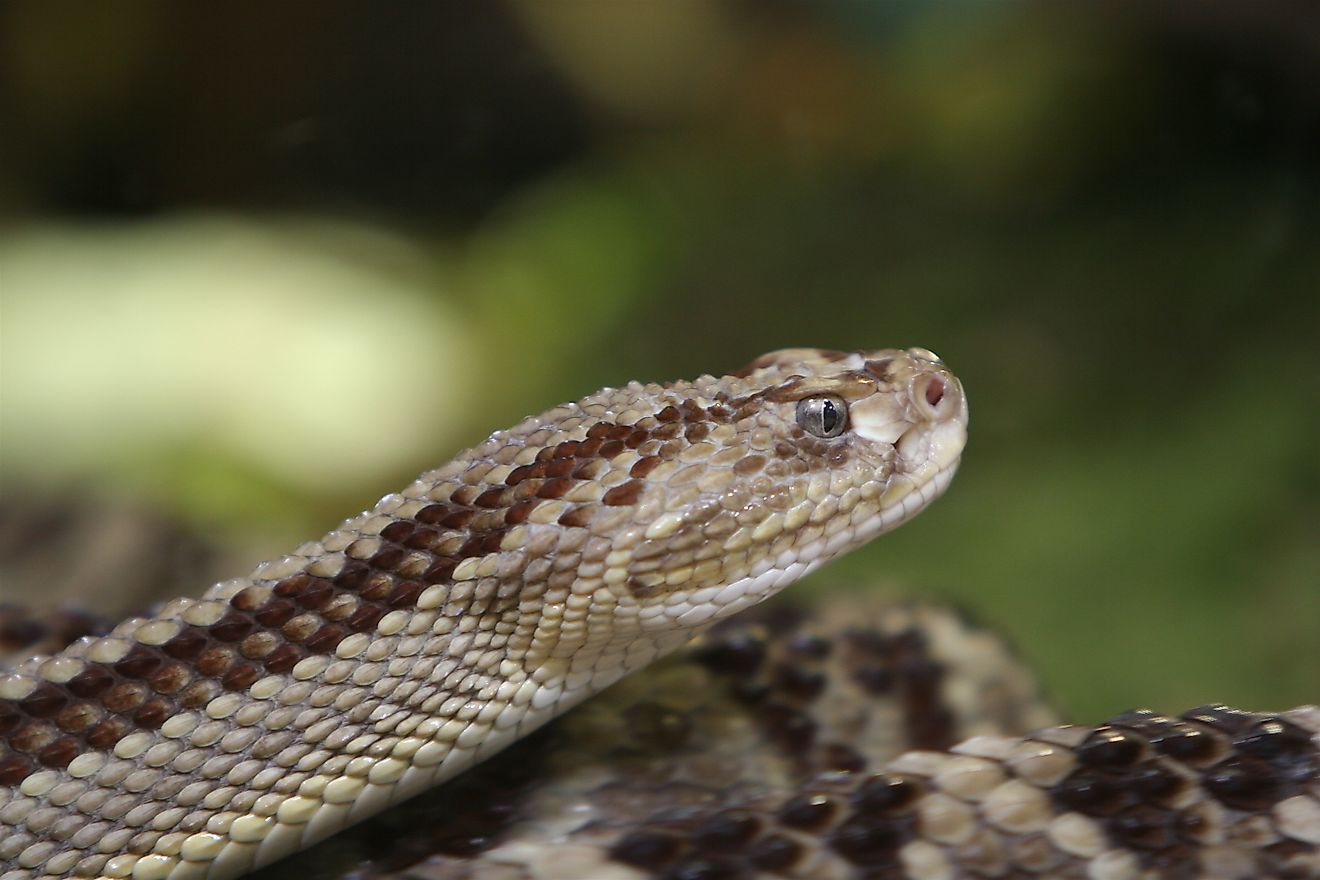
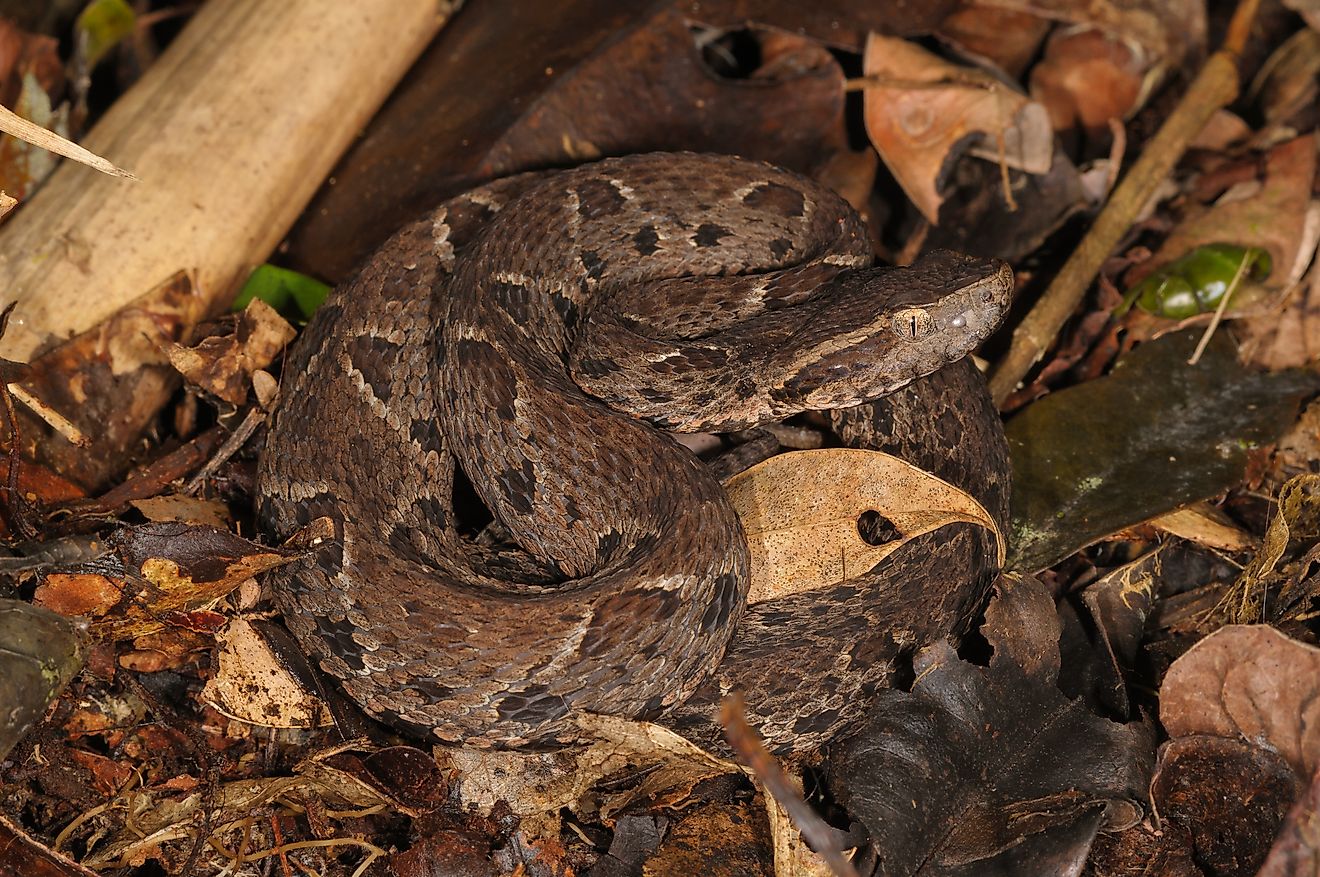
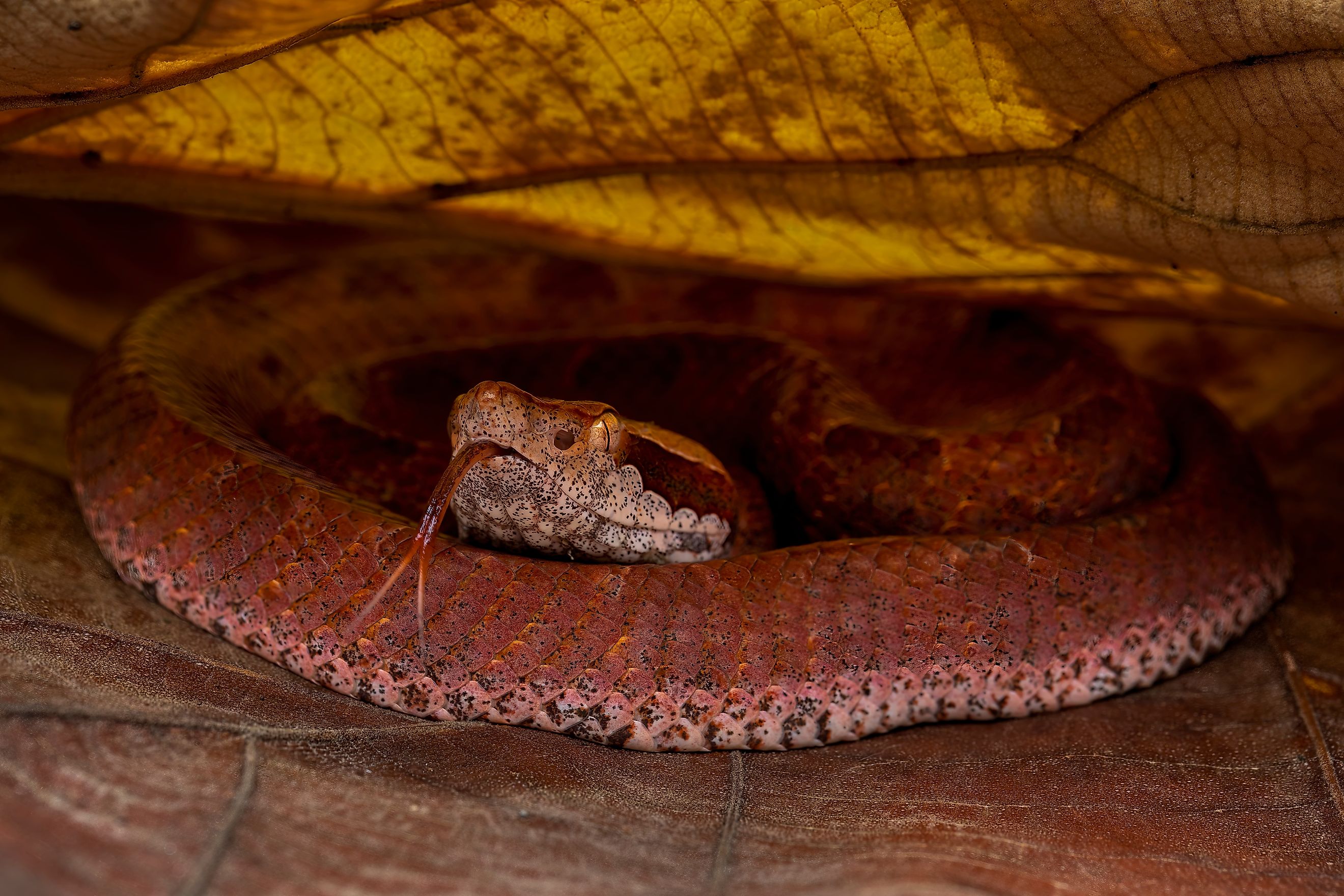
The head is broad, flat, and sharply triangular, set off clearly from a narrow neck, and it ends in a pointed, slightly upturned snout that ranks among the animal's easiest field marks. The eyes are small, with vertical, cat-like pupils suited to dim light. The body ranges from reddish-brown through purplish-brown to grayish, patterned with two rows of large dark brown, black-edged triangular blotches whose tips either meet or alternate down the back. A thin dark line often runs along the spine, and a dark diagonal band crosses each side of the face from the eye to the corner of the mouth.
One feature separates this snake from every other Asian pit viper. Most vipers carry keeled scales, each with a raised central ridge that gives a rough texture, but the Malayan pit viper has smooth dorsal scales together with enlarged, plate-like scales on the crown of the head. That combination makes it distinctive both to identify and to handle, at least for people trained to do so safely.
Range and Habitat

The Malayan pit viper is a Southeast Asian endemic. Its range runs through Thailand, Cambodia, Laos, and Vietnam, extends into Myanmar, reaches south through northern Peninsular Malaysia, and takes in the Indonesian island of Java, the type locality, along with a few smaller Indonesian islands. Populations reported from parts of Borneo appear to have been introduced by people for rodent control on plantations rather than being native to that island.
It is very much a lowland animal. Records run from near sea level up to roughly 5,000 feet (1,524 m), though the snake is most abundant well below that ceiling. Preferred ground includes dry lowland and coastal forest, bamboo stands, rubber and fruit plantations, orchards, and neglected farmland with dense cover. This taste for cultivated and disturbed land, where rodents gather in numbers, runs through the whole of its biology and is the main reason it so often meets farm and plantation workers.
Diet

The Malayan pit viper is an ambush hunter that relies on stillness and camouflage rather than pursuit. It settles into leaf litter or grass, blends with its surroundings, and waits for prey to wander within striking range. Rodents form the bulk of its diet, with rats and mice taken most often, and it rounds this out with frogs, lizards, and the occasional bird.
The heat-sensing pits on its face let it detect the body warmth of a mouse or rat in complete darkness, guiding a fast and accurate strike. After the bite lands, venom begins breaking down tissue and starts digestion before the meal is even swallowed. Because the snake hunts by sitting and waiting, it can hold the same patch of ground for long stretches, a habit that keeps it near reliable rodent runs around buildings, grain stores, and fields.
Behavior

For a snake with such a dangerous reputation, the Malayan pit viper is strikingly inactive. It is largely nocturnal but will move and hunt by day when the weather turns cloudy or wet, and field studies have tied its activity closely to humidity. It is also remarkably sedentary and has been found resting in the same spot hours after an encounter with a person.
That tendency to stay put is exactly what makes it dangerous. Rather than retreat, a disturbed snake often coils partway, draws its neck into an S-shape, and vibrates its tail against dry leaves to produce a faint rattling sound. Its strike is very fast, and it is quick to deliver one, which has earned it a name for being short-tempered. Many bites happen when a person steps on or reaches near a snake that simply refused to leave.
Reproduction

Unlike a number of vipers that give live birth, the Malayan pit viper lays eggs. A female produces a clutch of a dozen to two dozen eggs, usually around August and September, and deposits them in concealed sites such as leaf litter or a rotting log.
What follows is unusual for a snake. The female coils around her clutch and broods it, guarding the eggs against intruders through an incubation that lasts about six weeks to two months. Hatchlings emerge at around 6 inches (15 cm) and already wear the adult pattern. Young snakes also carry a pale, whitish tail tip, which they wave to imitate a wriggling grub and lure small prey within reach, a behavior known as caudal luring.
Importance to the World

Ecologically, the Malayan pit viper is a steady check on rodent numbers. By taking rats and mice around plantations and farmland, it helps limit crop damage and the spread of rodent-borne disease, a service that gives it real value even to people who fear it.
Its greatest fame, though, comes from its venom. Researchers isolated a thrombin-like enzyme from it called ancrod, marketed under the names Arvin and Viprinex, which breaks down fibrinogen in the blood and reduces clotting. Ancrod was investigated for years as a treatment for ischemic stroke, deep-vein thrombosis, and related conditions, though its clinical use was later suspended after trial results proved inconclusive. The venom still interests scientists for its rich mix of platelet-acting and tissue-acting compounds. The World Health Organization lists the species as a Category 1 medically important snake, a reflection of both its wide range and the burden of its bites.
Threats and Conservation

The Malayan pit viper is listed as Least Concern on the IUCN Red List, assessed in 2012 and carried forward in later updates, on the strength of a wide distribution and a stable overall population. It is a common snake across much of its range and tolerates disturbed and cultivated land well, which buffers it against many of the pressures that squeeze more specialized species.
That status offers no guarantee at the local level. Deforestation for logging and agriculture can thin out individual populations, and the snake's habit of living near people cuts both ways, since many are killed on sight out of fear or in response to bites. On balance, it remains one of the region's more secure vipers, in no small part because the same farmland that brings it into conflict with humans also supplies it with an abundant supply of food.
Takeaway
The Malayan pit viper earns its reputation the hard way, through a fast strike, a stubborn refusal to retreat, and a venom that can cost careless victims their tissue or fingers without prompt care. Yet the same animal quietly controls rodents across Southeast Asian farmland and has handed medicine a blood-thinning compound studied around the world. Widespread and secure for now, it stands as a reminder that the region's most feared snakes are often also among its most useful.
Fun Facts

- A stroke drug hides in its venom. The blood-thinning enzyme ancrod, once trialed against ischemic stroke and clotting disorders, was purified from Malayan pit viper venom.
- It breaks the viper mold. This is the only Asian pit viper with smooth back scales and large, plate-like crown scales, where most vipers have rough, keeled scales.
- Mothers stand guard. The species lays eggs and then coils around them, brooding the clutch until it hatches, a level of parental care that is uncommon among snakes.
- Young snakes go fishing. Hatchlings wave a pale tail tip to mimic a worm and draw curious prey within striking distance.
- It would rather not move. So sedentary that it is often found in the same spot hours later, its refusal to flee is a leading reason people get bitten.
Quick Facts
- Scientific name: Calloselasma rhodostoma
- Family and subfamily: Viperidae, Crotalinae (pit vipers)
- IUCN status: Least Concern
- Length: Average about 30 inches (76 cm), reaching about 39 inches (100 cm) in large females
- Build: Stout and heavy-bodied, with a short tail
- Lifespan: Estimated around 10 years in the wild
- Diet: Carnivore, mainly rodents, plus frogs, lizards, and the occasional bird
- Range: Southeast Asia, from Thailand and Indochina through northern Peninsular Malaysia to Java