European Adder
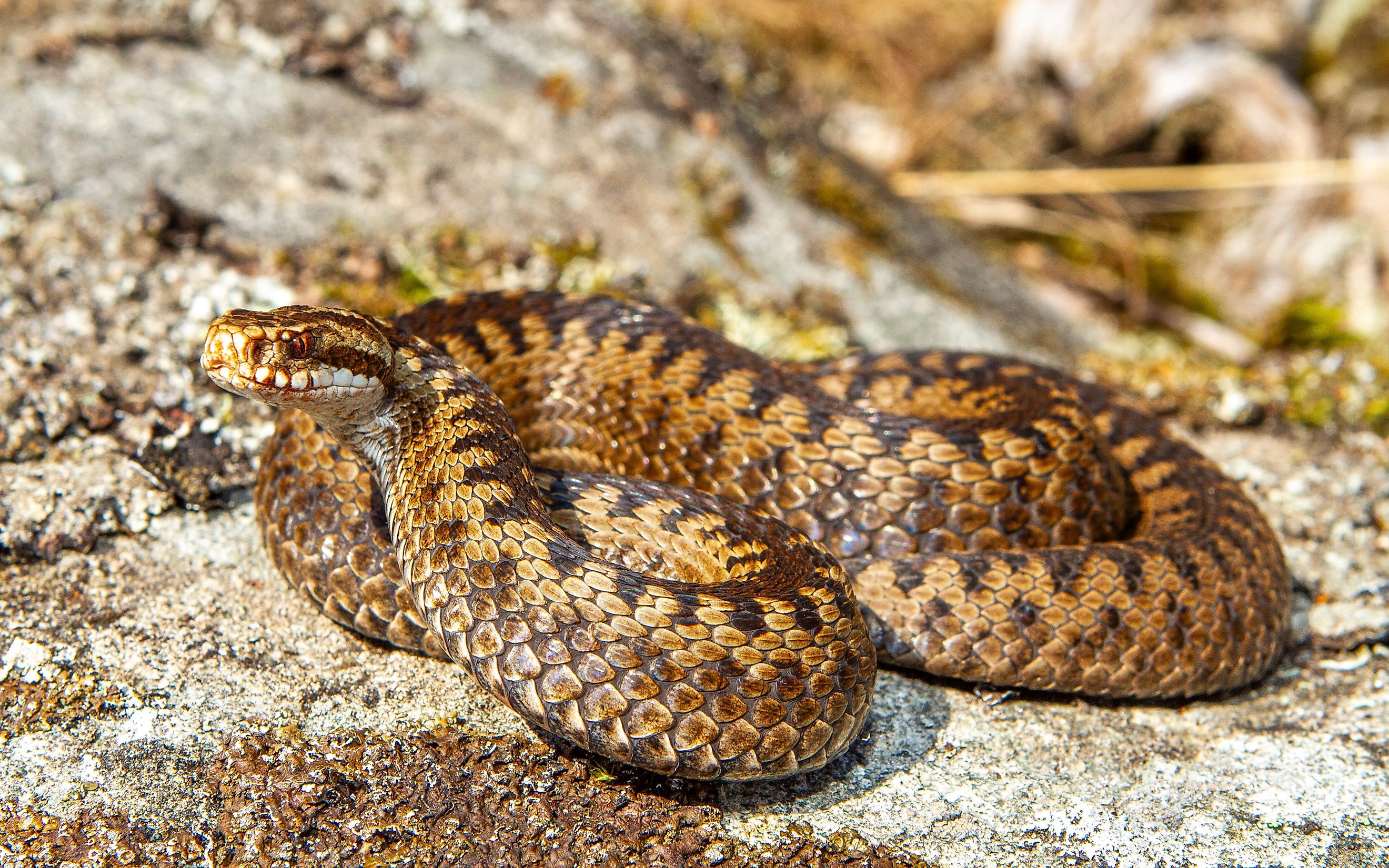
The European adder is the only venomous snake native to Britain and one of the hardiest serpents on Earth, ranging further north than any other snake and surviving above the Arctic Circle where winter locks the ground in ice for months. Small, thick-bodied, and marked with a bold dark zigzag down its spine, it has crawled through European folklore for centuries, feared far out of proportion to the modest danger it actually poses.
Known to science as Vipera berus, the adder occurs across an enormous swathe of the northern world, reaching the hedgerows of the United Kingdom in the west and the forests of the Russian Far East in the east. It is a shy, retiring animal that would rather flee than fight, and its bite, though painful, rarely proves fatal to a healthy adult.
That blend of familiarity and menace has kept the adder close to people for a very long time. The word itself descends from the Old English nædre, a general term for serpent that narrowed over the centuries to this one snake, and the adder was among the first reptiles that early naturalists set about naming and fitting into the order of living things.
Taxonomic Classification

The European adder belongs to the family Viperidae, the true vipers, within the order Squamata that contains all lizards and snakes. Its full scientific name is Vipera berus, and it was formally described by Carl Linnaeus in 1758, making it one of the earliest snakes to enter the modern system of scientific naming. The genus Vipera includes roughly two dozen species of Eurasian vipers, several of which share the adder's stout build and keeled scales.
Three subspecies are generally recognized. The nominate form, V. b. berus, ranges across most of Europe and Asia. V. b. bosniensis occupies the Balkans, while V. b. sachalinensis is found in the far east of the species' range, including Sakhalin Island. As with many widespread reptiles, the boundaries between these forms are debated, and some herpetologists treat certain populations as distinct species. The common names common adder, common viper, and northern viper all refer to the same animal.
Physical Description

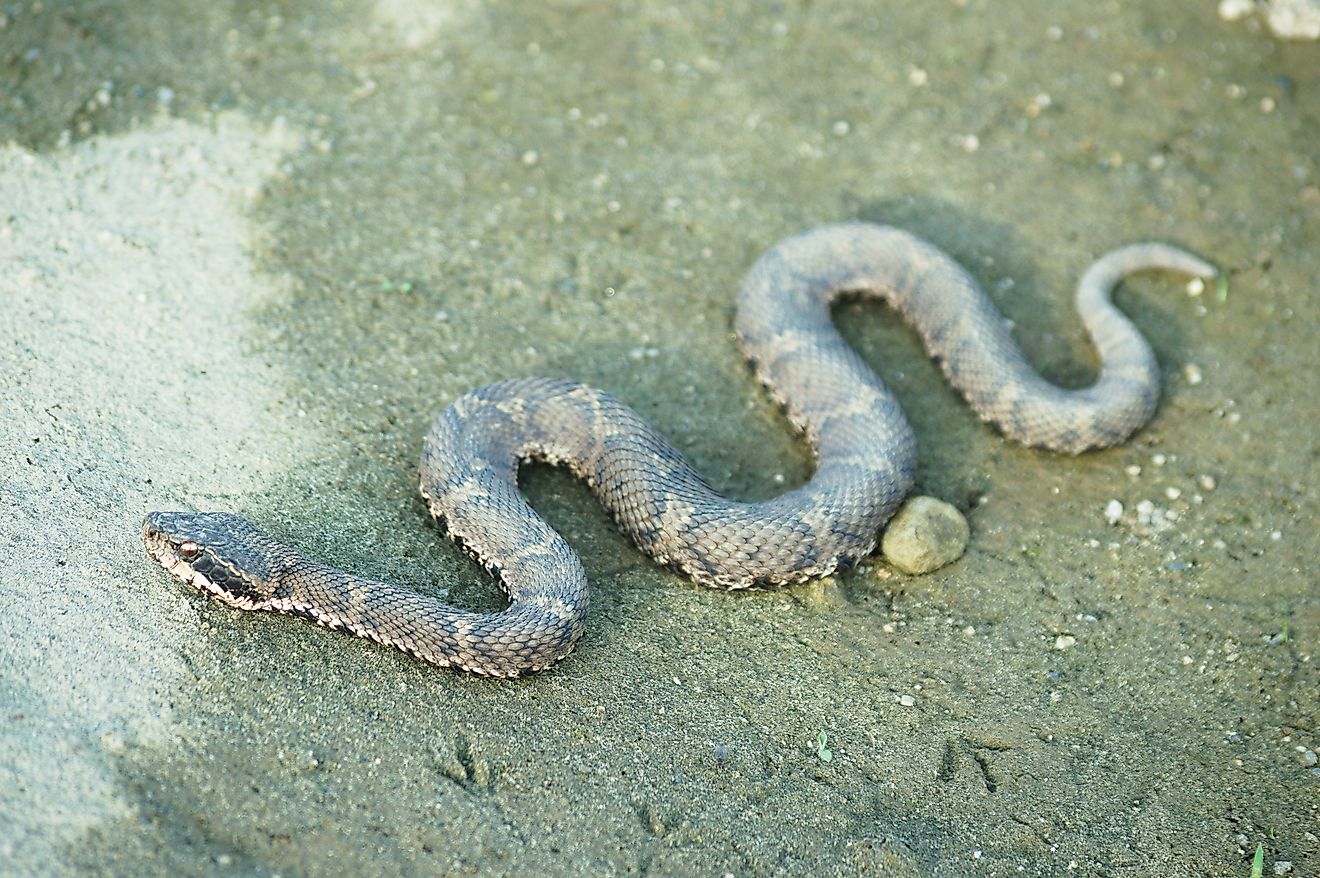
The adder is a compact, muscular snake. Adults typically measure 24 to 35 inches (60 to 90 cm) in length, with most individuals falling toward the lower end of that range. Britain's largest recorded specimens approach 34 inches (87 cm), while exceptional animals from Scandinavia have reached beyond 40 inches (104 cm). Weight ranges from about 1.8 to 6.3 ounces (50 to 180 g). Females grow noticeably larger and heavier than males, a common pattern among vipers.
The most recognizable feature is the dark zigzag stripe running the length of the back, set against a paler ground color that varies between grey and reddish brown. Males tend toward grey with black markings, while females lean toward brown. Some populations, particularly in the cold north and in mountainous areas, produce all-black (melanistic) individuals whose darker skin absorbs heat more efficiently in cool climates. The head is broad and somewhat triangular, set off from the body by a distinct neck, and the eyes carry the vertical slit pupils typical of vipers. A dark V or X shape often marks the crown of the head.
Range and Habitat

Few snakes cover as much ground as the adder. Its range runs across Great Britain and Scandinavia, eastward through northern and central Europe and Russia, and on to the Pacific coast, taking in Sakhalin Island, North Korea, northern Mongolia, and northern China. This makes it one of the most widely distributed terrestrial snakes in the world. It is also the only snake that lives north of the Arctic Circle, reaching the far north of Norway where few reptiles of any kind can survive.
The adder favors open, sunny habitats with plenty of cover and places to bask. Heathland, moorland, woodland edges, coastal dunes, marshes, and rough grassland all suit it well. Access to sunlight matters enormously for a cold-blooded animal that must raise its body temperature by basking, so a mosaic of open ground and dense vegetation is ideal. In much of Britain the loss of managed heathland has removed exactly this kind of terrain, and adder populations have contracted as a result.
Diet

The adder is an ambush predator that relies on venom to subdue its prey. Small mammals form the core of its diet, especially voles, mice, and shrews, along with lizards, frogs, newts, and the occasional ground-nesting bird or nestling. Newborn adders, too small to tackle rodents, start out on smaller fare such as young lizards and invertebrates including spiders and worms.
Hunting is a patient business. An adder will lie in wait or move slowly through vegetation, strike a passing animal, deliver a quick venomous bite, and then release it rather than risk injury from a struggling meal. The snake follows the scent trail of the dying prey and swallows it whole once the venom has taken effect. Because a large meal can sustain the animal for a considerable time, adders may feed only a handful of times across the active season.
Behavior

Adders are chiefly diurnal, active by day and most visible in spring when they emerge from winter dormancy to bask. They are among the few European snakes that reliably survive harsh winters, and they do so by retreating into frost-free refuges known as hibernacula, often shared communally by many individuals in regions where suitable shelter is scarce. Emergence in early spring brings the snakes into the open to warm themselves before the breeding season begins.
For all their fearsome reputation, adders are timid and non-aggressive. When disturbed, an adder usually freezes, then attempts to slip away, hissing and striking only as a last resort. Most bites to humans happen when a snake is trodden on, cornered, or picked up. The spring courtship period features one of the species' most striking displays, in which rival males rear up and wrestle in a swaying contest sometimes called the adder dance, each trying to force the other to the ground without ever biting.
Reproduction

Unlike most snakes, the adder does not lay eggs. It is ovoviviparous, meaning the female retains her eggs internally and gives birth to live young, an adaptation that lets embryos develop in the warmth of the mother's body rather than in cold northern soil. This reproductive strategy is a major reason the species can breed so far north.
Females typically reproduce only once every two or three years, since carrying and provisioning young is demanding in a short, cool summer. Mating takes place in spring after emergence, and litters of roughly 3 to 20 young arrive in late summer or early autumn. Newborns measure only 5.5 to 9 inches (14 to 23 cm) but are fully venomous from birth and independent almost immediately, staying with the mother for just a few days before dispersing. In the wild, adders may live around 15 years, though many die far younger.
Venom and Bites

The adder's venom is a complex mixture of proteins that acts mainly on tissue and blood, with cytotoxic and hemorrhagic effects that can cause pain, swelling, and bruising around the bite. Most bites produce local symptoms that resolve with treatment, and serious systemic reactions such as nausea, a drop in blood pressure, or, rarely, anaphylaxis occur in only a minority of cases. Fatalities are very rare and tend to involve small children, elderly people, or those with underlying health problems.
The medical advice for a suspected adder bite is straightforward. The victim should stay calm and still, since movement speeds the spread of venom, remove tight clothing or jewelry before swelling sets in, and seek medical care promptly. Old remedies such as tourniquets, cutting the wound, or trying to suck out venom are useless or harmful. The great majority of encounters end with the snake retreating and no bite at all.
Importance to the World

As both predator and prey, the adder plays a valuable part in the ecosystems it occupies. By hunting voles, mice, and other small rodents, it helps keep those populations in check, while its own body feeds birds of prey, foxes, badgers, and other predators. A healthy adder population is often taken as a sign of a well-functioning, biodiverse landscape, since the snake depends on the same varied, undisturbed habitat that supports many other species.
The adder also occupies a deep place in European culture. It threads through folklore, place-names, and old country beliefs, including the mythical adder stone said to be forged by serpents and the weather lore that treated the snake's first spring appearance as a marker of the turning year.
Threats and Conservation

The European adder is currently listed as Least Concern on the IUCN Red List, a reflection of its vast range and continued abundance across much of Eurasia. That reassuring global status hides a more troubling local picture, and populations in several countries, including Britain, are known to be declining.
The chief threat is habitat loss. The open heaths, bogs, and rough grasslands the adder needs have been drained, built over, planted with dense forestry, or left to scrub over as traditional management has lapsed. Fragmentation isolates small populations and cuts them off from one another, road traffic kills basking and dispersing snakes, and deliberate persecution by people who fear the animal still takes a toll. The adder is legally protected in many range states, including the United Kingdom, where it is an offense to kill, injure, or trade the species, and conservation increasingly focuses on restoring and reconnecting the open habitats it cannot do without.
Takeaway
Few animals carry such a gap between reputation and reality. The adder that a walker recoils from on a spring heath is the same creature that endures winters no other snake could survive, warms itself back to life each March, and asks nothing more of a landscape than sun, cover, and small rodents to hunt. It has spread clear across Eurasia on those modest terms. What it cannot outlast is the slow erosion of the open ground it depends on, and that loss is already thinning the adder out of Britain even as the species holds firm further east. Keeping this snake a familiar sight in the northern countryside is less about rescuing it from the brink of extinction than about refusing to let a common animal slide into scarcity while no one is watching.
Fun Facts

- The world's most northerly snake. The adder is the only serpent that lives north of the Arctic Circle, reaching the far north of Norway where almost no other reptile survives.
- It gives birth, not eggs. Females produce fully formed, venomous young rather than laying eggs, an adaptation that allows the species to breed in cold climates.
- The adder dance. In spring, rival males rear up and wrestle in an upright swaying contest, each pressing the other toward the ground without landing a bite.
- Black adders are real. All-black melanistic individuals occur naturally, especially in cold and mountainous regions, where dark skin gathers heat more quickly.
- Named by Linnaeus himself. Vipera berus was described in 1758, in the founding work of modern zoological naming.
- Britain's only venomous snake. It is the sole native venomous serpent in the United Kingdom, and its bite is seldom dangerous to healthy adults.
Quick Facts
- Scientific name: Vipera berus (Linnaeus, 1758)
- Family: Viperidae (true vipers)
- Order: Squamata
- IUCN status: Least Concern (population decreasing)
- Length: 24 to 35 inches (60 to 90 cm), rarely longer
- Weight: 1.8 to 6.3 ounces (50 to 180 g)
- Lifespan: up to around 15 years in the wild
- Diet: small mammals, lizards, amphibians, and ground-nesting birds
- Reproduction: live-bearing, 3 to 20 young every 2 to 3 years
- Range: across Europe and Asia, Great Britain in the west and the Russian Far East in the east
- Habitat: heathland, moorland, woodland edges, coastal dunes, and rough grassland