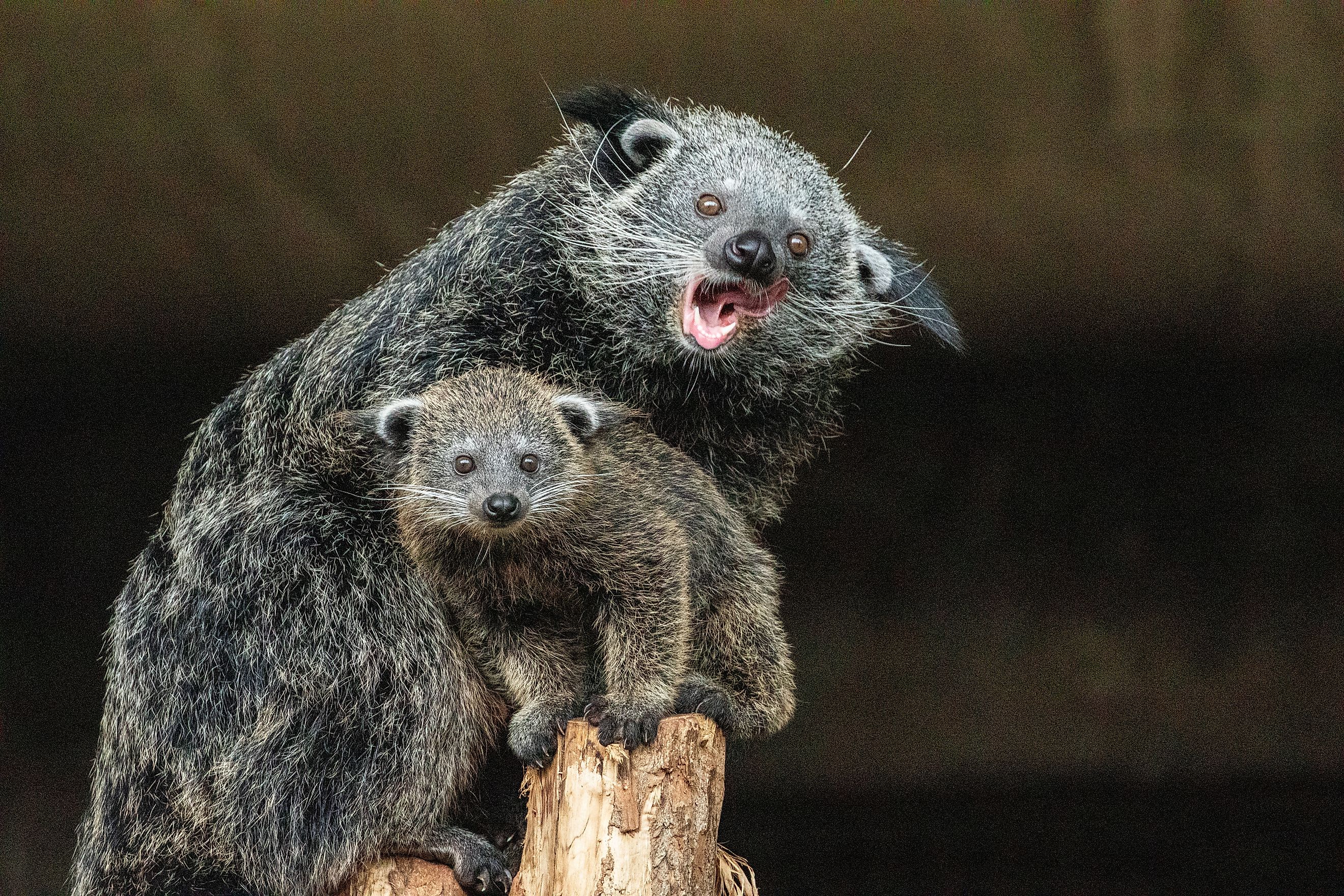
Binturong
The binturong is one of the strangest carnivores in the Asian rainforest, an animal that smells like buttered popcorn, climbs down tree trunks headfirst, and anchors itself to branches with a tail nearly as long as its body. Often called the bearcat, it is neither a bear nor a cat but a viverrid, a close relative of the civets and genets. Its shaggy black coat, white tufted whiskers, and slow, deliberate movements give it an unmistakable presence in the forest canopy of South and Southeast Asia.
Despite its heavy build and formidable appearance, the binturong spends most of its life eating fruit and dispersing seeds high above the forest floor. It is the largest member of its family and one of only two carnivores on Earth with a fully prehensile tail. Widespread but rarely seen, it has slipped toward decline across much of its range, and today it stands as a species worth understanding before it becomes harder to find.
Taxonomic Classification

The binturong belongs to the family Viverridae in the order Carnivora, placing it alongside civets, genets, and their kin rather than with true bears or cats. Within Viverridae it sits in the subfamily Paradoxurinae, the group that includes the Asian palm civets. Its scientific name is Arctictis binturong, and it is the only living species in the genus Arctictis. Nine subspecies have been described, varying only slightly in size and coloration across their island and mainland ranges.
The genus name carries a small joke of its own. Arctictis comes from the Greek words for bear and weasel, which makes the animal a "bear-weasel" by translation even though it is properly a civet relative. Thomas Stamford Raffles first described the species in 1822 from a specimen collected in Malacca, and the naturalist Coenraad Jacob Temminck erected the genus two years later. The common name binturong comes from a Malay term, and the older label bearcat reflects nothing more than its odd mix of features.
Physical Description

A binturong has a long, low, heavy body set on short, sturdy legs, an outline that reads as part bear and part oversized weasel. Adults measure roughly 24 to 38 inches (60 to 97 cm) in head and body length, with a muscular tail that runs nearly the same length again. Typical wild animals weigh between 20 and 45 pounds (9 to 20 kg), though well-fed captive females have reached about 70 pounds (32 kg). The coat is coarse and shaggy, deep black overall and often frosted with gray or buff tips that give the animal a grizzled look.
The head is broad, the muzzle short and blunt, and the small rounded ears are edged and tufted with pale hair. Long white whiskers spread from the face, and in some subspecies they grow as long as the head itself. Females are the larger and dominant sex, running about 20 percent bigger and heavier than males, a reversal of the pattern seen in most mammals. The tail deserves special mention, because it is thickly furred, powerfully muscled, and prehensile, working as a fifth limb that can grip a branch and hold the animal's weight.
Range and Habitat

Binturongs are native to South and Southeast Asia, and their range stretches across a wide belt of the tropics. They occur in India, Nepal, Bhutan, and Bangladesh in the west, through Myanmar, Thailand, Laos, Cambodia, and Vietnam, into the Yunnan region of southern China. Southward the species extends through Malaysia and across the Indonesian islands of Sumatra, Borneo, and Java, reaching its eastern limit on the island of Palawan in the Philippines.
Throughout this range the binturong is tied closely to tall, dense forest. It favors mature tropical rainforest with a thick, connected canopy, the kind of habitat that lets an arboreal animal move and feed without dropping to the ground. It has been recorded from lowland forest near sea level up into hill forest well above 3,000 feet (900 m). Because it depends on continuous stands of large trees, the binturong tends to vanish from cleared or heavily logged land, which helps explain why it has grown scarce across much of its former territory.
Diet

Although it is classed as a carnivore, the binturong eats more like a frugivore, and fruit forms the bulk of its diet across the seasons. Figs are the standout food, and the animal will spend hours in a single fruiting fig tree working through the crop. Alongside fruit it takes leaves, shoots, birds, eggs, insects, small mammals, and carrion, shifting its menu with whatever the forest offers at a given time. This flexible, fruit-leaning appetite makes it an opportunist rather than a specialist hunter.
Foraging happens mostly at night and mostly in the trees, where the binturong moves slowly and methodically between branches. It has also been observed swimming and even diving to reach food, an unusual habit for an animal so committed to the canopy. Its heavy body and careful pace suit a life of harvesting fruit rather than chasing prey, and this diet places it at the center of an important ecological role that reaches well beyond its own survival.
Behavior

The binturong is primarily nocturnal, with bursts of activity around dawn and dusk, and it rests high in the trees during the heat of the day. It is a mostly solitary animal that tends to avoid others of its kind rather than defend firm territorial borders. The clearest exception involves mothers and their young, which stay together, and breeding pairs, which come together to mate and sometimes remain in contact afterward.
On the ground a binturong is slow and clumsy, ambling on flat feet with its body held low. In the canopy it becomes far more capable, thanks to two remarkable adaptations. Its prehensile tail grips branches like an extra hand, and its hind ankles can rotate a full 180 degrees, letting the animal keep its claws locked into bark as it climbs straight down a trunk headfirst. Communication runs heavily on scent, deposited from glands and urine as the animal drags its tail along branches, and it is backed up by a range of chuckles, growls, hisses, and wailing calls used during social and breeding encounters.
Reproduction

Binturongs can breed at any time of year, and they are among the small group of mammals capable of delayed implantation. In this strategy a fertilized egg pauses its development and does not attach to the uterine wall until conditions favor the survival of the young. That control allows females to time births to the best season, and in practice most young arrive between January and March.
Gestation lasts roughly 84 to 99 days, centering near 91 days, and a typical litter holds one to three young, with as many as six on record. Newborns, sometimes called bintlets, weigh only around 5 ounces (142 g) and are born with their eyes sealed shut, staying hidden in their mother's dense fur during their first weeks. Females reach breeding age at about 30 months and males at about 28 months. In the wild binturongs may live into their late teens, and in human care they have reached 20 years and beyond, with reports approaching 25 years.
Importance to the World

The binturong earns its keep in the forest as a seed disperser, and this is where its heavy fruit diet pays a wider dividend. As it feeds on figs and other fruits and then travels through the canopy, it spreads viable seeds across the forest in its droppings, helping trees regenerate over a wide area. The animal is often described as a keystone species for this reason, because its feeding shapes the plant community around it.
One relationship stands out. The binturong is the only animal known to reliably disperse the seeds of certain strangler figs, and its gut appears to help ready those seeds for germination. Strangler figs are themselves keystone plants that feed a huge cast of forest species, so the loss of the binturong could ripple outward through the whole system. By also taking rodents and other small animals, the binturong lends a measure of natural pest control on top of its work replanting the forest.
Threats and Conservation

The binturong is listed as Vulnerable on the IUCN Red List, assessed in 2016, and its population is decreasing. That status rests on an estimated decline of more than 30 percent over roughly the past three decades, a slide driven above all by the loss of the tall, connected forest the species needs. Logging, conversion of forest to agriculture, and the spread of oil palm plantations have all fragmented and shrunk its habitat across South and Southeast Asia.
Hunting and the wildlife trade compound the pressure. Binturongs are taken for their meat and fur, captured for the exotic pet trade, and in some areas used in traditional practices. Because the animal breeds slowly and depends on intact forest, these losses are hard to replace. Conservation efforts include legal protection in several range countries, protected reserves that keep forest standing, and captive breeding programs in zoos that maintain a safeguard population and help draw public attention to a species most people will never encounter in the wild.
Takeaway
The binturong has an unusual combination of traits that sets it apart from most Asian mammals. Despite its heavy build and carnivorous classification, much of its diet consists of fruit, while its fierce appearance contrasts with its slow, deliberate movements. Its prehensile tail and rotating ankles are well suited to life in the canopy, and its distinctive popcorn-like scent has made it particularly memorable. More importantly, its habit of eating fruit and dispersing the seeds of figs makes it an important contributor to forest regeneration. Yet the tropical forests it depends on continue to disappear, contributing to its Vulnerable status. Protecting the binturong therefore requires preserving the tall, connected forests where it feeds, moves, and helps regenerate the ecosystem around it.
Fun Facts

- It smells like popcorn. A binturong's scent comes from 2-acetyl-1-pyrroline, the very same compound that gives popcorn and freshly baked bread their aroma, and it turns up in the animal's urine.
- It climbs down headfirst. The binturong can rotate its hind ankles a full 180 degrees, keeping its claws dug into bark so it can descend a tree trunk head down.
- Females rule. Female binturongs are about 20 percent larger than males and are the dominant sex, which is unusual among mammals.
- It can hit pause on pregnancy. Through delayed implantation, a female can hold a fertilized egg in waiting until the timing is right to give birth.
- It is a rare tailed carnivore. The binturong and the kinkajou are the only two carnivores with a fully prehensile tail that works as a fifth limb.
Quick Facts
- Scientific name: Arctictis binturong
- Family and order: Viverridae, Carnivora
- Common names: binturong, bearcat
- IUCN status: Vulnerable (population decreasing)
- Length: head and body 24 to 38 inches (60 to 97 cm), tail nearly as long again
- Weight: 20 to 45 pounds (9 to 20 kg), up to about 70 pounds (32 kg) in captive females
- Lifespan: up to about 18 years in the wild, 20 to 25 years in human care
- Diet: omnivore with a strong preference for fruit, especially figs
- Range: South and Southeast Asia, extending east to Palawan in the Philippines