Beluga Whale
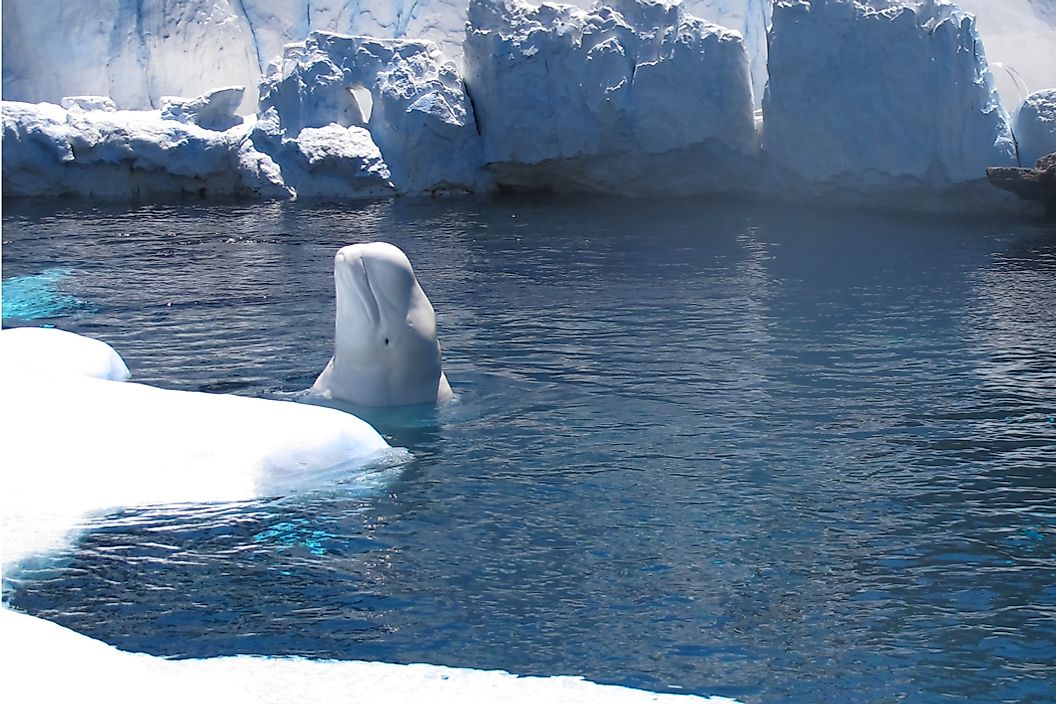
Beluga whales are, in the eyes of humans, the happiest cetaceans. Famous for their bright white coloring, rounded foreheads, expressive faces, and chirping and whistling calls, they are sometimes called the "canaries of the sea." Belugas have a discontinuous circumpolar distribution across the Arctic and sub-Arctic, from Alaska and northern Canada to Greenland, Svalbard, and Russia. A few populations live farther south, including those in Cook Inlet, Alaska, and the St. Lawrence Estuary in Canada. About two-thirds of the world's belugas summer in Canadian waters.
Conservation Status

The beluga whale is classified globally as Least Concern by the International Union for Conservation of Nature, following a 2017 assessment. However, the risks faced by individual populations vary greatly. More than 150,000 belugas are estimated to live across Arctic and sub-Arctic waters, although the remoteness of their habitat makes precise global counts difficult. The Cook Inlet population in Alaska is listed as Endangered under the United States Endangered Species Act and as Depleted under the Marine Mammal Protection Act. The best current abundance estimate is 331 whales, with an estimated range of 290 to 386. Scientists cannot yet conclude with certainty that the population has begun to recover.
In Canada, the St. Lawrence Estuary population is listed as Endangered under the Species at Risk Act. Fisheries and Oceans Canada estimates that approximately 1,850 belugas live there. Historical hunting, chemical contaminants, underwater noise, habitat disturbance, and changes in prey availability have all contributed to concerns about this isolated population. Protection is not uniform across the range, however, and legally managed Indigenous subsistence hunts continue in parts of the Arctic.
Taxonomic Classification

The beluga whale is part of the Cetacea order, which includes all whales, dolphins, and porpoises. The scientific name of the beluga whale is Delphinapterus leucas. It is one of two extant species in the family Monodontidae, along with the narwhal. Although closely related, belugas are white and have visible teeth, while narwhals are grey-brown. They are both medium-sized toothed whales and live in the Arctic waters, and both lack a true dorsal fin, but the key distinguishing difference is that the narwhal has its notable long spiraled tusk.
Range And Habitat
The beluga whale lives in the Northern Hemisphere, in the cold waters of the Arctic and sub-Arctic. They are found in Canada, where two-thirds of the global population live. They are also found in the waters off Alaska, where five distinct groups live in Cook Inlet, Bristol Bay, Eastern Bering Sea, Eastern Chukchi Sea, and Beaufort Sea. Belugas are found in the waters at Svalbard, Norway, in coastal fjords and near glaciers, in pods ranging from 2 to 30. Belugas at Svalbard are relatively resident, and they stay in the Svalbard archipelago waters year-round. Large numbers of belugas are found along the Russian Arctic coasts, including the White Sea and the Sea of Okhotsk.
In Russian waters, they face unusual risks compared to Canada, the United States, and Norway; in Russia, they have been used in military training programs. Recent satellite images have shown belugas kept in pens at military bases in Murmansk. Belugas have also been captured illegally for the aquarium trade. In 2018, nearly 100 belugas and orcas were found in cramped sea pens in Russia's Far East after reportedly being captured for sale to marine parks in China. After a months-long operation, 87 belugas and 10 orcas were eventually released.
In the summer, belugas move to shallow waters along the coasts, in the warmer waters of river mouths and estuaries, to feed and give birth. In the winter, they move close to pack ice or move to deep offshore waters, and can dive over 2,900 feet (900 meters) for up to 25 minutes to find food. Without a dorsal fin, belugas are able to swim smoothly under heavy sea ice.
Physical Description

The key physical characteristics of beluga whales are their bright white skin, the bulbous forehead, and a lack of a dorsal fin. They are also famed for appearing to smile, exuding what reads as friendliness, and that appeals to humans. Part of the toothed whale Suborder Odontoceti, belugas are medium-sized whales, with adults measuring 11 to 18 feet (3.5 to 5.5 meters). Adults weigh between 1,000 and 3,300 pounds (500 to 1,500 kilograms). Although males and females are sexually monomorphic in color and appearance, males are much larger. The beluga body form is muscular and spindle-shaped, tapering at both ends, aiding in smooth movement in icy water.
The round, flexible, bulbous fatty pad on the forehead, called the melon, is used to focus echolocation clicks and vocalizations. The neck is flexible, compared to other cetaceans, and their seven neck vertebrae are not fused. This allows them to turn their head side-to-side and nod vertically. They lack a true pronounced beak, and their simple conical teeth number between 32 and 40, even on the upper and lower jaws. Calves are born with a dark brown-gray or blue-gray color, lightening as they age, with females generally becoming completely white after about 14 years and males after about 18 years. Belugas molt every summer, shedding their outer skin by rubbing against shallow gravel beds. They have a thick blubber layer around 4 to 5 inches thick, which is up to 40 percent of the total body weight, ideal for extreme polar insulation. Belugas have small and round pectoral flippers and broad tail flukes, and they notably lack a dorsal fin. In its place, they have a tough, sometimes notched dorsal ridge, ideal for swimming beneath floating ice sheets with ease.
Diet

Opportunistic hunters, beluga whales eat a wide variety of fish, crustaceans, and cephalopods. Their peg-like teeth are used to grab prey and swallow it completely whole rather than chewing. Their diet includes Arctic cod, saffron cod, capelin, and herring as staple fare in the Arctic. When migrating on coastal waters, they eat salmon, eulachon, and smelt, as well as flounder, sculpin, and flatfish. They will also eat invertebrates and seafloor prey, such as octopus, squid, and clams, crustaceans, and sandworms and bristle worms.
Reproduction

Female beluga whales give birth to a single calf every 2 to 3 years following a 14-to-15-month gestation period. Mating takes place in the late winter or spring, and calves are born during the summer in warm coastal estuaries. Females generally reach sexual maturity between about 6 and 14 years of age, while males mature slightly later. Belugas are polygynandrous, with males and females mating with multiple partners across different seasons, which may help preserve genetic diversity. Newborns are around 5 feet (1.6 meters) and are colored dark blue-gray or brown. They are nursed for two years, being weaned on small fish and shrimp. Mothers provide long-term care past nursing, teaching the complex social and survival skills of belugas.
Importance Of Beluga Whales

Beluga whales are a sentinel species; their presence and overall well-being are a crucial way to monitor the health of their ecosystem. As top predators, they stabilize the Arctic food web, and by absorbing contaminants in their fatty blubber layers, they help scientists to monitor toxic pollution and climate change impacts. Belugas also help control the populations of marine animals. With their seasonal migrations, they move nutrients across different marine and coastal regions. This, in turn, helps to support ocean productivity. They also have cultural and economic importance for Arctic Indigenous communities. Hunted for food, belugas provide sustenance, including maktaaq, vitamin- and protein-rich skin and blubber. The beluga is also tied to traditional knowledge and community identity among the northern peoples.
The Whale With The Smile
As people begin to reassess the nature of public aquariums and the practice of having aquatic mammals perform for us, it may become more difficult over time to see a beluga whale up close. In nature, they live in the Arctic and subarctic regions, often isolated areas, or accessible only on pricey cruise ships. However, the loss of those dubious attractions is probably worth it in the long run. Some beluga populations continue to face serious threats in their native waters, and with climate change, more challenges may lie ahead. Nevertheless, issues facing beluga whale populations are being addressed, and with effort and time, we may be able to stabilize their populations and ensure their presence in northern waters.