Section 01
The State That Lost Its Forest Twice
Mississippi's wildlife history turns on two clearances. The first was the longleaf pine forest, which covered much of the southern half of the state in open, fire-maintained savanna. Industrial logging between roughly 1880 and 1930 cut nearly all of it, and what regrew was mostly dense loblolly plantation with fire excluded, which is a different habitat supporting different animals.
The second was the Delta. The Mississippi Alluvial Plain in the northwest was once a nearly continuous bottomland hardwood forest, flooded seasonally, with enormous cypress and oak. It was cleared for cotton and later soybeans through the 20th century, and roughly 80 percent of that forest is gone. The Delta is now some of the flattest, most intensively farmed land in America.
What that did to wildlife was specific. The ivory-billed woodpecker, the Carolina parakeet, and the red wolf all disappeared. Black bears were reduced to a handful. Longleaf specialists such as the red-cockaded woodpecker, gopher tortoise, and dusky gopher frog were pushed to fragments.
What Mississippi still has is water and coast. The state has extensive swamp, oxbow lakes, and roughly 62 miles of mainland Gulf shore behind a chain of barrier islands, with the Mississippi Sound between them. The Pascagoula River is the largest river system in the lower 48 with no dams or major impoundments on its main stem, which makes it a genuinely rare thing: a large southern river that still floods and moves the way it always did.
Section 02
Mississippi's Official State Animals
| Designation | Animal | Adopted |
|---|---|---|
| State bird | Northern mockingbird Mimus polyglottos | 1944 |
| State game bird | Wood duck Aix sponsa | 1974 |
| State land mammal | White-tailed deer Odocoileus virginianus | 1974 |
| State water mammal | Bottlenose dolphin Tursiops truncatus | 1974 |
| State reptile | American alligator Alligator mississippiensis | 2005 |
| State amphibian | Green treefrog Hyla cinerea | 2005 |
| State fish | Largemouth bass Micropterus salmoides | 1974 |
| State saltwater fish | Spotted seatrout Cynoscion nebulosus | 2001 |
| State insect | Honeybee Apis mellifera | 1980 |
| State butterfly | Spicebush swallowtail Papilio troilus | 1991 |
Mississippi gave the world the teddy bear. In November 1902 President Theodore Roosevelt joined a bear hunt near Onward, Mississippi. Guides cornered an exhausted black bear and tied it to a tree so Roosevelt could shoot it, and he refused, considering it unsportsmanlike. A Washington Post cartoon of the incident inspired a Brooklyn shopkeeper to make stuffed bears called Teddy's bears. The irony is that Mississippi's black bears were then hunted to near-elimination anyway, falling to perhaps a few dozen animals by the mid-20th century, and only began recovering in recent decades.

The state has separate land and water mammal designations, both made in 1974, which is a sensible acknowledgement that a Gulf state's wildlife is half marine. The alligator and green treefrog designations in 2005 came from schoolchildren campaigns.
Section 03
Habitats By Region, And Who Lives In Each
1. Mississippi Delta and bottomland hardwood
Flat alluvial plain, mostly farmed, with remnant bottomland forest in refuges and along bayous. This is black bear range and the historic centre of the ivory-billed woodpecker's Mississippi records. Also wood duck, prothonotary warbler, swamp rabbit, American alligator, and enormous wintering waterfowl numbers in flooded fields. Related: Mississippi River Delta.
2. Loess Bluff hills
A narrow band of wind-deposited silt along the Delta's eastern edge, deeply eroded into steep ravines with rich hardwood forest. The bluffs hold plant and invertebrate communities unusual for the region, plus copperhead, timber rattlesnake, and forest interior birds.
3. North-central hills and Black Prairie
Rolling upland with mixed pine and hardwood, plus the Black Prairie belt of dark calcareous soils that once carried tallgrass prairie and now supports pasture. White-tailed deer, wild turkey, bobcat, and coyote are common, and Tishomingo County in the far northeast has the state's only rocky uplands with Appalachian affinities.
4. Piney Woods and longleaf remnants
The southern half of the state, historically longleaf savanna and now mostly loblolly and slash pine. Where fire is still used, the community returns: red-cockaded woodpecker, gopher tortoise, Bachman's sparrow, southern hognose snake, and pitcher plant bogs with their specialised insects. De Soto National Forest holds the best remaining examples.
5. Coastal marsh, barrier islands, and Mississippi Sound
Salt marsh, tidal creek, and a chain of low barrier islands including Horn, Petit Bois, and Ship. Least terns nest on Gulfport beaches in unusually large numbers, and the islands hold nesting shorebirds and wintering sparrows. Bottlenose dolphins are resident in the Sound, and sea turtles including Kemp's ridley use the nearshore Gulf of Mexico. See also the seven sea turtle species.
6. The Pascagoula River
The largest undammed river system in the lower 48, with sandbars, oxbows, and swamp forest that still flood naturally. It holds Gulf sturgeon, an exceptional fish and mussel fauna, and the yellow-blotched map turtle, which is found in this basin and nowhere else on Earth.
Section 04
Mammals Of Mississippi
- White-tailed deer: the state land mammal, roughly 1.5 million animals, restored from near-collapse in the early 20th century.
- Black bear: two subspecies occur, the Louisiana black bear in the southwest and the American black bear in the north and east. Reduced to perhaps a few dozen animals by the mid-1900s, the population is now growing slowly and is state endangered, with females and cubs documented in several regions after decades with almost no reproduction.
- Bobcat, coyote, gray and red fox, river otter, mink, long-tailed weasel, striped and spotted skunk, raccoon, opossum, beaver, armadillo, swamp rabbit, marsh rabbit: all widespread.
- Nutria: an invasive rodent damaging coastal marsh, as in Louisiana. See nutria rats.
- Bats: 15 species, including Rafinesque's big-eared bat roosting in hollow bottomland trees and the federally endangered gray bat in the northeast. See where bats live.
- Marine mammals: bottlenose dolphin, the state water mammal, resident in Mississippi Sound, plus the critically endangered Rice's whale in the deeper northern Gulf and occasional manatees.
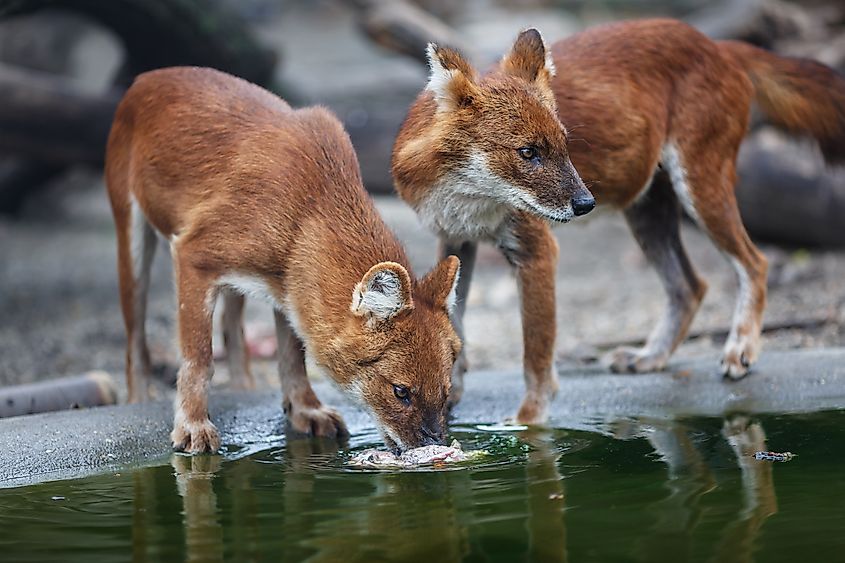
A pair of red wolves

Gone: red wolf, which was native and whose last wild range included the Gulf coastal plain, plus eastern cougar, bison, and elk. Florida panthers historically ranged into Mississippi and no longer do, though occasional dispersing individuals have been documented in the region.
Section 05
Birds Of Mississippi
Around 420 species have been recorded. The state sits on the Mississippi Flyway and its coast receives trans-Gulf migrants.
- Waterfowl: the Delta's flooded fields and refuges winter very large numbers of mallard, gadwall, northern pintail, green-winged teal, and snow and white-fronted geese. Wood duck, the state game bird, breeds in tree cavities over swamp water.
- Longleaf pine specialists: red-cockaded woodpecker, which excavates cavities in living pines and needs open burned forest, plus Bachman's sparrow and brown-headed nuthatch. Mississippi holds several of the more important remaining populations.
- Coastal birds: least tern colonies on Gulfport's beaches are among the largest anywhere, plus black skimmer, Wilson's plover, American oystercatcher, snowy plover, and wintering piping plovers and red knots on the barrier islands.
- Trans-Gulf migration: in April, warblers, tanagers, buntings, and orioles arrive after crossing the Gulf non-stop. When weather forces them down, coastal woodlots fill with migrants.
- Others: northern mockingbird (the state bird), Mississippi kite, swallow-tailed kite in the southern swamps, bald eagle nesting on reservoirs, and Mississippi sandhill crane, a non-migratory subspecies discussed below.
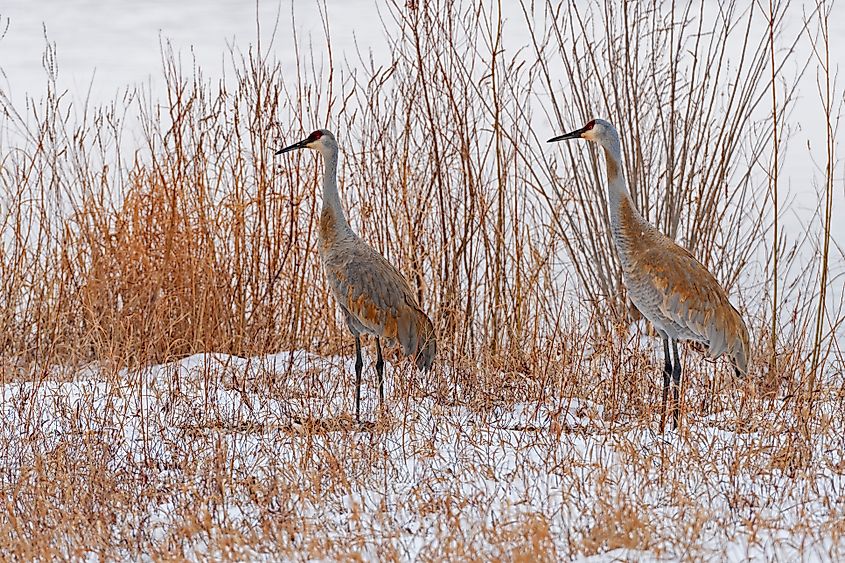
A pair of A Mississippi sandhill cranes

The Mississippi sandhill crane is one of the rarest birds in North America: a non-migratory subspecies confined to wet pine savanna in Jackson County, which fell to roughly 30 to 35 birds by the 1970s. A national wildlife refuge was established for it, and captive breeding plus prescribed burning has lifted the flock to well over a hundred. It survives only because a specific piece of savanna is burned on schedule.
Section 06
Reptiles, Amphibians, And Fish
Mississippi has around 60 reptile and 60 amphibian species, a high total reflecting its warm, wet climate.

Snakes: about 40 species, six venomous: copperhead, cottonmouth, eastern diamondback rattlesnake, timber or canebrake rattlesnake, pygmy rattlesnake, and eastern coral snake. The black pine snake, a non-venomous longleaf specialist, is federally threatened.
Turtles: the yellow-blotched map turtle is endemic to the Pascagoula system and found nowhere else, and the ringed map turtle is nearly so in the Pearl. Also alligator snapping turtle, gopher tortoise in the southeast pine, diamondback terrapin in coastal marsh, and five sea turtle species offshore.
Amphibians: the dusky gopher frog is among the most endangered amphibians in the world, once ranging across the Gulf coastal plain and now reduced to a handful of ponds in southern Mississippi, with a wild population that has at times numbered only around a hundred adults. Also three-toed amphiuma, greater siren, gopher frog, green treefrog (the state amphibian), and around 30 frog and toad species.
Fish: roughly 200 freshwater species. Gulf sturgeon spawn in the Pascagoula and Pearl systems and are federally threatened, and alligator gar, paddlefish, and a rich mussel fauna occupy the larger rivers. The Pascagoula's lack of dams is the main reason its aquatic fauna remains relatively intact.
Section 07
Dangerous Animals In Mississippi
- Venomous snakes: six species. Copperheads cause most bites and are rarely fatal. Cottonmouths are common near water and will stand their ground.
- American alligator: present across the southern two thirds of the state with a regulated hunt. Attacks are very rare. Never feed them. Related: parks with the most alligators.
- Fire ants and Africanized bees: stinging insects cause the most animal-related deaths through allergic reaction, and fire ants are ubiquitous.
- Ticks and mosquitoes: Rocky Mountain spotted fever, ehrlichiosis, alpha-gal syndrome, and West Nile virus are all present.
- White-tailed deer: thousands of vehicle collisions annually.
- Brown recluse and black widow spiders: both common in outbuildings.
- Sharks, stingrays, and jellyfish: bull sharks enter brackish and fresh water in Mississippi rivers, and stingray injuries are routine in shallow Gulf water.
Section 08
Endangered And Protected Species
| Species | Where | Status |
|---|---|---|
| Dusky gopher frog | A few south Mississippi ponds | ENDANGERED |
| Mississippi sandhill crane | Jackson County savanna | ENDANGERED |
| Rice's whale | Northern Gulf of Mexico | ENDANGERED |
| Red-cockaded woodpecker | Managed pine forest | ENDANGERED |
| Black pine snake | Longleaf pine, southeast | THREATENED |
| Gulf sturgeon | Pascagoula, Pearl rivers | THREATENED |
| Yellow-blotched map turtle | Pascagoula basin only | THREATENED |
| Gopher tortoise | Southeast pine | ENDANGERED |
| Kemp's ridley sea turtle | Gulf waters | ENDANGERED |
| Gray bat | Northeast caves | ENDANGERED |
| Black bear | Scattered forest | STATE ENDANGERED |
The dusky gopher frog produced one of the more consequential Endangered Species Act cases in recent decades. The Fish and Wildlife Service designated critical habitat on private Louisiana land that the frog did not currently occupy but which contained suitable ponds, and the landowner sued. The Supreme Court ruled in 2018 that critical habitat must be habitat, sending the question back to lower courts and narrowing how the agency can designate unoccupied land. The frog itself remains one of the world's most endangered amphibians.
Mississippi's broader pressures are fire suppression in pine, conversion of bottomland forest, coastal marsh loss and barrier island erosion, sedimentation and nutrient runoff into rivers, and the aftermath of the Deepwater Horizon oil spill, which affected dolphins, sea turtles, and marsh along the Sound.
Section 09
Where To See Wildlife In Mississippi
- Mississippi Sandhill Crane National Wildlife Refuge: the endemic crane flock, with tours in winter.
- Gulf Islands National Seashore: barrier island shorebirds, nesting terns, and dolphins.
- Yazoo and Panther Swamp National Wildlife Refuges: Delta bottomland with wintering ducks, alligators, and bear sign.
- Noxubee National Wildlife Refuge: red-cockaded woodpecker colonies with marked cavity trees, plus wood ducks and alligators.
- De Soto National Forest: the best remaining longleaf pine, gopher tortoise, and pitcher plant bogs.
- Pascagoula River Wildlife Management Area: an undammed river system by canoe, with map turtles and sandbars.
- Tishomingo State Park: rocky uplands and species with Appalachian affinities found nowhere else in the state.
Timing: April for trans-Gulf migrant arrival on the coast, best after a spring front. November through February for Delta waterfowl and crane tours. Spring for red-cockaded woodpecker nesting and pitcher plant bloom. Summer for alligators, sea turtle nesting, and frog choruses, though heat and mosquitoes are heavy. Beach-nesting bird areas are fenced from spring into midsummer.
Section 10
Common Questions
- What is the state animal of Mississippi?
- Mississippi names two: the white-tailed deer as state land mammal and the bottlenose dolphin as state water mammal, both in 1974. The state bird is the northern mockingbird, the state reptile the American alligator.
- Did the teddy bear come from Mississippi?
- Yes. On a 1902 hunt near Onward, guides tied an exhausted black bear to a tree for President Theodore Roosevelt to shoot, and he refused. A newspaper cartoon of the incident inspired a Brooklyn shopkeeper to make stuffed Teddy's bears.
- Are there bears in Mississippi?
- Yes, but few. Black bears were reduced to perhaps a few dozen animals by the mid-1900s and remain state endangered, though the population is now growing slowly with documented reproduction in several regions.
- How many venomous snakes live in Mississippi?
- Six: copperhead, cottonmouth, eastern diamondback rattlesnake, timber or canebrake rattlesnake, pygmy rattlesnake, and eastern coral snake.
- What is special about the Pascagoula River?
- It is the largest river system in the lower 48 with no dams or major impoundments on its main stem, so it still floods and shifts naturally. It holds Gulf sturgeon and the yellow-blotched map turtle, which lives in this basin and nowhere else on Earth.
- What is the dusky gopher frog?
- One of the most endangered amphibians in the world, reduced to a handful of ponds in southern Mississippi. It was the subject of a 2018 Supreme Court ruling that critical habitat designated under the Endangered Species Act must actually be habitat, which narrowed how unoccupied land can be designated.
- What is the most dangerous animal in Mississippi?
- Stinging insects, including fire ants and bees, cause the most deaths through allergic reaction. Ticks and mosquitoes carry the greatest disease burden, and deer cause the most vehicle collisions.
This page was last updated on September 2, 2026